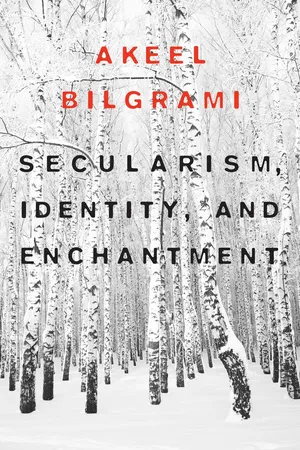
Bringing clarity to a subject clouded by polemic, Secularism, Identity, and Enchantment is a rigorous exploration of how secularism and identity emerged as concepts in different parts of the modern world. At a time when secularist and religious worldviews appear irreconcilable, Akeel Bilgrami strikes out on a path distinctly his own, criticizing secularist proponents and detractors, liberal universalists and multicultural relativists alike.
Those who ground secularism in arguments that aspire to universal reach, Bilgrami argues, fundamentally misunderstand the nature of politics. To those, by contrast, who regard secularism as a mere outgrowth of colonial domination, he offers the possibility of a more conceptually vernacular ground for political secularism. Focusing on the response to Salman Rushdie's Satanic Verses, Bilgrami asks why Islamic identity has so often been a mobilizing force against liberalism, and he answers the question with diagnostic sympathy, providing a philosophical framework within which the Islamic tradition might overcome the resentments prompted by its colonized past and present.
Turning to Gandhi's political and religious thought, Bilgrami ponders whether the increasing appeal of religion in many parts of the world reflects a growing disillusionment not with science but with an outlook of detachment around the rise of modern science and capitalism. He elaborates a notion of enchantment along metaphysical, ethical, and political lines with a view to finding in secular modernity a locus of meaning and value, while addressing squarely the anxiety that all such notions hark back nostalgically to a time that has past.
- 399 pages
- English
- ePUB (mobile friendly)
- Available on iOS & Android
eBook - ePub
Secularism, Identity, and Enchantment
About this book
Information
Topic
PhilosophySubtopic
Philosophy History & TheoryFOUR
Gandhi, the Philosopher
1.
I was once asked by a literary magazine to write a review essay on Nehru. Some weeks later, the editor asked me if I would throw in Gandhi as well. As it happened I never wrote the piece, but I remember thinking that it was like being asked while climbing the Western Ghats whether I would take a detour and climb Mount Everest as well. I am not now trying to scale any great peak or to give a defining interpretation to Gandhi. It’s generally foolhardy to write about Gandhi, not only because you are never certain you’ve got him right, but because you are almost sure to have him wrong. There is a lack of plain argument in his writing and there is an insouciance about fundamental objections, which he himself raises, to his own intuitive ideas. The truth of his claims seems to him so instinctive and certain that mere arguments seem frivolous even to readers who disagree with them. Being trained in a discipline of philosophy of a quite different temperament, I will try to not get distracted by the irritation I sometimes feel about this.
In reading Gandhi recently I have been struck by the integrity of his ideas. I don’t mean simply that he was a man of integrity in the sense that he tried to make his actions live up to his ideals, though perhaps in fact he tried more than most to do so. I mean something more abstract: that his thought itself was highly integrated, his ideas about very specific political strategies in specific contexts flowed (and in his mind necessarily flowed) from ideas that were very remote from politics. They flowed from the most abstract epistemological and methodological commitments. This quality of his thought sometimes gets lost because, on the one hand, the popular interest in him has been keen to find a man of great spirituality and uniqueness and, on the other, the social scientist’s and historian’s interest in him has sought out a nationalist leader with a strikingly effective method of non-violent political action. It has been common for some decades now to swing from a sentimental perception of him as a “Mahatma” to a cooler assessment of Gandhi as “the shrewd politician.” I will steer past this oscillation because it hides the very qualities of his thought I want to uncover. The essay is not so much (in fact hardly at all) inspired by the plausibility of the philosophy that emerges as by the stunning intellectual ambition and originality that this “integrity” displays.
2.
Non-violence is a good place to get a first glimpse of what I have in mind.
Violence has many sides. It can be spontaneous or planned, it can be individual or institutional, it can be physical or psychological, it can be delinquent or adult, it can be revolutionary or authoritarian. A great deal has been written on violence: on its psychology, on its possible philosophical justifications under certain circumstances, and of course on its long career in military history. Non-violence has no sides at all. Being negatively defined, it is indivisible. It began to be a subject of study much more recently and there is much less written on it, not merely because it is defined in negative terms but because until it became a self-conscious instrument in politics in this century, it was really constituted as or in something else. It was studied under different names, first usually as part of religious or contemplative ways of life remote from the public affairs of men and state, and later with the coming of Romantic thought in Europe, under the rubric of critiques of industrial civilization.
For Gandhi, both these contexts were absolutely essential to his conception of non-violence. Non-violence was central in his nationalist mobilization against British rule in India. But the concept is also situated in an essentially religious temperament as well as in a thoroughgoing critique of ideas and ideologies of the Enlightenment and of an intellectual paradigm of perhaps a century earlier than the Enlightenment. This is a paradigm in which science became set on a path which seemed destined to lead to cumulative results, building to a progressively complete understanding of the world in which we lived, a world which we could as a result control. It is a familiar point that there is no understanding Gandhi, the anti-colonial nationalist, without situating him in these larger trajectories of his thought.
The strategy of non-violent resistance was first introduced by him so as to bring into the nationalist efforts against the British an element beyond making only constitutional demands. On the face of it, for those reared on Western political ideas, this seems very odd. Constitutional demands, as they are understood in liberal political theory, are the essence of nonviolent politics; as is well known the great early propounders of liberal democratic thought conceived and still conceive of constitutions and their constraints on human public action as a constraint against tendencies toward violence in the form of coercion of individuals by states and other collectivities, not to mention by other individuals. So why did Gandhi, the prophet of non-violence, think that the Indian people, in their demands for greater self-determination, needed more than constitutional demands? And why did he think that this is best called “nonviolent” action? The obvious answer is the instrumental and strategic one: He knew that making demands for constitutional change had not been particularly effective or swift in the first two decades of this century and that since the conventionally conceived alternative was violent revolutionary action—which found advocates on the fringes of nationalist sentiment in India—he instead introduced his own strategy of civil disobedience, at once a non-violent and yet a non- or extra-constitutional strategy. But, of course, he had more in mind than this obvious motive.
First, Gandhi wanted all of India to be involved in the movement, in particular the vast mass of its peasant population. He did not want the nationalist achievement to be the effort of a group of elite, legally and constitutionally trained, upper-middle-class Indian men (“Macaulay’s bastards”), who argued in assemblies and round-table conferences. He almost single-handedly transformed a movement conceived and promoted along those lines by the Congress Party into a mass movement of enormous scale, and he did so within a few years of arriving from South Africa on Indian soil. Non-violent action was the central idea of this vast mobilization. Second, he knew that violent revolutionary action could not possibly carry the mass of people with it. Revolutionary action was mostly conceived hugger-mugger in underground cells and took the form of isolated subversive terrorist action against key focal points of government power and interest; it was not conceived as a mass movement. He was not unaware that there existed in the West ideologies of revolutionary violence which were geared to mass movements, but he was not unaware, either, that these were conceived in terms of middle-class leadership vanguards that were the fonts of authority. Peasant consciousness mattered very little to them. In Gandhi there was not a trace of this vanguard mentality of a Lenin. He did indeed think that his “satyagrahis”—the non-violent activists whom he described, with that term, as “seekers of truth”—would provide leadership which the masses would follow, but it was absolutely crucial to him that these were not to be the vanguard of a revolutionary party along Leninist lines. They were to be thought of along entirely different lines; they were to be moral exemplars, not ideologues who claimed to know history and its forward movement better than the peasants to whom they were giving the lead. Third, Gandhi chose his version of non-violent civil disobedience instead of the constitutional demands of the Congress leadership because he thought that the Indian people should not merely ask the British to leave their soil. It was important that they should do so by means that were not dependent and derivative of ideas and institutions that the British had imposed on them. Otherwise, even if the British left, the Indian populations would remain a subject people. This went very deep in Gandhi and his book Hind Swaraj is full of a detailed anxiety about the cognitive enslavement even of the nationalist and anti-colonial Indian mind, which might, even after independence, never recover from that enslavement.
These points are well known, and they raise the roughly political considerations which underlie his commitment to non-violence. As I said, they give only a first glimpse of the integrity of his ideas. There are deeper and more ambitious underlying grounds than these in his writing.
3.
The idea that non-violence was of a piece with the search for truth was central to what I have called his “integrity” and to these more ambitious and abstract considerations than the ones I have just discussed. Gandhi was explicit about this, even in the terminology he adopted, linking ahimsa (non-violence) with satyagraha (literally, “truth-force,” or more liberally, a tenacity in the pursuit of truth). There is a standard and entrenched reading of Gandhi which understands the link as follows (and I am quoting from what is perhaps the most widely read textbook of modern Indian history, Sumit Sarkar’s Modern India): “Non-violence or ahimsa and satyagraha to Gandhi personally constituted a deeply-felt and worked-out philosophy owing something to Emerson, Thoreau and Tolstoy but also revealing considerable originality. The search for truth was the goal of human life, and as no one could ever be sure of having attained the truth, use of violence to enforce one’s own view of it was sinful.”1
I have no doubt that Gandhi says things that could lead to such a reading, and for years, I assumed that it was, more or less uncontroversially, what he had in mind. After scrutiny of his writings however, especially his many dispatches to Young India, it seems to me now a spectacular misreading. It fails to cohere with his most fundamental thinking.
Notice that according to this reading, or misreading, his view is no different from one of the most celebrated liberal arguments for tolerance—the meta-inductive argument of Mill’s On Liberty.2 Mill contends that since much that we have thought to be true in the past has turned out to be wrong, this in itself suggests that what we presently think true might also be wrong. We should therefore tolerate, not repress dissent from our present convictions just in case they are not true. According to Mill, and according to Gandhi on this widespread misreading of him, truth is never something we are sure we have attained. We must therefore be made modest in the way we hold our present opinions, and we must not impose our own conceptions of the truth on others. To do so would be a form of violence, especially if it was enforced by the apparatus of the state.
The modesty would appeal to Gandhi, but he would find something very alien in Mill’s argument for it. There is no echo in Gandhi of the idea that the source of this modesty is that however much we seek truth, we cannot attain it, which is what Sarkar contends is the ground of his non-violence. In fact, it makes little sense to say that truth (or anything else) is something we should seek, even if we can never attain it. How can we intend to attain what we know we cannot attain? It would be bootless to protest that Gandhi and Mill are not saying that we can never attain the truth, only that we cannot know if we have attained it—so there is still point in the search for truth. That does little to improve matters. What sort of a goal or search is that? On this epistemological view, our inquiry and search for truth would be analogous to sending a message in a bottle out to sea, a search that is blinded about its own possible success, making all success a sort of bonus or fluke.
In any case, there is something rather odd in Mill’s argument for tolerance. There is an unsettling tension between the argument’s first two premises. The first premise is that our past beliefs have often turned out to be wrong. The second is that this is ground for thinking that our present opinions might be wrong. And the conclusion is that we should therefore be tolerant of dissent from current opinion. But the fact is that when past opinions are said to be wrong, that is a judgment made from the present point of view, and we cannot make that judgment unless we have the conviction in the present opinions which Mill is asking us not to have. It is all right to be asked to be diffident about our present opinions, but then we should, at least to that extent, be diffident about our judgment made on their basis, viz., that our past opinions are wrong. And if so, the first premise is shakier than he presents it as being.
The pervasive diffidence and lack of conviction in our opinions, which is the character of the epistemology that Mill’s argument presupposes, is entirely alien to Gandhi; and though he is all in favor of the modesty with which we should be holding our opinions, that modesty does not have its source in such an epistemology and such a conception of unattainable truth.3 What, then, is its source?
It is quite elsewhere than where Sarkar and everybody else who has written on Gandhi has located it; its source is to be found in his conception of the very nature of moral response and moral judgment. The “satyagrahi” or non-violent activist has to show a certain kind of self-restraint, in which it was not enough simply not to commit violence. It is equally important not to bear hostility to others or even to criticize them; it is only required that one not follow these others, if conscience doesn’t permit it. To show hostility and contempt, to speak or even to think negatively and critically, would be to give in to the spiritual flaws that underlie violence, to have the wrong conception of moral judgment. For it is not the point of moral judgment to criticize. (In the section called “Ashram Vows” of his book Hindu Dharma,4 he says, “Ahimsa is not the crude thing it has been made to appear. Not to hurt any living thing is no doubt part of ahimsa. But it is its least expression. It is hurt by hatred of any kind, by wishing ill of anybody, by making negative criticisms of others.”) This entails the modesty with which one must hold one’s moral opinions and which Mill sought in a quite different source: in a notion of truth which we are never sure we have attained and therefore (from Gandhi’s point of view) in a quite untenable epistemology. The alternative source of the modesty in Gandhi has less to do with issues about truth and more to do with the way we must hold our moral values.
Despite the modesty, one could, of course, resist those with whom one disagrees, and Gandhi made an art out of refusal and resistance and disobedience. But resistance is not the same as criticism. It can be done with a “pure heart.” Criticism reflects an impurity of heart and is easily corrupted to breed hostility and, eventually, violence. With an impure heart you could still indulge in non-violent political activism, but that activism would be strategic, merely a means to a political end. In the long run it would, just as surely as violence, land you in a midden. Even the following sensible-sounding argument for his own conclusion, often given by many of his political colleagues who found his moral attitudes obscure, did not satisfy Gandhi: “Let us adopt non-violent and passive resistance instead of criticizing the British colonial government because to assert a criticism of one’s oppressor would usually have the effect of getting his back up, or of making him defensive, and so it might end up making things harder for oneself.” Gandhi himself did occasionally say things of that sort, but he thought that colleagues who wanted to rest with such arguments as the foundation of non-violence were viewing it too much as an instrument and they were not going deep enough into the spiritual nature of the moral sense required of the satyagrahi. One did not go deep enough until one severed the assumed theoretical connection between moral judgment and moral criticism, the connection which, in our analytical terms, we would describe by saying that if one judges that “x is good,” then we are obliged to find morally wrong those who, in relevant circumstances, judge otherwise or fail to act on x. For Gandhi this does not follow. The right moral sense, the morally pure-hearted satyagrahi, sees no such connection between moral judgment and moral criticism. Of course, we cannot and must not cease to be moral subjects; we cannot stop judging morally about what is and is not worthy, cannot fail to have moral values. But none of that requires us to be critical of others who disagree with our values or who fail to act in accord with them. That is the relevant modesty which Mill sought to justify by a different argument.
This view of the moral sense might well seem frustratingly namby-pamby now as it certainly did to those around him at the time. Can’t it be argued, then, that Gandhi is shrewdly placing a screen of piety around the highly creative political instrument he is creating, both to confuse his colonial masters and to tap the religious emotions of the Indian masses? This is the oscillating interpretation I have been inveighing against, which, finding his religiosity too remote from politics, then fails to take his philosophical ideas as being intended seriously and views him only as a crafty and effective nationalist politician. It sells short both his moral philosophy and his politics. The fact is that his view of moral sense is of considerable philosophical interest, and is intended entirely earnestly by its author. It is given a fascinating theoretical consolidation in his writing which may be lost on his readers because it is buried in a porridge of saintly rhetoric, of “purity of heart.”
4.
What is the assumed theoretical connection between moral judgment and moral criticism, which Gandhi seems to be denying? It has a long history in the Western tradition of moral philosophy. Our moral judgments or values are the basis of our moral choices and actions. Unlike trivial judgments of taste which are the basis, say, for choosing a flavor of ice cream, moral judgments have a certain feature which is often called “universalizability.” To choose an action on moral grounds under certain circumstances is to generate a principle which we think applies as an “ought” or an imperative to all others faced with relevantly similar circumstances.
Strictly speaking, though the two are closely related, universalizability is not to be confused with universality. Universality is the idea that a moral value, whether or not someone in particular holds it, applies to all persons. Universalizability suggests merely that if someone in particular holds a moral value, then he must think that it applies to all others (in relevantly similar situations). Yet despite the fact that it is weaker than universality in this sense, it still generates the critical power which Gandhi finds disquieting. If moral judgments are universalizable, one cannot ...
Table of contents
- Cover
- Series Page
- Title Page
- Copyright
- Dedication
- Contents
- Preface
- Secularism
- Secular Enchantment
- Identity
- Reflections on Edward Said
- Notes
- Sources
- Author Index
- Subject Index
- Series List
Trusted by 375,005 students
Access to over 1.5 million titles for a fair monthly price.
Study more efficiently using our study tools.
Frequently asked questions
Yes, you can cancel anytime from the Subscription tab in your account settings on the Perlego website. Your subscription will stay active until the end of your current billing period. Learn how to cancel your subscription
No, books cannot be downloaded as external files, such as PDFs, for use outside of Perlego. However, you can download books within the Perlego app for offline reading on mobile or tablet. Learn how to download books offline
Perlego offers two plans: Essential and Complete
- Essential is ideal for learners and professionals who enjoy exploring a wide range of subjects. Access the Essential Library with 800,000+ trusted titles and best-sellers across business, personal growth, and the humanities. Includes unlimited reading time and Standard Read Aloud voice.
- Complete: Perfect for advanced learners and researchers needing full, unrestricted access. Unlock 1.5M+ books across hundreds of subjects, including academic and specialized titles. The Complete Plan also includes advanced features like Premium Read Aloud and Research Assistant.
We are an online textbook subscription service, where you can get access to an entire online library for less than the price of a single book per month. With over 1.5 million books across 990+ topics, we’ve got you covered! Learn about our mission
Look out for the read-aloud symbol on your next book to see if you can listen to it. The read-aloud tool reads text aloud for you, highlighting the text as it is being read. You can pause it, speed it up and slow it down. Learn more about Read Aloud
Yes! You can use the Perlego app on both iOS and Android devices to read anytime, anywhere — even offline. Perfect for commutes or when you’re on the go.
Please note we cannot support devices running on iOS 13 and Android 7 or earlier. Learn more about using the app
Please note we cannot support devices running on iOS 13 and Android 7 or earlier. Learn more about using the app
Yes, you can access Secularism, Identity, and Enchantment by Akeel Bilgrami in PDF and/or ePUB format, as well as other popular books in Philosophy & Philosophy History & Theory. We have over 1.5 million books available in our catalogue for you to explore.