Like many inhabitants of booming metropolises, Machiavelli alternated between love and hate for his native city. He often wrote scathing remarks about Florentine political myopia, corruption, and servitude, but also wrote about Florence with pride, patriotism, and confident hope of better times. Despite the alternating tones of sarcasm and despair he used to describe Florentine affairs, Machiavelli provided a stubbornly persistent sense that his city had all the materials and potential necessary for a wholesale, triumphant, and epochal political renewal. As he memorably put it, Florence was "truly a great and wretched city."
Mark Jurdjevic focuses on the Florentine dimension of Machiavelli's political thought, revealing new aspects of his republican convictions. Through The Prince, Discourses, correspondence, and, most substantially, Florentine Histories, Jurdjevic examines Machiavelli's political career and relationships to the republic and the Medici. He shows that significant and as yet unrecognized aspects of Machiavelli's political thought were distinctly Florentine in inspiration, content, and purpose. From a new perspective and armed with new arguments, A Great and Wretched City reengages the venerable debate about Machiavelli's relationship to Renaissance republicanism. Dispelling the myth that Florentine politics offered Machiavelli only negative lessons, Jurdjevic argues that his contempt for the city's shortcomings was a direct function of his considerable estimation of its unrealized political potential.
eBook - ePub
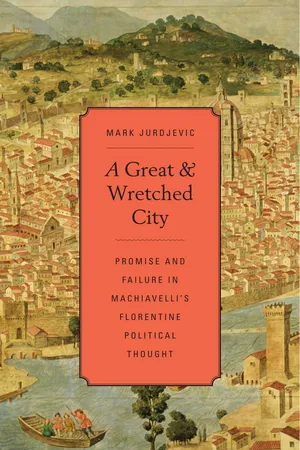
A Great and Wretched City
Promise and Failure in Machiavelli’s Florentine Political Thought
- English
- ePUB (mobile friendly)
- Available on iOS & Android
eBook - ePub
A Great and Wretched City
Promise and Failure in Machiavelli’s Florentine Political Thought
About this book
Information
Topic
Historia1
The Savonarolan Lens
To begin to appreciate the Florentine content of Machiavelli’s political thought and his later activist republicanism, we need first to reconsider the impact on his thinking of Savonarola’s ascendancy in Florence and of the Savonarolan currents that remained in the city after the friar’s death. More than any other moment in the city’s history, the Savonarolan moment and the political controversies it created raised questions that Machiavelli’s writings subsequently explored in detail—the political uses of religion, the role of prophecy in the foundation of new modes and orders, the composition and purpose of factions, and the necessity of possessing one’s own arms. From his first political writing in 1498 to his constitutional text of 1520, he regularly meditated on the meaning and significance of the Savonarolan phenomenon in ways that reveal striking and relatively unappreciated aspects of his political thinking.
Machiavelli’s understanding of Savonarola was considerably more complex than many have suggested. Owing to a disproportionately heavy reliance on two texts—Machiavelli’s letter to Ricciardo Becchi in 1498 and chapter 6 of the Prince—the general consensus is that he had a rather dim view of Savonarola himself, saw his conduct and political strategies as ineffective and unworthy of emulation, and interpreted his overall movement as a failure.
There are certainly grounds in these two texts for such a view. At times, Machiavelli declared the Savonarolan experiment a failure, and he often used Savonarola as a foil against which to consider how a successful reformer ought to proceed. The recognition of failure, however, is not necessarily synonymous with opposition or condemnation. Savonarola had failed, but Machiavelli thought frequently and creatively about the nature of the friar’s failure and its larger significance. In addition, Machiavelli had many other things to say in other texts, less widely commented on, that complicate that general view.
This chapter considers the full range of Machiavelli’s commentary on Savonarola.1 It focuses not only on Machiavelli’s understanding of and thoughts about Savonarola himself but also on Machiavelli’s reflection on the broader Savonarolan movement and its impact on Florence—and especially its durability after the friar’s execution. The chapter makes three related arguments. First, reflection on the political meaning of the Savonarolan episode provided Machiavelli with a conceptual vocabulary and emerging convictions that helped determine the way he read Livy and other classical sources and hence informed key arguments in the Prince, Discourses, Florentine Histories, and Discourse on Florentine Affairs. Second, Savonarola’s sudden rise to power provided a rare but enduring reminder for Machiavelli that Florentines could organize their politics around something larger than the usual factional quarrels. Savonarola therefore became crucial evidence of the potential for political renewal in Florence and hence helped shape the optimism that underlay Machiavelli’s later activist republicanism. And third, Machiavelli’s Discourse on Florentine Affairs was, among other things, an attempt to explain to the Medici some important merits in Savonarolan republicanism and to show its compatibility with Medici interests.
To appreciate these points, we need to remember just how unexpected and surprising the Savonarolan episode was. Preachers of repentance were of course a recurring feature of religious life during the Renaissance, and the Savonarolan apocalyptic variety was particularly prevalent following Charles VIII’s descent into Italy.2 Earlier itinerants and mystics such as Francis of Assisi and Catherine of Siena may have had a far greater spiritual impact than Savonarola did on Italian religious life, but none even approached the kind of political influence he exercised. Even the sainted archbishop Antonino, one of the most influential and politically minded Florentine prelates of the fifteenth century, did not have a political following, did not through his sermons set the terms of political debate subsequently taken up by the priors and their senior advisers, did not represent the republic on ambassadorial missions to secular powers, and did not transform Florentine public space the way Savonarola so dramatically did.3
Machiavelli did not share Savonarola’s vision for Florence but must have recognized that an essential ingredient in the friar’s success was his ability to infuse his factional politics with a transcendent cultural and ideological message. In his later writings, Machiavelli lamented time and again that Florentine factions fought for and gained power always for factional benefit and never for a cause that transcended faction; this is one of the deepest and most recurring problems he discusses in the Florentine Histories. One of the most striking features, then, of the Savonarolan episode for Machiavelli must have been Savonarola’s attempt to grasp the levers of power as a means to an end rather than as the end itself, as it so clearly was, in Machiavelli’s estimation, for the Ciompi, Albizzi, or Medici regimes. The friar’s success further proved to Machiavelli that Florentines, in spite of what their own political history suggested, were responsive to the kind of larger cultural and ideological language of politics required to instill in them a dynamic and regenerative sense of unity. This point can be connected to the final chapter of the Prince, Machiavelli’s thoughts on Moses, his conviction about the value of Roman religion and Numa, and his privileging the Great Council in his Discourse on Florentine Affairs.
The larger controversy over Machiavelli’s interpretation of Savonarola and his impact on Machiavelli’s imagination is in many ways a controversy over how to read and interpret Machiavelli’s first political correspondence, the letter to Ricciardo Becchi of March 1498. The Florentine Signoria had ordered Becchi, the Florentine orator at the papal court, to persuade Alexander VI to allow Savonarola to continue preaching, and Becchi subsequently requested from Machiavelli an account of Savonarola’s latest sermons and an update on the politics surrounding them. Machiavelli wrote a detailed reply—his most sustained commentary on the friar—that focused on Savonarola’s tactics as a political figure, particularly the way the tone and implications of his sermons adapted to the rapidly shifting political landscape in Florence and Rome. The letter is a fine example of Machiavelli’s dry humor, irony, and simultaneous dense immersion in and objective detachment from Florentine politics, all factors making it, like so much of his writing, difficult to interpret.
Most scholars view it as a thorough and unequivocal indictment of Savonarola’s character and methods. Gennaro Sasso has argued that the “vehemently anti-Savonarolan” Becchi letter contains no trace of intellectual sympathy for Savonarola. Rather, Sasso’s Machiavelli inverted all of Savonarola’s arguments, divesting them in the process of their religious content and hence stripping away the principal source of the his charisma.4 Donald Weinstein, although dissenting from Sasso’s view that Machiavelli remained permanently hostile to Savonarola, read the letter to Becchi in similar terms. Weinstein concluded that Machiavelli’s early judgment was uniformly unfavorable, that he considered the friar a “demagogue and liar who, to compensate for his political impotence, makes false innuendoes about his enemies.”5 Marcia Colish has concluded from the Becchi letter that Machiavelli “detested” Savonarola, seeing him as a “fraud, [a] hypocrite, and a demagogue,” and that Machiavelli continued to repeat that message in numerous places.6 Roberto Ridolfi, an apologist for Machiavelli and Savonarola alike, attempted to downplay the apparent extremism of Machiavelli’s indictment by suggesting that it was an immature and superficially considered moment of rhetorical excess—by far the least plausible of all competing interpretations.7
Only a few scholars have offered dissenting readings. Mario Martelli has argued that in purely “technical terms” the Becchi letter renders a positive verdict in its recognition of Savonarola’s adaptability and skillful political instincts.8 John Najemy concurs with Martelli, adding that Machiavelli particularly admired Savonarola’s recognition that religion required contextual interpretation.9
Most interpretations of the Becchi letter, including the revisionist, are unusually literal and hence are an exception to the more frequently contextual reading of Machiavelli’s writings.10 Few scholars deny that the meaning of the Prince and the Florentine Histories were conditioned by a Medicean audience, imagined or real, or that the Art of War was conditioned by Machiavelli’s plans for an actual Florentine militia. Put slightly differently, to use Quentin Skinner’s vocabulary, scholars recognize that Machiavelli intended to his texts to do work, to accomplish specific political and social goals often unmentioned in the texts themselves.11 Yet the Becchi letter is almost universally read in the “sincere” mode, as a direct and transparent reflection of Machiavelli’s core convictions about Savonarola, related candidly to Ricciardo Becchi with no specific political purpose.12 The letter is as laden with contextual subtleties, however, as any of Machiavelli’s writings, and they affect its reading significantly. When we read them in context, we see that the positive reading of Najemy and Martelli should be pushed further, in ways broadly compatible with similar readings of Machiavelli’s subsequent writings on reformers and founders of states.
Becchi’s request for Machiavelli’s assessment of Savonarola’s latest sermons was hardly an unofficial expression of curiosity between friends but was a request by a major politician of the republic for an update on a controversial subject that Becchi himself had been embroiled in two years earlier. He was a venerable and experienced statesman in both the renewed republic and the preceding Medici regime. He had earlier been a recipient of and participant in Lorenzo’s personal patronage and by the mid-1490s had established close relations with the Roman court and Alexander VI’s entourage, particularly with the pope’s first secretary, Cardinal Lodovico Podocataro, and Cardinal Giovanni Lopez.13 In the first years of the renewed republic Becchi became the principal agent of the Dieci di Libertà e Balìa in Rome. For example, in 1495, the Dieci asked Becchi—presumably because of his court contacts, since he was not yet an ambassador—to persuade Alexander VI to allow the taxation of Florentine ecclesiastical assets. In 1497 the Dieci made Becchi their formal ambassador at Alexander’s court and began relying on him to pacify the growing conflict between Alexander, Savonarola, and the Florentine government, which was at that point largely sympathetic to the friar.14
Becchi faced an inherently difficult task since neither of the principal antagonists, Savonarola and Alexander, were diplomatically inclined by nature. But it seems that Becchi’s difficulties were increased by his reluctance to compromise hard-won alliances at the Roman court by persistent lobbying on behalf of a person for whom he had little sympathy. Cardinals Podocataro and Lopez had already warned Becchi against the Florentine government’s ill-considered loyalty to Savonarola. Becchi subsequently wrote to the Florentines on March 3 that his Roman contacts urged the Florentine government to think carefully about the consequences of their actions and to rectify their relations with Rome.15 The atmosphere toward Savonarola in Rome was clearly poisonous, so to some extent the damning remarks about Savonarola in Becchi’s letters reflect the Roman setting rather than Becchi’s own convictions.
But there is nevertheless an evident growing impatience in Becchi’s correspondence with Savonarola and the regime that tolerated him. As the conflict continued, Becchi elaborated with increasing detail the precise criticisms and mockery circulating in Rome of Savonarola and the Florentines. On March 22 he wrote: “To tell the truth—and consider if today, Holy Thursday, I desire to lie—here everyone laughs at the Florentine government that allows itself to be governed by a friar.”16 On March 26 he wrote that public opinion in the Roman court viewed the authority permitted Savonarola and his fanciulli—gangs of boys who publicly enforced Savonarola’s moral agenda—as dishonorable, disgraceful, and outright dangerous, adding that given the ubiquity of such statements and the stature and authority of those who voiced them, their judgment was difficult for him to contradict. He went on to detail the difficulties he faced because of the Florentine government’s loyalty, explaining that he had to negotiate every day with cardinals who had contempt for Savonarola and considerable disapproval for the regime that tolerated and therefore implicitly championed him. The pope, Becchi reported, was hostile to the Florentine government more over its patience with Savonarola than over any other matter; and even those who were well disposed to the city were convinced that Savonarola would become the cause of “scandals and ruin.” In short, the city had “lost its mind and reputation.”17 The Dieci clearly recognized the challenges they faced in Rome and perhaps also recognized Becchi’s diminishing resolve: shortly after the arrival of his despairing letters, the Dieci sent one of their secretaries, the committed fratesco and frequent Savonarolan interlocutor Alessandro Braccesi, to Rome to assist Becchi, whose task had become yet more difficult after Savonarola obstructed the incorporation of San Marco into the Tuscan-Roman congregation.18
Consider the audience for whom and the context in which Machiavelli wrote his analysis of Savonarola in March 1498. Machiavelli was not yet a government official but had aspirations to become one and would be elected second chancellor shortly thereafter, on June 15 and 19.19 A senior politician, prominent in both the republic and the preceding Medici regime, had sought Machiavelli’s opinion on the single most important and controversial aspect of Florentine politics, one Becchi himself had been closely involved in and frequently complained about. Scholarship has generally confirmed Ridolfi’s assertion that Machiavelli’s appointment was politically charged, that his success derived in part from apparent opposition to the friar’s following.20 The only source that offers any evidence of such opposition prior to the collapse of the republic is the Becchi letter, a means by which Machiavelli could signal to those in power his intellectual solidarity with the growing anti-Savonarolan sentiment in the city.
He certainly had a vested interest in doing so. He was indebted to Becchi as a patron and was seeking favors from Becchi’s powerful anti-Savonarolan contacts in Rome. Earlier that year the Machiavelli family was engaged in a property dispute with the Pazzi family over land attached to the parish church of Santa Maria di Fagna. M...
Table of contents
- Cover
- Series Page
- Title Page
- Copyright
- Dedication
- Contents
- Introduction: The Florentine Question
- 1. The Savonarolan Lens
- 2. Roman Doubts
- 3. Nobles and Noble Culture in the Florentine Histories
- 4. A New View of the People
- 5. The Albizzi Regime in the Florentine Histories
- 6. The Virtues and Vices of Medici Power in the Florentine Histories
- 7. The Failure of Florentine Institutions
- Conclusion: Machiavelli’s Republican Realism
- Notes
- References
- Acknowledgments
- Index
Trusted by 375,005 students
Access to over 1.5 million titles for a fair monthly price.
Study more efficiently using our study tools.
Frequently asked questions
Yes, you can cancel anytime from the Subscription tab in your account settings on the Perlego website. Your subscription will stay active until the end of your current billing period. Learn how to cancel your subscription
No, books cannot be downloaded as external files, such as PDFs, for use outside of Perlego. However, you can download books within the Perlego app for offline reading on mobile or tablet. Learn how to download books offline
Perlego offers two plans: Essential and Complete
- Essential is ideal for learners and professionals who enjoy exploring a wide range of subjects. Access the Essential Library with 800,000+ trusted titles and best-sellers across business, personal growth, and the humanities. Includes unlimited reading time and Standard Read Aloud voice.
- Complete: Perfect for advanced learners and researchers needing full, unrestricted access. Unlock 1.5M+ books across hundreds of subjects, including academic and specialized titles. The Complete Plan also includes advanced features like Premium Read Aloud and Research Assistant.
We are an online textbook subscription service, where you can get access to an entire online library for less than the price of a single book per month. With over 1.5 million books across 990+ topics, we’ve got you covered! Learn about our mission
Look out for the read-aloud symbol on your next book to see if you can listen to it. The read-aloud tool reads text aloud for you, highlighting the text as it is being read. You can pause it, speed it up and slow it down. Learn more about Read Aloud
Yes! You can use the Perlego app on both iOS and Android devices to read anytime, anywhere — even offline. Perfect for commutes or when you’re on the go.
Please note we cannot support devices running on iOS 13 and Android 7 or earlier. Learn more about using the app
Please note we cannot support devices running on iOS 13 and Android 7 or earlier. Learn more about using the app
Yes, you can access A Great and Wretched City by Mark Jurdjevic in PDF and/or ePUB format, as well as other popular books in Historia & Historia del Renacimiento europeo. We have over 1.5 million books available in our catalogue for you to explore.