As religious violence flares around the world, we are confronted with an acute dilemma: Can people coexist in peace when their basic beliefs are irreconcilable? Benjamin Kaplan responds by taking us back to early modern Europe, when the issue of religious toleration was no less pressing than it is today.
Divided by Faith begins in the wake of the Protestant Reformation, when the unity of western Christendom was shattered, and takes us on a panoramic tour of Europe's religious landscape--and its deep fault lines--over the next three centuries. Kaplan's grand canvas reveals the patterns of conflict and toleration among Christians, Jews, and Muslims across the continent, from the British Isles to Poland. It lays bare the complex realities of day-to-day interactions and calls into question the received wisdom that toleration underwent an evolutionary rise as Europe grew more "enlightened." We are given vivid examples of the improvised arrangements that made peaceful coexistence possible, and shown how common folk contributed to toleration as significantly as did intellectuals and rulers. Bloodshed was prevented not by the high ideals of tolerance and individual rights upheld today, but by the pragmatism, charity, and social ties that continued to bind people divided by faith.
Divided by Faith is both history from the bottom up and a much-needed challenge to our belief in the triumph of reason over faith. This compelling story reveals that toleration has taken many guises in the past and suggests that it may well do the same in the future.
eBook - PDF
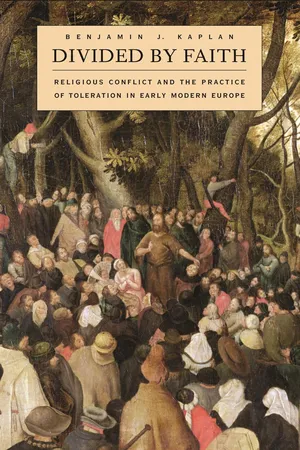
Divided by Faith
Religious Conflict and the Practice of Toleration in Early Modern Europe
- 430 pages
- English
- PDF
- Available on iOS & Android
eBook - PDF
Divided by Faith
Religious Conflict and the Practice of Toleration in Early Modern Europe
About this book
Information
Table of contents
- Contents
- List of Maps and Illustrations
- Introduction
- I. OBSTACLES
- II. ARRANGEMENTS
- III. INTERACTIONS
- IV. CHANGES
- Notes
- Further Reading
- Acknowledgments
- Index
Trusted by 375,005 students
Access to over 1.5 million titles for a fair monthly price.
Study more efficiently using our study tools.
Frequently asked questions
Yes, you can cancel anytime from the Subscription tab in your account settings on the Perlego website. Your subscription will stay active until the end of your current billing period. Learn how to cancel your subscription
No, books cannot be downloaded as external files, such as PDFs, for use outside of Perlego. However, you can download books within the Perlego app for offline reading on mobile or tablet. Learn how to download books offline
Perlego offers two plans: Essential and Complete
- Essential is ideal for learners and professionals who enjoy exploring a wide range of subjects. Access the Essential Library with 800,000+ trusted titles and best-sellers across business, personal growth, and the humanities. Includes unlimited reading time and Standard Read Aloud voice.
- Complete: Perfect for advanced learners and researchers needing full, unrestricted access. Unlock 1.5M+ books across hundreds of subjects, including academic and specialized titles. The Complete Plan also includes advanced features like Premium Read Aloud and Research Assistant.
We are an online textbook subscription service, where you can get access to an entire online library for less than the price of a single book per month. With over 1.5 million books across 990+ topics, we’ve got you covered! Learn about our mission
Look out for the read-aloud symbol on your next book to see if you can listen to it. The read-aloud tool reads text aloud for you, highlighting the text as it is being read. You can pause it, speed it up and slow it down. Learn more about Read Aloud
Yes! You can use the Perlego app on both iOS and Android devices to read anytime, anywhere — even offline. Perfect for commutes or when you’re on the go.
Please note we cannot support devices running on iOS 13 and Android 7 or earlier. Learn more about using the app
Please note we cannot support devices running on iOS 13 and Android 7 or earlier. Learn more about using the app
Yes, you can access Divided by Faith by Benjamin J. Kaplan,Benjamin J Kaplan in PDF and/or ePUB format, as well as other popular books in History & European History. We have over 1.5 million books available in our catalogue for you to explore.