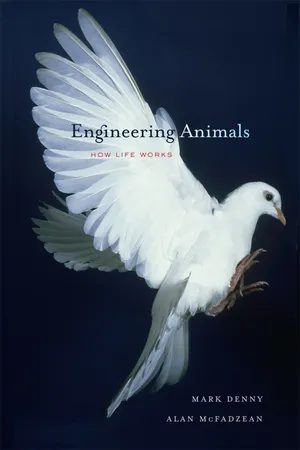
The alarm calls of birds make them difficult for predators to locate, while the howl of wolves and the croak of bullfrogs are designed to carry across long distances. From an engineer's perspective, how do such specialized adaptations among living things really work? And how does physics constrain evolution, channeling it in particular directions?
Writing with wit and a richly informed sense of wonder, Denny and McFadzean offer an expert look at animals as works of engineering, each exquisitely adapted to a specific manner of survival, whether that means spinning webs or flying across continents or hunting in the dark—or writing books. This particular book, containing more than a hundred illustrations, conveys clearly, for engineers and nonengineers alike, the physical principles underlying animal structure and behavior.
Pigeons, for instance—when understood as marvels of engineering—are flying remote sensors: they have wideband acoustical receivers, hi-res optics, magnetic sensing, and celestial navigation. Albatrosses expend little energy while traveling across vast southern oceans, by exploiting a technique known to glider pilots as dynamic soaring. Among insects, one species of fly can locate the source of a sound precisely, even though the fly itself is much smaller than the wavelength of the sound it hears. And that big-brained, upright Great Ape? Evolution has equipped us to figure out an important fact about the natural world: that there is more to life than engineering, but no life at all without it.
- 396 pages
- English
- PDF
- Available on iOS & Android
eBook - PDF
About this book
Information
Topic
Scienze biologicheSubtopic
BiologiaTable of contents
- Contents
- Prologue
- Part One: Structure and Movement
- Part Two: Remote Sensing
- Epilogue
- Notes
- Further Reading
- References
- Acknowledgments
- Index
Trusted by 375,005 students
Access to over 1.5 million titles for a fair monthly price.
Study more efficiently using our study tools.
Frequently asked questions
Yes, you can cancel anytime from the Subscription tab in your account settings on the Perlego website. Your subscription will stay active until the end of your current billing period. Learn how to cancel your subscription
No, books cannot be downloaded as external files, such as PDFs, for use outside of Perlego. However, you can download books within the Perlego app for offline reading on mobile or tablet. Learn how to download books offline
Perlego offers two plans: Essential and Complete
- Essential is ideal for learners and professionals who enjoy exploring a wide range of subjects. Access the Essential Library with 800,000+ trusted titles and best-sellers across business, personal growth, and the humanities. Includes unlimited reading time and Standard Read Aloud voice.
- Complete: Perfect for advanced learners and researchers needing full, unrestricted access. Unlock 1.5M+ books across hundreds of subjects, including academic and specialized titles. The Complete Plan also includes advanced features like Premium Read Aloud and Research Assistant.
We are an online textbook subscription service, where you can get access to an entire online library for less than the price of a single book per month. With over 1.5 million books across 990+ topics, we’ve got you covered! Learn about our mission
Look out for the read-aloud symbol on your next book to see if you can listen to it. The read-aloud tool reads text aloud for you, highlighting the text as it is being read. You can pause it, speed it up and slow it down. Learn more about Read Aloud
Yes! You can use the Perlego app on both iOS and Android devices to read anytime, anywhere — even offline. Perfect for commutes or when you’re on the go.
Please note we cannot support devices running on iOS 13 and Android 7 or earlier. Learn more about using the app
Please note we cannot support devices running on iOS 13 and Android 7 or earlier. Learn more about using the app
Yes, you can access Engineering Animals by Mark Denny,Alan McFadzean,Mark Denny in PDF and/or ePUB format, as well as other popular books in Scienze biologiche & Biologia. We have over 1.5 million books available in our catalogue for you to explore.