A Chronicle of Higher Education "Top 10 Books on Teaching" Selection
Winner of the Virginia and Warren Stone Prize
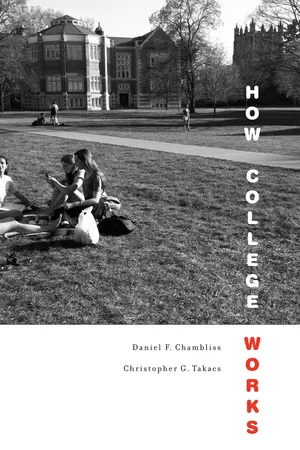
Constrained by shrinking budgets, can colleges do more to improve the quality of education? And can students get more out of college without paying higher tuition? Daniel Chambliss and Christopher Takacs conclude that the limited resources of colleges and students need not diminish the undergraduate experience. How College Works reveals the surprisingly decisive role that personal relationships play in determining a student's collegiate success, and puts forward a set of small, inexpensive interventions that yield substantial improvements in educational outcomes.
"The book shares the narrative of the student experience, what happens to students as they move through their educations, all the way from arrival to graduation. This is an important distinction. [Chambliss and Takacs] do not try to measure what students have learned, but what it is like to live through college, and what those experiences mean both during the time at school, as well as going forward."
—John Warner, Inside Higher Ed
- 219 pages
- English
- PDF
- Available on iOS & Android
eBook - PDF
How College Works
About this book
Information
Publisher
Harvard University PressYear
2014Print ISBN
9780674979802
9780674049024
eBook ISBN
9780674726093
Topic
EducationSubtopic
Education GeneralTable of contents
- Contents
- 1. The Search for a Solution
- 2. Entering
- 3. Choosing
- 4. The Arithmetic of Engagement
- 5. Belonging
- 6. Learning
- 7. Finishing
- 8. Lessons Learned
- Appendix: Methods
- Notes
- Acknowledgments
- Index
Trusted by 375,005 students
Access to over 1.5 million titles for a fair monthly price.
Study more efficiently using our study tools.
Frequently asked questions
Yes, you can cancel anytime from the Subscription tab in your account settings on the Perlego website. Your subscription will stay active until the end of your current billing period. Learn how to cancel your subscription
No, books cannot be downloaded as external files, such as PDFs, for use outside of Perlego. However, you can download books within the Perlego app for offline reading on mobile or tablet. Learn how to download books offline
Perlego offers two plans: Essential and Complete
- Essential is ideal for learners and professionals who enjoy exploring a wide range of subjects. Access the Essential Library with 800,000+ trusted titles and best-sellers across business, personal growth, and the humanities. Includes unlimited reading time and Standard Read Aloud voice.
- Complete: Perfect for advanced learners and researchers needing full, unrestricted access. Unlock 1.5M+ books across hundreds of subjects, including academic and specialized titles. The Complete Plan also includes advanced features like Premium Read Aloud and Research Assistant.
We are an online textbook subscription service, where you can get access to an entire online library for less than the price of a single book per month. With over 1.5 million books across 990+ topics, we’ve got you covered! Learn about our mission
Look out for the read-aloud symbol on your next book to see if you can listen to it. The read-aloud tool reads text aloud for you, highlighting the text as it is being read. You can pause it, speed it up and slow it down. Learn more about Read Aloud
Yes! You can use the Perlego app on both iOS and Android devices to read anytime, anywhere — even offline. Perfect for commutes or when you’re on the go.
Please note we cannot support devices running on iOS 13 and Android 7 or earlier. Learn more about using the app
Please note we cannot support devices running on iOS 13 and Android 7 or earlier. Learn more about using the app
Yes, you can access How College Works by Daniel F. Chambliss,Christopher G. Takacs in PDF and/or ePUB format, as well as other popular books in Education & Education General. We have over 1.5 million books available in our catalogue for you to explore.