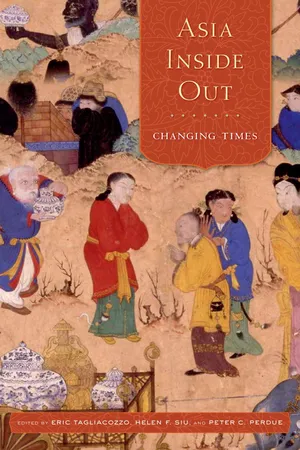
The first of three volumes surveying the historical, spatial, and human dimensions of inter-Asian connections, Asia Inside Out: Changing Times brings into focus the diverse networks and dynamic developments that have linked peoples from Japan to Yemen over the past five centuries.
Each author examines an unnoticed moment—a single year or decade—that redefined Asia in some important way. Heidi Walcher explores the founding of the Safavid dynasty in the crucial battle of 1501, while Peter C. Perdue investigates New World silver's role in Sino–Portuguese and Sino–Mongolian relations after 1557. Victor Lieberman synthesizes imperial changes in Russia, Burma, Japan, and North India in the seventeenth century, Charles Wheeler focuses on Zen Buddhism in Vietnam to 1683, and Kerry Ward looks at trade in Pondicherry, India, in 1745. Nancy Um traces coffee exports from Yemen in 1636 and 1726, and Robert Hellyer follows tea exports from Japan to global markets in 1874. Anand Yang analyzes the diary of an Indian soldier who fought in China in 1900, and Eric Tagliacozzo portrays the fragility of Dutch colonialism in 1910. Andrew Willford delineates the erosion of cosmopolitan Bangalore in the mid-twentieth century, and Naomi Hosoda relates the problems faced by Filipino workers in Dubai in the twenty-first.
Moving beyond traditional demarcations such as West, East, South, and Southeast Asia, this interdisciplinary study underscores the fluidity and contingency of trans-Asian social, cultural, economic, and political interactions. It also provides an analytically nuanced and empirically rich understanding of the legacies of Asian globalization.
eBook - ePub
Asia Inside Out
- English
- ePUB (mobile friendly)
- Available on iOS & Android
eBook - ePub
About this book
Trusted by 375,005 students
Access to over 1 million titles for a fair monthly price.
Study more efficiently using our study tools.
Information
1
1501 in Tabriz
From Tribal Takeover to Imperial Trading Circuit?
HEIDI A. WALCHER
Tracing the question of one of the most consequential or decisive dates in Iranian history, 1501 [907]1 would make a compelling and logical date, understood as the year of the founding of the Safavid dynasty by Ismail I, by capturing Tabriz and proclaiming Shiʿism as the official religion of his rule. Most historians, even those working on other periods (like this author), and probably also theologians, political scientists, and art historians concerned with Iran would agree. In a certain sense it can be read almost as an “official” date; it has become a practical textbook date and even in a revisionist approach to the history of wider Iran2 it would probably not completely lose a certain relevance. Even if one considers with skepticism the condensation of vast time periods and geopolitical spaces or the concept of accessing broad, long-term historical trends through a single date, in an Iranian context 1501 would still resonate with a certain meaning and evoke specific historical frameworks, identities, and trends. Moreover, the heavy weight of 1501 in marking a new era in Iranian history is extremely persuasive, as it neatly fits into the axiom of 1500 as indicating the beginning of the “early modern period.” In European historiography, by overwhelming consensus, 1500 marks a new epoch, because of the synchronous convergence of such events as the Reformation, early capitalism, and the opening of sea routes to Asia and the Americas. Accepting the inception of modernity in the non-European world as concurrent with these overall global trends promotes the notion of an “early modern period” in Asia and the Middle East, beginning at the same time.
However, linking this date (1501) and place (“early modern Iran” in its broadest sense) to Asia raises many questions, provides very few answers, and offers no straightforward narrative nor anything close to a new paradigm or model. The cultural and historical space of Iran has always interacted with both directions—Europe and Asia. On the one hand, most Iranians would consider themselves Middle Eastern or Asian and momentarily cheer for the Asian rather than the European football team.3 In 1905, many Iranians decisively identified with Japan’s military victory against Russia, hailing this as a major if rare success for a small Asian state against the superpower of the time. On the other hand, since the mid-1800s Europe has become so central to Iranian politics and developments that, from the perspectives of late nineteenth-century Iranian history or twentieth-century historiography, Asia is not necessarily the first point of reference.
A widely accepted historical canon understands the Ottoman, Safavid, and Mughal states as a world system with innate cultural and regional interdependencies. Applying the term “civilization” to this system implies a specific cultural cohesion, commonality, and patterns of political-commercial interaction, including far-reaching networks of naval ties to Southeast Asia and sub-Saharan Africa. (i.e., Dale 2010, 3) Most discussions of these three states focus on the period beginning with the late sixteenth century, a phase of intensive interaction also with Europe. While in the late 1400s and early 1500s an active transregional exchange from the Bosporus to the Amu Darya and beyond existed, it followed older historical patterns. The rhythms and scope of these exchanges were different from those of a century later, when sea routes and central imperial control had changed their parameters. Thus, how the diverse regions of Iran in the early 1500s were precisely linked to patterns of interaction beyond the system of the three empires and tied into wider Asia remains a more intricate and open-ended discussion. Examining historical precedents and geographical connections, this chapter aims to suggest a few tentative critical thoughts.
In tracing historical developments and attempting to define caesurae, epochs, or phases of change, single big events marking a clear-cut point of departure and measuring changing rhythms of time, place, or trends serve as numerical markers for timelines. 1501 in Tabriz has been and can be read precisely as such a marker, especially from frameworks of national or religious history. Yet if interpretations and perspectives of national history are dissolved, this date and place lose precision and perhaps even relevance. Despite its indisputable ideological and political meaning, 1501 is in fact an ambivalent date, denoting more a variable point of reference and an unpredictable origin rather than a clear-cut point of departure. It might be used as an auxiliary aid to pursue questions about the complex interactivity of communication, exchange, interdependence, and transition in Asia, covering people and territories from the Persian Gulf to the South China Sea. Marking a point in time half a century before the worldwide commercial boom of the late sixteenth century, driven heavily also by European players, 1501 in a transnational as well as an Iranian or western Asian context is an unwieldy date.
The trans-Asian relations of Iran are more apparent in earlier periods, such as the Il-Khanid or Timurid times of the thirteenth to fifteenth centuries. Later, also, more concrete ties, traceable through larger documentary evidence, emerge in the post-Tabriz period since the 1590s, when the center of the Safavid state had become more stable, and territories under its rule were more effectively linked to global maritime networks along the seam of the Persian Gulf. Nader Shah’s 1739 seizure of the Mughal throne in Delhi provides a tangible example of Persia reaching into South Asian territory. The export of the first chests of opium to Batavia in 1869 marks Iran’s rising role in supplying the opium trade to China (and Europe). Almost any year in the late nineteenth century—when the pace of modern transport and the volume of the exchange of goods, people, and ideas had reached unprecedented scales and when the material matrix of commodities and communication is more quantifiable or tangible—demonstrates more direct and active Asian contact. The argument for wider Iranian interaction with Asia in the early 1500s is, however, more circumstantial, even though it followed earlier patterns. This examination of links to Asia in 1501 thus attempts to trace aspects different from quantifiable commodities, specific trading communities, or commercial connections by discussing spaces of premodern historical, cultural, political, and geographical interdependencies.
This discussion will thus limit its focus to the very early 1500s, or the first few decades of what has been called the “classical period” of Safavid rule (1501–1590), summarizing the “revolutionary phase” (1447–1501) (Babayan 2002, 143). At the time, the occupation of Tabriz was a local event, whose consequences over a longue durée were uncertain. 1501 in Tabriz has thus a different tempo and geographical pattern than the later Safavid period. As a landlocked city, it lies at the very fringes of what in historical and geographical terms has been considered Western Asia, and thus it lacks easy links to East or South Asia. Current and historical geopolitical understandings and definitions further complicate the task. Since the artificial creation of the term “Middle East,” based on British and American policy considerations of the early twentieth century, implicit politico-ideological and religio-ideological notions compound or distort the question of geographic and geopolitical alignments (Lewis and Wigen 1997, 35–103; Adelson 1995, passim). Because of this influence, Iran has become somewhat marginal to the current definition or understanding of Asia as a geographical, political, or cultural-economic entity. The various (often contradictory) layers of geographic and political names shall not be untangled conclusively here. Yet once wider Iran, including the Persian Gulf, is taken out of the construct of a “Middle East” or textbook narratives of the “Making of the Modern Middle East,” its situation at the very southwestern rim of Asia and its geostrategic position midway between the Atlantic coast of Portugal and the East China Sea deserves a different framework. One of central Iran’s most important links to Asia (as well as the Atlantic world) since the early modern period has been its maritime connection through the Persian Gulf. Yet from the land-based rule of the Safavids, particularly in the pre-Isfahan period up to 1598, the control of maritime affairs was indirect and tenuous. Iran today also exhibits a longstanding North–South bias, with wealth and especially power concentrated in the urban centers of the north. In the early modern period, land-based frontiers and transit routes held conspicuous primacy. The maritime connection through the Persian Gulf always existed, but only gained economic primacy and centrality in Safavid policy in the mid-sixteenth century, about five to six decades after the installation of the Safavid monarchy in 1501. And even then, the Safavid strategy of enforcing hegemony in the Persian Gulf approached it much like another land-based region (Chaudhuri 1990, 112–148).
Although Ismail I’s zeal and the primacy of religious ideology may have been a specific regional phenomenon, in terms of the time–space frame of this discussion, we may also interpret 1501 as a dynastic starting point, a means of pinpointing new political and religious frameworks and economic developments. In this sense it fits neatly into the time frame termed the “early modern period,” which sees the concurrence of new intellectual, technical, and economic processes launched by the Renaissance and the opening of new sea routes to South Asia and the Americas. A parallel case is Babur’s 1503 conquest of Kabul, which facilitated his seizure of Agra in 1526, founding the Mughal dynasty (see Lieberman essay in this volume). In chronology, 1501 in Tabriz thus fits into the notion of large-scale global changes between the 1500s and 1600s. At the same time, pursuing horizontal continuities in the framework of Asia and its local or regional dimensions, 1501 looks less like a starting point and more like a time of transition or a catalyst of earlier trends that both repeats earlier trends as well as transforms them. Questioning the meaning of 1501 as a starting point for a specifically Iranian trajectory may also subvert dynastic frameworks, including conventional presumptions, posing the question: how Safavid was early Safavid Iran?
The Military Victory—or the 1501 Event
In 907, the Year of the Dog, or July/August of 1501, the young Ismail, spiritual and military leader of the extremist messianic Safaviyya order, won a battle at the village of Sharur in the Araxes Valley of Nakhichevan against the vastly larger forces of the Aq Qoyunlu Sultan Alvand Bayandur, who had controlled the northeastern third of the late tripartite Aq Qoyunlu state.4 This military success allowed Ismail to seize the Aq Qoyunlu’s capital of Tabriz. For Ismail and his tribal Qizilbash warriors, who followed his spiritual and military claims with divine reverence, this was a decisive victory in territorial as well as psycho-religious terms.
Ismail’s father had been killed in battle by his brother-in-law Yaqub Aq Qoyunlu in 1488. Ismail was brought up in hiding, protected by the Safaviyya brotherhood’s innermost supporters in Lahijan (Khvāndamīr [1370] 1991, 31–34; Roemer 2003, 215). At age seven he received the compelling title vali allah (“lieutenant of god”), elevating him to a status almost equal to the first Shiʿi caliph Ali.5 In 1499, when the ruling members of the Aq Qoyunlu were in the midst of their own power struggles, he made a bid for power. By the spring of 1500, he had gathered thousands of messianically driven military followers from sympathizers and devotees of the Turcoman tribes in Azerbaijan and Eastern Anatolia. The division of the Aq Qoyunlu’s state aided Ismail’s ambition. With the defeat of his enemy’s larger forces and the occupation of the important Turco-Iranian city of Tabriz, he gained a major strategic advantage, also facilitating his grab of royal power. Taking the place of grand master of the Safaviyya Sufi order (following the 1494 death of his brother), Ismail had secured the absolute spiritual and political power to which his father and grandfather aspired (Woods 1976, 173; Roemer 1986, 189; Khunjī [1382] 2003, 252–308).
The Relevance of Tabriz
Ismail I’s occupation of Tabriz had an innate logic. Besides its role as the regional center of Azerbaijan and headquarters of the ruling power, it had an economic and strategic infrastructure as well as historical stature. Although the town of Ardabil, as the Safaviyya order’s place of origin and ancestral shrine, carried a certain sanctity, it had neither the function nor the strategic advantage or historical eminence of Tabriz (Mazzaoui 1972, 43–44).
The topography of extensive mountain massifs around Tabriz and the local river system place...
Table of contents
- Cover
- Title Page
- Copyright
- Contents
- Introduction: Structuring Moments in Asian Connections
- 1. 1501 in Tabriz: From Tribal Takeover to Imperial Trading Circuit?
- 2. 1555: Four Imperial Revivals
- 3. 1557: A Year of Some Significance
- 4. 1636 and 1726: Yemen after the First Ottoman Era
- 5. 1683: An Offshore Perspective on Vietnamese Zen
- 6. 1745: Ebbs and Flows in the Indian Ocean
- 7. 1874: Tea and Japan’s New Trading Regime
- 8. China and India Are One: A Subaltern’s Vision of “Hindu China” during the Boxer Expedition of 1900–1901
- 9. Before the Gangrene Set In: The Dutch East Indies in 1910
- 10. 1956: Bangalore’s Cosmpolitan Pasts and Monocultural Futures?
- 11. 2008: “Open City” and a New Wave of Filipino Migration to the Middle East
- Contributors
- Acknowledgments
- Index
Frequently asked questions
Yes, you can cancel anytime from the Subscription tab in your account settings on the Perlego website. Your subscription will stay active until the end of your current billing period. Learn how to cancel your subscription
No, books cannot be downloaded as external files, such as PDFs, for use outside of Perlego. However, you can download books within the Perlego app for offline reading on mobile or tablet. Learn how to download books offline
Perlego offers two plans: Essential and Complete
- Essential is ideal for learners and professionals who enjoy exploring a wide range of subjects. Access the Essential Library with 800,000+ trusted titles and best-sellers across business, personal growth, and the humanities. Includes unlimited reading time and Standard Read Aloud voice.
- Complete: Perfect for advanced learners and researchers needing full, unrestricted access. Unlock 1.4M+ books across hundreds of subjects, including academic and specialized titles. The Complete Plan also includes advanced features like Premium Read Aloud and Research Assistant.
We are an online textbook subscription service, where you can get access to an entire online library for less than the price of a single book per month. With over 1 million books across 990+ topics, we’ve got you covered! Learn about our mission
Look out for the read-aloud symbol on your next book to see if you can listen to it. The read-aloud tool reads text aloud for you, highlighting the text as it is being read. You can pause it, speed it up and slow it down. Learn more about Read Aloud
Yes! You can use the Perlego app on both iOS and Android devices to read anytime, anywhere — even offline. Perfect for commutes or when you’re on the go.
Please note we cannot support devices running on iOS 13 and Android 7 or earlier. Learn more about using the app
Please note we cannot support devices running on iOS 13 and Android 7 or earlier. Learn more about using the app
Yes, you can access Asia Inside Out by Eric Tagliacozzo, Helen F. Siu, Peter C. Perdue, Eric Tagliacozzo,Helen F. Siu,Peter C. Perdue in PDF and/or ePUB format, as well as other popular books in History & Asian History. We have over one million books available in our catalogue for you to explore.