Convened following Napoleon's defeat in 1814, the Congress of Vienna is remembered as much for the pageantry of the royals and elites who gathered there as for the landmark diplomatic agreements they brokered. Historians have nevertheless generally dismissed these spectacular festivities as window dressing when compared with the serious, behind-the-scenes maneuverings of sovereigns and statesmen. Brian Vick finds this conventional view shortsighted, seeing these instead as two interconnected dimensions of politics. Examining them together yields a more complete picture of how one of the most important diplomatic summits in history managed to redraw the map of Europe and the international system of the nineteenth and twentieth centuries.
The Congress of Vienna investigates the Vienna Congress within a broad framework of influence networks that included unofficial opinion-shapers of all kinds, both men and women: artists and composers, entrepreneurs and writers, hosts and attendees of fashionable salons. In addition to high-profile negotiation and diplomatic wrangling over the post-Napoleonic fates of Germany, Italy, and Poland, Vick brings into focus other understudied yet significant issues: the African slave trade, Jewish rights, and relations with Islamic powers such as the Ottoman Empire and Barbary Corsairs. Challenging the usual portrayal of a reactionary Congress obsessed with rolling back Napoleon's liberal reforms, Vick demonstrates that the Congress's promotion of limited constitutionalism, respect for religious and nationality rights, and humanitarian interventions was influenced as much by liberal currents as by conservative ones.
- 440 pages
- English
- ePUB (mobile friendly)
- Available on iOS & Android
eBook - ePub
About this book
Trusted by 375,005 students
Access to over 1.5 million titles for a fair monthly price.
Study more efficiently using our study tools.
Information
CHAPTER ONE
Peace and Power in Display
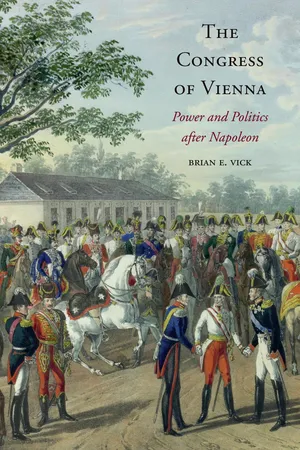
In the autumn of 1814, most eyes in Europe turned to Vienna. On Sunday, 25 September, many were fixed—directly or vicariously—on the parade route by which Tsar Alexander and King Friedrich Wilhelm of Prussia would enter the city. The Tabor Bridges formed the cynosure of attention, where the pair was greeted by Emperor Franz of Austria. That liminal moment on the far side of the bridge, within the suburbs but just outside the city proper, gave rise to numerous verbal and visual depictions of “the three monarchs” or “the three allies” and still provides some of the most-reproduced images associated with the Congress of Vienna (Figure 1.1). Prince Trauttmansdorff and the court officials in charge of etiquette and festivities had of course carefully choreographed the ceremonial details beforehand (out of deference to the tsar’s hearing-impaired left ear, the tsar rode on Franz’s left rather than his right).1 Yet the entry represented a celebration not just of the court but also of the city and its citizenry. The military escort and associated parade constituted a major part of the event, beginning with the early-morning cannon salvos that announced the approach of the foreign sovereigns several hours in advance (needlessly early, complained a rudely awakened Prince Metternich). Leading and concluding the procession, however, came units not just of the regular army and its marching bands but also of the civilian militia. The citizen military units and their role in ceremonial can be traced back to early modern and medieval times, but in this case they also reflected the brand new institutions of the Wars of Liberation and the dawning age of mass armies, patriotic participation, and total war during the revolutionary and Napoleonic eras. The parade continued to the great star of the Prater park and then wound through the narrow streets of the old city center to the Imperial Palace, waiting ready to house the imperial and royal guests. Gathered to greet them stood thirty white-clad young maidens, who presented the tsar and the Prussian king with wreaths and a poem. Classic symbols of innocence and futurity, reminders of what one had been fighting to defend, the girls were led by their French instructor, suggesting reconciliation within the European family after decades of war.2
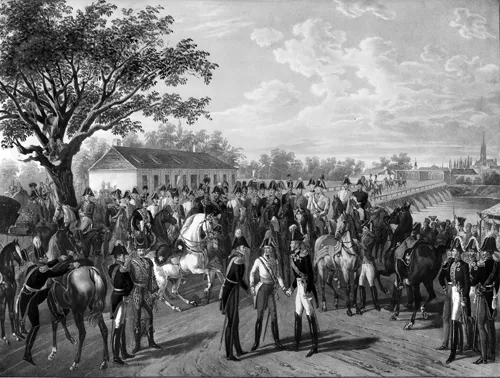
FIGURE 1.1 Reception of Tsar Alexander I of Russia and King Friedrich Wilhelm III of Prussia near Vienna on 25 September 1814. Colored lithograph by Franz Wolf after Johann Nepomuk Hoechle, Vienna, 1835. (ÖNB/Vienna, Pk 187,12)
This sort of monarchical meeting and associated pomp might seem perfectly normal from a twenty-first-century perspective, with its frequent photo-op encounters and summit meetings between heads of state, and with two centuries of such intersovereign moments to draw on in the collective memory, be it monarchical or republican. In the eighteenth century, however, such a coming together of sovereigns was extremely rare, and almost unthinkable. Instead, eighteenth-century rulers typically remained in their territories and left it to their mostly not-yet professional ambassadors and envoys to communicate with other rulers and to represent them at their courts—not just presenting their views, but serving as a representation of their sovereign persons in the more richly symbolic sense. If rulers had met, it would simply have heightened the dangers of tension, insult, and resultant war. Status, reputation, and ceremonial protocol remained all-important points of conflict. Attitudes began to change during the Napoleonic period, in gatherings such as the Congress of Erfurt or the famous encounter between Napoleon and Tsar Alexander at Tilsit. But it was the Congress of Vienna that first fully explored the possibilities of such meetings, in conditions more or less freely chosen rather than coerced, and with the expectation that it might promote lasting peace rather than imminent war.3
The choreographers of Congress events like Prince Trauttmansdorff of course drew heavily on the fund of traditional display and representational culture from the old courtly-aristocratic public sphere, even as the novel presence of so many royals offered opportunities for creative experimentation and potentially headache-inspiring conundrums of etiquette. At the same time, however, the sovereigns’ presence in Vienna during the Congress shone a spotlight on a preexisting web of institutions, mechanisms, and languages of political culture involving voluntarist civic elements of representation and display and driven in part by grassroots patriotism and market forces in entertainment culture of the sort associated with the new, socially and communicatively broader public sphere, sometimes called the bourgeois public sphere, though more recent literature has shown the extent to which it was constituted by middle-class and aristocratic elements in combination.4 This public web was comprised to a significant degree of actors positioned in both systems, the state or courtly and the voluntary or market-driven.
In taking the culture of display as the subject of investigation, this chapter adopts a somewhat different approach from much of the existing literature on the “new political history” or court culture. Such studies tend toward analyses of symbolism and ritual grounded in anthropological theory. They focus on long-term continuities and gradual transitions in the symbolism of power, and often emphasize the differences between the representational public sphere on the one hand and the realm of print culture and political debate on the other (with its own manner of legitimating or contesting power). Here, the aim is rather to illuminate the similarities and interconnections between the two arenas of representation, as both emerged from a common overarching political culture made up of elements of display, print media, and visual, musical, and material culture in the new world of broader publics and efficient markets. In that realm, elements of tradition and references to the newest cultural trends and political events coexisted and coalesced in crucial ways that were stimulating for contemporaries and are revealing to historians. The mixture of religious and military display in particular stands out in this regard, each reflecting newer meanings in contemporary contexts as well as those inherited from tradition. In a social sense too, festive culture in Vienna tended to bring the classes closer together and to shrink rather than exaggerate the distances within social hierarchies and between rulers and subjects. This chapter also contributes to debates about the significance of gender and the role of women in public and politics during this period. As we shall see, while the militarization and democratization that helped blur class distinctions did promote a partial masculinization of the public sphere, opportunities for women’s presence increased as well.
If this chapter’s recognition of the extent of mixing of court, state, and private initiatives in the production of festive culture and display marks relatively new ground, it also intervenes in an older but ongoing debate about the level of public participation in representational culture and its political effects. Jürgen Habermas’s relative praise for the bourgeois public sphere of print culture, civil society, and parliamentary politics formed only a small part of a larger critique of post–Second World War society and politics as being simply acclamatory and focused on the admiration of celebrity in ways not unlike the court-based aristocratic representational culture of the medieval and early modern public sphere. Slogans rather than reasoned arguments shaped political debate, and glitzy campaigns and advertising swayed potential voters emotionally and viscerally more than intellectually, analogous to the legitimation of power in older ceremonies and festivals. In France during the radical 1960s, Guy Debord and the Situationists similarly critiqued the modern “society of the spectacle” and the mass culture of entertainment and consumption that fed it. In their analysis, atomized individuals cling to the illusion of agency in choosing what they have been led to desire, isolated from collective experience, and distracted from pushing for social and political change. Both points of view remain influential among historians and contemporary social and cultural critics. Other scholars, however, have begun to rehabilitate the realm of spectacle and entertainment culture as potentially more empowering and liberating than merely mind-numbing, both for its classic phase in the late nineteenth and early twentieth centuries and for Napoleonic pageantry and festivities. For some, the public’s role in early modern and nineteenth-century parades and display was to line the streets, behave, and make plenty of cheerful noise when the great and the good passed by. But considerable room for popular input and participation remained as well, in ways that bore implications for the liberalization or democratization of politics in the revolutionary and Napoleonic eras. Monarchical representation could itself function as a form of political communication that involved spectators’ active interpretation.5 The present discussion too highlights the participatory rather than simply acclamatory side of the culture of display after Napoleon.
Even contemporaries sometimes proved keen to contest the idea that spectatorship implied mere gawking, or slavish fawning. Referencing the array of accounts and images of the three allied rulers that had preceded their entry to Vienna on 25 September, the coverage in the new Viennese cultural periodical the Pages of Peace claimed:
It was not three monarchs, surrounded by the trappings [Prunk] of majesty, stared at with senseless curiosity: it was the sight of these three, blessed by all the peoples of Europe, worshipped in particular by their own peoples, honored by all men of heart and spirit for their own sake; it was these three, friends bound through fate, through sufferings and joys, through their own hearts, which captivated all gazes and made their appearance an angel’s apparition for every joy-drunk eye and for every delighted heart.
By this account, the acclamation represented not obedient noise to play a part but instead something deeply felt, involving close identification with the rulers as human beings, and broader sentimental and patriotic discourses by “men of heart and spirit” in this era of war and peace.6
Military and Religious Display
Although the image of the dancing Congress often comes first to mind when one thinks of its festive culture, the Congress offered almost as many opportunities for military as for terpsichorean display. Troops on parade, as we have seen, already marked the arrival of Tsar Alexander and the king of Prussia on 25 September, and further military displays occurred on 30 September and 1, 2, 6, 8, 9, 10, and 18 October, just to take examples from the Congress’s first weeks. The pace slackened thereafter but never halted. If anything, the Viennese and their visitors experienced an even greater density of display after Napoleon’s return, as from late March to early May an almost unending succession of reviews and parades took place for the troops marching through Vienna on their way to the Rhine.7
It is important to note in this context that such militarized political spectacle, ancient though it might seem, for the most part falls under the heading of “invented traditions” and has more recent origins than one might think. This is not to say that kings had not paraded their troops before, or that crowds had not watched them do so—the spring troop revue in the Berlin Tiergarten by Prussia’s “Soldier King,” Friedrich Wilhelm I, already represented a “spectacle for the entire city” in the early eighteenth century, and Prussian style sparked imitations later in the century elsewhere in the Holy Roman Empire, in parades and in the increasingly standard wearing of uniforms by rulers, courts, and even civilian officials.8 Yet such exercises began to assume more modern forms and meanings at about the same time as the changes in the public sphere of the later eighteenth century, and did not get into full swing until the Napoleonic wars, in part through imitation of Napoleonic rule and display itself, where reviewing troops in choreographed spectacle constituted a crucial aspect of his appeal to legitimacy. Such militarized display also drew on the seminal role of the French National Guard and other military units in stagings or representations of the nation during the French Revolution.9 It was significant in this regard that along with planning the Congress and negotiating peace, one of the preoccupations of Prince Metternich and Emperor Franz in the year 1814 was to introduce a new set of uniforms for government officials, making sure that everything looked just right and in the best of taste. Such a move would both boost morale and self-image among the bureaucrats and make the desired impression on state occasions.10
It is worth emphasizing that such festive and patriotic use of soldiers, uniforms, and martial music did not have to wait until the classic age of “invented traditions” in the late nineteenth century to find eager promoters or enthusiastic publics. If anything, the main difference in 1814 was that the spectacle did not need to come bearing the blatant trappings of the traditional but proved all the more effective when making the regime seem to be working in the spirit of the times and at the cutting edge of postrevolutionary political culture. The Prussian diplomat and litterateur Karl Varnhagen von Ense underscored these trends, observing that “the modern festival is essentially military; the earlier religious, the later courtly character of public opulence is entirely merged in the military, which speaks most clearly to the crowd and still commands from it the most respect, through earnestness and efficiency.”11
Military spectacle also made up the lion’s share of public display at the Napoleonic precursor to the Vienna Congress, the Congress of Erfurt of 1808. If the Austrians were to put on a better, and more legitimate, show in Vienna in 1814, then they needed to surpass the revolutionary Corsican on the same field—the parade ground—even as they emphasized the courtly and religious dimensions of display as well. In this way, too, restoration governments could combine reinvention of tradition with assertion of their fully modern and up-to-date status. Since Tsar Alexander cherished a well-known love of troop reviews and parades, the planners also served the parallel goal of playing to the preferences of their most important guest.12
Military display performed a variety of functions and was more than just a vehicle for eliciting acclamation. Most important here, military display served immediate political purposes. It too represents a “speech act” with an illocutionary force, or intended effect among its observers, and indeed among those performing. A good review or maneuver could showcase the military capacity, skill, and efficiency of the army in question, as well as allow it to demonstrate its esprit de corps and its patriotic commitment to both ruler and country (pater and patria, father-figure and fatherland). Done right, such display could even help build those very qualities, in practicing for the events and in receiving praise from commanders, rulers, and cheering crowds.13
Even the acclamation of subjects or citizens could serve a useful purpose, as a reminder...
Table of contents
- Cover
- Title Page
- Copyright
- Contents
- Introduction
- 1. Peace and Power in Display
- 2. Selling the Congress
- 3. Salon Networks
- 4. Negotiating Religion
- 5. Europe in the Wider World
- 6. Between Reaction and Reform
- 7. Poland, Saxony, and the Crucible of Diplomacy
- Conclusion
- Notes
- Acknowledgments
- Index
Frequently asked questions
Yes, you can cancel anytime from the Subscription tab in your account settings on the Perlego website. Your subscription will stay active until the end of your current billing period. Learn how to cancel your subscription
No, books cannot be downloaded as external files, such as PDFs, for use outside of Perlego. However, you can download books within the Perlego app for offline reading on mobile or tablet. Learn how to download books offline
Perlego offers two plans: Essential and Complete
- Essential is ideal for learners and professionals who enjoy exploring a wide range of subjects. Access the Essential Library with 800,000+ trusted titles and best-sellers across business, personal growth, and the humanities. Includes unlimited reading time and Standard Read Aloud voice.
- Complete: Perfect for advanced learners and researchers needing full, unrestricted access. Unlock 1.5M+ books across hundreds of subjects, including academic and specialized titles. The Complete Plan also includes advanced features like Premium Read Aloud and Research Assistant.
We are an online textbook subscription service, where you can get access to an entire online library for less than the price of a single book per month. With over 1.5 million books across 990+ topics, we’ve got you covered! Learn about our mission
Look out for the read-aloud symbol on your next book to see if you can listen to it. The read-aloud tool reads text aloud for you, highlighting the text as it is being read. You can pause it, speed it up and slow it down. Learn more about Read Aloud
Yes! You can use the Perlego app on both iOS and Android devices to read anytime, anywhere — even offline. Perfect for commutes or when you’re on the go.
Please note we cannot support devices running on iOS 13 and Android 7 or earlier. Learn more about using the app
Please note we cannot support devices running on iOS 13 and Android 7 or earlier. Learn more about using the app
Yes, you can access The Congress of Vienna by Brian E. Vick in PDF and/or ePUB format, as well as other popular books in History & 19th Century History. We have over 1.5 million books available in our catalogue for you to explore.