Magisterial in vision, sweeping in scope, this monumental work presents a seamless account of Japanese society during the modern era, from 1600 to the present. A distillation of more than fifty years' engagement with Japan and its history, it is the crowning work of our leading interpreter of the modern Japanese experience.
Since 1600 Japan has undergone three periods of wrenching social and institutional change, following the imposition of hegemonic order on feudal society by the Tokugawa shogun; the opening of Japan's ports by Commodore Perry; and defeat in World War II. The Making of Modern Japan charts these changes: the social engineering begun with the founding of the shogunate in 1600, the emergence of village and castle towns with consumer populations, and the diffusion of samurai values in the culture.
Marius Jansen covers the making of the modern state, the adaptation of Western models, growing international trade, the broadening opportunity in Japanese society with industrialization, and the postwar occupation reforms imposed by General MacArthur. Throughout, the book gives voice to the individuals and views that have shaped the actions and beliefs of the Japanese, with writers, artists, and thinkers, as well as political leaders given their due.
The story this book tells, though marked by profound changes, is also one of remarkable consistency, in which continuities outweigh upheavals in the development of society, and successive waves of outside influence have only served to strengthen a sense of what is unique and native to Japanese experience. The Making of Modern Japan takes us to the core of this experience as it illuminates one of the contemporary world's most compelling transformations.
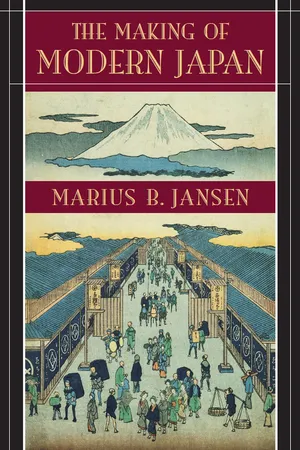
- 932 pages
- English
- PDF
- Available on iOS & Android
eBook - PDF
The Making of Modern Japan
About this book
Information
Table of contents
- Contents
- Preface
- Acknowledgments
- Note on Names and Romanization
- 1. Sekigahara
- 2. The Tokugawa State
- 3. Foreign Relations
- 4. Status Groups
- 5. Urbanization and Communications
- 6. The Development of a Mass Culture
- 7. Education, Thought, and Religion
- 8. Change, Protest, and Reform
- 9. The Opening to the World
- 10. The Tokugawa Fall
- 11. The Meiji Revolution
- 12. Building the Meiji State
- 13. Imperial Japan
- 14. Meiji Culture
- 15. Japan between the Wars
- 16. Taisho Culture and Society
- 17. The China War
- 18. The Pacific War
- 19. The Yoshida Years
- 20. Japan Since Independence
- Further Reading
- Notes
- Credits
- Index
Trusted by 375,005 students
Access to over 1.5 million titles for a fair monthly price.
Study more efficiently using our study tools.
Frequently asked questions
Yes, you can cancel anytime from the Subscription tab in your account settings on the Perlego website. Your subscription will stay active until the end of your current billing period. Learn how to cancel your subscription
No, books cannot be downloaded as external files, such as PDFs, for use outside of Perlego. However, you can download books within the Perlego app for offline reading on mobile or tablet. Learn how to download books offline
Perlego offers two plans: Essential and Complete
- Essential is ideal for learners and professionals who enjoy exploring a wide range of subjects. Access the Essential Library with 800,000+ trusted titles and best-sellers across business, personal growth, and the humanities. Includes unlimited reading time and Standard Read Aloud voice.
- Complete: Perfect for advanced learners and researchers needing full, unrestricted access. Unlock 1.5M+ books across hundreds of subjects, including academic and specialized titles. The Complete Plan also includes advanced features like Premium Read Aloud and Research Assistant.
We are an online textbook subscription service, where you can get access to an entire online library for less than the price of a single book per month. With over 1.5 million books across 990+ topics, we’ve got you covered! Learn about our mission
Look out for the read-aloud symbol on your next book to see if you can listen to it. The read-aloud tool reads text aloud for you, highlighting the text as it is being read. You can pause it, speed it up and slow it down. Learn more about Read Aloud
Yes! You can use the Perlego app on both iOS and Android devices to read anytime, anywhere — even offline. Perfect for commutes or when you’re on the go.
Please note we cannot support devices running on iOS 13 and Android 7 or earlier. Learn more about using the app
Please note we cannot support devices running on iOS 13 and Android 7 or earlier. Learn more about using the app
Yes, you can access The Making of Modern Japan by Marius B. Jansen,Marius B. Jansen in PDF and/or ePUB format, as well as other popular books in History & Japanese History. We have over 1.5 million books available in our catalogue for you to explore.