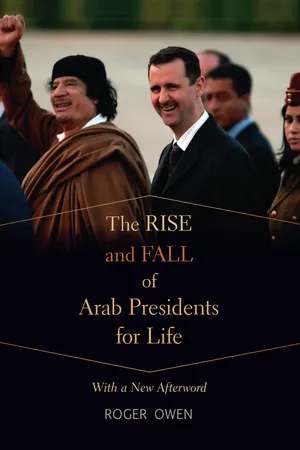
The monarchical presidential regimes that prevailed in the Arab world for so long looked as though they would last indefinitely—until events in Tunisia and Egypt made clear their time was up. The Rise and Fall of Arab Presidents for Life exposes for the first time the origins and dynamics of a governmental system that largely defined the Arab Middle East in the twentieth century.
Presidents who rule for life have been a feature of the Arab world since independence. In the 1980s their regimes increasingly resembled monarchies as presidents took up residence in palaces and made every effort to ensure their sons would succeed them. Roger Owen explores the main features of the prototypical Arab monarchical regime: its household; its inner circle of corrupt cronies; and its attempts to create a popular legitimacy based on economic success, a manipulated constitution, managed elections, and information suppression.
Why has the Arab world suffered such a concentration of permanent presidential government? Though post-Soviet Central Asia has also known monarchical presidencies, Owen argues that a significant reason is the "Arab demonstration effect," whereby close ties across the Arab world have enabled ruling families to share management strategies and assistance. But this effect also explains why these presidencies all came under the same pressure to reform or go. Owen discusses the huge popular opposition the presidential systems engendered during the Arab Spring, and the political change that ensued, while also delineating the challenges the Arab revolutions face across the Middle East and North Africa.
- English
- ePUB (mobile friendly)
- Available on iOS & Android
eBook - ePub
About this book
Information
Topic
HistoriaSubtopic
Historia africana1 The Search for Sovereignty in an Insecure World
The Arab state system that now exists across the Middle East and North Africa, and the origins of its particular style of presidential rule, are the result of a combination of colonialism, Arabism, and the new world order of sovereign states that was introduced after 1945 under the aegis of the United Nations.
Although Europe established very few formal colonies in this region, the boundaries of three sets of Arab states—those in North Africa, in the Fertile Crescent, and in the Arabian Peninsula—and their international acceptance were largely the work of British and French governments anxious to establish spheres of influence on the far side of the Mediterranean Sea and along the land and sea routes running east to India. This process began in Arab North Africa, starting with the French invasion and occupation of Algeria in 1830. It continued with the establishment of a protectorate in Tunisia in 1881, followed by the British occupation of Egypt in 1882 and of Sudan in 1898, and then the Italian invasion of Libya in 1911. Finally, it was rounded out by the French declaration of a protectorate of Morocco a year later.
European military and political expansion east of Suez, though not the establishment of spheres of cultural and commercial influence, was checked by the existence of the Ottoman Empire, which was closely allied to Britain in an effort to prevent Russian influence from spreading outward toward the Mediterranean and the Persian Gulf. However, once the Ottomans decided to enter World War I on the German side, plans were put in place for an European carve-up of the Arab provinces of the empire. The result was that the British established themselves in what was to become Iraq, Palestine, and—after 1922—Transjordan (later Jordan). Meanwhile, the French created new states in Syria and Lebanon.
All these structures were technically termed “mandates,” a form of international trusteeship devised by the powers controlling the new League of Nations to conform to what was seen as “the spirit of the age,” a reference to Woodrow Wilson’s call for national self-determination in Europe. Nevertheless, they were run more like colonies than nations-to-be, notwithstanding a certain amount of international oversight and Britain’s obligation to adhere to the Balfour Declaration of November 1917 promising to encourage the development of a Jewish national home in Palestine. As is well known, the disputes engendered by this promise were to lead, by 1947, to Palestine’s violent partition into what emerged as the new state of Israel in May 1948 and two Palestinian entities, the West Bank and Gaza, under, respectively, Jordanian and Egyptian rule.
In the Arabian Peninsula, power before World War I was divided among several entities: the Ottoman Empire, Britain, and a few family administrations that had managed to maintain an uneasy form of local independence, notably the successive states created by the house of House of Saud based in Riyadh, the imams who controlled the mountainous interior of western Yemen, and the sultans of Oman in the east. This system continued largely intact into the oil era, which began in the 1930s with the ruling families cementing their hold on power with the use of their new wealth, distributed along familiar lines of patronage to their relatives and tribal and merchant supporters.
The Colonial Legacy
The impact of the colonial period was vital not just for the creation of the new Arab state structures but also in terms of its continuing influence on the process by which they became independent and on many of the policies they then pursued. On the one hand, the British and the French created internationally recognized statelike entities with central administrations, legal systems, geographical boundaries, and the ability to sign treaties and concession agreements. Such agreements and treaties could be entered into not just with the departing colonial powers themselves but also with private companies anxious to exploit their mineral resources in the form of metals and oil. On the other hand, the way in which these new entities were put together out of a mélange of different ethnic and religious groups involved a difficult balancing act that was, in some cases, to pose enormous problems for nation building.
These problems were especially evident in the new states carved out of the Ottoman Empire, which included not just Palestine (where the British attempt to create a single political community was sabotaged almost from the start by rival Arab Palestinian and Jewish Zionist agendas) but also Iraq (where a Sunni elite ruled uncomfortably over a majority of Shi’is and Kurds), and Lebanon (where institutionalized neglect of the interests of the growing Shiite community was one of the primary factors leading to the long civil war in that country, from 1975 to 1989). Colonial encouragement of foreign settlement also played a major role in the history of Algeria, where some two million French and other European residents conducted a fierce fight after World War II to prevent Algeria’s independence as a separate Arab nation.
There were other important types of legacy from colonial influence as well. In some cases, notably across most of North Africa including Egypt and Sudan, the anticolonial struggle produced a coherent nationalist movement that provided not only the first leaders at independence but also their programs for establishing control over their national assets, while reversing what were identified as the worst features of colonial policy, such as the neglect of education and of local industry. East of Suez, nationalism itself was a more problematic issue, partly because of competition between rival ethnic and religious groups, and partly because of the widespread significance of an Arabism that claimed a higher loyalty than that of the individual states.
The Importance Attached to Sovereignty and Strength
The majority of Arab states obtained their independence after World War II. They were ruled by regimes whose legitimacy was immediately very much weakened, first by defeat in the 1948 war with Israel, and then by the fact that their elites were all too easily accused by their people of being allied too closely with the former colonial powers. Members of the various successor regimes were also aware of the possibility that, if they ran afoul of European or American interests, they might be attacked and reoccupied, as the British and French attempted to do in Egypt in 1956, menaced by Israel or subjected to some form of foreign-influenced political change. The result, in Mohammed Ayoob’s words, was an “acute sense of internal and external insecurity” that they shared with much of the former colonial world and that derived from a similarly “inadequate stateness” that prevented them from imposing a legitimate political order at home, while making them “uniquely vulnerable to external pressures—political, military, economic or technological—from other and usually more developed states.”1
The establishment and protection of sovereignty—what President Nasser described in 1954 as the “aspiration” of the Egyptian people to “be the masters of their fate” and to live in an Egypt “now free and strong”—was all.2 Domestically, the response of the newly independent regimes was to try to augment their hold over their own populations using institutions and techniques, notably an increasing emphasis on policing, security, and the management of elections, borrowed directly from the practices of their former colonial masters. There was also a tendency, reinforced by their defeats at the hands of the new Israeli army in 1948/1949, to increase, and then to reequip, their own small armies. Most importantly, this process necessitated a considerable increase in the number of middle- and lower-middle-class officers produced by their own military academies, most of them imbued with an intense patriotism that was to have significant consequences once they began to influence or, in some cases, remove civilian politicians.
Meanwhile, the new regimes did everything they could to strengthen their international sovereignty while, in some cases, using the outbreak of the Cold War to obtain military and diplomatic support from either Britain and America or the Soviet Union. Other important policy initiatives included reinforcing inter-Arab ties via the creation of the League of Arab States (1945), as well as, more spectacularly, President Gamal Abdel Nasser’s participation in the Afro-Asian Solidarity Conference at Bandung in 1955. This had the immediate effect of encouraging Egypt’s president to call for greater solidarity between the newly independent, nonaligned countries of Africa and Asia in the interests of making a final attack on the last remaining outposts of colonialism.
Nevertheless, the Arab Middle East remained a dangerous place for sitting postindependence governments, as outside interference continued. Examples include rival British/American and Soviet plots to exert influence in Syria in 1957, as well as more radical domestic political movements—often allied with the military—that pushed for changes in the existing distribution of wealth and power. There were major Middle East wars in 1956 and 1967. There were also many years of fierce fighting between the French and the Algerian nationalists, as well as the more intermittent French military interference in Tunisia and Morocco. And, starting with Syria in 1949, there were numerous attempts at military coups: fifty-five of them between September 1961 and September 1969 alone, of which twenty-seven were successful.3 Only the states of the Gulf, secure under British protection until the early 1970s, remained largely exempt such turmoil. But even there, individual rulers like those in Abu Dhabi and Oman who were thought to stand in the way of such modernizing measures as the building of schools and hospitals and roads were removed in family coups masterminded from London.
The Second-Generation Arab Regimes
In much of the Arab world, the postindependence governments were sooner or later replaced by more radical regimes that, usually in name of “revolution,” made a concerted effort to remove all traces of colonial influence. These attempts included disbanding the remaining foreign military bases, encouraging the exit of most of what remained of the non-Muslim and foreign populations in countries such as Algeria, Egypt, Libya, and Syria, and nationalizing much of what had been a flourishing globally connected private sector in the interests of a protectionist and state-led economic and social development. Meanwhile, the notion of electoral democracy was delegitimized and disvalued by its association with what was seen by most of the elite as a shameful era of domestic division and national defeat. So, too, was the existence of any alternative to a uniform secular nationalism, for example, one based on particular interpretation of the major principles of Islam.
The primary exemplar of this new system was the Nasser-led military coup in Egypt in 1952, spearheaded by the Revolutionary Command Council, and the establishment the next year of a set of revolutionary courts. The aim of these courts was not only to vilify members of the old monarchical establishment but also to supply a revolutionary legitimacy for the new regime based upon a single authoritative narrative concerning Egypt’s long struggle for independence. This was followed by roughly similar coups in Iraq and Sudan in 1958, Algeria in 1965, and Syria in the late 1960s. Paler imitations of the same process took place in Yemen from 1962 onward and Libya in 1969.
Note too that in Egypt, Iraq, Libya, and Yemen, the installation of revolutionary regimes involved the removal of kings or other hereditary heads of state. This was also true in Tunisia, where the modernizing regime of Habib Bourguiba came to power directly after independence in 1956. Meanwhile, the monarchs of Jordan, Morocco, and Saudi Arabia only just managed to survive a series of attempted military coups or assassinations, events that pushed them to assume the mantle of centralizing modernizers in roughly the same way as their republican neighbors.
The preferred political structure of most of the second wave of postindependent Arab regimes was the authoritarian one-party state with its monopoly of political power and control over the process of planned, “scientific” development and the measures taken to improve social welfare via a large-scale redistribution of wealth. This structure was seen as serving the essential tasks of nation building and of providing regime legitimacy, often through some vague notion of Arab socialism, while allowing a tight control over people, borders, and the official brand of Islam.
Similar postindependence regimes were being constructed all over the former colonial world for more or less the same reasons. Where the Arab world differed from other postcolonial entities was in the degree to which its regimes were able to obtain significant resources, directly or indirectly, from oil and from Cold War aid, a form of rent that accrued to them as a result of the region’s geographical importance augmented by the internationalization of the Arab-Israeli dispute. The sense of Arabism shared by these regimes was also important, promoting a process of sharing, as techniques of rule were passed from one to another, sometimes voluntarily, sometimes as the result of the short-lived drive for Arab unity led by Egypt in the late 1950s and early 1960s.
Bankruptcy and Ideological Defeat after 1967
The comprehensive defeat of the Egyptian, Syrian, Iraqi, and Jordanian armies, combined with the Israeli occupation of the whole of pre-1948 Palestine, sent shockwaves throughout the Arab world, where this was seen not just as a military disgrace but also as a demonstration of the bankruptcy of the secular, Arab socialist, postindependence, self-styled revolutionary regimes themselves. Algeria, with its proud tradition of resistance to the French still intact, was the sole notable exception. In the short run, the military disaster led to further coups in Iraq (1968) and Syria (1970), as well as to the rise of the Palestine Liberation Organization (PLO) under Yasser Arafat. It also created something of an ideological vacuum, allowing the reemergence of religious ideologies backed, in some instances, by the activities of small jihadi groups such as those that took over the Grand Mosque in Mecca in 1979 and those that assassinated President Anwar Sadat of Egypt in 1981.
Yet, over time, the shock of defeat encouraged several significant new trends in political thinking. One was the need, if not for peace, at least for an accommodation with Israel, exemplified by Sadat’s highly controversial visit to Jerusalem in 1977. A second trend was a reconsideration of the implications of an aggressive unitary Arab nationalism, with the result that all Arab regimes now sought ways to avoid further acts of union like the short-lived Egypto-Syrian one of 1958–1961, as well as preventing themselves from being drawn into yet another damaging war with Israel in pursuit of such central Arab causes as the plight of the dispossessed Palestinians.
Dangers of this type had never been a great problem for the regimes in North Africa, whose countries were sufficiently removed geographically from the Israeli-Palestinian dispute that they did not feel the need to take part in such pan-Arab causes. But as far as the leaders of the new Ba’th Party regimes in Iraq and Syria were concerned, and with the single exception of their participation in the short October war of 1973, they managed to perfect a way of talking tough about the need to assist the PLO without actually doing anything that might force them into a military confrontation with their obviously more powerful Israeli enemy.
Four other significant developments began to make an impact in the late 1960s and early 1970s. The first was the start of the process best described as the “reprofessionalization” of the Arab armies. This can be seen most clearly in the case of Egypt, where part of the poor performance of its army in the 1967 war can be attributed to the way in which promotions under Field Marshal Abdel-Hakim Amer, Nasser’s confidant, had been based more on personal favors than on merit. With Amer removed after the defeat, it was then possible to address the pressing need to retrain the army in order to be able to dislodge the Israelis from their positions just across the Suez Canal. President Nasser, and then, after his death in 1970, President Anwar Sadat, managed both to reestablish control over the military and then to turn it into a proper fighting force whose goal was not self-aggrandizement but national defense. Something of the same process took place in Syria and Iraq as well, where a series of military presidents had previously failed to maintain control over a highly politicized officer corps anxious to use the army for its own factional purposes.
Second, the 1967 war coincided with the moment when several Arab countries began to experience difficulty financing their expensive programs of investment and social welfare, due to a combination of scarce foreign currency and of limited domestic resources. This in turn encouraged the idea of trying to obtain money from outside the country through what in Egypt came to be known as infitah, a form of liberalization that involved a selective opening up of the economy to make it more attractive to foreign investors. The new spirit of liberalization also made it possible for several million Egyptians to migrate to the oil-rich states of Saudi Arabia and the Gulf, making their remittances a major source of local funds.
As time went on, the pro...
Table of contents
- Cover
- Half Title
- Title Page
- Copyright
- Dedication
- Contents
- Preface
- Introduction
- 1. The Search for Sovereignty in an Insecure World
- 2. The Origins of the Presidential Security State
- 3. Basic Components of the Regimes
- 4. Centralized State Systems in Egypt, Tunisia, Syria, and Algeria
- 5. Presidents as Managers in Libya, Sudan, and Yemen
- Illustrations
- 6. Constrained Presidencies in Lebanon and Iraq after Hussein
- 7. The Monarchical Security States of Jordan, Morocco, Bahrain, and Oman
- 8. The Politics of Succession
- 9. The Question of Arab Exceptionalism
- 10. The Sudden Fall
- Conclusion
- Afterword
- Notes
- Bibliography
- Acknowledgments
- Index
Trusted by 375,005 students
Access to over 1.5 million titles for a fair monthly price.
Study more efficiently using our study tools.
Frequently asked questions
Yes, you can cancel anytime from the Subscription tab in your account settings on the Perlego website. Your subscription will stay active until the end of your current billing period. Learn how to cancel your subscription
No, books cannot be downloaded as external files, such as PDFs, for use outside of Perlego. However, you can download books within the Perlego app for offline reading on mobile or tablet. Learn how to download books offline
We are an online textbook subscription service, where you can get access to an entire online library for less than the price of a single book per month. With over 1.5 million books across 990+ topics, we’ve got you covered! Learn about our mission
Look out for the read-aloud symbol on your next book to see if you can listen to it. The read-aloud tool reads text aloud for you, highlighting the text as it is being read. You can pause it, speed it up and slow it down. Learn more about Read Aloud
Yes! You can use the Perlego app on both iOS and Android devices to read anytime, anywhere — even offline. Perfect for commutes or when you’re on the go.
Please note we cannot support devices running on iOS 13 and Android 7 or earlier. Learn more about using the app
Please note we cannot support devices running on iOS 13 and Android 7 or earlier. Learn more about using the app
Yes, you can access The Rise and Fall of Arab Presidents for Life by Roger Owen in PDF and/or ePUB format, as well as other popular books in Historia & Historia africana. We have over 1.5 million books available in our catalogue for you to explore.