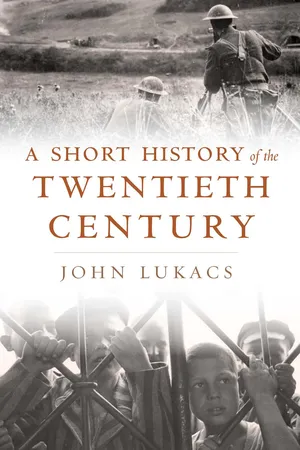
The historian John Lukacs offers a concise history of the twentieth century—its two world wars and cold war, its nations and leaders. The great themes woven through this spirited narrative are inseparable from the author's own intellectual preoccupations: the fading of liberalism, the rise of populism and nationalism, the achievements and dangers of technology, and the continuing democratization of the globe.
The historical twentieth century began with the First World War in 1914 and ended seventy-five years later with the collapse of the Soviet Empire in 1989. The short century saw the end of European dominance and the rise of American power and influence throughout the world. The twentieth century was an American century—perhaps the American century. Lukacs explores in detail the phenomenon of national socialism (national socialist parties, he reminds us, have outlived the century), Hitler's sole responsibility for the Second World War, and the crucial roles played by his determined opponents Churchill and Roosevelt. Between 1939 and 1942 Germany came closer to winning than many people suppose.
Lukacs casts a hard eye at the consequences of the Second World War—the often misunderstood Soviet-American cold war—and at the shifting social and political developments in the Far and Middle East and elsewhere. In an eloquent closing meditation on the passing of the twentieth century, he reflects on the advance of democracy throughout the world and the limitations of human knowledge.
- 230 pages
- English
- ePUB (mobile friendly)
- Available on iOS & Android
eBook - ePub
A Short History of the Twentieth Century
About this book
Information
1
“GOD WRITES STRAIGHT WITH CROOKED LINES”
“Century”—An American century—The German potentiality—Hitler’s primary role—1989 or 1945?—The American superpower presence—Stalin and the retreat of Russian power—The end of colonialism—Recovery and rise of China—The end of the Modern or European Age—From liberal democracy to the universality of popular sovereignty
THERE IS NO SERIOUS HISTORY of the twentieth century that I know of; but my purpose in this book is not quite filling that gap. I lived through much of the twentieth century, and I was a participant in and a historian of a few of its portions. I have devoted much of my life to asserting, teaching, and writing that “objective” and “scientific” history are inadequate desiderata; but so, too, is “subjective” history. Our historical knowledge, like nearly every kind of human knowledge, is personal and participatory, since the knower and the known, while not identical, are not and cannot be entirely separate. We do not possess truth completely. Yet pursue truth we must. So many seemingly endless and incomplete truths about the history of the twentieth century are still worth pursuing, and perhaps forever.
Now, enough of this philosophic premise. Historical knowledge, nay, understanding, depends on description rather than on definition. It consists of words and sentences that are inseparable from “facts”; they are more than the wrapping of facts. “In the beginning was the Word,” and so it will be at the end of the world.
About the term “century”: it had none of its present meaning until around 1650, when it appeared in English and French. Before that, it meant a regiment of one hundred soldiers—in Latin, centuria (related to the term centurion, their commander). That appearance of a new meaning was the mark of an emerging historical consciousness. So was the appearance of words for three historical ages, Ancient, Middle, and Modern. People in the Middle Ages did not know that they were medieval people. They knew that things were changing—some of them for the worse, others for the better—but that was that. The Waning of the Middle Ages, written by the great Dutch historian Johan Huizinga, was published in 1920. Five hundred years before, no one, or only a very few, would have understood what that title meant. Our historical consciousness in many ways and forms had progressed by the twentieth century—so much so, that more and more people are somehow aware that we are living during the waning of the Modern Age. Even more obvious is that the twentieth century also meant the end of the European Age: another main theme, or sub-theme, of the present book. Now add to this (historically, not numerically) that the twentieth century was a short century, seventy-five years, extending from 1914 to 1989, marked by two world wars (probably the last), of which the Communist revolution and state in Russia were a consequence; and then that state too collapsed, in 1989. (The historical nineteenth century lasted longer: ninety-nine years, from the fall of Napoleon in 1815 to the outbreak of the First World War in 1914.)
One more matter. The twentieth century was—an? the?—American century. Such a statement may not surprise many of my readers; but it would have surprised many of those who lived before the First, or even the Second, World War. It should not surprise us to hear or read that 1914–1989 (and now even beyond that) has been an American century, while the nineteenth was largely a British century and the eighteenth a French one. These characterizations allude not only to military strength, naval power, and imperial possessions, but to many other kinds of influences—yet military and naval power mattered above all. The enormous events of the twentieth century, the two mountain ranges that largely determined its landscape, were the two world wars—the Second largely a consequence of the First, and the so-called Cold War almost entirely a consequence of the Second. Without their military alliance with the United States, Britain and Russia, even together, could not have won the Second World War; without America’s entry into the First World War, the British and French might not have won that either, at least not in 1918. But there was more to these alliances than military and sea and air power. They meant the end of the European Age. A few Europeans had recognized this, looking at the world map even before 1914: Europe was but a peninsula of Asia.
The British—mostly their successive governments, but also much of their press—thought they had to have good relations with the United States, accepting its supremacy in some places and ways (though seldom admitting this before 1914). As late as 1895, there was a minor crisis between Washington and London regarding Venezuela. But less than three years later, in 1898, the American decision to go to war against Spain (a war that was provoked by the United States) was supported almost without exception by the British government and the British press. Thereafter, and throughout the twentieth century, there was no instance in which a British government would strongly oppose the United States. During the fifteen years before 1914, American influence on much of British life grew. Sir James Bryce, who served as ambassador to the United States and knew the country well, went so far as to write (in his book The American Commonwealth): “America has in some respects anticipated European nations. She is walking before them along paths which they may probably follow.” Much of this went beyond (or beneath) politics. It involved countless examples of American practices and inventions, especially in the English-speaking countries, but also in many other places throughout the world. Even more important: in 1940, Hitler came close to winning the Second World War. Had it not been for Winston Churchill and Franklin Roosevelt, he may have achieved that.
Meanwhile the British presence and influence in the United States were decreasing. Once the British Isles had been the primary source of immigrants to America, but this stream was diminishing in the fifteen years before 1914—a period when immigration from other European countries was still rapidly growing. Theodore Roosevelt, one of America’s greatest presidents, was aware of this. His advocacy of a New Nationalism was not nationalism as we understand it today; rather, it was stentorian advice to the new arrivals—at that time coming especially from Eastern and Southern Europe—to become Americanized as soon as they could. This Rooseveltian advocacy was more than successful during most of the twentieth century. Nationalism, of course, has various forms and desiderata, one example of this being the United States of America. Going further, and forecasting one main argument of this book, we can say that nationalism (related to but altogether different from old-fashioned patriotism) has been and still is the most popular and populist political sentiment in the twentieth century, almost everywhere.1
“God writes straight with crooked lines”: this is a profound and wise Portuguese proverb. Nonbelievers may find this arguable (I do not), but it does not mean that the course of world history was inevitable. Neither was the history of the United States. History does not consist of endless alternatives—but behind or during or prior to every human event, the actuality is colored by a different potentiality. For example, Germany had the potential to become the greatest power in the twentieth century. Toward the end of his life, Hitler once said that he was “Europe’s last hope.” (Some hope.)2 Yet he did not really think of himself as a European. (Neither did he quite fathom the great dependence of Britain upon the United States.) Near the end of his life, Otto von Bismarck was reputed to have said that the most important factor in the coming twentieth century would be that Americans spoke English.
Still, there was a possibility that Germany could become a dominant power in the world. There were a few, though not many, Englishmen and Scotsmen advocating for a British alliance with Germany (some of them for racial reasons). There was considerable anti-British sentiment among the American people, and among some of their leaders as well, though it did not amount to much in the long run. But when one contemplates the history of Europe, surely before 1945, many actualities could have been different. The impact and influence of Germany—military as well as political, ideological as well as cultural and intellectual, industrial as well as technological—were still increasing in 1900, in 1914, and even after the First World War, which Germany came close to winning (it came even closer to winning the Second World War, at least from 1939 to 1942). But the First World War was almost exclusively a “European War” (the official name given to it by the British government throughout that war). The Second World War was then fought on other continents and across other oceans; but the inclinations of many Americans notwithstanding, the American military and political leaders were correct in deciding early that the Allies’ defeat of Germany must have priority over the American war against Japan that would follow the collapse of Germany. Still, 80 million Germans were ranged against almost 500 million British, Americans, French, and Russians—most decisively in Europe, where it took nearly six years to conquer them.
People in the Far East may argue that the Second World War began not in September 1939 in Poland but in September 1931 in China: in that month, Japanese armies advanced from Manchuria and Korea into China proper, overrunning and occupying its main seaboard cities, penetrating the interior of the country during the next ten years—and eventually leading to war between Japan and the United States. Yet this perspective is insufficient. Japan’s ambition to establish its empire along the Far Eastern Asian mainland had existed before 1931. It was also part and parcel of the movement of anticolonialism, arising here and there before 1931. Much of this was also due to the growing evidence of uneasy sentiments among the British and French and also other European nations that were reluctant to extend or even maintain their role in some of their overseas colonies, most of them acquired during the nineteenth century. More important was that in 1939 another war breaking out in Europe was welcomed by the Japanese.
Here I must insist on the obvious. Both world wars broke out in Europe. The events of 1914, the origins of World War I, the cascade of decisions leading to its outbreak, the various parts played by statesmen and by entire governments have been debated among historians for nearly one hundred years, and even now. Yet the outbreak of World War II was due to one man, Adolf Hitler. Had he not started a second world war in 1939, another war in Europe may have come about years later—perhaps. Had he conquered much of Europe, an American-Japanese war may have come about years later—perhaps. Yet “perhaps” and the extent of a potentiality that exists behind actuality are not the same thing.
With the above in mind, let me ask: Was the twentieth century even shorter than I (and presumably others) now see it? Did it end not in 1989 but already in 1945? I wrote that the historical landscape of the twentieth century was dominated by the enormous mountain ranges of the two world wars. Yet after 1945, the age of world wars was over. Such wars may never occur again. There has been, after all, a change in the very structure of international history. The wars after 1945 have been smaller—but their sizes do not matter much. What matters is that they have more often been wars between nations or tribes than wars between states. The existence of nations preceded the formation of states but the former will survive the latter, creating all kinds of problems.
There were other landmark changes in the history of the world after 1945. Almost all wars were now undeclared. Others were fought mainly by air. The United States had become the only superpower in the world. After 1945, most people (and many Americans) came to think that the political landscape of the world was now marked by two superpowers—one Communist, the other not—wrestling for domination over much of the globe. This was not so. (After General de Gaulle visited the Soviet Union in 1966, he remarked that there was only one superpower in the world: the United States.) But it was not American pressure that led to the dissolution of the Soviet Union. It was the overdue breakup of the Russian Empire, including the ever more obvious nonsense of an international Communism.
Meanwhile, the presence of the United States—perhaps even more than its actual power—grew and grew. The many American military bases around the world shrank in number after 1945, as soldiers were demobilized and sent home, but the Cold War (and other influences) reversed this trend. By 1956 the United States had more than 150 ground, naval, and air bases athwart the globe. That year, the Republican Party’s platform cheered them on, calling for an American military presence “all around the world.” When the Cold War with the Soviet Union came to its end, there were (and still are) more than 900 such bases. There is reason to think that an American president or even a secretary of defense would not be able to list them all. Oddly enough, only a minuscule portion of the American people have ever been wholly aware of this—unlike substantial portions, probably the majorities, of the British or Dutch or Portuguese or French or Italian people, who a century before had been proud or at least in favor of their country’s colonial possessions.
Americans were different. The presence of their bases abroad had little or nothing to do with the natural richness of their colonial possessions, as had been the case with most Europeans. At the same time, most Americans supported the foreign wars that their soldiers fought during the Cold War and after. This was a reasonable choice during the Korean War in 1950–1953, but less so with American military intrusions in the Near East or Vietnam or Iraq; during these involvements, American popular support of costly campaigns waned. A significant symptom of the exceptional nature of the American character was the generous inclination toward recent enemies: the Japanese, Germans, Vietnamese, and so on. Consider, too, the general absence of American self-congratulation when the Soviet Union collapsed, beginning in the 1980s—all of Ronald Reagan’s previous bombastic and nationalistic phrases notwithstanding.
That the Second World War did not debouch into another war between the great powers was also due to the—uneasy—acceptance by the Americans, the British, and continental Europeans of the division of Europe in 1945. (This was also due to Stalin and then to his successors, by their calculations.)
It was also the main reason Stalin avoided a war with the United States. He insisted on ruling most of Eastern Europe—no more than that. Russia had an enormous appetite now, Churchill told de Gaulle in November 1944, “but after the meal comes the digestion period,” with its many troubles. Near the end of his life, Stalin recognized this. In October 1952, he proposed a settlement involving a reciprocal retreat of Soviet and American forces from an eventually reunited and “neutral” Germany (an American-German alliance was one of Stalin’s main fears). He died not long afterward. Soon, Russia began divesting itself of its 1945 conquests. In 1955, it gave up its bases in Austria and Finland (and also its bases in China); it reached a settlement with Yugoslavia. It was stunned and dismayed by the 1956 revolution in Hungary and by the rise of nationalism in Poland. This evolution of a gradual though sometimes interrupted withdrawal of Russian power from Eastern Europe continued until the demise of the Soviet Union in 1989.
Successive American governments and most of the American people were often unwilling to recognize this. In 1959, Nikita Khrushchev, then leader of the Soviet Union, visited the United States to confer with President Dwight Eisenhower. In many ways, he came cap in hand (among other matters, he suggested an American-Russian collaboration against Communist China). The American host—who fourteen years earlier had been one of the more enthusiastic proponents of American friendship with the Soviet Union—received his Russian guest with a sour face and without much interest. By 1952, anti-Communism had become synonymous with American nationalism. An enduring result was the rise of the American “conservative” movement—a political adjective which previously had been unpopular among Americans but which thirty years later many Americans would prefer to “liberal.”
Quite different was the history of the so-called Third World (a very imprecise term) after 1945. Opposition to colonialism was an element in the American credo from the country’s very beginning. It was a powerful though often indirect factor in the rapid decline of the European Age, as Britain, France, Holland, Belgium, Portugal, and Italy gave up their colonial possessions. So did Japan, of course. Before 1945, almost all of Africa was a European colony of one kind or another. Twenty years later, there were practically no European colonies anywhere in that enormous continent—or in Asia. In the Near East after 1920, the Ottoman Empire gave up just about all of its adjacent possessions inhabited by non-Turkish peoples. Since 1990, such a devolution has been discernible even in some of the older parts of the Soviet Union.
But to declare or regard anti- or noncolonialism as part of a worldwide advance of democracy is misleading. During the Cold War, whether affected by it or not, some places of the world, including states and nations in Central and South America, occasionally installed Communist or pro-Communist regimes. Outside the Russian sphere in Europe (except for Yugoslavia), this did not happen. But Cuba—and later other minor, formerly Spanish colonies—were prime examples of such Communist establishments. Sometimes they absurdly recapitulated the pattern in which revolts against colonialism had occurred long after the conclusion of the French revolutionary and Napoleonic wars, mostly after 1815. Their main purpose was the assertion of national independence, though often their motives were more obscure than that.
In Cuba, the principal motive of Fidel Castro and his supporters (as with those of some other dictators in Central and South America) was not Communism but anti-Americanism. It speaks well of the United States that, save for a few brief, small-scale, clandestine episodes, the American government refrained from subduing these agitated and irresponsible governments militarily. Castro and others soon learned that the help they might expect to get from the Soviet Union was less than minimal. In 1962, when Khrushchev agreed to Castro’s frantic requests to furnish Cuba with medium-range rockets (limited in range, and under complete Russian control) against a potential American invasion, a stern American reaction, including a naval blockade, put an end to this largely senseless episode. This Russian presence in the Western Hemisphere faded almost immediately. One of its consequences was the ouster of Khrushchev by his Politburo less than two years later; another was an overall though fitful improvement in American-Soviet relations during the subsequent twenty-five years.
Russia’s relations with China were different, as always. China was not one of the great powers of the world in 1945, though President Roosevelt declared that it was. But as so often before, China, despite its enormous size and population, was something like a geopolitical vacuum. The Japanese now left China for good. Within and outside China, the British were likewise packing up. The Chinese government, under Chiang Kai-shek (whose ultimate defeat ought not to obscure some of his merits and political talents), depended largely on the United States. But in and after 1945, Washington and the American military were preoccupied with what to do and where to stand in the Western Pacific, including the China Sea. They would not be involved, except quite marginally, in a developing Chinese civil war between Chiang’s nationalists and Mao Tse-tung’...
Table of contents
- Cover
- Title Page
- Copyright
- Contents
- 1. “God Writes Straight with Crooked Lines”
- 2. “Now We Have Only Peoples’ Wars”
- 3. “National Self-Determination”
- 4. “Cossacks! Brethren!”
- 5. No Nostalgia for the “World of Yesterday”
- 6. South of the Border and Across the Pacific
- 7. “Middle Class” Is Not “Bourgeois”
- 8. “I Was a Nationalist, but I Was Not a Patriot”
- 9. The Wave of the Future
- 10. “I Hope It Is Not Too Late”
- 11. To Subdue and Conquer Germany and Japan
- 12. The Division of Europe Almost Complete
- 13. The Brave Harry Truman
- 14. American Nationalism, American Benevolence
- 15. “Europe,” and the End of the Cold War
- 16. “Great Leap Forward”
- 17. The Limitations of Human Knowledge
- Index
Trusted by 375,005 students
Access to over 1.5 million titles for a fair monthly price.
Study more efficiently using our study tools.
Frequently asked questions
Yes, you can cancel anytime from the Subscription tab in your account settings on the Perlego website. Your subscription will stay active until the end of your current billing period. Learn how to cancel your subscription
No, books cannot be downloaded as external files, such as PDFs, for use outside of Perlego. However, you can download books within the Perlego app for offline reading on mobile or tablet. Learn how to download books offline
Perlego offers two plans: Essential and Complete
- Essential is ideal for learners and professionals who enjoy exploring a wide range of subjects. Access the Essential Library with 800,000+ trusted titles and best-sellers across business, personal growth, and the humanities. Includes unlimited reading time and Standard Read Aloud voice.
- Complete: Perfect for advanced learners and researchers needing full, unrestricted access. Unlock 1.5M+ books across hundreds of subjects, including academic and specialized titles. The Complete Plan also includes advanced features like Premium Read Aloud and Research Assistant.
We are an online textbook subscription service, where you can get access to an entire online library for less than the price of a single book per month. With over 1.5 million books across 990+ topics, we’ve got you covered! Learn about our mission
Look out for the read-aloud symbol on your next book to see if you can listen to it. The read-aloud tool reads text aloud for you, highlighting the text as it is being read. You can pause it, speed it up and slow it down. Learn more about Read Aloud
Yes! You can use the Perlego app on both iOS and Android devices to read anytime, anywhere — even offline. Perfect for commutes or when you’re on the go.
Please note we cannot support devices running on iOS 13 and Android 7 or earlier. Learn more about using the app
Please note we cannot support devices running on iOS 13 and Android 7 or earlier. Learn more about using the app
Yes, you can access A Short History of the Twentieth Century by John Lukacs in PDF and/or ePUB format, as well as other popular books in History & 20th Century History. We have over 1.5 million books available in our catalogue for you to explore.