The American philosopher Wilfrid Sellars ranks as one of the leading twentieth-century critics of empiricism—a philosophical approach to knowledge that seeks to ground it in human sense experience. Sellars stood in the forefront of a recoil within analytic philosophy from the foundationalist assumptions of contemporary empiricists. From Empiricism to Expressivism is a far-reaching reinterpretation of Sellars from one of the philosopher's most brilliant intellectual heirs.
Unifying and extending Sellars's most important ideas, Robert Brandom constructs a theory of pragmatic expressivism which, in contrast to empiricism, understands meaning and knowledge in terms of the role expressions play in social practices. The key lies in Sellars's radical reworking of Kant's idea of the categories: the idea that the expressive job characteristic of many of the most important philosophical concepts is not to describe or explain the empirical world but rather to make explicit essential features of the conceptual framework that makes description and explanation possible.
Brandom reconciles otherwise disparate elements of Sellars's system, revealing a greater level of coherence and consistency in the philosopher's arguments against empiricism than has usually been acknowledged. From Empiricism to Expressivism clarifies what Sellars had in mind when he talked about moving analytic philosophy from its Humean to its Kantian phase, and why such a move might be of crucial importance today.
eBook - ePub
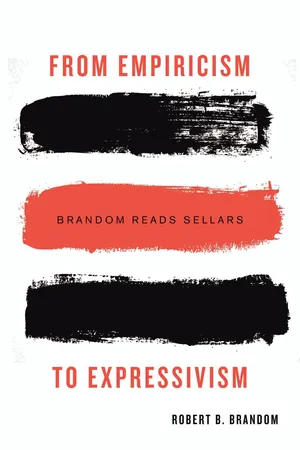
From Empiricism to Expressivism
Brandom Reads Sellars
- 289 pages
- English
- ePUB (mobile friendly)
- Available on iOS & Android
eBook - ePub
About this book
Information
Topic
PhilosophieSubtopic
Épistémologie en philosophieChapter One
Categories and Noumena: Two Kantian Axes of Sellars’s Thought
Part I: On the Way to a Theory of the Categories
1. Introduction
Several decades ago, Richard Rorty suggested that philosophical admirers of Wilfrid Sellars could be divided into two schools, defined by which of two famous passages from his masterwork Empiricism and the Philosophy of Mind are taken to express his most important insight:
In the dimension of describing and explaining the world, science is the measure of all things, of what is that it is, and of what is not that it is not. (§41)
or
[In] characterizing an episode or a state as that of knowing, we are not giving an empirical description of that episode or state; we are placing it in the logical space of reasons, of justifying and being able to justify what one says. (§36)1
The first passage, often called the “scientia mensura,” expresses a kind of scientific naturalism. Its opening qualification is important: there are other discursive and cognitive activities besides describing and explaining. The second passage says that characterizing something as a knowing is one of them. And indeed, Sellars means that in characterizing something even as a believing or a believable, as conceptually contentful at all, one is doing something other than describing it. One is placing the item in a normative space articulated by relations of what is a reason for what. Meaning, for him, is a normative phenomenon that does not fall within the descriptive realm over which natural science is authoritative.
Rorty called those impressed by the scientific naturalism epitomized in the scientia mensura “right-wing Sellarsians” and those impressed by the normative nonnaturalism about semantics expressed in the other passage “left-wing Sellarsians.” Acknowledging the antecedents of this usage, he used to express the hope that right-wing and left-wing Sellarsians would be able to discuss their disagreements more amicably and irenically than did the right-wing and left-wing Hegelians, who, as he put it, “eventually sorted out their differences at a six-month-long seminar called ‘the Battle of Stalingrad.’” According to this botanization, I am, like my teacher Rorty and my colleague John McDowell, a left-wing Sellarsian, by contrast to such eminent and admirable right-wing Sellarsians as Ruth Millikan, Jay Rosenberg, and Paul Churchland.
While I think Rorty’s way of dividing things up is helpful, I want here to explore a different perspective on some of the same issues. I, too, will focus on two big ideas that orient Sellars’s thought. I also want to say that one of them is a good idea and the other one on the whole is a bad idea—a structure that is in common between those who would self-identify as either right- or left-wing Sellarsians. And the one I want to reject is near and dear to the heart of the right-wing. But I want, first, to situate the ideas I’ll consider in the context of Sellars’s neo-Kantianism: they are his ways of working out central ideas of Kant’s. Specifically, they are what Sellars makes of two fundamental ideas that are at the center of Kant’s transcendental idealism: the metaconcept of categories, or pure concepts of the understanding, and the distinction between phenomena and noumena. The latter is a version of the distinction between appearance and reality, not in a light epistemological sense, but in the ontologically weighty sense that is given voice by the scientia mensura. I cannot say that these fall under the headings, respectively, of What Is Living and What Is Dead in Sellars’s thought, since the sort of scientific naturalism he uses to interpret Kant’s phenomena/noumena distinction is undoubtedly very widespread and influential in contemporary Anglophone philosophy. My aim here is threefold: to explain what I take it Sellars makes of these Kantian ideas, why I think the first line of thought is more promising than the second, and the way forward from each that seems to me most worth developing.
When asked what he hoped the effect of his work might be, Sellars said he would be happy if it helped usher analytic philosophy from its Humean into its Kantian phase. (A propos of this remark, Rorty also said, not without justice, that in these terms my own work could be seen as an effort to help clear the way from analytic philosophy’s incipient Kantian phase to an eventual Hegelian one.)2 Sellars tells us that his reading of Kant lies at the center of his work. He used that theme to structure his John Locke lectures, to the point of devoting the first lecture to presenting a version of the Transcendental Aesthetic with which Kant opens the Critique of Pure Reason. Those lectures, published as Science and Metaphysics: Variations on Kantian Themes, are Sellars’s only book-length, systematic exposition of his views during his crucial middle period. The development of Kantian themes is not only self-consciously used to give that book its distinctive shape, but also implicitly determines the contours of Sellars’s work as a whole. I think the best way to think about Sellars’s work is as a continuation of the neo-Kantian tradition. In particular, I think he is the figure we should look to today in seeking an appropriation of Kant’s theoretical philosophy that might be as fruitful as the appropriation of Kant’s practical philosophy that Rawls initiated. On the theoretical side, Sellars was the greatest neo-Kantian philosopher of his generation.3
In fact, the most prominent neo-Kantians of the previous generation, C. I. Lewis and Rudolf Carnap, were among the most immediate influences on Sellars’s thought. Kant was the door through which Lewis found philosophy and, later, the common root to which he reverted in his attempt to reconcile what seemed right to him about the apparently antithetical views of his teachers, William James and Josiah Royce. (Had he instead been trying to synthesize Royce with Dewey, instead of James, he would have fetched up at Hegel.) In his 1929 Mind and the World Order, Lewis introduced as a central technical conception the notion of the sensory “Given,” which Sellars would famously use (characteristically, without mentioning Lewis by name) as the paradigm of what he in EPM called the “Myth of the Given.” (Indeed, shortly after his 1946 An Analysis of Knowledge and Valuation, which Sellars also clearly has in mind in EPM, Lewis wrote a piece addressing the question “Is the Givenness of the Given Given?” His answer was No: It is a necessary postulate of high philosophical theory, which dictates that without a sensory Given, empirical knowledge would be impossible.)
We shall see in subsequent chapters that Sellars modeled his own Kantian “metalinguistic” treatments of modality and the ontological status of universals explicitly on ideas of Carnap. Although, like Lewis, Carnap is not explicitly mentioned in EPM, his presence is registered for the philosophical cognoscenti Sellars took himself to be addressing there by the use of the Carnapian term “protocol sentence” (as well as Schlick’s “Konstatierung”) for noninferential observations. Unlike Lewis, Carnap actually stood in the line of inheritance of classical nineteenth-century German neo-Kantianism. His teacher, Bruno Bauch, was (like Heidegger) a student of Heinrich Rickert in Freiburg—who, with the older Wilhelm Windelband, led the Southwest or Baden neo-Kantian school. In spite of these antecedents, Bauch was in many ways closer to the Marburg neo-Kantians, Hermann Cohen and Paul Natorp, in reading Kant as first and foremost a philosopher of the natural sciences, mathematics, and logic. I suppose that if one had asked Carnap in what way his own work could be seen as a continuation of the neo-Kantian tradition of his teacher, he would first have identified with this Marburg neo-Kantian understanding of Kant, and then pointed to the logical element of his logical empiricism—itself a development of the pathbreaking work of Frege, Bauch’s friend and colleague at Jena when Carnap studied with both there—as giving a precise and modern form to the conceptual element in empirical knowledge, which deserved to be seen as a worthy successor to Kant’s own version of the conceptual.
If Lewis and Carnap do not immediately spring to mind as neo-Kantians, that is because each of them gave Kant an empiricist twist, which Sellars was concerned to undo. If you thought that Kant thought that the classical empiricists’ Cartesian understanding of the sensory contribution to knowledge was pretty much all right, and just needed to be supplemented by an account of the independent contribution made by a conceptual element, you might well respond to the development of the new twentieth-century logic with a version of Kant that looks like Lewis’s Mind and the World Order and An Analysis of Knowledge and Valuation, and Carnap’s Aufbau (and for that matter, Nelson Goodman’s Structure of Appearance). That assumption about Kant’s understanding of the role played by sense experience in empirical knowledge is exactly what Sellars challenges in EPM.
One of the consequences of his doing that is to make visible the neo-Kantian strand in analytic philosophy that Lewis and Carnap each, in his own way, represented—and which Sellars and, in our own time, John McDowell further developed. Quine was a student of both Lewis and Carnap, and the Kantian element of the common empiricism he found congenial in their thought for him drops out entirely—even though the logic remains. His Lewis and his Carnap are much more congenial to a narrative of the history of analytic philosophy initiated by Bertrand Russell and G. E. Moore, according to which the movement is given its characteristic defining shape as a recoil from Hegel (seen through the lenses of the British Idealism of the waning years of the nineteenth century). They understood enough about the Kantian basis of Hegel’s thought to know that a holus bolus rejection of Hegel required a diagnosis of the idealist rot as having set in already with Kant. This narrative does pick out one current in the analytic river—indeed, the one that makes necessary the reappropriation of the metaconceptual resources of Kant’s theoretical philosophy in the late twentieth and early twenty-first centuries. But it was never the whole story.4 The neo-Kantian tradition comprising Lewis, Carnap, and Sellars can be thought of as an undercurrent, somewhat occluded from view by the empiricist surface.
2. Categories in Kant
Many Kantian themes run through Sellars’s philosophy. I am going to focus on two master-ideas, each of which orients and ties together a number of otherwise apparently disparate aspects of his work. The first is the idea that besides concepts whose characteristic expressive job it is to describe and explain empirical goings-on, there are concepts whose characteristic expressive job it is to make explicit necessary structural features of the discursive framework within which alone description and explanation are possible. Failing to acknowledge and appreciate this crucial difference between the expressive roles different bits of vocabulary play is a perennial source of distinctively philosophical misunderstanding. In particular, Sellars thinks, attempting to understand concepts doing the second, framework-explicating sort of work on the model of those whose proper use is in empirical description and explanation is a fount of metaphysical and semantic confusion.5 Among the vocabularies that play the second sort of role, Sellars includes modal vocabulary (not only the alethic, but also the deontic species), semantic vocabulary, intentional vocabulary, and ontological-categorial vocabulary (such as ‘proposition’, ‘property’ or ‘universal’, and ‘object’ or ‘particular’). It is a mistake, he thinks, to understand the use of any of these sorts of vocabulary as fact-stating in the narrow sense that assimilates it to describing how the world is. It is a corresponding mistake to recoil from the metaphysical peculiarity and extravagance of the kinds of facts one must postulate in order to understand statements couched in these vocabularies as fact-stating in the narrow sense (e.g. normative facts, semantic facts, conditional facts, facts about abstract universals) by denying that such statements are legitimate, or even that they can be true. (Though to say that they are true is not, for Sellars, to describe them.) Both mistakes (the dogmatic metaphysical and the skeptical), though opposed to one another, stem from the common root of the descriptivist fallacy. That is the failure to see that some perfectly legitimate concepts do not play a narrowly descriptive role, but rather a different, explicative one with respect to the practices of description and explanation. Following Carnap, Sellars instead analyzes the use of all these kinds of vocabulary as, each in its own distinctive way, “covertly metalinguistic.”
In opposing a Procrustean descriptivism about the expressive roles locutions can play, Sellars makes common cause with the later Wittgenstein. For Wittgenstein, too, devotes a good deal of effort and attention to warning us of the dangers of being in thrall to (“bewitched by”) a descriptivist picture. We must not simply assume that the job of all declarative sentences is to state facts (“I am in pain,” “It is a fact that . . .”), that the job of all singular terms is to pick out objects (“I think . . .”), and so on. In addition to tools for attaching, detaching, and in general reshaping material objects (hammer and nails, saws, draw-knives, . . .), the carpenter’s tools also include plans, a foot-rule, level, pencil, and toolbelt. So, too, with discursive expressive stoolss. Wittgenstein’s expressive pluralism (language as a motley) certainly involves endorsement of the anti-descriptivism Sellars epitomizes by saying
[O]nce the tautology ‘The world is described by descriptive concepts’ is freed ...
Table of contents
- Cover
- Title Page
- Copyright
- Dedication
- Contents
- Title Abbreviations
- Introduction
- 1. Categories and Noumena: Two Kantian Axes of Sellars’s Thought
- 2. The Centrality of Sellars’s Two-Ply Account of Observation to the Arguments of Empiricism and the Philosophy of Mind
- 3. Pragmatism, Inferentialism, and Modality in Sellars’s Arguments against Empiricism
- 4. Modality and Normativity: From Hume and Quine to Kant and Sellars
- 5. Modal Expressivism and Modal Realism: Together Again
- 6. Sortals, Identity, and Modality: The Metaphysical Significance of the Modal Kant-Sellars Thesis
- 7. Sellars’s Metalinguistic Expressivist Nominalism
- Credits
- Index
Trusted by 375,005 students
Access to over 1.5 million titles for a fair monthly price.
Study more efficiently using our study tools.
Frequently asked questions
Yes, you can cancel anytime from the Subscription tab in your account settings on the Perlego website. Your subscription will stay active until the end of your current billing period. Learn how to cancel your subscription
No, books cannot be downloaded as external files, such as PDFs, for use outside of Perlego. However, you can download books within the Perlego app for offline reading on mobile or tablet. Learn how to download books offline
Perlego offers two plans: Essential and Complete
- Essential is ideal for learners and professionals who enjoy exploring a wide range of subjects. Access the Essential Library with 800,000+ trusted titles and best-sellers across business, personal growth, and the humanities. Includes unlimited reading time and Standard Read Aloud voice.
- Complete: Perfect for advanced learners and researchers needing full, unrestricted access. Unlock 1.5M+ books across hundreds of subjects, including academic and specialized titles. The Complete Plan also includes advanced features like Premium Read Aloud and Research Assistant.
We are an online textbook subscription service, where you can get access to an entire online library for less than the price of a single book per month. With over 1.5 million books across 990+ topics, we’ve got you covered! Learn about our mission
Look out for the read-aloud symbol on your next book to see if you can listen to it. The read-aloud tool reads text aloud for you, highlighting the text as it is being read. You can pause it, speed it up and slow it down. Learn more about Read Aloud
Yes! You can use the Perlego app on both iOS and Android devices to read anytime, anywhere — even offline. Perfect for commutes or when you’re on the go.
Please note we cannot support devices running on iOS 13 and Android 7 or earlier. Learn more about using the app
Please note we cannot support devices running on iOS 13 and Android 7 or earlier. Learn more about using the app
Yes, you can access From Empiricism to Expressivism by Robert B. Brandom,Robert B. Brandom in PDF and/or ePUB format, as well as other popular books in Philosophie & Épistémologie en philosophie. We have over 1.5 million books available in our catalogue for you to explore.