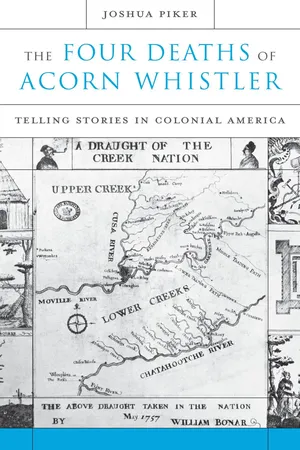
Who was Acorn Whistler, and why did he have to die? A deeply researched analysis of a bloody eighteenth-century conflict and its tangled aftermath, The Four Deaths of Acorn Whistler unearths competing accounts of the events surrounding the death of this Creek Indian. Told from the perspectives of a colonial governor, a Creek Nation military leader, local Native Americans, and British colonists, each story speaks to issues that transcend the condemned man's fate: the collision of European and Native American cultures, the struggle of Indians to preserve traditional ways of life, and tensions within the British Empire as the American Revolution approached.
At the hand of his own nephew, Acorn Whistler was executed in the summer of 1752 for the crime of murdering five Cherokee men. War had just broken out between the Creeks and the Cherokees to the north. To the east, colonists in South Carolina and Georgia watched the growing conflict with alarm, while British imperial officials kept an eye on both the Indians' war and the volatile politics of the colonists themselves. They all interpreted the single calamitous event of Acorn Whistler's death through their own uncertainty about the future. Joshua Piker uses their diverging accounts to uncover the larger truth of an early America rife with violence and insecurity but also transformative possibility.
- 310 pages
- English
- ePUB (mobile friendly)
- Available on iOS & Android
eBook - ePub
About this book
Information
Prologue
APRIL 1, 1752
THE DAY’S VIOLENCE was unexpected and thus all the more shocking. “About an hour before sunset,” twenty-six Creeks fired on a party of twelve Cherokees. Initial reports that the Creeks “have Killed every one of them” or that “Ten . . . are destroyed” were wrong, but the carnage was still appalling. The attack clearly took the Cherokees by surprise. Three were killed “at the first volley; the rest fled, one of which was killed in the Chace, and one taken Prisoner”; at least two Cherokees were wounded. Later reports suggest that a fifth Cherokee died, and since there is no record of the prisoner ever being returned, he likely died as well. The numbers alone, moreover, cannot convey the brutality of the attack. A colonist who overheard the Creek barrage soon found “the head of an Indian lying in the road and near the side of it saw the body of an Indian lying.” Another colonist reported that “one old Man had his Throat cut,” while a second victim “was shot thro’ the body, and his Head was cut off.” All were “scalp’d.” Twelve days afterward, one colonist labeled the incident a “Skirmish,” but most adopted the term South Carolina officials were using by 9 p.m. on April 1: “murder.”1
As brutal as the attack was, however, its location was worse. This was no frontier dust-’em-up, no ambush in the woods. Consider this: the Cherokee party was heading north, and the Creeks struck from “behind,” that is, from the south. If the Cherokees turned around at the sound of the Creeks’ guns, the last thing they might have seen—besides the onrushing Creeks, of course—was the setting sun glinting off St. Philips Church, “the most elegant Religious Edifice in British America.”2 The Cherokees were, in other words, “within the Sight of Charles Town,” in the heart of British South Carolina, on “The High Way” that ran up a narrow peninsula linking the colony’s capital city to the mainland. South Carolina Governor James Glen had a penchant for hyperbole, but no one—Indian or colonist—quarreled with his assertion that “the Murder” happened “in the very Face of this Government . . . and, in a manner, in our Arms!” The more phlegmatic colonists labeled the attack an “insult” and “outrage,” while the more melodramatic spoke of “the Heinousness of the Crime” that was “done in open Defiance and Contempt of the English.” The Cherokees had no trouble agreeing, telling Glen that “your broad Path is sprinkled with the Blood of our People”; “the Mischief done . . . at his Excellency’s Door” demonstrated, they said, that “the Creeks think Nothing” of the governor. Even Creeks came to recognize that the “Blood . . . spilt at your very Gates” was an “Insult and Injury” that “could not well be greater,” an “Evil” that could not be ignored.3
And, in fact, the site of the attack was even more inflammatory than that. Think of those Cherokees facing north. When the Creeks attacked from the south and the Cherokees whirled around, did they turn to the right or the left? We cannot know, of course, but if they turned right, the first thing they might have seen—even before the Creeks—was Belvedere, Governor Glen’s mansion. The attack took place less than “half a mile” from “Your Excellency’s gate,” close enough that his gravely ill wife surely heard the shots. Perhaps the Cherokees were not speaking metaphorically when they claimed that their people were killed “close by his Door”? Glen, who arrived home after the attack, awoke very early the next morning—he had summoned his council to a 7 a.m. meeting—to the news “that there were several bodys of Dead Indians . . . lying on the Path.” The dead Cherokees were almost certainly on the land of Artimus Elliott, Glen’s neighbor and a member of one of the colony’s “great rice-planting families.” And the living? They were seen a mile or two north, on the “Plantation” of Joseph Wragg, a recently deceased “eminent Merchant” and longtime “Member of his Majesty’s Council.”4 This was an exclusive neighborhood in which to stage a massacre.
Worse than the violence of the attack, though, and worse than the incongruity of its location, was the fact that all involved had taken steps to avoid just this sort of incident. The Creeks and Cherokees were at war in 1752, but these Creeks had been warned—explicitly, publicly, repeatedly—not to harm these Cherokees, and these Creeks had promised—explicitly, publicly, repeatedly—that these Cherokees were safe. The Creek and Cherokee parties first met by accident in Charleston on March 29. The Creeks had arrived the day before and were “encamped” by “the old School-House,” where the Cherokees also intended to stay. This “Accident” almost “produced very ill Consequence,” according to Glen, “for the Creeks seeing [the Cherokees] coming in imagined, I suppose, that they were coming to attack them and immediately took to their Arms.” They “were on the very Point of firing on the Cherokees” when colonists intervened and “with much ado . . . prevented . . . Bloodshed.”5
Two days later, on March 31, Glen met with the Creeks in the council chambers. He told them that “the Cherokees are our Friends, so that the killing any of them in our Settlements is the same as killing any of us” and “a Thing we could not have put up with.” The Creeks’ response reassured Glen: “they had made Peace with them and . . . they had Eat and Drank with them and exchanged Blankets and Smoaked together and shaken Hands.” Glen knew enough of Indian diplomacy to recognize that exchanging food and clothes and sharing tobacco represented a powerful statement of goodwill. “In fine,” he said, the Creeks “looked upon” the Cherokees “as Brothers, and gave me the strongest Assurances that they would not touch them.” Better yet, the Creeks “promised” to end the ongoing Creek-Cherokee war by making “the Peace general, when they went home.” Glen, in turn, told the Cherokees “that they might depend on it, that the Creeks would not hurt them.” Given the bloody events of the following afternoon, it is not hard to see why Glen would later begin a story about April 1, 1752, by remarking, “But will you believe it, Friends and Brothers, or can you think it possible, what we are now to tell you?”6
The spokesman for the Creek party—the man who made all those pretty promises—was Acorn Whistler, a head warrior from the Creek town of Little Okfuskee. Four and a half months later he was dead, executed by his fellow Creeks to make amends for the April 1 attack. Beginning immediately after his mid-August execution, Creeks and Britons talked incessantly about Acorn Whistler’s guilt and the meaning of his death, a conversation that only ended in the summer of 1753 when a new crisis pushed the Acorn Whistler affair into the background. Prior to that point, though, stories about Acorn Whistler made the rounds in Creek country, the British colonies, and Great Britain.
People interested in ending the Creek-Cherokee war sought to use the April 1 attack as an example of warfare’s horrors and Acorn Whistler’s execution as evidence of the Creek desire for peace. Other people, especially those personally connected to Acorn Whistler, instanced his execution as proof of their eagerness to resume relations with the groups victimized by the attack. Still others saw Acorn Whistler’s execution as a chance not to renew old political ties but to create new ones, either by remaking their own society or by repositioning themselves within their societies’ hierarchies of wealth and status. Whatever their goals, though, all of these people found it necessary to tell stories about Acorn Whistler’s death. And whatever their goals, no one—not even Acorn Whistler’s kinsmen and townspeople—took it upon themselves to use their story to defend his innocence. Generations of historians, taking their cue from the unanimity among Acorn Whistler’s contemporaries, have blamed him for the April 1 attack.7 In so doing, these scholars have unwittingly joined an old conversation, a centuries-long discussion that features the regular retelling of stories about Acorn Whistler. That these stories shape our histories more than two and a half centuries later tells us a great deal about their power, but the stories themselves tell us almost nothing about either what happened on April 1, 1752, or why Acorn Whistler had to die. There were, it turns out, many reasons to execute Acorn Whistler, but no one at the time truly believed that he died because he was responsible for the April 1 attack.
Consider, for example, that neither Acorn Whistler nor his followers were present when the Cherokees were killed. At the time of the attack, Acorn Whistler was, in his words, “about the town drinking.” Moreover, he said, “our People were scattered here and there, and some on board of Ships” in Charleston’s harbor. No one disputed these points; nor did they object when Acorn Whistler distinguished “our people” from “they” who “did it of themselves.” Everyone knew from the very beginning that the attackers were all Lower Creeks. Acorn Whistler, by contrast, was an Upper Creek, as were his eleven followers. He was, then, on very firm ground when he declared “[t]his was done by the Lower Creeks and not by me.”8
Better still for Acorn Whistler, he was not the Lower Creeks’ leader. In fact, he barely knew them. The Upper and Lower Creek parties had traveled separately from Creek country to South Carolina, meeting by accident sixty miles from Charleston while both were visiting Sheldon, Lieutenant Governor William Bull’s plantation. Acorn Whistler may then have persuaded the Lower Creeks to accompany his people, and he spoke for the joint party when they arrived in Charleston. But he was not granted leadership over the Lower Creeks until after April 1, 1752. That dubious honor was foisted on him as a post hoc promotion designed to smooth over plot problems in postmortem stories.9
Consider, as well, that neither Acorn Whistler nor his Upper Creek followers believed themselves to blame for the violence. In the aftermath of the attack, the Upper Creeks were, in their words, “very much scared” but did not act as if they were guilty, while the Lower Creeks were quite obviously guilty but not scared, or at least not for long. Thus, after killing the Cherokees, all the Lower Creeks immediately fled, leaving Charleston at such “a prodigious Rate” that militia dispatched four hours later to “go in pursuit” never caught up with them. Once safely away from Charleston, however, the Lower Creeks concluded the heat was off. They stopped at planter Henry de Sausseur’s home on April 3 and stayed until April 6. While there, they bragged of attacking the Cherokees, offered to sell their prisoner for eight bottles of rum, and “express[ed] no manner of fear that they should be pursued.”10
Acorn Whistler and all of his Upper Creeks, by contrast, remained in Charleston for almost twenty-four hours. While there, the Upper Creeks “utterly” denied “all Knowledge of the proceedings of ye Lower People.” Of course, “they appeared all very much Concerned,” but they did not flee until after meeting with Governor Glen in the afternoon of April 2. At that session, the Upper Creeks became alarmed when Glen stated that they would be disarmed and imprisoned until his suspicions were allayed; the colonists outside the room opining that “they all ought to be hanged” did nothing to ease the Upper Creeks’ minds. And so, after leaving the council chamber, all the Upper Creeks but one took to their heels. Four men who stopped at Mary Surreau’s Ashley Ferry house were captured that night, taken back to Charleston, admonished by Glen, and then released; three men and two women headed west to Pon Pon, where they rejoined those captured at the ferry. And one man simply disappeared.11
For his part, Acorn Whistler first went to ground for a week and then straggled into Lieutenant Governor Bull’s house alone and “almost starved with Hunger and Cold.” After receiving “Victuals and some Cloaths,” he rejoined his Upper Creek party, but not before promising he would “hunt in those Parts, and then would return to Charles Town.” He never did. Perhaps he learned from his people that there was no reason to do so? After all, Glen had told the Upper Creeks captured at the ferry that “if you should meet Acorn Whistler you should laugh at him for his Fear.” He need not have run off because “[t]he English never punish the Innocent with the Guilty” and “never intend[ed] to resent upon the Upper Creeks the injuries done by the Lower Creeks only.” Acorn Whistler’s flight, then, had not changed Glen’s conclusion about “the Upper Creeks,” whose “Conduct has not only been blameless but commendable.”12
That does not mean, of course, that Acorn Whistler was a saint. True, after his execution, a fellow Creek called him “as great a Man and Warriour as any in their Nation,” and in his lifetime he was described as a “King” with seven towns under his “command” whose “love [of] Peace” had earned him the name “White King.” But the details of Acorn Whistler’s life belie those rosy assessments. He drank, sometimes to excess. He used violence as a political tool, frequently to excess. He was a relentless self-promoter, invariably to excess. In fact, the only person to claim that Acorn Whistler was a “White King” who ruled over seven towns was Acorn Whistler himself, and it is worth noting that in Acorn Whistler’s Muskogee language only one letter separates lak.cv [acorn] from lak.sv [liar].13 Those wishing to blame him for the assault, therefore, have some evidence at their disposal.
Acorn Whistler, for example, certainly knew of the Lower Creeks’ plan prior to the attack. Under close questioning by Glen on April 2, Acorn Whistler first claimed ignorance of what the Lower Creeks had intended but then acknowledged “They asked me the Night before if I would joyn them,” information that he neglected to pass along to the British because “I was very lame in my Knee. The Indians kicked me and I could not walk, and I was drunk as well as they.” Besides, he said, “I did not think they would have done it after I refused it.” Glen was unimpressed. “I am surprised how he can contradict himself so. . . . There is a great Difference betwixt saying that one forgot a Thing and of never knowing any Thing about it.” Glen had a point, but it is also true that it is one thing to hear of a plan from drunken men while you yourself are drunk; it is something else entirely to participate in that plan while you are sober. And when Acorn Whistler sobered up, not only did he decline to participate in the attack but “as soon as I found” the Lower Creeks “were a going,” he realized his refusal to join them had not scotched their plans; “I then run away & told the Interpreter” that the Cherokees were in danger. In other words, he did not exactly keep the Lower Creeks’ secret under his hat.14
More damning, though, is the possibility that Acorn Whistler’s involvement in the attack went beyond prior knowledge of Lower Creek plans. The assault may have been his idea. Or at least that is what Hiacpellechi, one of the Lower Creek attackers, claimed four months later: “Acorn Whistler was the Cause of all the Mischief that was done. . . . [I]t was by his Orders that they feigned a Peace with the Cherokees and when they went out of Town he told them that it would be good to kill them.” Hiacpellechi’s story, however, is shot through with lies and at least one half-truth. And, of equal importance, Hiacpellechi would have taken the rap if Acorn Whistler did not. As a kinswoman told him, “You too was one that was the Occasion of all this Disturbance, and . . . some of you must suffer Death for it.” She cautioned that “you had better tell the Truth,” but who could blame him for interpreting that advice as “Lie or die”? In other words, Hiacpellechi was not exactly an unimpeachable witness.15
Of course, less reliable people than Hiacpellechi have sent better men than Acorn Whistler to their deaths, and sometimes those deaths were well deserved. That does not seem to have been the case with Acorn Whistler, however. He was guilty of bad judgment, bad luck, bad timing, and perhaps even bad faith, but not murder. It is clear, in fact, that he became a scapegoat. The initial failure to tell Glen of the Lower Creeks’ plans. The possible involvement in hatching those plans. The dead Cherokees at Glen’s door. The shifting alibi. The flight from Charleston. The week spent in hiding. The failure to return to Charleston. There was just enough there—in the right light with the right spin from the right hands—to cost Acorn...
Table of contents
- Cover
- Title Page
- Copyright
- Dedication
- Contents
- Prologue: April 1, 1752
- Introduction: Acorn Whistler and the Storytellers
- Part I. Imperial
- Part II. National
- Part III. Local
- Part IV. Colonial
- Epilogue: June 5, 1753
- Abbreviations
- Notes
- Acknowledgments
- Index
Trusted by 375,005 students
Access to over 1.5 million titles for a fair monthly price.
Study more efficiently using our study tools.
Frequently asked questions
Yes, you can cancel anytime from the Subscription tab in your account settings on the Perlego website. Your subscription will stay active until the end of your current billing period. Learn how to cancel your subscription
No, books cannot be downloaded as external files, such as PDFs, for use outside of Perlego. However, you can download books within the Perlego app for offline reading on mobile or tablet. Learn how to download books offline
Perlego offers two plans: Essential and Complete
- Essential is ideal for learners and professionals who enjoy exploring a wide range of subjects. Access the Essential Library with 800,000+ trusted titles and best-sellers across business, personal growth, and the humanities. Includes unlimited reading time and Standard Read Aloud voice.
- Complete: Perfect for advanced learners and researchers needing full, unrestricted access. Unlock 1.5M+ books across hundreds of subjects, including academic and specialized titles. The Complete Plan also includes advanced features like Premium Read Aloud and Research Assistant.
We are an online textbook subscription service, where you can get access to an entire online library for less than the price of a single book per month. With over 1.5 million books across 990+ topics, we’ve got you covered! Learn about our mission
Look out for the read-aloud symbol on your next book to see if you can listen to it. The read-aloud tool reads text aloud for you, highlighting the text as it is being read. You can pause it, speed it up and slow it down. Learn more about Read Aloud
Yes! You can use the Perlego app on both iOS and Android devices to read anytime, anywhere — even offline. Perfect for commutes or when you’re on the go.
Please note we cannot support devices running on iOS 13 and Android 7 or earlier. Learn more about using the app
Please note we cannot support devices running on iOS 13 and Android 7 or earlier. Learn more about using the app
Yes, you can access The Four Deaths of Acorn Whistler by Joshua Piker in PDF and/or ePUB format, as well as other popular books in History & Early American History. We have over 1.5 million books available in our catalogue for you to explore.