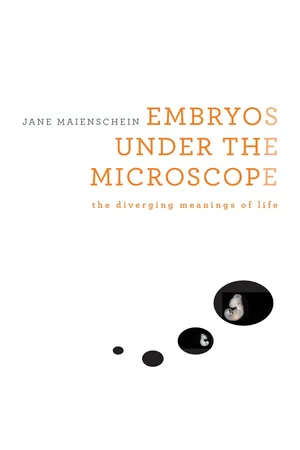
Too tiny to see with the naked eye, the human embryo was just a hypothesis until the microscope made observation of embryonic development possible. This changed forever our view of the minuscule cluster of cells that looms large in questions about the meaning of life. Embryos under the Microscope examines how our scientific understanding of the embryo has evolved from the earliest speculations of natural philosophers to today's biological engineering, with its many prospects for life-enhancing therapies. Jane Maienschein shows that research on embryos has always revealed possibilities that appear promising to some but deeply frightening to others, and she makes a persuasive case that public understanding must be informed by up-to-date scientific findings.
Direct observation of embryos greatly expanded knowledge but also led to disagreements over what investigators were seeing. Biologists confirmed that embryos are living organisms undergoing rapid change and are not in any sense functioning persons. They do not feel pain or have any capacity to think until very late stages of fetal development. New information about DNA led to discoveries about embryonic regulation of genetic inheritance, as well as evolutionary relationships among species. Scientists have learned how to manipulate embryos in the lab, taking them apart, reconstructing them, and even synthesizing—practically from scratch—cells, body parts, and maybe someday entire embryos. Showing how we have learned what we now know about the biology of embryos, Maienschein changes our view of what it means to be alive.
- 111 pages
- English
- ePUB (mobile friendly)
- Available on iOS & Android
eBook - ePub
About this book
Information
Index
AAAS (American Association for the Advancement of Science), 199, 254
abortion: social climate, 10–11, 155–156, 158–161; state regulation of, 14–15, 157–158, 282; Catholic views on, 21; and contraception, 154, 158–161. See also Roe v. Wade
achromatic microscopes, 42–43
ACT (Advanced Cell Technology), 203, 231–233
adult stem cells: hematopoietic stem cells, 102–103, 190, 204, 235; defined, 226, 235; compared to embryonic, 235, 244, 245; difficulty locating, 235–236; therapies, 236; research funding, 237, 244–245
Advanced Cell Technology (ACT), 203, 231–233
Aequorea victoria, 137
Akin, Todd, 10, 11
alleles, 112
Allen, Garland, 66, 81
Amblystoma (Ambystoma), 60
American Association for the Advancement of Science (AAAS), 199, 254
American Recovery and Reinvestment Act (ARRA, 2009), 248, 249
American Society for Cell Biology, 54
American Society for Reproductive Medicine, 174
American Society of Zoologists, 190
“Amphibians, In Analysis of Development” (Holtfreter), 91
animals, as proxy for humans, 193
antirejection drugs, 103
apoptosis, 186
applications of research, 220–225, 248, 255, 272
Archiv für Entwickelungsmechanik (Roux), 68
Aristotle, 2, 23, 29, 31–35, 36, 69
ARRA (American Recovery and Reinvestment Act), 248, 249
artificial insemination, 152
artificial parthenogenesis, 16, 80
Asilomar conference, 169
Association for Molecular Pathology, et al. v. Myriad Genetics, Inc., et al., 260
Atlas of Fertilization and Karyokinesis of the Ovum (Wilson), 51–53
Augustine, Saint, 20
Bacon, Francis, 272
Baluch, Mary Spaulding, 286
Barnard, Christian, 103
Barry, Martin, 42
basic science, 67, 220–222, 280, 286
Bateson, William, 113
battery-type models, 129–130
Bayh-Dole Act, 217
Bell, Eugene, 188
Bell Center for Regenerative Biology and Tissue Engineering, 188, 189
beta cells, 265
biodiversity, preservation of, 203–204
bioethics: influence of biology on, 161, 276–277; mechanistic conception of, 183; chimeras, 192–194; cloning, 198–200, 201–202; stem cell research, 202–203, 229–231, 237–238; genetic engineering, 209–210; in vitro fertilization, 230; federal organizations, 242, 243, 255; ethical principles, 255–256; synthetic biology, 255–256, 257, 267, 270–271
biogenetic law, 46–48
Biological Bulletin (Marine Biological Laboratory), 83
Biological Lectures (Marine Biological Laboratory), 83
biological sciences, 161, 166–167, 172, 204. See also synthetic biology
Biomedical Systems Research Institute (proposed), 224
biomimetic devices, 265–266
bioreactors, 261
birth control, 153–155, 158–161
Blackburn, Elizabeth H., 187
Blackmun, Harry, 156
blastocyst stage, 5, 6, 146–148, 151, 205, 227, 275
blastomeres, 6, 190
blastula stage, 125, 126
blood circulation, 35–36, 51
blood vessels, stem cells from, 264
bone marrow, stem cells from: hematopoietic stem cells, 102–103, 190, 204, 235; in adult stem cell therapies, 236; in synthetic transplants, 261, 262
bone marrow transplants, 103
Bonner, John Tyler, 185
Bonnet, Charles, 37–38
Boston Herald, 182
“bottom-up” synthetic biology approach, 256
Boveri, Theodor, 75–76, 77, 115, 116
Brachet, Jean, 184
Brenner, Sydney, 58
Briggs, Robert, 123–125, 225
“Bringing them Back to Life” (Zimmer), 204
British Human Fertilisation and Embryology Authority, 194
Britten, Roy J., 128–132
Broun, Paul, 11
Brown, Lesley, 145
Brown, Louise, 145, 151
Brüstle, Oliver, 259
Bryn Mawr, 177
Burdach, Karl Friedrich, 39–40
Burrows, Montrose, 95
Bush, George W., 223, 242, 243, 248–249, 278
Bush, Vannevar, 218–219, 221
Caenorhabditis elegans, 58
California, 225, 232
Campbell, Keith, 195, 197–198
Canada, 194
canalizat...
Table of contents
- Cover
- Half Title
- Title Page
- Copyright
- Contents
- Preface
- One: Recurring Questions, Seeing and Believing
- Two: Hypothetical and Observed Embryos with Microscopes at Work
- Three: Experimental Embryos in the Laboratory
- Four: Inherited, Evolved, and Computed Embryos
- Five: The Visible Human Embryo
- Six: The Idea of Engineered and Constructed Embryos
- Seven: Constructing Embryos for Society, Stem Cells in Action
- Eight: Constraints and Opportunities for Construction
- Therefore …
- Notes
- Acknowledgments
- Index
Trusted by 375,005 students
Access to over 1.5 million titles for a fair monthly price.
Study more efficiently using our study tools.
Frequently asked questions
Yes, you can cancel anytime from the Subscription tab in your account settings on the Perlego website. Your subscription will stay active until the end of your current billing period. Learn how to cancel your subscription
No, books cannot be downloaded as external files, such as PDFs, for use outside of Perlego. However, you can download books within the Perlego app for offline reading on mobile or tablet. Learn how to download books offline
Perlego offers two plans: Essential and Complete
- Essential is ideal for learners and professionals who enjoy exploring a wide range of subjects. Access the Essential Library with 800,000+ trusted titles and best-sellers across business, personal growth, and the humanities. Includes unlimited reading time and Standard Read Aloud voice.
- Complete: Perfect for advanced learners and researchers needing full, unrestricted access. Unlock 1.5M+ books across hundreds of subjects, including academic and specialized titles. The Complete Plan also includes advanced features like Premium Read Aloud and Research Assistant.
We are an online textbook subscription service, where you can get access to an entire online library for less than the price of a single book per month. With over 1.5 million books across 990+ topics, we’ve got you covered! Learn about our mission
Look out for the read-aloud symbol on your next book to see if you can listen to it. The read-aloud tool reads text aloud for you, highlighting the text as it is being read. You can pause it, speed it up and slow it down. Learn more about Read Aloud
Yes! You can use the Perlego app on both iOS and Android devices to read anytime, anywhere — even offline. Perfect for commutes or when you’re on the go.
Please note we cannot support devices running on iOS 13 and Android 7 or earlier. Learn more about using the app
Please note we cannot support devices running on iOS 13 and Android 7 or earlier. Learn more about using the app
Yes, you can access Embryos under the Microscope by Jane Maienschein in PDF and/or ePUB format, as well as other popular books in Biowissenschaften & Gynäkologie, Geburtshilfe & Hebammen. We have over 1.5 million books available in our catalogue for you to explore.