In the most crucial phase of the Second World War, German troops, fighting in regions as far apart as the Sahara and the Caucasus, confronted the Allies across lands largely populated by Muslims. Nazi officials saw Islam as a powerful force with the same enemies as Germany: the British Empire, the Soviet Union, and the Jews. Islam and Nazi Germany's War is the first comprehensive account of Berlin's remarkably ambitious attempts to build an alliance with the Islamic world.
Drawing on archival research in three continents, David Motadel explains how German officials tried to promote the Third Reich as a patron of Islam. He explores Berlin's policies and propaganda in the Muslim war zones, and the extensive work that authorities undertook for the recruitment, spiritual care, and ideological indoctrination of tens of thousands of Muslim volunteers who fought in the Wehrmacht and the SS.
Islam and Nazi Germany's War reveals how German troops on the ground in North Africa, the Balkans, and the Eastern front engaged with diverse Muslim populations, including Muslim Roma and Jewish converts to Islam. Combining measured argument with a masterly handling of detail, it illuminates the profound impact of the Second World War on Muslims around the world and provides a new understanding of the politics of religion in the bloodiest conflict of the twentieth century.
- 504 pages
- English
- ePUB (mobile friendly)
- Available on iOS & Android
eBook - ePub
Islam and Nazi Germany’s War
About this book
Information
PART I
FOUNDATIONS
CHAPTER ONE
Origins
On 25 July 1940, just after the fall of France and at the outset of the Battle of Britain, the retired diplomat Max von Oppenheim sent the German Foreign Office a seven-page memorandum on the incitement of rebellion in the enemy’s Islamic territories.1 It was time, he explained, for a comprehensive strategy to mobilize the Islamic world against the British Empire. In cooperation with influential religious figures like the pan-Islamic leader Shakib Arslan and the mufti of Jerusalem, Amin al-Husayni, German officers were to provoke unrest in the entire Muslim corridor from Egypt to India. Aged eighty, Oppenheim knew what he was speaking about. Few had shaped Germany’s policy toward Islam in the late Kaiserreich as much as he had.
Trained as a lawyer and fluent in several Middle Eastern languages, Oppenheim had long traveled through Africa and the Middle East.2 In 1896 he was recruited by the Foreign Office and worked for twelve years in Cairo, where he monitored political developments in the Muslim world. During the Mahdi rebellion in Sudan, he had first encountered Islam as a political force. He had discussed questions of politics and Islam with the young Shakib Arslan and prominent Islamic reformers like Muhammad ‘Abduh. With the Ottoman Sultan Abdülhamid II he had exchanged thoughts about pan-Islamism, which the Sublime Porte propagated to rally support both within and outside of its empire. Wilhelm II personally read Oppenheim’s political reports about the Muslim world.
The Imperial Politics of Islam
German diplomats, politicians, and colonial officials had increasingly engaged with Islam since the late nineteenth century. Imperial Germany ruled over substantial Muslim populations in its colonies—in Togo and, more importantly, Cameroon and German East Africa. In these possessions, German authorities from the outset sought to employ religion as a tool of rule.3 Local Islamic structures were left intact as long as Muslim leaders accepted the colonial presence. Shari‘a courts were recognized, waqf endowments left untouched, madrasas kept open, and religious holidays acknowledged. German officials ruled through Muslim intermediaries and Islamic dignitaries, who, in return, gave the colonial state legitimacy. In the eyes of German colonial officials, often isolated and anxious to secure order and prevent uprisings, this policy of indirect rule proved highly effective. Only after the turn of the century did they occasionally tighten control in the Islamic areas and confront religious leaders unwilling to cooperate. German troops fought Mahdist revolts in northern Cameroon (1907) and were mobilized when the so-called Mecca letters had provoked unrest in Togo (1906) and German East Africa (1908).4 Yet, overall, these frictions did not change German policies, which continued to use Islam to enhance colonial control (Figure 1.1).
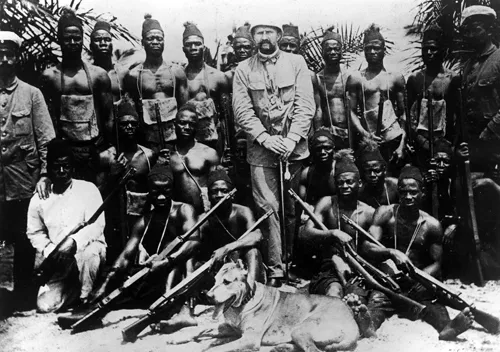
1.1 Muslim policemen wearing the fez in the German colony of Cameroon, 1891 (BPK).
With the German involvement in the Muslim world, state officials and experts discussed Islam increasingly as a political category.5 Schemes for a policy toward Islam, or Islampolitik, were widely debated in colonial and government circles. At colonial congresses, Islam and colonial policy toward Muslims were regularly at the top of the agenda. An important part in these debates was played by experts in Islamic studies. Previously preoccupied with research on classical Islam, they now began to engage in research on the contemporary Muslim world and to discuss the practices of imperial policies toward Islam. Scholars like Carl Heinrich Becker, who taught at the newly established Colonial Institute (Deutsches Kolonialinstitut) in Hamburg, and Martin Hartmann and Diedrich Westermann, both of whom taught in Berlin, placed their knowledge in the service of empire. After the turn of the century, the Colonial Office (Reichskolonialamt) supported their investigations of Islam in the colonies. They were to accumulate knowledge on its spread, impact, and potential threat to German rule and on the Muslims’ connections to the wider Islamic world. The three largest surveys were launched by Becker in 1908,6 Hartmann in 1911,7 and Westermann in 1913,8 although only Westermann published his results. An important forum for specialist debates about Islam and colonial policies became the German Society for the Study of Islam (Deutsche Gesellschaft für Islamkunde), with its periodical, Die Welt des Islams (The World of Islam), both established in 1912. Two years earlier, the journal Der Islam (Islam) had been founded at the Colonial Institute in Hamburg, providing another medium for discussions of contemporary Islam and politics.
Most experts supported the employment of religious structures in the colonies. In contrast to indigenous animist religions, regularly dismissed as savage, Islam was seen as a civilized faith governed by a specific set of rules, norms, and dogmas that could be studied and used. The best-known proponent of an active employment of Islam in colonial policies was Becker.9 Islam was not, he claimed, a threat to colonial government but could and should be used to bolster imperial rule and guarantee peace, stability, and order. Becker believed that the “danger of Islam” would fade once the right colonial policy was adopted. Muslim institutions, itinerant preachers, and pilgrims should be kept under strict surveillance, while Islamic law, madrasas, and pious endowments should be formally recognized. Becker was highly influential on policy making in Berlin. His views were supported by other scholars, including Diedrich Westermann.10 Only a small minority of experts, most notably Martin Hartmann, opposed any accommodation of Islam in the colonies.11 Hartmann perceived the Muslim religion as a threat that had to be controlled. Pointing to the alleged militant spirit of Islam, religious fanaticism, Mahdism, and the danger of holy war, he warned colonial officials not to rely on Muslim authorities and institutions. Overall, however, criticism of German colonial policies toward Islam was limited to Christian missionary circles, which saw in Islam a threat to their work and to the colonial state and regularly accused German administrators of enabling the expansion of Islam in the colonies by favoring Muslims.12 In practice, their activism had little effect.
In contrast to their British, French, Dutch, and Russian colleagues, German colonial officers did not see Islamic anti-imperialism and pan-Islamism as a threat.13 In Berlin, Islam was mainly considered an opportunity, not just in the colonies but also in the context of Wilhelm II’s Weltpolitik. This became most obvious during the kaiser’s Middle Eastern tour in the autumn of 1898 and in his spectacular speech, given after visiting the tomb of Saladin in Damascus, in which he declared himself a “friend” of the world’s “300 million Mohammedans.”14 One inspiration behind this effort was, in fact, Oppenheim, who by then had become one of the most tireless promoters of the political potential of pan-Islam. German officials were well aware that the specter of Islamic revolt and pan-Islamic mobilization haunted government corridors in London, Paris, and St. Petersburg.15 Indeed, in many anticolonial struggles in the Muslim world Islam played a major role in legitimizing, unifying, and organizing resistance to imperial intrusion.16 German courtship of Islam finally culminated in Berlin’s efforts to mobilize Muslims during the First World War.
Muslim Mobilization during the First World War
On 11 November 1914, the Ottoman shaykh al-Islam, Ürgüplü Hayri, issued five fatwas (legal opinions) calling on Muslims around the world to wage holy war against the Entente powers and promising them the status of martyr if they fell in battle.17 Three days later, in the name of the sultan-caliph, Mehmed V, the “commander of the faithful” (amir al-mu’minin), the decree was publicly read out to a large crowd outside the great Fatih Mosque in Constantinople. Afterward, in an officially organized rally, masses with flags and banners moved through the streets of the Ottoman capital, cheering for jihad. The texts of the fatwas were composed in the usual fashion, each including a doctrinal and hypothetical question to the shaykh al-Islam and his answer. Addressing not only Ottoman subjects but also Muslims living in the Entente empires, the proclamation was translated into Arabic, Persian, Urdu, and Tatar. In the following months, local ‘ulama, including the powerful Shi‘a mujtahids of Najaf and Karbala, reacted with decrees supporting the call for holy war.18 Across the Ottoman Empire, imams carried the message of jihad to believers in their Friday sermons.
The fatwas of the shaykh al-Islam drew on an unusual concept of “jihad.” Throughout history, the meaning of “jihad” had always been highly fluid, ranging from intellectual reflection to military struggle against infidels.19 A particularly influential interpretation distinguished between “lesser jihad” (al-jihad al-asghar), which is the armed fight against unbelievers, and “greater jihad” (al-jihad al-akbar), which is the personal inner struggle of every individual for moral self-improvement. Interestingly, the fatwas of the shaykh al-Islam did not follow this interpretation, declaring the war against the sultan’s enemies an al-jihad al-akbar. Moreover, compared to earlier proclamations of jihad, the decree was theologically unorthodox (though not unprecedented) as it called for a selective armed jihad directed only against the British, French, Montenegrins, Serbs, and Russians but not against the Ottomans’ Christian allies, Germany and Austria-Hungary. Thus, the war was not a religious war in the classic sense, waged between “believers” and “infidels.” As only Britain, France, Russia, Serbia, and Montenegro had turned hostile to the Islamic caliphate, only they could be considered enemies of Islam. The fatwas pronounced that it was the duty of all Muslims governed by these powers to fight a jihad against their rulers, while proclaiming it a great sin for Muslims to fight the caliphate’s allies.
Although the declaration of holy war can be seen as part of the Ottoman politics of pan-Islamism, pursued by the Porte since the reign of Abdülhamid II to sustain unity within its heterogeneous empire and to win support abroad, German officers and Islam experts were intimately involved in the jihad plan.20 In fact, it was the Germans who had pushed for the proclamation of jihad at the beginning of the war.21 In Berlin, the scheme had been under discussion for quite some time. At the height of the July Crisis, Wilhelm II had already made his famous comment about the inflammation of the Islamic world. Helmuth von Moltke, chief of the general staff, formally confirmed the idea in a memorandum the following month, ordering to “awaken the fanaticism of Islam” in the Muslim populated possessions of Germany’s adversaries (Figure 1.2). In October 1914, before the Ottomans had entered the war, Max von Oppenheim had worked out a 136-page policy paper titled “Memorandum on the Revolutionizing of the Islamic Territories of Our Enemies” (Denkschrift betreffend die Revolutionierung der islamischen Gebiete unserer Feinde). After a German-Ottoman military alliance had been secured, religious violence was to be incited in the Muslim areas in the enemies’ colonies and imperial peripheries.22 The Islamic hinterland of the rival empires was to be destabilized to keep troops away from the fronts of Europe. A “call for holy war” was to be proclaimed “as...
Table of contents
- Cover
- Title Page
- Copyright
- Contents
- Map
- Introduction
- Part I. Foundations
- Part II. Muslims in the War Zones
- Part III. Muslims in the Army
- Conclusion
- Note on Sources
- Notes
- Acknowledgments
- Index
Trusted by 375,005 students
Access to over 1.5 million titles for a fair monthly price.
Study more efficiently using our study tools.
Frequently asked questions
Yes, you can cancel anytime from the Subscription tab in your account settings on the Perlego website. Your subscription will stay active until the end of your current billing period. Learn how to cancel your subscription
No, books cannot be downloaded as external files, such as PDFs, for use outside of Perlego. However, you can download books within the Perlego app for offline reading on mobile or tablet. Learn how to download books offline
Perlego offers two plans: Essential and Complete
- Essential is ideal for learners and professionals who enjoy exploring a wide range of subjects. Access the Essential Library with 800,000+ trusted titles and best-sellers across business, personal growth, and the humanities. Includes unlimited reading time and Standard Read Aloud voice.
- Complete: Perfect for advanced learners and researchers needing full, unrestricted access. Unlock 1.5M+ books across hundreds of subjects, including academic and specialized titles. The Complete Plan also includes advanced features like Premium Read Aloud and Research Assistant.
We are an online textbook subscription service, where you can get access to an entire online library for less than the price of a single book per month. With over 1.5 million books across 990+ topics, we’ve got you covered! Learn about our mission
Look out for the read-aloud symbol on your next book to see if you can listen to it. The read-aloud tool reads text aloud for you, highlighting the text as it is being read. You can pause it, speed it up and slow it down. Learn more about Read Aloud
Yes! You can use the Perlego app on both iOS and Android devices to read anytime, anywhere — even offline. Perfect for commutes or when you’re on the go.
Please note we cannot support devices running on iOS 13 and Android 7 or earlier. Learn more about using the app
Please note we cannot support devices running on iOS 13 and Android 7 or earlier. Learn more about using the app
Yes, you can access Islam and Nazi Germany’s War by David Motadel in PDF and/or ePUB format, as well as other popular books in History & German History. We have over 1.5 million books available in our catalogue for you to explore.