A political theorist teases out the century-old ideological transformation at the heart of contemporary discourse in Muslim nations undergoing political change.
The Arab Spring precipitated a crisis in political Islam. In Egypt Islamists have been crushed. In Turkey they have descended into authoritarianism. In Tunisia they govern but without the label of "political Islam." Andrew March explores how, before this crisis, Islamists developed a unique theory of popular sovereignty, one that promised to determine the future of democracy in the Middle East.
This began with the claim of divine sovereignty, the demand to restore the shar??a in modern societies. But prominent theorists of political Islam also advanced another principle, the Quranic notion that God's authority on earth rests not with sultans or with scholars' interpretation of written law but with the entirety of the Muslim people, the umma. Drawing on this argument, utopian theorists such as Ab?'l-A?l? Mawd?d? and Sayyid Qu?b released into the intellectual bloodstream the doctrine of the caliphate of man: while God is sovereign, He has appointed the multitude of believers as His vicegerent. The Caliphate of Man argues that the doctrine of the universal human caliphate underpins a specific democratic theory, a kind of Islamic republic of virtue in which the people have authority over the government and religious leaders. But is this an ideal regime destined to survive only as theory?
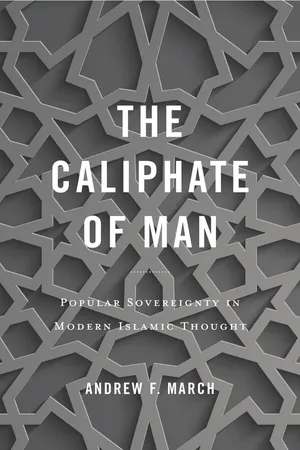
- 300 pages
- English
- ePUB (mobile friendly)
- Available on iOS & Android
eBook - ePub
About this book
Information
Topic
Theology & ReligionSubtopic
Middle Eastern History1
The Idea of Islamic Democracy
Islamist Movements in History
The post-2011 period was far from the first time Islamist movements had demonstrated in practice “moderation,” pragmatism, or compromise. The story of Islamists engaging with democratic or merely consultative or representative forms of government is a long one, dating back to debates within the Muslim Brotherhood in the 1940s1 and the Jamāʿat-i Islāmī after the independence of Pakistan.2 There are vast and rich literatures on the effects of Islamist parties on political processes,3 on the question of an Islamist electoral advantage,4 and on how semi-authoritarian political systems affect Islamists in turn.5
Of course, Islamism is not just a political theory, but the sum of many social movements comprised of political parties, public intellectuals, non-governmental organizations (NGOs), militant groups, think tanks, professional associations, charities, and humanitarian organizations. All of these real-world actors display not only a considerable degree of ideological variation but also a range of political attitudes and judgments about how to act politically within the world.6 This spectrum ranges from rejection and refusal to participate in systems regarded as “non-Islamic” to competing in elections within semi-authoritarian political regimes. Islamist movements have on occasion expressed both opposition to authoritarian regimes and a vision for a consensual, pluralist political process in cooperation with non-Islamist oppositional movements. In Tunisia, for example, a very specific precursor to the political process after 2011 was the so-called “Collectif 18 octobre pour les droits et des libertés en Tunisie,” a forum for dialogue between Islamist and secular opposition groups, which resulted in a series of joint declarations on a shared commitment to gender equality, freedom of conscience, a “civil state” that nonetheless does not seek to suppress or monopolize religious expression, and other basic aspects of good governance and political freedoms.7
One major debate pertains to the so-called “inclusion-moderation hypothesis,” which holds “that political groups and individuals may become more moderate as a result of their inclusion in pluralist political processes.”8 Major case studies for this debate include Yemen, Jordan, Morocco, Egypt, Pakistan, and Turkey, countries with limited democratic elections in which Islamist parties had competed for years.9 Other countries, including Tunisia, have sometimes been referred to as evidence for an “exclusion-moderation hypothesis.”10 Moreover, the political behavior of Islamist groups is rarely reducible to a religious, ideological appeal. Islamist political parties, for example, often appeal to voters on the basis of local, organizational bonds of trust, social service provision, or a reputation for honesty and good governance, rather than high ideology.11
Alongside this empirical literature, there is a sizable literature on the doctrinal and ideological shifts within the Islamist movement.12 Scholarly attention to the question of “Islam and democracy” has been a mainstay of writing about political Islam for decades,13 but particularly since the 1990s, when there was an explosion of scholarly attention to this question.14 More interesting for political theorists than the brute question of whether “Islam is compatible with democracy” are questions related to particular versions or modifications of democracy in an Islamic political context.15 Many theorists have been interested in how the evolution of political Islam points to unique models of democracy with a “religious referent” or with a more public role for religion than recent liberal democratic theory would prefer, often referred to as a vision or ideology of “Muslim democracy” (as opposed to secular democracy or a utopian Islamist state).16
However, in a more or less radical rejection of an ideology-centered approach, some argue that political Islam is political practice. Islamism is what Islamism does and so “democratic Islamism” or “post-Islamism” ought to be descriptions of political praxis rather than political philosophy. Asef Bayat has argued that, by looking beyond theology and even ideological dogma, it was possible to observe a “post-Islamist” phase of pragmatic, pluralist Islamic political action in practice from the 1980s and 1990s, although one that did not conform to any doctrinaire liberal secularism.17 Even without claiming a formal moderation of Islamist political doctrine, some scholars have noted that Islamist groups have a long-standing “demotic praxis,”18 or that Islamist groups have long formed an important countervailing force against secular authoritarian states.
So, in some important ways, the Arab Spring was less a revolutionary break with a past characterized by a conflict between illegitimate authoritarian states and utopian Islamist ideologues and more a continuity with pre-2011 politics. Before 2011, regimes employed a range of strategies of co-optation and resistance to democratic accountability, and Islamist movements exhibited a variety of forms of political and social behavior and multiple registers of ideological opposition. But none of this changes the fact that the context of relatively open political competition to help define and give character to new regimes, both in the form of extended constituent moments and the founding elections that accompanied them, represents new challenges to a political movement that, for all its pragmatism and variation, is fundamentally defined by its grand moral and ideological alternative to state secularism.
This present historical moment, which is characterized most notably by the severe counterrevolutionary suppression of Islamists (Egypt, the Gulf), the transformation of Islamists into post-ideological authoritarians (Turkey), or the indefinite acquiescence to a democratic system characterized by pluralism and resilient secularism (Tunisia), is an occasion to reflect upon the origins, development, and prospects for modern Islamism as a political philosophy. This book is about the development of a particular ideal theory of a regime type distinct from both the classical Islamic condominium of authority between rulers and scholars and the modern sovereign nation-state. It is a regime type that I refer to as “Islamic democracy,” at odds with a few notable alternatives within modern Islamic religious discourse, namely, a kind of “neo-Traditionalist” quietism represented by an alliance between authoritarian rulers and an official religious bureaucracy, and a radical Islamist rejection of the language of “democracy” and insistence on absolute divine sovereignty. Modern democratic Islamism is, from a political philosophical standpoint, particularly interesting because of its ideal theory of politics, and our present moment is an occasion to take stock of that vision and, perhaps, its permanent loss.
The Legacy of Modern Islamic Constitutionalism
Similarly, 2011 was hardly the first time that questions of Islamic constitutionalism had been raised in Muslim-majority countries. Quite the opposite. Much of the modern political history of Muslim states is the history of attempts to demonstrate religious legitimacy through constitution making.19 In addition to this, efforts to realize an “Islamic state” or an Islamic legal order did not wait for Islamist political movements to take power. The idea of “political Islam” should not be restricted to social movements seeking to attain power or to those revolutionary governments brought to power by Islamist activism (Iran, Sudan, Afghanistan).20 The goals of political Islam, above all Islamizing domestic legislation, have been co-opted by many states, including Pakistan, Egypt, Morocco, Malaysia, Indonesia, and Nigeria.21
The first written constitutions in Muslim countries, namely in Tunisia (1861), the Ottoman Empire (1876), and Egypt (1882), came about in the context of European imperial pressure and the desire of various local elites to form strong, centralized states capable of resisting that pressure.22 For present purposes, it is fair to note that, unlike in the case of European revolutions in 1789, 1830, and 1848, the first constitutions in the Muslim world were the products of efforts to stabilize and strengthen existing state structures. As such, the defenses of constitutionalism and legal reform written by intellectuals during the nineteenth century were often modest, aiming mostly to defend limitations on traditional sovereign executives as compatible with the true commitments of Islam and to define the political aspects of the sharīʿa as whatever advanced justice and the public interest.23
The Persian constitutional revolution of 1906–1911 was the great exception to this and thus represents, particularly in its 1907 Supplement, the first constitution with the true hallmarks of twentieth-century Islamic constitutionalism. There, high-ranking religious authorities (Grand Ayatollahs) were arrayed on both sides of the struggle, and the polemics produced in favor of and against a written constitution are some of the most complex and sophisticated works of modern Islamic political thought. They prefigured not only the debates after the 1979 Islamic revolution in Iran but also much twentieth-century constitutional thought throughout the Muslim world.24
The key feature of that constitution was found in the 1907 Supplement that, after considerable conservative and clerical opposition to the first version, revised the legislative powers of the National Consultative Assembly in a new Article 2: “At no time must any legal enactment of the Sacred National Consultative Assembly … be at variance with the sacred rules of Islam or the laws established by His Holiness the Best of Mankind (on whom and on whose household be the Blessings of God and His Peace).”25 In order to guarantee the sharīʿa compatibility of all enacted laws, Article 2 also provided for a council of religious scholars to review legislation: “It is hereby declared that it is for the learned doctors of theology (the ʿulamāʾ) … to determine whether such laws as may be proposed are or are not conformable to the rules of Islam; and it is therefore officially enacted that there shall at all times exist a committee composed of not fewer than five mujtahids [scholars of the highest rank] or other devout theologians, cognizant also of the requirements of t...
Table of contents
- Cover
- Title Page
- Copyright
- Dedication
- Contents
- Preface: “The People Wills …”
- 1. The Idea of Islamic Democracy
- 2. The Question of Sovereignty in Classical Islamic Political Thought
- 3. The Crisis of the Caliphate and the End of Classical Islamic Political Theory
- 4. The Sovereignty of God and the Caliphate of Man
- 5. The Law We Would Give Ourselves
- 6. A Sovereign Umma and a Living Sharīʿa
- 7. After Islamic Democracy, after Sovereignty
- Notes
- Acknowledgments
- Index
Trusted by 375,005 students
Access to over 1.5 million titles for a fair monthly price.
Study more efficiently using our study tools.
Frequently asked questions
Yes, you can cancel anytime from the Subscription tab in your account settings on the Perlego website. Your subscription will stay active until the end of your current billing period. Learn how to cancel your subscription
No, books cannot be downloaded as external files, such as PDFs, for use outside of Perlego. However, you can download books within the Perlego app for offline reading on mobile or tablet. Learn how to download books offline
Perlego offers two plans: Essential and Complete
- Essential is ideal for learners and professionals who enjoy exploring a wide range of subjects. Access the Essential Library with 800,000+ trusted titles and best-sellers across business, personal growth, and the humanities. Includes unlimited reading time and Standard Read Aloud voice.
- Complete: Perfect for advanced learners and researchers needing full, unrestricted access. Unlock 1.5M+ books across hundreds of subjects, including academic and specialized titles. The Complete Plan also includes advanced features like Premium Read Aloud and Research Assistant.
We are an online textbook subscription service, where you can get access to an entire online library for less than the price of a single book per month. With over 1.5 million books across 990+ topics, we’ve got you covered! Learn about our mission
Look out for the read-aloud symbol on your next book to see if you can listen to it. The read-aloud tool reads text aloud for you, highlighting the text as it is being read. You can pause it, speed it up and slow it down. Learn more about Read Aloud
Yes! You can use the Perlego app on both iOS and Android devices to read anytime, anywhere — even offline. Perfect for commutes or when you’re on the go.
Please note we cannot support devices running on iOS 13 and Android 7 or earlier. Learn more about using the app
Please note we cannot support devices running on iOS 13 and Android 7 or earlier. Learn more about using the app
Yes, you can access The Caliphate of Man by Andrew F. March in PDF and/or ePUB format, as well as other popular books in Theology & Religion & Middle Eastern History. We have over 1.5 million books available in our catalogue for you to explore.