In the aftermath of a financial crisis marked by bank-friendly bailouts and loosening campaign finance restrictions, a chorus of critics warns that business leaders have too much influence over American politics. Mark Mizruchi worries about the ways they exert too little. The Fracturing of the American Corporate Elite advances the surprising argument that American CEOs, seemingly more powerful today than ever, have abrogated the key leadership role they once played in addressing national challenges, with grave consequences for American society.
Following World War II, American business leaders observed an ethic of civic responsibility and enlightened self-interest. Steering a course of moderation and pragmatism, they accepted the legitimacy of organized labor and federal regulation of the economy and offered support, sometimes actively, as Congress passed legislation to build the interstate highway system, reduce discrimination in hiring, and provide a safety net for the elderly and needy. In the 1970s, however, faced with inflation, foreign competition, and growing public criticism, corporate leaders became increasingly confrontational with labor and government. As they succeeded in taming their opponents, business leaders paradoxically undermined their ability to act collectively. The acquisition wave of the 1980s created further pressures to focus on shareholder value and short-term gain rather than long-term problems facing their country.
Today's corporate elite is a fragmented, ineffectual group that is unwilling to tackle the big issues, despite unprecedented wealth and political clout. Mizruchi's sobering assessment of the dissolution of America's business class helps explain the polarization and gridlock that stifle U.S. politics.
- English
- ePUB (mobile friendly)
- Available on iOS & Android
eBook - ePub
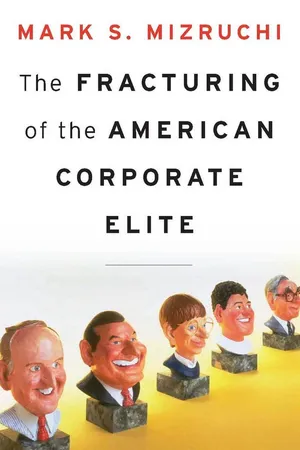
The Fracturing of the American Corporate Elite
About this book
Information
1
Introduction
In October 1957, the Soviet Union successfully launched the first artificial satellite to orbit the earth. The American public reacted in panic at the possibility that the Communist power was poised to surpass the United States in space technology and, by extension, possibly military technology as well. Intelligence reports had already suggested that the Soviets were about to launch their satellite, and President Eisenhower had been duly forewarned. Most policy makers, members of the media, and the public were taken by surprise, however.
Shortly after this episode, an organization of business leaders, the Committee for Economic Development (CED), sprang into action. The group held a high-level meeting with government officials. It prepared reports on the need for increased government efficiency, coordination of defense expenditures, economic performance, and a massive upgrading of American education, all of which the group saw as essential to fighting the Cold War with the Soviets. Within a year, government officials had begun to address these issues. Congress passed the National Defense Education Act, which increased federal education funding to more than six times what it had been earlier in the decade. President Eisenhower signed the bill that created the National Aeronautics and Space Administration (NASA). In the following decade, federal funding for scientific research increased tenfold. The United States, living up to President Kennedy’s call, put a man on the moon.
It is possible that this massive effort would have occurred without the input and support of these business elites. Presidents Eisenhower and Kennedy were both committed to it, as were members of Congress. The public, clearly alarmed, was supportive as well. Yet the business support was crucial. The CED, several of whose members had been appointed to President Eisenhower’s cabinet, played a significant role in developing the ideas behind these policies, as did organizations such as the Council for Aid to Education and the Rockefeller Brothers Fund, both of which participated in the debates over the expansion of American education.1 This episode was far from anomalous. A decade earlier, the CED had helped form a plan for the postwar reconversion of the American economy. The group was instrumental in convincing a skeptical Congress and public of the need for a massive aid plan to Europe, what became the Marshall Plan. A few years later, the CED’s members serving in Eisenhower’s administration were instrumental in the Republican president’s decision to not only maintain the core elements of the New Deal but to increase them. And in the 1960s, a group of business leaders provided the key support for an element of President Johnson’s Great Society—the building of new, low-density public housing for the poor. Even as many, perhaps the majority, of American businessmen continued to hold to the traditional views of laissez-faire, the leaders of the largest American corporations were in the vanguard of moderate, pragmatic solutions to pressing economic and social problems.
The twenty-first century has presented the United States with problems of a similarly grave nature. The nation has experienced two major financial crises. The system of public education is in disarray in many parts of the country. The cost of health care has become so debilitating that it threatens economic catastrophe. Although seemingly blunted by the financial crisis, the nation continues to experience cultural divides that threaten its long-term health, including elements that resist the teaching of evolutionary biology in the schools. The nation’s infrastructure is in disrepair, its roads, bridges, air, and rail systems in need of massive upgrading. And years of denial and inaction on the nation’s energy needs have resulted in serious, and potentially irreparable, damage to the environment. These problems have occurred during a period of record-setting deficits that threaten the nation’s future. They are exacerbated by a gridlocked political system that seems to ensure that virtually nothing can be done to address them. All of these concerns threaten to leave the United States further behind the other developed countries, as well as the rapidly advancing Chinese.
Unlike in the mid-twentieth century, however, there has been a noticeable lack of action from the leaders of large American corporations as these problems have mounted. Many large companies have supported health care reform as a means of addressing the cost issues with which they are increasingly burdened, but the corporate community has been unable to provide a solution to the crisis. Despite occasional voices from individual business leaders calling for greater attention to the society’s infrastructure and its educational system, no group of corporate officers has developed a comprehensive plan that has attracted serious attention from elected officials. The leaders of big business have also done little to break the gridlock in Washington. During the debt ceiling crisis in the summer of 2011, the Business Roundtable, a group of chief executive officers from large firms, was reduced to offering a vacuous plea to the president and Congress to fix the problem. Unlike the business leaders of the earlier era, the leaders in 2011 made their appeal without proposing a single specific recommendation.
The problems that the United States has experienced in the early twenty-first century are not necessarily of greater magnitude than those of earlier decades. Even the apparent golden age of American economic strength, in the post–World War II era, witnessed severe crises, including involvement in a devastating war and enormous social and political turmoil. Yet there is a significant difference between the postwar era, which dates from 1945 to roughly 1973, and the period since then, in the willingness of American business leaders to mount a systematic effort to address the problems of our age. Some commentators have described the change in terms of the rise of what they call “neoliberalism,” an ideology that emphasizes the virtues of free markets and is critical of the relatively high level of government involvement in the economy that characterized the postwar period (Harvey 2007; Crouch 2011). Others have discussed the shift in corporate orientation from a focus on powerful professional managers to a system in which the capital market now determines corporate behavior and managers are reduced to mere pawns in the service of “shareholder value” (Fligstein 2001; Zajac and Westphal 2004). Others have viewed the change as a shift from a “Fordist” mode of production toward “post-Fordism,” in which mass production in large manufacturing firms has given way to a disjointed system in which smaller, service-oriented firms predominate (Piore and Sabel 1984; Boyer 1990). And still others have focused on the shift from an economy based on the production of goods to one driven by financial instruments that generate revenue by converting funds from one form to another (Davis 2009; Krippner 2011).
All of these views are related—in fact similar—and all identify significant changes that have occurred in American society since the early 1970s. Whatever differences I might have with the specific components of these arguments, I do not take issue with their general thrust. My concern in this book is with what I believe is a neglected aspect of the changes others have described, and that may in fact constitute the root cause of those changes: the changing nature of leadership in the United States, in particular the leadership within the community of large corporations. I argue that the leaders of the largest American corporations, to whom I refer as the American corporate elite, once played an important role in addressing, if not resolving, the needs of the larger society. Since the 1970s, the members of this group have largely abandoned their concern with issues beyond those of their individual firms. This abandonment, I suggest, is one of the primary causes of the economic, political, and social disarray that American society has experienced in the twenty-first century. In earlier decades, the United States had a corporate elite that, however imperfect, was willing to see beyond the short-term interests of the firms that its members directed. Today this is no longer the case. The corporate elite that exists today is a disorganized, largely ineffectual group. Paradoxically, I argue, individual American corporations have more political power in the early twenty-first century than at any time since the 1920s. As a group, they are fragmented, however. Unlike their predecessors in earlier decades, they are either unwilling or unable to mount any systematic approach to addressing even the problems of their own community, let alone those of the larger society.
In this book I examine the rise and fall of the American corporate elite, from its pinnacle in the 1945–1973 period, through its period of turmoil and transition in the 1970s and 1980s, to its present state, in which the group is only a shadow of its former self. I argue that the decline of this elite is a significant source of the current crisis of American democracy and a major cause of the predicament in which the twenty-first-century United States finds itself.
In making this claim, I do not want to imply that the corporate elite of the postwar period was uniformly altruistic or public spirited. On the contrary, business leaders during that age were strongly protective of their interests, as they have been in every historical era. Nor am I suggesting that postwar America was a society that we should attempt to emulate in every respect. Social and cultural norms have become far less oppressive since that time. Our society today is far more tolerant and accepting of difference than it was half a century ago. Innovation, especially in the area of information technology, has improved peoples’ lives in many, albeit not all, respects. Consumer products in general are more plentiful and less expensive than in earlier years. There is no returning to the past, nor should this be an ideal to pursue. Yet for all its problems, the postwar United States had a number of qualities that are lacking today: an expanding economy with a high level of upward mobility, declining inequality, a relatively high level of security, a well-functioning political system, and a widespread belief that problems were solvable. And underpinning these forces was a corporate elite that provided a degree of leadership and vision that are not in evidence today. My goal in this book is to explain how this elite emerged, what sustained it, how it declined, and the consequences of the group’s demise.
The Rise and Fall of the American Corporate Elite
In the postwar period, a small segment of leaders emerged in the American business community. This was not the first time that American business leaders had organized. In the early 1900s, a group of business leaders formed the National Civic Federation, in which they developed a series of suggestions for dealing with some of the deleterious consequences of the rise of corporate capitalism at the turn of the twentieth century (Weinstein 1968). The postwar effort to address major national concerns was equally serious. The leaders of this group sat atop the largest firms and held positions in multiple organizations, which allowed them to see the world from a relatively cosmopolitan perspective. This breadth led these elites to exhibit a moderate approach to politics that included limited acceptance of both labor unions and government regulation. They participated actively in policy-making organizations, such as the CED, and they played a significant role in formulating ideas that were later adopted as national policy, in both Republican and Democratic administrations. These people were not liberals. Like the heads of smaller firms, they too were largely opposed to organized labor and had major reservations about government intervention in the economy. The heads of the leading firms tended to hold a more pragmatic approach toward strategy, however. They also believed that it was in their long-term interest to have a well-functioning society.
Three forces, I argue, contributed to the moderate, pragmatic approach adopted by the postwar corporate elite: a relatively active and highly legitimate state, a well-organized and relatively powerful labor movement, and the financial community, which served as a source of interfirm consensus. The state provided regulation of the economy through its taxing and spending policies, its provision of welfare expenditures (which helped it create effective demand for the products of American industry), and its regulation of business with agencies such as the Federal Trade Commission and the Securities and Exchange Commission. Because of the enormous success that the American economy experienced during the postwar period, a Keynesian consensus emerged among national political leaders and economic policy makers. As we shall see in Chapter 3, the corporate elite largely accepted this consensus. The labor movement provided a series of constraints on firms’ actions as well as benefits for the firms. The unions’ industry-wide presence in core sectors of the economy helped maintain a relatively stable price structure, which prevented destructive competition. Union leaders also worked with corporations to ensure that more radical elements within their ranks were kept at bay. Management assisted in this effort by agreeing to provide relatively high wages and benefits in exchange for labor peace, an agreement that has been referred to as the postwar “capital-labor accord.” The banks, meanwhile, because of their concern with the economy as a whole, played a role in mediating disputes across sectors. Bank boards of directors became meeting places for the chief executives of leading nonfinancial corporations, which helped to generate and maintain a broad consensus on issues of business-wide concern. The banks also occasionally played a role in disciplining individual capitalists who engaged in erratic or deviant behavior.
This situation prevailed from the mid-1940s until the early 1970s. Although this period was characterized by significant social turmoil, it was also a time of sustained economic growth, the expansion of the middle class, and an increasing level of economic equality. The relative strength and legitimacy of both organized labor and the state was not only a consequence of the moderate orientation of the corporate elite. These institutions, along with the financial community, also acted as constraints on business, compelling them to maintain their accommodationist perspective. Corporate leaders fought with unions and government during this period, sometimes fiercely, but they accepted the existence and permanence of these institutions, deciding it was better to work with them than to mount a full-scale assault. This approach was reflected in the attitudes of the corporate elite. By 1971, a majority of top corporate executives expressed support for both Keynesian deficit spending and the idea that the government should step in to provide full employment if the private economy was incapable of doing so (Barton 1985).
This system began to unravel during the 1970s. High government spending levels, the emergence of foreign competition, and the energy crisis of 1973 created an unprecedented combination of high inflation and unemployment, which called into question the Keynesian economic orthodoxy of the time. The aftermath of Vietnam and Watergate created a legitimacy crisis among major American institutions, including business. The emergence of new regulatory agencies, most notably the Environmental Protection Agency and the Occupational Safety and Health Administration, which were instituted over the opposition of many corporations, turned many businesses against regulation.
As a result of these crises, corporate elites saw business as embattled, and vulnerable. In response, they mounted a counteroffensive, a full-scale mobilization in which corporations, large and small, found an increasingly unified voice. Business organizations, including the newly formed Business Roundtable, began to attack government regulation. They also became increasingly aggressive in fighting unions. By the time of Ronald Reagan’s election as president, labor was already in significant retreat, and after Reagan’s inauguration in 1981, regulations were more loosely enforced.
As we moved into the 1980s, however, a paradox became evident. Corporate interests had been extremely successful in weakening the labor movement and thwarting government regulation. In winning this war, however, it became apparent that organized collective action within the business community was no longer necessary. As a result, the corporate elite began to fragment. This fragmentation was hastened by the decline of commercial banks, a group whose boards of directors had served as meeting places for the heads of the leading nonfinancial corporations. As the banks dropped from the center of the corporate network, the cohesiveness of the elite began to decline as well. Companies began to go their own way, increasingly pursuing relatively minor firm and industry-specific issues, as exemplified by the Tax Reform Act of 1986, in which a plethora of individual and small groups of firms lobbied separately for specific provisions to the law. By the late 1980s, the relatively cohesive, relatively pragmatic character of the American corporate elite had begun to disappear. The corporate elite had, ironically, been “killed” by its own success. In later years, this decline would become evident in the elite’s inability to act collectively to address issues with which its members were concerned.
Meanwhile, in response to a chronically undervalued stock market and a state that had become negligent in enforcing antitrust laws, a massive acquisition wave emerged, which led to the disappearance of one-third of the Fortune 500 during the decade. Corporate CEOs, who, although subject to pressures from government and labor during the postwar period, had been insulated from pressures from stockholders and Wall Street analysts, began to see themselves as increasingly vulnerable. As executive tenure declined—average tenure among Fortune 500 CEOs dropped nearly 25 percent between the early 1980s and 2000—sitting CEOs were no longer thinking about the long-term interests of the business community but rather about their own short-term survival. The increasing turnover also led to a further decline in group cohesion, as long-term ties were severed.
The consequence of these developments, I argue, is that there was no longer a relatively cohesive group of moderate, pragmatic leaders at the top of the American business community. Patrician, statesmanlike CEOs such as H. J. Heinz II and Reginald Jones gave way to more colorful but single-minded executives like Albert J. Dunlap Jr. and John F. Welch Jr., known, respectively, as “Chainsaw Al” and “Neutron Jack” for their willingness to slash jobs in an effort to increase shareholder value. This generational shift left the society with a collection of large corporations that, while increasingly able to realize their firm-specific interests through lobbying, were increasingly less able to provide collective solutions to issues of concern to the business community, and the society, as a whole.
The decline of the American corporate elite has played a major role in the crisis of twenty-first-century American democracy, I argue. The gridlock in Washington, the prominent role of extremist elements who in earlier decades would have been considered outside the realm of legitimate political discourse, the inability to address serious problems such as health care, the deficit, financial reform, and global warming are all due in part to the absence of a committed, moderate elite capable of providing political leadership and keeping the destructive sectors of the American polity in check.
These claims require substantiation, of course, especially considering that to some extent they run counter to established wisdom. After all, as Kim Phillips-Fein (2009) has argued in a widely acclaimed book, from its inception in the 1930s, powerful American capitalists worked tirelessly to undermine, and even fully repeal, the policies from the New Deal that provided a social safety net for the larger population. And yet to focus only on those who attempted to dismantle the New Deal provides only a partial account. It is true that there have always been corporate interests in the United States that have fought to prevent, or reverse, virtually all legislation designed to protect the public from the ravages of capitalism. It is even fair to say that this view has represented the center of gravity of business opinion in the United States. But it also misses something very important. The leaders of the corporate world—the heads of the largest corporations—were not always preoccupied with reversing the New Deal. On the contrary, in the postwar period this group exhibited moderation and pragmatism. Its memb...
Table of contents
- Cover
- Half Title
- Title Page
- Copyright
- Dedication
- Contents
- Acronyms
- Preface
- Epigraph
- 1. Introduction
- 2. The Rise of the American Corporate Elite
- 3. The State and the Economy
- 4. Labor as Uneasy Partner
- 5. The Banks as Mediators
- 6. The Breakdown of the Postwar Consensus
- 7. Winning the War but Losing the Battle: The Fragmentation of the American Corporate Elite
- 8. The Aftermath
- 9. The Ineffectual Elite
- Notes
- References
- Index
Trusted by 375,005 students
Access to over 1.5 million titles for a fair monthly price.
Study more efficiently using our study tools.
Frequently asked questions
Yes, you can cancel anytime from the Subscription tab in your account settings on the Perlego website. Your subscription will stay active until the end of your current billing period. Learn how to cancel your subscription
No, books cannot be downloaded as external files, such as PDFs, for use outside of Perlego. However, you can download books within the Perlego app for offline reading on mobile or tablet. Learn how to download books offline
Perlego offers two plans: Essential and Complete
- Essential is ideal for learners and professionals who enjoy exploring a wide range of subjects. Access the Essential Library with 800,000+ trusted titles and best-sellers across business, personal growth, and the humanities. Includes unlimited reading time and Standard Read Aloud voice.
- Complete: Perfect for advanced learners and researchers needing full, unrestricted access. Unlock 1.5M+ books across hundreds of subjects, including academic and specialized titles. The Complete Plan also includes advanced features like Premium Read Aloud and Research Assistant.
We are an online textbook subscription service, where you can get access to an entire online library for less than the price of a single book per month. With over 1.5 million books across 990+ topics, we’ve got you covered! Learn about our mission
Look out for the read-aloud symbol on your next book to see if you can listen to it. The read-aloud tool reads text aloud for you, highlighting the text as it is being read. You can pause it, speed it up and slow it down. Learn more about Read Aloud
Yes! You can use the Perlego app on both iOS and Android devices to read anytime, anywhere — even offline. Perfect for commutes or when you’re on the go.
Please note we cannot support devices running on iOS 13 and Android 7 or earlier. Learn more about using the app
Please note we cannot support devices running on iOS 13 and Android 7 or earlier. Learn more about using the app
Yes, you can access The Fracturing of the American Corporate Elite by Mark S. Mizruchi in PDF and/or ePUB format, as well as other popular books in Social Sciences & Business History. We have over 1.5 million books available in our catalogue for you to explore.