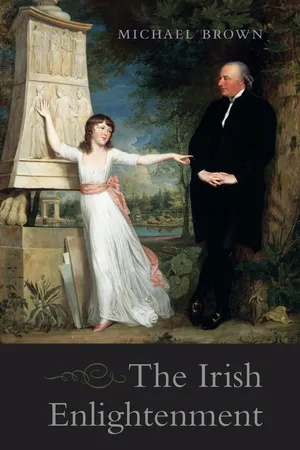
During the eighteenth-century Enlightenment, Scotland and England produced such well-known figures as David Hume, Adam Smith, and John Locke. Ireland's contribution to this revolution in Western thought has received much less attention. Offering a corrective to the view that Ireland was intellectually stagnant during this period, The Irish Enlightenment considers a range of artists, writers, and philosophers who were full participants in the pan-European experiment that forged the modern world.
Michael Brown explores the ideas and innovations percolating in political pamphlets, economic and religious tracts, and literary works. John Toland, Francis Hutcheson, Jonathan Swift, George Berkeley, Edmund Burke, Maria Edgeworth, and other luminaries, he shows, participated in a lively debate about the capacity of humans to create a just society. In a nation recovering from confessional warfare, religious questions loomed large. How should the state be organized to allow contending Christian communities to worship freely? Was the public confession of faith compatible with civil society? In a society shaped by opposing religious beliefs, who is enlightened and who is intolerant?
The Irish Enlightenment opened up the possibility of a tolerant society, but it was short-lived. Divisions concerning methodological commitments to empiricism and rationalism resulted in an increasingly antagonistic conflict over questions of religious inclusion. This fracturing of the Irish Enlightenment eventually destroyed the possibility of civilized, rational discussion of confessional differences. By the end of the eighteenth century, Ireland again entered a dark period of civil unrest whose effects were still evident in the late twentieth century.
- 625 pages
- English
- ePUB (mobile friendly)
- Available on iOS & Android
eBook - ePub
The Irish Enlightenment
About this book
Information
PART ONE
The Religious Enlightenment, 1688–ca. 1730
1
The Presbyterian Enlightenment and the Nature of Man
The poor creatures we meet in the streets seem to know the avenues to the humane breast better than our philosophers.—Francis Hutcheson, ‘Reflections on the Common Systems of Morality’, 1724
THE ENLIGHTENMENT had a shaping influence on all the Christian confessions in Ireland. The shift in foundational assumption—that the human being and not God was the starting point for meaningful philosophical reflection—raised questions about the source of religious learning and the character and condition of humanity. Thus, to comprehend the Irish Enlightenment it is necessary to examine the debates within each of the major confessions of the island; to examine in turn how Enlightenment methodologies were appropriated and utilised by Presbyterians, Anglicans, and Catholics. This leads to three observations: First, it is necessary to look to debates within the confessions, and not between them, to understand the first generation of the Irish Enlightenment. Second, it is important to recognise that the full spectrum of Enlightenment methodologies—empiricism, rationalism, and free thought—can be identified as operating in each of the confessions. Third, it can be shown that one methodology is more dominant than the others in each particular confession. While none was inclined to entertain the adherents of speculative free thought, the Presbyterian church was the most open to rationalist methods of justifying human knowledge, the Church of Ireland depended for political reasons on the empirical method to articulate its legitimacy, and the Catholic Church remained largely wedded to Scholastic learning that helped make sense of its political defeat at the Battle of the Boyne in 1690. This chapter and the two which follow will identify how Presbyterianism, Anglicanism, and Catholicism mediated the impact of the Enlightenment.
In the case of Presbyterianism, there was a convoluted controversy over subscription to the Westminster Confession of Faith in the 1720s, in which the stakes were marked out by commitments for and against the Enlightenment. Those who wished to defend the Confession broadly maintained a commitment to Scholastic readings of the Bible; the non-subscribers who opposed them were intent on developing rationalist approaches to scriptural interpretation. At question was the issue of how to justify the public articulation of the Presbyterian faith when the confession was faced with legal restrictions imposed by an Anglican state.
In other words, the Presbyterian encounter with the Enlightenment was largely the result of theological revisions conducted by non-subscribers using a rationalist methodology to pose a vocal challenge to the Scholastic worldview of the subscribing tendency. This challenge was tempered by a small faction that articulated a moderate Presbyterian vision grounded on empirical assumptions, while the Presbyterian faith also harboured a few figures who dallied with heterodoxy and free thought, giving further heat to an already divisive dispute. That dispute, and its pro- and anti-Enlightenment character, is the subject of this chapter.
The Depravity of Man
Humanity was irredeemable. Among the five basic tenets of the Presbyterian faith, enunciated at the Synod of Dort in 1619, was the presumption of total depravity. This belief underpinned and informed all the theological assertions that followed: the unconditional election of the chosen; the limited power of atonement; the irresistible nature of God’s grace; and the perseverance of the saints. It defined a pessimistic vision of man’s moral nature and set in dramatic relief the gift of God’s grace. Calvinism denied the human capacity for virtue without the intervention of divine will. Good behaviour was a gift from God. Elect or reprobate, the intrinsic qualities of humanity were to be despised, not celebrated; repressed, not reformed; controlled, not liberated.
This assumption of moral inability informed the doctrine of British Presbyterians in the seventeenth century. Coming together in 1643, a gathering of divines at Westminster met in the shadow of civil war in England and an intracommunal conflict within the three-kingdom dynastic holdings of the Stuart line. Their purpose was clear: to delineate a shared doctrinal position among English and Scottish Presbyterian adherents that would provide a church settlement in the archipelago as a whole. The document they drafted, the Westminster Confession of Faith, was the last great flower to bloom in the covenanting strand of Presbyterian theology in the British Isles, which had begun with the ‘First Bond’ of 1559, and it provided a benchmark for measuring orthodoxy among the faithful.1
Of particular pertinence to the conflicts that lay ahead was chapter two, ‘Of God and the Holy Trinity’, which asserted not only that ‘there is but one only, living and true God, who is infinite in being and perfection’ but that ‘in the unity of the godhead there be three persons of one substance, power and eternity; God the Father, God the Son and God the Holy Ghost. The Father is of none, neither begotten nor proceeding, the Son is eternally begotten of the Father, the Holy Ghost eternally proceeding from the Father and the Son.’2 Chapter twenty was also relevant to the debates of the 1720s, for under the rubric ‘Of Christian Liberty and Liberty of Conscience’ the Confession pronounced: ‘Under the New Testament the liberty of Christians is further enlarged, in their freedom from the yoke of the ceremonial law to which the Jewish church was subjected . . . God alone is the Lord of the conscience and hath left it free from the doctrines and commandments of men which are in this thing contrary to his Word, or beside it in matters of faith and worship’.3
Although Calvinism was the established confession in Scotland, in Ireland the Presbyterian Church was a minority faith. Adhered to by Scottish migrants in the northern province of Ulster, and by a southern community of English origin congregating around Dublin, the faith was in a deeply anomalous position. Part of the Reformed tradition, it could play a part in a pan-Protestant front when confronting the Roman Catholic Church. Yet, it was not an established church like Anglicanism, and its membership shared an experience of legal discrimination with Catholic contemporaries.
In particular, the ambiguity surrounding marriage caused deep personal anxiety and resentment.4 The dilemma was that, as the state tended to treat marriage solely in terms of its status as a religious ceremony, the sacrament came under the remit of the Anglican Church courts. Ecclesiastic lawyers therefore tended to treat only those weddings that had been conducted by an established minister as valid, leaving the matrimonies of Presbyterians of questionable value. The legal implication was that the children of these unions were illegitimate, and hence unable to inherit property from their parents. It equally left the couple open to prosecution for fornication. An occasional campaign of prosecution appears to have been conducted by the Anglican bishops in the period from 1697 to 1702, but its formalisation was delayed until 1711, when the Irish Convocation passed a canon preventing the recognition of any wedding that had not been conducted by a clergyman of the Church of Ireland. The pressure did not alleviate with the death of Anne and the accession of George I in 1714. Prosecutions continued, despite a failed attempt to gain legislative redress in 1723, when, under the direction of the Whig lord lieutenant, Lord Grafton, heads of a bill recognising Presbyterian marriages were sent to London for sanction by the Privy Council but rejected upon its return to the Irish House of Commons. In the years that followed, persecutions became less frequent, and less successful, making the Relief Act of 1737 which legalised Presbyterian marriage a recognition and not an alteration of the practical reality.5
Less intimate but just as galling was the passage of a bar to Presbyterian participation in the public life of the country.6 The test clauses of 1704 enacted that every candidate to ‘bear any offices civil or military or who shall receive any pay, salary, fee or wages’ from the state had publicly to take the oaths of supremacy and abjuration before receiving ‘the sacrament of the Lord’s supper, according to the usage of the Church of Ireland’.7 These provisions ensuring the conformity of the state’s officers with the church-state settlement disqualified dissenters from the political pursuit of the common good in Ireland; identifying their status as second-class subjects. Particularly insulting was the test’s inclusion in the Act to Prevent the Further Growth of Popery, thereby equating the Presbyterians with the Catholic community and separating them from their fellow Protestants. Their removal from the political nation was rhetorical as much as practical.
Yet, the legal circumstance was not clear-cut. Alongside these hindrances, the Anglican state provided some relief. At its most limited and halfhearted, this took the form of a Toleration Act sanctioned by the Irish parliament in 1719.8 The Act for Exempting the Protestant Dissenters of this Kingdom from certain Penalties, to which they are now Subject removed the necessity to take the oath of uniformity from Protestant dissenters, leaving only the oath of abjuration, which declared against papal power and stipulated that ‘the person pretended to be prince of Wales during the life of the late King James, and since his decease pretending to be, and taking upon himself the style and title of King of England, by the name of James the third, or of Scotland, by the name of James the eighth, or the style and title of king of Great Britain, hath not any right or title whatsoever to the crown of Great Britain.’9 Those who subscribed in front of justices of the peace at either general or quarter sessions were, by clause VIII, released from the threat of prosecution under the Act of Uniformity or as clause XVIII rendered it: from being ‘prosecuted in any ecclesiastical court, for or by reason of his or their nonconforming to the Church of Ireland, as by law established.’10 Dissenting ministers and teachers were formally exempted from the duty of jury service, giving limited state recognition to their status within nonconforming communities.
More constructively, the state provided a grant to help in the material support of Presbyterian ministers. Originating with Charles II, the regium donum, or king’s grant, had been suspended by James II before its reintroduction under William.11 The donation was stipulated to be £1,200 in 1691—some £15 for every minister in the country—and remained at this level throughout William’s reign. Queen Anne renewed the grant upon her accession in 1702 and, despite the protest lodged by the House of Commons in Dublin in 1703 that ‘the pension of £1,200 per annum granted to the Presbyterian ministers in Ulster is an unnecessary branch of the establishment’, payment continued unabated until, under pressure from High Church Tories, it was suspended in 1714.12 By the summer of 1715, the situation once again favoured the Presbyterians: the Hanoverian accession in 1714 had ensured a change in political tack, as George I declared in favour of the grant’s resumption. Payment started by mid-1715, at the same rate as before. The amount was increased in 1718 to £1,600, alongside a new grant of £400 set aside for the Protestant dissenters of the south of Ireland, recognising the cultural difference between those of Scottish extraction who were loyal to the Synod of Ulster and those of English origin who made up a looser Southern Association. Equally importantly, the grant was moved to the English Civil List, removing it from the remit of the Dublin parliament. George II and George III both confirmed its existence upon their accession, and the payment remained at a total worth of £2,000 until its final removal in 1784, a measure in line with the wider policy of limiting state interference in the unestablished churches of the country. In all this, the regium donum’s history encapsulates the peculiarities of the Presbyterian position in the early eighteenth century: paid yet persecuted, tolerated when not tormented, considered Protestant but restricted for being Presbyterian.13
Alongside the practical difficulties caused by living this political half-life, the Presbyterian comm...
Table of contents
- Cover
- Title Page
- Copyright
- Dedication
- Contents
- Epigraph
- Introduction: Locating the Irish Enlightenment
- Part One. The Religious Enlightenment, 1688–ca. 1730
- Part Two. The Social Enlightenment, ca. 1730–ca. 1760
- Part Three. The Political Enlightenment, ca. 1760–1798
- Conclusion: Ireland’s Missing Modernity
- Notes
- Acknowledgements
- Index
Trusted by 375,005 students
Access to over 1.5 million titles for a fair monthly price.
Study more efficiently using our study tools.
Frequently asked questions
Yes, you can cancel anytime from the Subscription tab in your account settings on the Perlego website. Your subscription will stay active until the end of your current billing period. Learn how to cancel your subscription
No, books cannot be downloaded as external files, such as PDFs, for use outside of Perlego. However, you can download books within the Perlego app for offline reading on mobile or tablet. Learn how to download books offline
Perlego offers two plans: Essential and Complete
- Essential is ideal for learners and professionals who enjoy exploring a wide range of subjects. Access the Essential Library with 800,000+ trusted titles and best-sellers across business, personal growth, and the humanities. Includes unlimited reading time and Standard Read Aloud voice.
- Complete: Perfect for advanced learners and researchers needing full, unrestricted access. Unlock 1.5M+ books across hundreds of subjects, including academic and specialized titles. The Complete Plan also includes advanced features like Premium Read Aloud and Research Assistant.
We are an online textbook subscription service, where you can get access to an entire online library for less than the price of a single book per month. With over 1.5 million books across 990+ topics, we’ve got you covered! Learn about our mission
Look out for the read-aloud symbol on your next book to see if you can listen to it. The read-aloud tool reads text aloud for you, highlighting the text as it is being read. You can pause it, speed it up and slow it down. Learn more about Read Aloud
Yes! You can use the Perlego app on both iOS and Android devices to read anytime, anywhere — even offline. Perfect for commutes or when you’re on the go.
Please note we cannot support devices running on iOS 13 and Android 7 or earlier. Learn more about using the app
Please note we cannot support devices running on iOS 13 and Android 7 or earlier. Learn more about using the app
Yes, you can access The Irish Enlightenment by Michael Brown in PDF and/or ePUB format, as well as other popular books in History & Early Modern History. We have over 1.5 million books available in our catalogue for you to explore.