A Times Higher Education Book of the Year
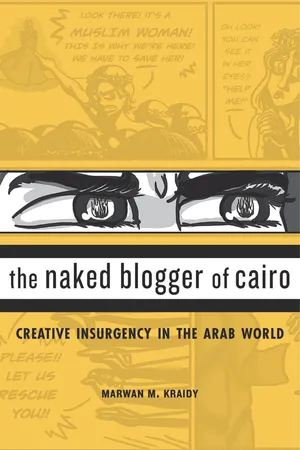
Uprisings spread like wildfire across the Arab world from 2010 to 2012, fueled by a desire for popular sovereignty. In Tunisia, Egypt, Syria, and elsewhere, protesters flooded the streets and the media, voicing dissent through slogans, graffiti, puppetry, videos, and satire that called for the overthrow of dictators and the regimes that sustained them. Investigating what drives people to risk everything to express themselves in rebellious art, The Naked Blogger of Cairo uncovers the creative insurgency at the heart of the Arab uprisings.
"A deep dive into the cultural politics of the Arab uprisings…Kraidy's sharp insights and rich descriptions of a new Arab generation's irrepressible creative urges will amply reward the effort. Reading Kraidy's accounts of the politically charted cultural gambits of wired Arab youth rekindles some of the seemingly lost spirit of the early days of the Arab uprisings and offers hope for the future."
—Marc Lynch, Washington Post
"The Naked Blogger of Cairo is a superb and important work not just for scholars but for anyone who cares about the relationships between art, the body, and revolution."
—Hans Rollman, PopMatters
- 294 pages
- English
- ePUB (mobile friendly)
- Available on iOS & Android
eBook - ePub
About this book
Information
Publisher
Harvard University PressYear
2016Print ISBN
9780674980051
9780674737082
eBook ISBN
9780674969506
NOTES
PART I. IN THE NAME OF THE PEOPLE
1. Michel Foucault, Remarks on Marx, trans. R. James Goldstein and James Cascaito (New York: Semiotext[e], 1996), 136.
2. Ibid., 138.
3. Evan Bleier, “Farmer Jailed for Dressing Donkey like Egyptian Presidential Candidate Abdel-Fattah al-Sisi,” Egypt Independent/UPI, April 2, 2014, http://www.upi.com/Odd_News/2014/04/02/Farmer-jailed-for-dressing-donkey-like-Egyptian-presidential-candidate-Abdel-Fattah-al-Sisi/3211396445914/.
4. Aliaa Magda Elmahdy, “Nude Art,” A Rebel’s Diary (blog), October 23, 2011, http://arebelsdiary.blogspot.com/2011/10/nude-art_2515.html. This text existed only in Arabic until November 19, when an English version appeared.
5. Ibid.
6. Marc Lynch, The Arab Uprising: The Unfinished Revolution of the New Middle East (New York: Public Affairs, 2013) uses “possibility” and “inevitability” (242).
7. Some scholars with Arabic fluency translated nidhaam as “system”: Hanan Sabea, “ ‘I Dreamed of Being a People’: Egypt’s Revolution, the People and Critical Imagination,” in The Political Aesthetics of Global Protest: The Arab Spring and Beyond, ed. Pnina Werbner, Martin Webb, and Kathryn Spellman-Poots (Edinburgh: Edinburgh University Press, 2014), 67–92. Others clearly thought in systemic terms, like Alain Badiou in The Rebirth of History: Times of Riots and Uprisings (London: Verso, 2012).
8. Nabiha Jerad, “The Tunisian Revolution: From Universal Slogans for Democracy to the Power of Language,” Middle East Journal of Culture and Communication 6, no. 2 (2013): 232–255.
9. Michael C. McGee, “In Search of ‘the People’: A Rhetorical Alternative,” Quarterly Journal of Speech 61, no. 3 (1975): 239.
10. Maurice Charland, “Constitutive Rhetoric: The Case of the Peuple Québécois,” Quarterly Journal of Speech 73, no. 2 (1987): 136. See also Elliott Colla, “The People Want,” Middle East Report 263, no. 42 (Summer 2012): 6.
11. See John D. H. Downing, Radical Media: The Political Experience of Alternative Communication (Boston: South End Press, 1984) and Clemencia Rodriguez, Citizens’ Media against Armed Conflict: Disrupting Violence in Colombia (Minneapolis: University of Minnesota Press, 2011). For a recent survey see John Downing, “Social Movement Theories and Alternative Media: An Evaluation and Critique,” Communication, Culture & Critique, 1 (2008), 40–50.
12. Abu Nasr al-Farabi, Mabadi’ ara’ ahl al-madina al-fadila, translated and edited by Richard Walzer as Al-Farabi on the Perfect State (Oxford: Oxford University Press, 1985); see also Louise Marlow, Hierarchy and Egalitarianism in Islamic Thought (Cambridge: Cambridge University Press, 1997).
13. Ernst Kantorowicz, The King’s Two Bodies: A Study in Mediaeval Political Theology (Princeton, NJ: Princeton University Press, 1957/1977), 449. See chapter 5 in particular. Al-Farabi, who helped preserve Greek philosophy through the Middle Ages, gets a single mention, in passing, footnote 240, page 387. Also Arnold D. Harvey, Body Politic: Political Metaphor and Political Violence (Newcastle, UK: Cambridge Scholars Publishing, 2007), 23 and Jean-William Lapierre, “Corps biologique, corps politique dans la philosophie de Hobbes,” Revue Européenne des Sciences Sociales 18, no. 49 (1980): 85–99.
14. Antoine De Baecque, Le Corps de l’histoire: Métaphores et politique (1770–1800) (Paris: Calmann-Lévy, 1993); Dorinda Outram, The Body and the French Revolution: Sex, Class and Political Culture (New Haven, CT: Yale University Press, 1989).
15. Anton-Hermann Chroust, “The Corporate Idea and the Body Politic in the Middle Ages,” Review of Politics 9, no. 4 (1947): 424.
16. Claude Lefort, The Political Forms of Modern Society: Bureaucracy, Democracy, Totalitarianism, trans. John B. Thompson (Cambridge, MA: MIT Press, 1986), 297, 300. On Syria under Hafez al-Assad, see Lisa Wedeen, Ambiguities of Domination: Politics, Rhetoric and Symbols in Contemporary Syria (Chicago: University of Chicago Press, 1999).
17. Chroust, “Corporate Idea and the Body Politic,” 423; Kantorowicz, King’s Two Bodies. For elaboration on the concept’s migration from the spiritual to the secular, see pp. 207–231 of Kantorowicz.
18. Kantorowicz, King’s Two Bodies, 225.
19. Recall that Hobbes, in Leviathan, was one of the first philosophers to develop the notion of a “social contract.”
20. Medieval corporatism had introduced a language of rights and duties that applied to both rulers and ruled. See Chroust, “Corporate Idea and the Body Politic,” 452.
21. See Ziad Fahmy, Ordinary Egyptians: Creating the Modern Nation through Popular Culture (Stanford, CA: Stanford University Press, 2011); Marc Lynch, Voices of the New Arab Public (New York: Columbia University Press, 2005); Naomi Sakr, Satellite Realms (London: I. B. Tauris, 2002); Marwan M. Kraidy and Joe F. Khalil, Arab Television Industries (London: British Film Institute/Palgrave Macmillan, 2009); and Marwan M. Kraidy, Reality Television and Arab Politics: Contention in Public Life (Cambridge: Cambridge University Press, 2010).
22. Mohamed Al-Bassyouni, The Facebook State (Cairo: al-Shurooq, 2011) [Arabic]; Muhammad Rayan, How Did the Revolution Explode on January 25?! Facebook and Revolutionary Information Technology (Cairo: Oktob, 2011) [Arabic]; Ilhem Allagui and Joanna Kuebler, eds., “The Arab Spring and the Role of ICTs,” International Journal of Communication 5, no. 1 (2011), http://ijoc.org/ojs/index.php/ijoc/article/view/1392/616; Ines Braune, ed., “The Net Worth of the Arab Spring,” Cyber-Orient 6, no. 1 (2012), http://www.cyberorient.net/article.do?articleId=7760; Philip Howard and Muzammil Hussein, Democracy’s First Wave? Digital Media and the Arab Spring (New York: Oxford University Press, 2013). Some tackled the body to some degree: Lina Khatib, Image Politics in the Middle East: The Role of the Visual in Political Struggle (London: I. B. Tauris, 2013), and Linda Herrera, Revolution in the Age of Social Media: The Egyptian Popular Insurrection and the Internet (London: Verso, 2014). See also Yves Gonzalez-Quijano, Arabités numériques: Le printemps du Web arabe (Paris: Sinbad, 2012).
23. “The farewell to the body never occurred.” Antonio A. Casilli, “Culture numérique: L’adieu au corps n’a jamais eu lieu,” Esprit 353 (2009): 151–153.
24. Henri Bergson, Creative Evolution (London: Macmillan, 1960); Henri Bergson, Matter and Memory (New York: Zone, 1988).
25. Maurice Merleau-Ponty, Phénoménologie de la perception (Paris: Gallimard, 19...
Table of contents
- Cover
- Title Page
- Copyright
- Contents
- List of Illustrations
- I. IN THE NAME OF THE PEOPLE
- II. BURNING MAN
- III. LAUGHING COW
- IV. PUPPETS AND MASTERS
- V. VIRGINS AND VIXENS
- VI. REQUIEM FOR A REVOLUTION?
- Notes
- Acknowledgments
- Index
Trusted by 375,005 students
Access to over 1.5 million titles for a fair monthly price.
Study more efficiently using our study tools.
Frequently asked questions
Yes, you can cancel anytime from the Subscription tab in your account settings on the Perlego website. Your subscription will stay active until the end of your current billing period. Learn how to cancel your subscription
No, books cannot be downloaded as external files, such as PDFs, for use outside of Perlego. However, you can download books within the Perlego app for offline reading on mobile or tablet. Learn how to download books offline
Perlego offers two plans: Essential and Complete
- Essential is ideal for learners and professionals who enjoy exploring a wide range of subjects. Access the Essential Library with 800,000+ trusted titles and best-sellers across business, personal growth, and the humanities. Includes unlimited reading time and Standard Read Aloud voice.
- Complete: Perfect for advanced learners and researchers needing full, unrestricted access. Unlock 1.5M+ books across hundreds of subjects, including academic and specialized titles. The Complete Plan also includes advanced features like Premium Read Aloud and Research Assistant.
We are an online textbook subscription service, where you can get access to an entire online library for less than the price of a single book per month. With over 1.5 million books across 990+ topics, we’ve got you covered! Learn about our mission
Look out for the read-aloud symbol on your next book to see if you can listen to it. The read-aloud tool reads text aloud for you, highlighting the text as it is being read. You can pause it, speed it up and slow it down. Learn more about Read Aloud
Yes! You can use the Perlego app on both iOS and Android devices to read anytime, anywhere — even offline. Perfect for commutes or when you’re on the go.
Please note we cannot support devices running on iOS 13 and Android 7 or earlier. Learn more about using the app
Please note we cannot support devices running on iOS 13 and Android 7 or earlier. Learn more about using the app
Yes, you can access The Naked Blogger of Cairo by Marwan M. Kraidy in PDF and/or ePUB format, as well as other popular books in Social Sciences & Middle Eastern History. We have over 1.5 million books available in our catalogue for you to explore.