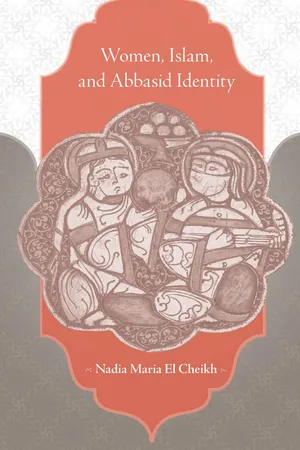
When the Abbasids overthrew the Umayyad dynasty in 750 CE, an important element in legitimizing their newly won authority involved defining themselves in the eyes of their Islamic subjects. Nadia Maria El Cheikh shows that ideas about women were central to the process by which the Abbasid caliphate, which ushered in Islam's Golden Age, achieved self-definition.
In most medieval Islamic cultures, Arab Islam stood in opposition to jahl, or the state of impurity and corruption that existed prior to Islam's founding. Over time, the concept of jahl evolved into a more general term describing a condition of ignorance and barbarism—as well as a condition specifically associated in Abbasid discourse with women. Concepts of womanhood and gender became a major organizing principle for articulating Muslim identity. Groups whose beliefs and behaviors were perceived by the Abbasids as a threat—not only the jahilis who lived before the prophet Muhammad but peoples living beyond the borders of their empire, such as the Byzantines, and heretics who defied the strictures of their rule, such as the Qaramita—were represented in Abbasid texts through gendered metaphors and concepts of sexual difference. These in turn influenced how women were viewed, and thus contributed to the historical construction of Muslim women's identity.
Through its investigation of how gender and sexuality were used to articulate cultural differences and formulate identities in Abbasid systems of power and thought, Women, Islam, and Abbasid Identity demonstrates the importance of women to the writing of early Islamic history.
- 164 pages
- English
- ePUB (mobile friendly)
- Available on iOS & Android
eBook - ePub
Women, Islam, and Abbasid Identity
About this book
Information
1
Hind bint ‘Utba
Prototype of the Jahiliyya and Umayyad Woman
IN EARLY Muslim historiography, accounts of the past were always tied to the present, as if the past was invoked only to be useful to the present.1 The historical narratives, all recorded during the early Abbasid period, were not, according to Tayeb El-Hibri, intended “to tell facts but rather to provide commentary” on political, sociocultural, and religious/moral causes deriving from controversial historical episodes. The history of the Rashidun caliphs was, for instance, represented according to political, legal, and rhetorical/artistic concerns that were prevalent in the early Abbasid period. Stories about the choice of Abu Bakr as first caliph, therefore, were more akin to polemical pieces than actual history, reflecting third/ninth-century debates on whether non-Arab converts had the right to partake in ruling the Islamic state or “whether the merits of Quraysh established its continuous political primacy.”2
The prehistory of Islam, in particular, in addition to being a conceptual notion for Abbasid historians seeking to understand the emergence of Islam, remains so for contemporary Muslims as a way to understand their relationship to their religion and their cultural heritage. The ruptures that are ascribed to the rise of Islam are represented in Islamic historiography as having been fundamental with respect to religion, comportment, and mentalities. The migration (hijra) of the Prophet Muhammad from Mecca to Medina in AD 622 was a major turning point signifying the end of the pre-Islamic era, commonly called al-jahiliyya. This momentous journey was a defining moment for the traditional periodization of Islamic history, constituting the starting point of the Muslim calendar. Jahiliyya indicated the negative image of a society seen as the opposite pole to Islam. It was portrayed as a state of corruption and immorality from which God delivered the Arabs by sending them the Prophet Muhammad.3 By describing rupture rather than transformation, the notion of jahiliyya represented a state of being and a belief, rather than history—“a belief in the uniqueness of a particular moment, when the laws of history … are suspended … a belief that Islam … and Islamic history are exceptional.”4
Jahiliyya thus served as a historical, ideological, and ethical counterpoint to the Islamic ethos. In this representation, the pre-Islamic period is equated with ignorance and savagery. The sharp distinction between the pre-Islamic and Islamic periods meant that the people of jahiliyya lingered in the imperial Muslim imagination. They functioned as a signifier of a new Muslim identity emanating from the heritage of jahiliyya, a Muslim identity that could not exist without the constant remembering and retelling of the story of jahiliyya. As such, jahiliyya could not be totally eradicated because it continued (and continues) to be the mark of conversion itself. The alterity of jahiliyya was, thus, integrated into the victorious Muslim present.
Thus, knowledge of pre-Islamic history was filtered through “the theologically inspired picture of the past provided by the later Muslim sources.”5 Abbasid rhetoric relied on the concept of jahiliyya, which supplied it with the image of a common past as well as an ulterior mode of existence against which the Abbasids could define themselves. Similar to the European Middle Ages, which are not merely a period in history, but rather “a vastness of time ripe for colonial exploitation,”6 jahiliyya, likewise, can only exist through typologies that define it as void of a positive meaning of its own. Jahiliyya took on meaning only in the context of another term, “Islam.” This juxtaposition explains the continued role of jahiliyya in the historicizing projects of the Abbasids. Jahiliyya was essentialized and reduced to a set of morally negative core features. To cultural critics, this historicizing is a familiar process whereby one social group tries to “intensify its own sense of itself by dramatizing the distance and difference between what is closer to it and what is far away.”7
The representation of Hind bint ‘Utba in the early Islamic texts provides a case study that needs to be reexamined within the context of jahiliyya. Hind bint ‘Utba is the jahiliyya woman par excellence. Her actions, as portrayed in the Abbasid texts, seem to constitute a prototype of jahiliyya behavior. The material on Hind provides an example of contrasts that contributes to the wider depictions of difference between Islamic values and those of the cultural system that existed before. The accounts pertaining to Hind express two levels of discourse, the pagan and the Islamic. It is an intentional construction, and tracing it allows us to begin to understand the elaboration of the jahiliyya concept and its significance as the antithesis to Islam.
Not only did Hind symbolize jahiliyya, but she also had a function in anti-Umayyad rhetoric. Hind, who was the mother of the first Umayyad caliph, Mu‘awiya b. Abi Sufyan, was central in the campaign to vilify the founder of the Umayyad dynasty. Henri Lammens suggests that Hind’s depiction is probably an Abbasid invention;8 William Muir thinks that the opposition of Hind and Abu Sufyan was not held against them until later, when “civil strife burst forth.”9 The analysis of the material posits the image of Hind as a construct of Muslim ideologues interested in defining, by opposition, the ideal Muslim ways of behavior as well as furthering Abbasid legitimacy in opposition to the Umayyad dynasty. I explore the accounts pertaining to Hind within these two different temporal axes: Hind as an embodiment of jahiliyya and Hind the Umayyad.
ONE OF THE EARLY REFERENCES in al-Tabari’s Tarikh puts Hind in contact with Zaynab, the Prophet’s daughter, who was planning to join her father in Medina. Knowing of her intentions, Hind offered her support: “Cousin, do not deny it. If you need anything which will make your journey more comfortable or any money to help you reach your father, I have whatever you need, so do not be ashamed to ask; for men’s quarrels have nothing to do with the women.”10 In spite of her family’s involvement in the conflict against the Prophet, solidarity with a relative took precedence and explains Hind’s offer of support. This brief anecdote demonstrates her strength and solidarity with others of her sex but also evokes a high degree of self-confidence.
Hind’s family opposed the Prophet Muhammad, who was forced, along with his supporters, to leave Mecca for the safety of the oasis of Yathrib/Medina in 1/622. Hind’s rage against the Muslims increased following the battle of Badr in 2/624. There she lost her father, ‘Utba b. Rabi‘a, her uncle Shayba b. Rabi‘a, her brother al-Walid b. ‘Utba, and her son Hanzala b. Abi Sufyan. Al-Waqidi relates that Abu Sufyan, upon his return to Mecca, instructed the Quraysh neither to cry over their killed relatives, nor to use a na’iha (professional mourner) to lament over them, nor for a poet to eulogize them lest their anger vanish and they fall prey to the derision of Muhammad and his companions. Hind reiterates these concerns, stating that she will not cry until she takes revenge: “If I knew that my sadness would leave my heart, I would cry; but nothing would take it away except seeing my revenge with my own eyes.”11 Not all proved so strong, and Hind herself fell short of her words. The first/seventh-century Kufan poet Ayman b. Huraym recalls scenes of lamentation spurred by these heavy losses:
The calamity that befell the Banu Harb left their women dazed.Had you seen Hind and Ramla, crying and beating their cheeks,You would have cried like a mother whose only son was carried off by fate.12
Indeed, Hind challenged the claim of the grieving female poet al-Khansa’ as being the most bereaved of all the Arabs, and declared that she, of all Arabs, had suffered the greatest of catastrophes. Dwelling on her grief, Hind set out for the fair of ‘Ukaz, sought out al-Khansa’, and challenged her claim, whereupon both women composed elegies on their dead. Hind said:
What an eye which saw a death like the death of my men!How many a man and woman tomorrowWill join with the keening women;… I was afraid of what I sawAnd today I am beside myself.How many a woman will say tomorrowAlas Umm Mu‘awiyya!13
The above-cited verses call us to emphasize Hind’s role as a learned poet in the genre of Marathi (elegies), which was, in pre-Islamic Arabia, reserved for warriors killed in battle.14 Often composed by women, such elegies immortalized the fallen hero, calling for vengeance as an act of purification to cleanse the tribe of disgrace and revitalize its kin by shedding enemy blood. According to Suzanne Stetkevych, women of the warrior class were allowed or even required to have a public voice on restricted occasions, namely, niyaha, lamenting for their adult menfolk, and tahrid, inciting their menfolk to battle.15 Hind was thus performing a quintessential role as a free woman in the pre-Islamic context.
In retaliation against their defeat at Badr, the Quraysh set out for the next battle of Uhud, taking their womenfolk with them, hoping that the women would spur them in battle and shame them from running away.16 The women, led by Hind, encouraged the men, singing, dancing, and beating their tambourines. Hind chanted:
If you advance we will embrace you and spread cushionsIf you turn your backs we will leave you and show you no tender love.17
Hind seems to have been especially keen on avenging her father, ‘Utba, killed by the Prophet’s uncle, Hamza. The Sira mentions that whenever Hind passed the Abyssinian slave Wahshi, she would say, “Satisfy your vengeance and ours.” Wahshi had been asked by his master, Jubayr, to kill Hamza in return for his freedom.18
On the battlefield, Hind incited the warriors into battle with such aggressiveness, belligerence, and fearlessness that she barely escaped death. Abu Dujana recounts how he took the sword of the Prophet and headed toward the battlefield. At some point he was seen with his sword hovering over the head of Hind. Then he turned away from her. Abu Dujana explains his action in the following way: “I saw a person inciting the enemy violently, and I made for him, and when I lifted my sword against him, he shrieked and I realized it was a woman. I so honor the sword of the Prophet so as not to hit with it a woman.”19 Hind’s close encounter with death was not enough to calm her, and when Wahshi hurled his javelin, killing Hamza, she seized the opportunity for retaliation. In a transport of vengeance, Hind and the women with her mutilated the corpses of the fallen Muslims. They strung their cut-off ears and noses into anklets and necklaces. Hind finally ripped out Hamza’s liver, biting on it. She was, however, unable to swallow his liver, and spat it out.20
In the next scene, Hind is seen standing on a high rock screaming verses at the top of her voice. The Prophet’s companion, ‘Umar b. al-Khattab, recalled this moment to the poet Hassan b. Thabit: “You should have heard what Hind was saying and seen her insolence as she stood on a rock reciting rajaz poetry against us and recounting how she had treated Hamza.”21 Hind’s feat of voicing her deed in language completed the act. Not only did she verbally acknowledge her crime; she had the audacity to proclaim it. Hind recited verses in which she expressed the deep sorrow she had been feeling as well as describing the act of revenge that appeased her anger:
We have paid you back for BadrAnd a war that follows a war is...
Table of contents
- Cover
- Title Page
- Copyright
- Dedication
- Contents
- Introduction
- 1. Hind bint ‘Utba: Prototype of the Jahiliyya and Umayyad Woman
- 2. Women’s Lamentation and Death Rituals in Early Islam
- 3. The Heretical Within: The Qaramita and the Intimate Realm
- 4. Beyond Borders: Gender and the Byzantines
- 5. Fashioning a New Identity: Women Exemplars and the Search for Meaning
- Conclusion
- Notes
- Acknowledgments
- Index
Trusted by 375,005 students
Access to over 1.5 million titles for a fair monthly price.
Study more efficiently using our study tools.
Frequently asked questions
Yes, you can cancel anytime from the Subscription tab in your account settings on the Perlego website. Your subscription will stay active until the end of your current billing period. Learn how to cancel your subscription
No, books cannot be downloaded as external files, such as PDFs, for use outside of Perlego. However, you can download books within the Perlego app for offline reading on mobile or tablet. Learn how to download books offline
Perlego offers two plans: Essential and Complete
- Essential is ideal for learners and professionals who enjoy exploring a wide range of subjects. Access the Essential Library with 800,000+ trusted titles and best-sellers across business, personal growth, and the humanities. Includes unlimited reading time and Standard Read Aloud voice.
- Complete: Perfect for advanced learners and researchers needing full, unrestricted access. Unlock 1.5M+ books across hundreds of subjects, including academic and specialized titles. The Complete Plan also includes advanced features like Premium Read Aloud and Research Assistant.
We are an online textbook subscription service, where you can get access to an entire online library for less than the price of a single book per month. With over 1.5 million books across 990+ topics, we’ve got you covered! Learn about our mission
Look out for the read-aloud symbol on your next book to see if you can listen to it. The read-aloud tool reads text aloud for you, highlighting the text as it is being read. You can pause it, speed it up and slow it down. Learn more about Read Aloud
Yes! You can use the Perlego app on both iOS and Android devices to read anytime, anywhere — even offline. Perfect for commutes or when you’re on the go.
Please note we cannot support devices running on iOS 13 and Android 7 or earlier. Learn more about using the app
Please note we cannot support devices running on iOS 13 and Android 7 or earlier. Learn more about using the app
Yes, you can access Women, Islam, and Abbasid Identity by Nadia Maria El Cheikh in PDF and/or ePUB format, as well as other popular books in History & European Medieval History. We have over 1.5 million books available in our catalogue for you to explore.