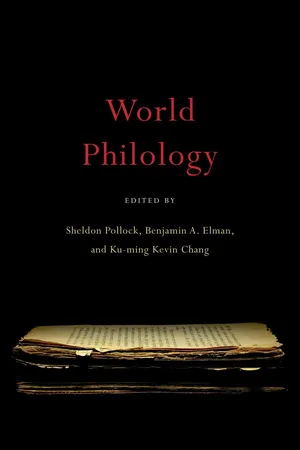
Philology—the discipline of making sense of texts—is enjoying a renaissance within academia after decades of neglect. World Philology charts the evolution of philology across the many cultures and historical time periods in which it has been practiced, and demonstrates how this branch of knowledge, like philosophy and mathematics, is an essential component of human understanding.
Every civilization has developed ways of interpreting the texts that it produces, and differences of philological practice are as instructive as the similarities. We owe our idea of a textual edition for example, to the third-century BCE scholars of the Alexandrian Library. Rabbinical philology created an innovation in hermeneutics by shifting focus from how the Bible commands to what it commands. Philologists in Song China and Tokugawa Japan produced startling insights into the nature of linguistic signs. In the early modern period, new kinds of philology arose in Europe but also among Indian, Chinese, and Japanese commentators, Persian editors, and Ottoman educationalists who began to interpret texts in ways that had little historical precedent. They made judgments about the integrity and consistency of texts, decided how to create critical editions, and determined what it actually means to read.
Covering a wide range of cultures—Greek, Roman, Hebrew, Arabic, Sanskrit, Chinese, Indo-Persian, Japanese, Ottoman, and modern European—World Philology lays the groundwork for a new scholarly discipline.
eBook - ePub
World Philology
- 452 pages
- English
- ePUB (mobile friendly)
- Available on iOS & Android
eBook - ePub
About this book
Information
CHAPTER ONE
From Book to Edition
Philology in Ancient Greece
FRANCO MONTANARI
The Birth of Philology in the Hellenistic Age
THE SCIENTIFIC discipline that for many centuries has been known by the name of “philology” is believed to have first arisen in Greece during the Hellenistic age, that is to say, over the period from the third to the first century B.C.E. This view recurs with some regularity in studies and overviews of the history of philology, and can be said in general to represent an established and accepted fact.1 When, however, we seek to define its exact meaning and limits, above all in relation to philology (not only classical) in the modern age, a number of problems arise and nonnegligible divergences come to light.
From a historical perspective, we may speak, in this regard, of the Alexandrian scholars and the Alexandrian period (early Hellenistic age) as the essential and decisive stage, which began under the reigns of Ptolemy I Soter (305–283 B.C.E.) and Ptolemy II Philadelphus (285–246 B.C.E.) and extended up to the second century B.C.E., centering on Alexandria with its institutions (chiefly the Library and the Museum) and its remarkable cultural ferment. The major personalities were Zenodotus of Ephesus (c. 325–260), Eratosthenes of Cyrene (c. 280–195), Aristophanes of Byzantium (c. 260–185), Aristarchus of Samothrace (c. 215–144), and the great scholar-poets Callimachus (c. 310–240) and Apollonius Rhodius (c. 300–220). The second century B.C.E. also saw the rise of the kingdom and city of Pergamum, which became a flourishing cultural center and rivaled Alexandria, also excelling in the field of philology and text interpretation: the figure of one of the greatest Pergamene representatives, Crates of Mallos,2 is usually mentioned for his controversies with Aristarchus, the “supreme authority as critic and interpreter” of the Alexandrian school.3
A second stage can be identified for the period extending from the generation of the first pupils of Aristarchus up to the work of the scholars of the Augustan age, such as Didymus, Aristonicus, and Theon—in other words, up to the end of the Hellenistic age. The attention of grammarians focused, first and foremost, on poets, obviously awarding priority to Homer, but also directed toward the works of lyric and scenic poets; prose writers also were objects of study, above all historians and orators (from a papyrus of the third century C.E. we have a fragment of Aristarchus’s commentary on Herodotus);4 finally, interest also began to center on “contemporaries” in a broad sense, that is, the major poets of the Hellenistic age. To assess the weight and importance of this cultural phenomenon it should be borne in mind that, by the age of Augustus, scholarship covered an extremely wide range of literary genres and took into consideration a vast chronological time span (from Homer to the Hellenistic age). For the purposes of this essay, I will focus on the Alexandrian period up to the second century B.C.E., a period we regard as the decisive phase that led to essential innovations.
On the cultural and intellectual plane, we can endeavor to bring the problem into sharper focus (setting aside numerous other aspects) by inquiring into the type of activity the Alexandrian grammatikoi (the ancient term for “scholars”) effectively undertook, what purposes they had in mind and what they aimed to accomplish by examining the texts of their cultural heritage, and what genuine change and intellectual progress effectively ensued from their ideas and activities. I believe that the question hinges fundamentally on the form and content of what was defined as the ekdosis, “edition,” of a text carried out by an ancient scholar.
What the Alexandrian philologists’ production of the ekdosis of a literary work really meant and truly involved is a problem that raises at least two main points, closely linked and mutually illuminating. That is to say, it is crucial to determine (1) how the ekdosis was performed, what material form it took, and how it was concretely built up—in other words, what a grammarian actually did when he set to work on producing an ekdosis,5 and (2) what was the real nature of the readings attributed by the erudite tradition to Alexandrian grammarians: conjectures ope ingenii and based only on subjective criteria, or variants deriving from collation of copies and thus the result of a selection, or a mixture of both proceedings? Indeed, this is the most crucial and central node of the work of the Alexandrian scholars. We will see that it is vital to be aware that we face a problem of principles and method, not of quantity of the data or quality of the results.
The ancients had a very clear idea of the concept of “textual reading,” and their technical terminology in this field made reference to the basic ideas of “reading” and “writing.” In Greek, the most widespread term in the erudite material known to us (scholia and grammatical works) is graphe (what is written) and the related verb graphein (to write), but the ancients also made use of anagnosis (what is read, a reading) and the associated verb anagignoskein (to read). In Latin one also finds scriptura, based on scribere (to write), but the most frequent term is certainly lectio, with the verb legere (to read). The concept of “variant,” expressed by varietas or more commonly by varia lectio, appears only later, in the Latin of humanism, and it has become established in modern philological terminology, where the term generally used is varia lectio/variae lectiones.6
Ekdosis: Correcting a Copy, Editing a Text
The Hellenistic age has rightly been seen as a civilization based on books, a society in which the spread of written copies of poetic-literary works gradually increased and became customary. Possession of books and personal reading took on a much greater role than in the past, even though the use of written books had already begun to be significant in the preceding two centuries. As stated by Rudolf Pfeiffer: “it is obvious that we have reached the age that we called—hesitatingly—a ‘bookish’ one; the book is one of the characteristic signs of the new, the Hellenistic, world. The whole literary past, the heritage of centuries, was in danger of slipping away in spite of the learned labors of Aristotle’s pupils; the imaginative enthusiasm of the generation living towards the end of the fourth and the beginning of the third century did everything to keep it alive. The first task was to collect and to store the literary treasures in order to save them for ever.”7 The idea that scholars should be concerned with preserving the magnificent culture and education (paideia) of previous centuries was certainly not restricted to the material aspect of book production and the collection of exemplars. The decisive cultural impetus came from Aristotelian and Peripatetic circles:8 intellectuals and men of culture realized that preserving the cultural heritage of a priceless and incomparable past could not be achieved without an understanding of its true worth and a proper interpretation of its content, and this called for the creation of appropriate and effective tools. In a logical order, which was also a chronological development, the first problem concerned the actual text of the great writers of the past, and the place of honor could not fail to be assigned to Homer, who had constituted the basis of the Greek paideia since the very beginning.
In the period from Zenodotus to Aristarchus and his direct pupils (i.e., roughly in the third and second centuries B.C.E.), the Alexandrian ekdosis confirmed its place within ancient culture as a typical product of Hellenistic philology along with the continuous commentary (hypomnema), the monograph (syngramma), the collection of words peculiar in form or significance or rare and obsolete (lexeis or glossai), and other exegetical-erudite products. Zenodotus was chosen by King Ptolemy as the first head of the Library of Alexandria. In the source from which this piece of information is derived, he is defined as the first diorthotes of Homer.9 The term diorthotes is highly significant and is confirmed in another source, which states that during the reign of Ptolemy II Philadelphus (285–246 B.C.E.) two philologist-poets, Alexander Aetolus and Lycophron, “dealt with” plays (the former with tragedy, the latter with comedy),10 while Zenodotus “dealt with” Homer and the other poets.
I have deliberately paraphrased the Greek verb with a neutral and imprecise phrase, “dealt with,” although in actual fact it is a precise and specific Greek term, that is, diorthoo, namely “straightening up, revising,” more precisely “correcting”: it is the verb from which is derived the designation diorthotes, used to characterize Zenodotus, literally “corrector.” The term that indicated the operation of correcting a text was, naturally, diorthosis (correction, emendation), which is used here in connection with both Zenodotus and Aristarchus. As Pfeiffer pointed out in this regard: “it is not improbable that Zenodotus, examining manuscripts in the library, selected one text of Homer, which seemed to him to be superior to any other one, as his main guide; its deficiencies he may have corrected from better readings in other manuscripts as well as by his own conjectures. Diorthosis can be the term for either kind of correction. It is hard to imagine any other way.”11
Klaus Nickau, who has produced fundamental studies on Zenodotus,12 is in agreement with the vision put forward by Pfeiffer on an important point, which in my view is to be made the basis of subsequent lines of reasoning: Zenodotus selected a copy he considered to be suitable and worked on it in various ways. Helmut van Thiel likewise believes the Alexandrian ekdosis consisted of the copy chosen by the grammarian from among those available, provided with a series of annotations.13 Martin West suggests that the particular eccentricity of Zenodotus’s text could not have been due merely to his judgment and opinions, but must in part have reflected an eccentricity of the tradition he followed: he may have worked on a rhapsodic exemplar produced in an Ionian context (perhaps brought with him to Alexandria from Ephesus, his native city), which thus reflected a line of tradition idiosyncratic and different from that which subsequently became widely accepted and was predominantly of Attic origin.14 Of course, this is no more than a mere hypothesis, which, however, is based on the same vision with regard to the manner of working of the first diorthotes of Homer: choosing a copy and performing a diorthosis, that is, carrying out corrections, emendations on the copy in question, in order to produce his own ekdosis.
By pondering on these themes over the years, I have come to the conclusion that the problem of the characteristics of the Alexandrian ekdosis can be profitably addressed by starting from its material form as a book, on the basis of the following presupposition: in order to understand the nature of what we call a grammarian’s ekdosis of a text and what it contained, it is crucial to examine the way it was materially constructed. I have therefore tried to emphasize the importance of the relationship between the bookshop artifact on the one hand and the text as an object of philological editing, with its various paratextual elements such as annotations and critical signs (see below) on the other.15 We must take into account and award suitable prominence to what we know regarding the creation of new copies of texts, in the scriptoria by professional scribes or privately by individuals, along with insights that can be gleaned from surviving examples. To look at the problem in this perspective, the papyri are an essential source of information that cannot be disregarded; we will thus start from the papyri to search for data helpful to illuminate these issues.
It is an accepted and well-documented fact that, in book production, new copies of literary works were normally reread and corrected through additional further comparison with the antigraph, at times even on the basis of a collation with other exemplars. Numerous types of evidence for this can be adduced on the basis of papyrus fragments of literary texts, and papyrologists are fully aware of the phenomena of corrections introduced in order to improve an exemplar in the framework of book production. Naturally we are particularly interested in the most ancient evidence, although we are hampered by the fact that the papyri datable to the period between the last decades of the fourth and the first half of the third century B.C.E. (the era of Zenodotus) are very limited in number.
Notwithstanding, some small corrections of material errors can already be observed in the two most ancient surviving literary papyri, the Persians of Timotheus (PBerol. inv. 9875) and the renowned Derveni Papyrus,16 dated to the last decades of the fourth century B.C.E. (recall the dates of Zenodotus: c. 325–260). Such examples suggest that the corrections were not the result of a systematic revision but were made by the scribe, perhaps in scribendo. Though not a highly striking phenomenon, these occasional corrections of small errors certainly represent the most ancient and visible evidence of a concern for a correct text, or better, of the intention to correct a text in which an error could be perceived.17 A few decades later we already find some considerably ric...
Table of contents
- Cover
- Title Page
- Copyright
- Contents
- Foreword
- Acknowledgments
- Introduction
- 1. From Book to Edition: Philology in Ancient Greece
- 2. The Bride of Mercury: Confessions of a ’Pataphilologist
- 3. Striving for Meaning: A Short History of Rabbinic Omnisignificance
- 4. Early Arabic Philologists: Poetry’s Friends or Foes?
- 5. What Was Philology in Sanskrit?
- 6. Reconciling the Classics: Two Case Studies in Song-Yuan Exegetical Approaches
- 7. Humanist Philologies: Texts, Antiquities, and Their Scholarly Transformations in the Early Modern West
- 8. Mughal Philology and Rūmī’s Mathnavī
- 9. The Rise of “Deep Reading” in Early Modern Ottoman Scholarly Culture
- 10. Early Modern or Late Imperial? The Crisis of Classical Philology in Eighteenth-Century China
- 11. The Politics of Philology in Japan: Ancient Texts, Language, and Japanese Identity
- 12. “Enthusiasm Dwells Only in Specialization”: Classical Philology and Disciplinarity in Nineteenth-Century Germany
- 13. The Intelligence of Philological Practice: On the Interpretation of Rilke’s Sonnet “O komm und geh”
- 14. Philology or Linguistics? Transcontinental Responses
- Notes
- Bibliography
- List of Contributors
- Index
Trusted by 375,005 students
Access to over 1.5 million titles for a fair monthly price.
Study more efficiently using our study tools.
Frequently asked questions
Yes, you can cancel anytime from the Subscription tab in your account settings on the Perlego website. Your subscription will stay active until the end of your current billing period. Learn how to cancel your subscription
No, books cannot be downloaded as external files, such as PDFs, for use outside of Perlego. However, you can download books within the Perlego app for offline reading on mobile or tablet. Learn how to download books offline
Perlego offers two plans: Essential and Complete
- Essential is ideal for learners and professionals who enjoy exploring a wide range of subjects. Access the Essential Library with 800,000+ trusted titles and best-sellers across business, personal growth, and the humanities. Includes unlimited reading time and Standard Read Aloud voice.
- Complete: Perfect for advanced learners and researchers needing full, unrestricted access. Unlock 1.5M+ books across hundreds of subjects, including academic and specialized titles. The Complete Plan also includes advanced features like Premium Read Aloud and Research Assistant.
We are an online textbook subscription service, where you can get access to an entire online library for less than the price of a single book per month. With over 1.5 million books across 990+ topics, we’ve got you covered! Learn about our mission
Look out for the read-aloud symbol on your next book to see if you can listen to it. The read-aloud tool reads text aloud for you, highlighting the text as it is being read. You can pause it, speed it up and slow it down. Learn more about Read Aloud
Yes! You can use the Perlego app on both iOS and Android devices to read anytime, anywhere — even offline. Perfect for commutes or when you’re on the go.
Please note we cannot support devices running on iOS 13 and Android 7 or earlier. Learn more about using the app
Please note we cannot support devices running on iOS 13 and Android 7 or earlier. Learn more about using the app
Yes, you can access World Philology by Sheldon Pollock, Benjamin A. Elman, Ku-ming Kevin Chang, Sheldon Pollock,Benjamin A. Elman,Ku-ming Kevin Chang in PDF and/or ePUB format, as well as other popular books in Literature & World History. We have over 1.5 million books available in our catalogue for you to explore.