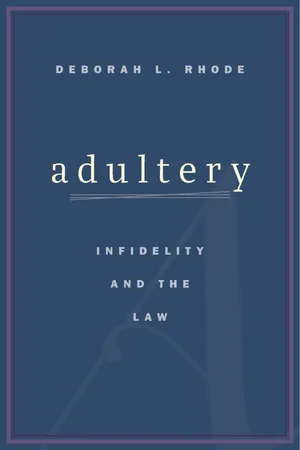
At a time when legal and social prohibitions on sexual relationships are declining, Americans are still nearly unanimous in their condemnation of adultery. Over 90 percent disapprove of cheating on a spouse. In her comprehensive account of the legal and social consequences of infidelity, Deborah Rhode explores why. She exposes the harms that criminalizing adultery inflicts, and she makes a compelling case for repealing adultery laws and prohibitions on polygamy.
In the twenty-two states where adultery is technically illegal although widely practiced, it can lead to civil lawsuits, job termination, and loss of child custody. It is routinely used to threaten and tarnish public officials and undermine military careers. And running through the history of anti-adultery legislation is a double standard that has repeatedly punished women more severely than men. An "unwritten law" allowing a man to avoid conviction for killing his wife's lover remained common well into the twentieth century. Murder under these circumstances was considered an act of understandable passion.
Adultery has been called the most creative of sins, and novelists and popular media have lavished attention on sexual infidelity. As a focus of serious study, however, adultery has received short shrift. Rhode combines a comprehensive account of the legal and social consequences of adultery with a forceful argument for halting the state's policing of fidelity.
- 262 pages
- English
- ePUB (mobile friendly)
- Available on iOS & Android
eBook - ePub
About this book
Information
1
Introduction
Adultery, said Anthony Burgess, “is the most creative of sins.”1 Perhaps that is why it so frequently figures in novels and popular media. Paradoxically, however, although affairs are a major theme in literature and a major focus of gossip among the public, their scholarly treatment has been far less extensive.2 That is particularly true in law, which is one of the best arenas in which to study the evolution of moral norms. This book aims to help fill the gap. It provides the first comprehensive account of adultery and its legal consequences in the United States, with some attention to international comparisons. The aim is to enhance our understanding of the evolution of the legal standards and social attitudes concerning adultery and to develop more informed public policies.
In essence, the book argues that the United States should repeal its civil and criminal penalties for adultery. These penalties are now infrequently and inconsistently enforced, and they ill serve societal values. Such sanctions remain on the books because American attitudes reflect a fundamental ambivalence. Disapproval of marital infidelity has increased at the same time that support for criminal prohibitions on adultery has declined. Yet intermittent enforcement of those prohibitions is out of step with international trends. And too many talented leaders have paid an undue price for conduct that bears no relationship to their job performance. Marriage as an institution is worthy of public respect, but criminalizing extramarital affairs is not the best way of supporting it.
For many Americans, the lingering role of legal prohibitions on infidelity will come as a surprise. “You’ve got to be kidding me,” said a sixty-one-year-old man sued for adultery by an aggrieved Chicago husband in 2004. “Is this thing for real?” The answer was yes. Illinois is one of the few states that retains a civil damages action for “alienation of affection.” “They say you can’t buy love,” noted the Chicago Tribune, “but one Chicago man is trying to make somebody pay for it.”3 The case arose when Stephen Cyl learned that his wife of fifteen years had met a neighbor in a local bar, and had begun an affair. Incensed, he sued. “I want them to admit what they did to me,” Cyl told reporters. He sought unspecified damages for “great mental suffering and anguish.” Cases like Cyl’s offer a window on American attitudes toward adultery, and their relation to legal standards. Adultery remains illegal in twenty-one states, and this book explores the way that such legal prohibitions are out of sync with social practices.
Overview of the Argument
This opening chapter portrays the social context of adultery in America. An understanding of its frequency, causes, and consequences is essential for evaluating the laws that attempt to regulate it. According to conventional usage and legal definitions, adultery refers to sexual relations between a married person and someone who is not his or her spouse. By that definition, estimates suggest that somewhere between 19 and 23 percent of men and 14 to 19 percent of women report committing adultery, although most experts believe that the actual incidence of infidelity is greater. The causes are varied, as are the consequences. Values, opportunities, and the quality of the marital relationship all affect the incidence of adultery.4 Some affairs are a response to problems in the adulterer’s marriage or personal life, while others provide benefits such as adventure, romance, and sexual variety. Although many individuals report satisfaction from affairs at least in the short term, experts believe that “for most people and most marriages, infidelity is dangerous.”5 Adultery is a leading cause of divorce and domestic violence, and children often bear some of the costs.
Chapter 2 explores the historical roots of current prohibitions. It begins by reviewing English common law, which provided the foundations for American legal regulations. Analysis focuses on the double standard, which made enforcement more stringent for women than men, and on the difficulties of divorce, which encouraged extramarital affairs. American law largely tracked English common law on adultery, but it made the penalties stiffer. Enforcement of adultery laws became less common in the late eighteenth and nineteenth centuries. With the separation of church and state following the American Revolution and the decline in the power of religious authorities, moral offenses became a less central concern. By the late nineteenth century, the most significant legal deterrent to adultery was no longer criminal prohibitions, but rather a fault-based divorce system that punished an adulterous spouse through financial penalties and denial of child custody. Adultery was also a factor in civil damage actions for alienation of affection, and in employment and immigration contexts where good moral character was a required qualification. A final legal context in which adultery mattered was in homicide cases. If a man killed his wife’s lover, juries simply did not convict, and this unwritten law was common until the mid-twentieth century.
Chapter 3 surveys contemporary American legal standards. It begins with the story of a sixty-six-year-old attorney who pled guilty to adultery in 2004 and lost his job as a consequence. This was an unusual case, but similar prosecutions are possible in any of the twenty-one states that still criminalize adultery. Infidelity can also carry workplace penalties or provide a basis for damages in cases alleging alienation of affection, and serve as a factor in allocating property and custody in divorce cases. The chapter argues that intermittent idiosyncratic invocations of adultery prohibitions do little to enforce marital vows or reinforce confidence in the rule of law. There are better ways to signal respect for the institution of marriage and better uses of law enforcement resources than policing private, consensual sexual activity.
Chapter 4 explores adultery in military contexts, the arena in which prohibitions are most frequently enforced. The discussion begins with the case of Lieutenant Kelly Flinn. She was the first woman to pilot a B-52 bomber, and was discharged from the U.S. Air Force in 1997 while facing charges stemming from adultery. Flinn was not alone. In the five years preceding her discharge, the military court-martialed nearly 900 individuals on charges that included adultery. Many more cases were handled administratively. At the same time that civilian adultery prosecutions have declined, military prosecutions have escalated, partly as a result of the increase of women in the armed forces. The chapter critically examines those prosecutions in the context of some celebrated cases. One involved four-star general David Petraeus, who resigned as director of the Central Intelligence Agency after disclosure of his extramarital affair. The case brought military prohibitions into public focus. Sixty-two percent of Americans believed that adultery should not be a military crime. This chapter supports that position and argues for the removal of adultery as a basis for military discipline.
Chapter 5 explores alternative lifestyles that frequently involve adultery. Estimates of the number of Americans in consensual multiple-partner relationships generally range from 0.5 million to 9.8 million. These relationships encompass a wide variety of practices including everything from polygamy to “swinging,” in which married or committed couples exchange partners for casual sex. The chapter argues that such alternative lifestyles should receive greater social and legal tolerance. Some of these relationships have benefits that include the sharing of resources and a greater fulfillment of physical, emotional, and social needs than is often found in monogamous relationships. The chapter argues for decriminalizing polygamous cohabitation but not permitting multiple marriage licenses. This approach would remove the sanctions that have forced polygamy into isolated, rural communities, while restricting access to the benefits associated with marriage. At the same time, further efforts should be made to address the abuses sometimes accompanying polygamy, such as underage marriage, tax fraud, and domestic violence. This strategy would respect the individual privacy and religious liberty of adults who have freely chosen an alternative lifestyle while mitigating its harms.
Chapter 6 explores adultery in political contexts. Among presidents alone, seventeen have had known sexual affairs, most of which involved adultery. The chapter raises several questions. What makes politicians willing to risk so much for sex? What does it say about their fitness for public office? Why are so few female politicians involved in sexual scandals? When and why does private conduct become a matter of public concern? The discussion addresses these questions in the context of America’s best-known examples of politicians’ adultery, such as Franklin D. Roosevelt, John F. Kennedy, Bill Clinton, Eliot Spitzer, John Edwards, and Mark Sanford. According to popular opinion polls, most Americans think that such private conduct is relevant for public leadership positions and should be disclosed. However, Chapter 6 argues that infidelity is not an accurate predictor of ethics or effectiveness in political office. A further problem with drawing adverse inferences from personal conduct is that it encourages the media to pander to our worst instincts and diverts attention from substantive issues. Peephole journalism is corrosive not only for politicians but also for the public.
The point is not that voters should entirely disregard sexual conduct when evaluating qualifications for leadership. Rather, it is that context matters. The nature and consequences of the conduct are relevant, as are the other issues at stake. Did the affair involve illegal conduct, financial improprieties, or unduly reckless behavior? Is moral leadership a crucial aspect of the position? What policy concerns will be implicated if the politician is forced out of office?
Chapter 7 explores adultery from an international perspective. The discussion highlights the enormous variation in cultural attitudes. In France, the mistress of a former prime minister can stand alongside the wife in a state funeral; in Muslim countries, parties guilty of infidelity can be stoned, flogged, or hanged, and three-quarters of surveyed Muslims approve of the penalty. In developed countries, the trend is to decriminalize adultery and to reduce its significance in other legal contexts such as divorce and child custody proceedings. By contrast, in Islamic nations, adultery is a serious crime and enforcement is targeted overwhelmingly at women and girls. Some countries even treat rape and out-of-wedlock pregnancy as evidence of adultery. Honor killings to avenge infidelity often go unpunished. The chapter argues for decriminalizing adultery and viewing these honor killings as serious human rights abuses.
A concluding chapter dr...
Table of contents
- Cover
- Title Page
- Copyright
- Dedication
- Contents
- 1. Introduction
- 2. Legal History
- 3. The American Legal Landscape
- 4. Sex in the Military
- 5. Alternative Lifestyles
- 6. Sex and Politics
- 7. International Perspectives
- 8. Conclusion
- Notes
- Acknowledgments
- Index
Trusted by 375,005 students
Access to over 1.5 million titles for a fair monthly price.
Study more efficiently using our study tools.
Frequently asked questions
Yes, you can cancel anytime from the Subscription tab in your account settings on the Perlego website. Your subscription will stay active until the end of your current billing period. Learn how to cancel your subscription
No, books cannot be downloaded as external files, such as PDFs, for use outside of Perlego. However, you can download books within the Perlego app for offline reading on mobile or tablet. Learn how to download books offline
Perlego offers two plans: Essential and Complete
- Essential is ideal for learners and professionals who enjoy exploring a wide range of subjects. Access the Essential Library with 800,000+ trusted titles and best-sellers across business, personal growth, and the humanities. Includes unlimited reading time and Standard Read Aloud voice.
- Complete: Perfect for advanced learners and researchers needing full, unrestricted access. Unlock 1.5M+ books across hundreds of subjects, including academic and specialized titles. The Complete Plan also includes advanced features like Premium Read Aloud and Research Assistant.
We are an online textbook subscription service, where you can get access to an entire online library for less than the price of a single book per month. With over 1.5 million books across 990+ topics, we’ve got you covered! Learn about our mission
Look out for the read-aloud symbol on your next book to see if you can listen to it. The read-aloud tool reads text aloud for you, highlighting the text as it is being read. You can pause it, speed it up and slow it down. Learn more about Read Aloud
Yes! You can use the Perlego app on both iOS and Android devices to read anytime, anywhere — even offline. Perfect for commutes or when you’re on the go.
Please note we cannot support devices running on iOS 13 and Android 7 or earlier. Learn more about using the app
Please note we cannot support devices running on iOS 13 and Android 7 or earlier. Learn more about using the app
Yes, you can access Adultery by Deborah L. Rhode in PDF and/or ePUB format, as well as other popular books in Law & Family Law. We have over 1.5 million books available in our catalogue for you to explore.