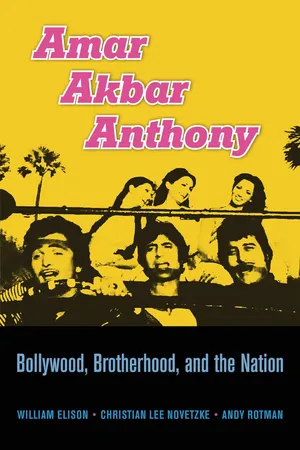
A Bollywood blockbuster when it was released in 1977, Amar Akbar Anthony has become a classic of Hindi cinema and a touchstone of Indian popular culture. Delighting audiences with its songs and madcap adventures, the film follows the heroics of three Bombay brothers separated in childhood from their parents and one another. Beyond the freewheeling comedy and camp, however, is a potent vision of social harmony, as the three protagonists, each raised in a different religion, discover they are true brothers in the end. William Elison, Christian Lee Novetzke, and Andy Rotman offer a sympathetic and layered interpretation of the film's deeper symbolism, seeing it as a lens for understanding modern India's experience with secular democracy.
Amar Akbar Anthony's celebration of an India built on pluralism and religious tolerance continues to resonate with audiences today. But it also invites a critique of modernity's mixed blessings. As the authors show, the film's sunny exterior only partially conceals darker elements: the shadow of Partition, the crisis of Emergency Rule, and the vexed implications of the metaphor of the family for the nation. The lessons viewers draw from the film depend largely on which brother they recognize as its hero. Is it Amar, the straight-edge Hindu policeman? Is it Akbar, the romantic Muslim singer? Or is it Anthony, the Christian outlaw with a heart of gold? In this book's innovative and multi-perspectival approach, each brother makes his case for himself (although the last word belongs to their mother).
eBook - ePub
Amar Akbar Anthony
Bollywood, Brotherhood, and the Nation
- 334 pages
- English
- ePUB (mobile friendly)
- Available on iOS & Android
eBook - ePub
Amar Akbar Anthony
Bollywood, Brotherhood, and the Nation
About this book
Information
Subtopic
20th Century History1
Amar
STRAIGHT SHOOTER
Lovers of a country don’t die … they become amar [immortal].—from Desh Premee (Manmohan Desai, 1982)
AS ONE can’t help but notice, Amar Akbar Anthony is a commentary on the formation of the Indian nation. Three children are separated from their parents and one another sometime in the 1950s on the Fifteenth of August—Independence Day. The film chronicles how they recover from this loss, highlighting the roles played by religion and love, family and surrogates, the city and the state. But this is also a story about Partition and the Emergency, the wounds they caused and their legacy, and the importance of an unmarked but muscular form of Hinduism as a balm for healing. This configuration of Hinduism sidelines Gandhi and embraces violence, and it promotes a domestic form of love and police action for rehabilitating fallen women, families, and ultimately the state. The catalyst for this process is a new dharma, which echoes and inverts the logic found in the stories of the gods Rama and Shiva, and which allows the state to be embodied—through a kind of sexual and somatic discipline—in Amar himself. What follows is an Amar-centric view of the film to explain why it is that big brother is a Hindu with a gun that he never uses, and what role he has to play in creating an idealized moral world to offset the parody and irony of Akbar and Anthony.
Here’s a Story of a Man Named Kishanlal, Who Was Busy with Three Boys of His Own
In order to make sense of Amar and his view of the world, we first need to understand how the three brothers became separated from their parents and one another, the role of fathers in the formation of the boys’ identities, and why Amar is so afraid that guns might end up in the wrong hands (and whose hands those might be). Much of this backstory takes place in the film’s prologue sequence, which lasts nearly twenty-five minutes and helps explain Amar’s perspective on India’s ills and why violence in the hands of the state is, to his mind, the remedy.
In the film, Kishanlal, the father of the family, is a driver for an underworld leader named Robert. After Robert hits and kills a man with his car, Kishanlal agrees to confess to the crime and then serves the latter’s prison sentence. Although Robert promises Kishanlal that he will pay his family double his monthly wages while Kishanlal is in prison serving Robert’s sentence, he ultimately gives them nothing. Kishanlal’s three children suffer in poverty, as does his wife, Bharati, who contracts tuberculosis. When Kishanlal is released from prison and returns home, he sees the pitiful condition of his family and learns they have received no payments. Infuriated at this double cross, Kishanlal goes to Robert’s lair, where the latter is lavishly celebrating his daughter’s first birthday. He beseeches his boss for the money but is rebuffed, then taunted and degraded. Filled with anger and shame, Kishanlal shoots Robert three times, but only hits the chain-mail vest protecting his chest.
Kishanlal then jumps out a window and escapes in one of Robert’s cars, which contains a crate of smuggled gold bars. He eludes Robert’s goons and drives home. Bharati, however, has already left. In her place is a letter explaining that she is going to end her life so that Kishanlal can use whatever he earns to provide for their children, not treat her illness. Kishanlal hustles the boys into the car and drives off. With Robert’s men giving chase, he understands the danger he’s in, so he stops his car at a park and rushes the boys inside, leaving them underneath a statue of Gandhi, the Father of the Nation. Inscribed on the side of the statue is ahiṃsā paramo dharmaḥ (Nonviolence is the supreme law), acknowledging the safety that Gandhi provides, as well as the difference in Gandhi’s and Kishanlal’s ideologies. Like Gandhi, Kishanlal and his family are Hindus, but Gandhi, unlike Kishanlal, never shot a man. Kishanlal has already transgressed the ethics hewn beneath the Mahatma’s statue.
Before Kishanlal can return to fetch his children, each is taken in by a replacement father. The youngest child is abandoned not only by his father but also by his two older brothers. The oldest runs after his father and is struck unconscious by the gangsters’ car, and the middle child runs off to find food to calm his younger brother, who is in tears. Multiply abandoned, the youngest is seen by a Muslim tailor who has stopped his car and is praying on the side of the road. Finding the boy all alone, the man decides to adopt him, and the camera nicely juxtaposes him with the Gandhi statue, signaling the similarities between the two men (Figure 3). The boy will be raised as Akbar, a qawwali singer with a big heart, who is the only brother to espouse the Gandhian ideal of nonviolence.
The middle brother eventually passes out on the steps of a Catholic church abutting the park. The head priest finds Bharati’s suicide note in the boy’s pocket and, concluding that the boy’s father must have likewise abandoned him out of poverty, brings him inside. The boy will be raised as Anthony, and the Padre will be the boy’s guardian and de facto father. But Anthony will never embrace the Padre’s Catholic vision. Nor will he join Akbar in adopting Gandhian nonviolence or sign on with the police, like Amar. Instead, Anthony will take over a neighborhood bar and become a local big man, beating people up to get his way, and the area around the bar will be known as Anthonyville—a testament to his popularity and the power that he wields. Like the Padre, Anthony imagines that he is doing God’s work, but his dispensation involves illegal activities (like harboring the fugitive Robert and his crate of gold from the police), which he believes are sanctioned by a higher authority (Jesus), to whom he gives half of his earnings.
Unlike his brothers, Amar, the oldest child, is not found at a place of refuge, like a Gandhi statue or a church, and is not found by an overtly religious man. Instead, he is found on the street by a police inspector, who then raises him as his own. Although Amar keeps his given name, he takes on his new father’s family name—Khanna1—and, also unlike his brothers, his new father’s profession. Later in the film we see Police Sub-Inspector Amar Khanna reporting to his father, who is now Inspector Khanna. Much like Anthony, Amar protects and provides for his community, but he does so officially, as an instrument of the state. Also like Anthony, he beats up people to get his way.
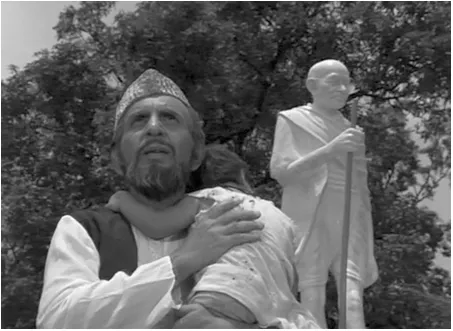
FIGURE 3. Haider Ali and Gandhi
Kishanlal just misses intercepting the police officer as the latter drives away with his son. After having left his children at the Gandhi park, Kishanlal crashes Robert’s car on a forest hillside and, in the process, discovers the crate of gold hidden inside. Now on foot, he approaches the park, but when he sees the police car he turns away, shielding himself and the gold as he pretends to urinate. With this act, however, he turns his back on Amar, who is taken away by the policeman. Once in the park he yells only for Amar, acknowledging the special connection he has with his oldest son. But it’s too late. He’s traded his children for a box of gold.
What is the faith of Inspector Khanna? Unlike the adoptive fathers of Anthony and Akbar, the inspector isn’t overtly religious. Judging by his name and manner, he is a secular Hindu, privy to the power and privilege of India’s dominant religion but more concerned with the rules of state than those of Hindu orthodoxy. Amar appears to be the same. He is never seen in prayer or in temple, his home has no shrine, and he wears no identifying religious insignia.2 Amar’s religiosity is seemingly unmarked, especially in comparison to that of his brothers, but it is certainly not indistinct.
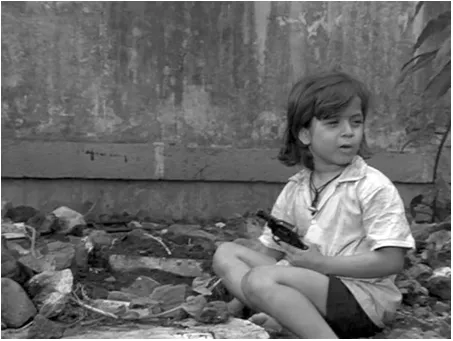
FIGURE 4. Amar buries the gun
Kishanlal tells Amar to stay under the Gandhi statue with his brothers, but Amar runs away from Gandhi, literally and figuratively. For Amar, nonviolence is not the supreme law. Amar uses violence repeatedly to uphold the authority of the state. Amar beats up a gang of extortionists; he beats up Anthony; and he beats up Robert’s men twice, once in jail and once at their hideout.3 In this way, Amar is the progeny of both Inspector Khanna, his adoptive father, and Kishanlal, his biological father. Like the former, he upholds the law, and like the latter, he doesn’t eschew violence, even if it’s reckless. Amar is a personification of Max Weber’s famous definition of a state: he claims a monopoly on the legitimate use of violence.4
Amar does avoid guns, however, at least one in particular—which we’ll revisit later in the chapter—and this is crucial for making sense of his character. When Kishanlal is released from prison and returns home, he finds the middle brother fighting with Amar and the youngest crying, and he tries to appease them all with gifts: a toy cricket bat for the youngest, a cart for the middle brother, and a pistol for Amar, which is presumably a toy but looks quite realistic.5 Amar, however, never plays with the gun, for the middle brother immediately tries to claim it as his own: “Brother Amar, don’t take the gun! Leave my gun alone!” Amar then runs out of the kitchen with the gun, and as Kishanlal leaves the house to confront Robert, he sees Amar burying it in the ground outside their home. Questioned, Amar explains, “I’m hiding it. If my little brother sees it, he’ll want it for himself” (Figure 4). The gun is in his hands, quite literally, yet his concern is that the gun might end up in the hands of his middle brother, the future Anthony. This concern, as we’ll see, is central to Amar’s identity—and to the moral world of the movie.
Guns in the film are certainly dangerous, albeit for Amar’s fathers, not his brothers. Three times Amar is almost orphaned because guns end up in the wrong hands. Kishanlal grabs a gun from one of Robert’s henchmen and then fires at Robert, setting in motion the events that lead Kishanlal to abandon his family. Later Robert grabs a gun from one of Kishanlal’s henchmen and fires at Kishanlal, and later still he grabs another gun and fires at Inspector Khanna. Kishanlal is saved because he’s wearing a chain-mail vest—taking after Robert but shrewdly using it to cover his back—but Inspector Khanna is less fortunate. He is hospitalized in critical condition, frightening Amar that he might be orphaned once again, but the inspector soon recovers. As a police officer, Amar is justified in wanting to prevent guns from falling into the wrong hands—and he uses his own hands, balled into fists, to do so (Figure 5).
Adoptive Fathers and Lovely Ladies
What drives the plot of the film, however, is how everyone—both the crooks (Kishanlal and Robert) and the brothers—tries to reconstitute broken families. The fracturing of the family and the trauma that ensues is a common theme in Indian film and literature, often gesturing back to the partitioning of Britain’s Indian empire, when millions of households were displaced, decimated, and forced to move and reconfigure.6 Within the film, the brokenness of families can indeed be read against Partition. Yet the film itself seems to gesture more directly toward the previous years of Emergency Rule, when civil liberties were radically curtailed and civil life fundamentally transfigured. There are, of course, myriad other causes and conditions that lead to family dysfunction (micro and macro, social and political, and so on), but the film’s diagnosis of this dysfunction and the cure that it offers—particularly as exemplified by Amar’s character—places it in direct conversation with the state as a social actor, much as it was in the 1970s.
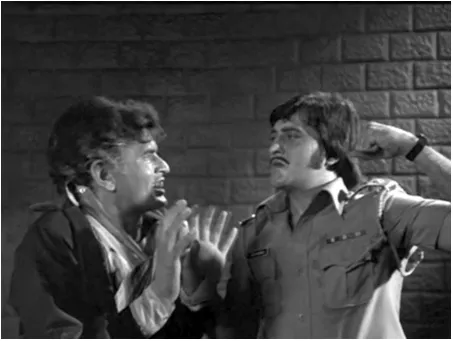
FIGURE 5. Amar’s fist
Reminiscent of Amar is Saleem Sinai, the main character in Salman Rushdie’s Midnight’s Children, which was published in 1981, four years after the release of Amar Akbar Anthony. Saleem is sterilized during Emergency Rule, and then, following this traumatic event, severs ties with the past and re-creates himself, even finding new parents. “Giving birth to parents,” he explains, “has always been one of my stranger talents.”7 This untethering of biology in the formation of identity, breaking down the traditional lineage of fathers and sons, appears in a negative formula on the novel’s last page: “My son … is not my son, and his son … will not be his, and his … will not be his.”8 Yet Saleem does have a patrimony, which is enjoyed by all the midnight’s children, whose birth coincided with the birth of the new nation: “All over the new India, the dream we all shared, children were being born who were only partially the offspring of their parents—the children of midnight were also the children of the time: fathered, you understand, by history.”9
This formulation of paternity and “elective filiation” reproduces the logic in Amar Akbar Anthony, which is similarly “fathered by history.”10 Amar, Akbar, and Anthony are reborn on Independence Day as a kind of midnight’s children—and Gandhi’s children too—and although their new fathers choose them and not the converse, both the book and the film share a sense of betrayal by India’s progenitors. In the book, the betrayer is an infanticidal Mother India—the Widow, a fictionalized version of Prime Minister Indira Gandhi—whereas the movie’s Mother India figure, Bharati, is among the betrayed. Another point of divergence between these two national allegories is that Amar Akbar Anthony’s hero is not one son but an entire family, and the key issue is how the family, after its great fall, can—like Humpty Dumpty—be put back together again.
Kishanlal, for one, tries to make up for the loss of his children by trading identities with Robert, his betrayer and nemesis (although Kishanlal is less cruel).11 After losing his children beneath the Gandhi statue, Kishanlal next appears in the film twenty-two years later looking just like Robert, and Robert appears looking just like Kishanlal did when he was Robert’s servant. Kishanlal has used the box of Robert’s gold with which he absconded to hire Robert’s men and re-create his smuggling operation, and he now wears the i...
Table of contents
- Cover
- Title Page
- Copyright
- Dedication
- Contents
- Introduction: Outright Hokum
- 1. Amar: Straight Shooter
- 2. Akbar: Parda and Parody
- 3. Anthony: Amar Akbar Irony
- 4. Maa—!
- Conclusion: Excuse Me, Please
- Appendix: Film Synopsis
- Notes
- Bibliography
- Acknowledgments
- Index
Trusted by 375,005 students
Access to over 1.5 million titles for a fair monthly price.
Study more efficiently using our study tools.
Frequently asked questions
Yes, you can cancel anytime from the Subscription tab in your account settings on the Perlego website. Your subscription will stay active until the end of your current billing period. Learn how to cancel your subscription
No, books cannot be downloaded as external files, such as PDFs, for use outside of Perlego. However, you can download books within the Perlego app for offline reading on mobile or tablet. Learn how to download books offline
Perlego offers two plans: Essential and Complete
- Essential is ideal for learners and professionals who enjoy exploring a wide range of subjects. Access the Essential Library with 800,000+ trusted titles and best-sellers across business, personal growth, and the humanities. Includes unlimited reading time and Standard Read Aloud voice.
- Complete: Perfect for advanced learners and researchers needing full, unrestricted access. Unlock 1.5M+ books across hundreds of subjects, including academic and specialized titles. The Complete Plan also includes advanced features like Premium Read Aloud and Research Assistant.
We are an online textbook subscription service, where you can get access to an entire online library for less than the price of a single book per month. With over 1.5 million books across 990+ topics, we’ve got you covered! Learn about our mission
Look out for the read-aloud symbol on your next book to see if you can listen to it. The read-aloud tool reads text aloud for you, highlighting the text as it is being read. You can pause it, speed it up and slow it down. Learn more about Read Aloud
Yes! You can use the Perlego app on both iOS and Android devices to read anytime, anywhere — even offline. Perfect for commutes or when you’re on the go.
Please note we cannot support devices running on iOS 13 and Android 7 or earlier. Learn more about using the app
Please note we cannot support devices running on iOS 13 and Android 7 or earlier. Learn more about using the app
Yes, you can access Amar Akbar Anthony by William Elison,Christian Lee Novetzke,Andy Rotman in PDF and/or ePUB format, as well as other popular books in Media & Performing Arts & 20th Century History. We have over 1.5 million books available in our catalogue for you to explore.