The way we create and organize knowledge is the theme of From the Tree to the Labyrinth, a major achievement by one of the world's foremost thinkers on language and interpretation. Umberto Eco begins by arguing that our familiar system of classification by genus and species derives from the Neo-Platonist idea of a "tree of knowledge." He then moves to the idea of the dictionary, which—like a tree whose trunk anchors a great hierarchy of branching categories—orders knowledge into a matrix of definitions. In Eco's view, though, the dictionary is too rigid: it turns knowledge into a closed system. A more flexible organizational scheme is the encyclopedia, which—instead of resembling a tree with finite branches—offers a labyrinth of never-ending pathways. Presenting knowledge as a network of interlinked relationships, the encyclopedia sacrifices humankind's dream of possessing absolute knowledge, but in compensation we gain the freedom to pursue an infinity of new connections and meanings.
Moving effortlessly from analyses of Aristotle and James Joyce to the philosophical difficulties of telling dogs from cats, Eco demonstrates time and again his inimitable ability to bridge ancient, medieval, and modern modes of thought. From the Tree to the Labyrinth is a brilliant illustration of Eco's longstanding argument that problems of interpretation can be solved only in historical context.
eBook - ePub
From the Tree to the Labyrinth
Historical Studies on the Sign and Interpretation
- English
- ePUB (mobile friendly)
- Available on iOS & Android
eBook - ePub
From the Tree to the Labyrinth
Historical Studies on the Sign and Interpretation
About this book
Information
1
From the Tree to the Labyrinth
1.1. Dictionary and Encyclopedia
For some time now the notions of dictionary and encyclopedia have been used in semiotics, linguistics, the philosophy of language and the cognitive sciences, to say nothing of computer science, to identify two models of semantic representation, models that in turn refer back to a general representation of knowledge and/or the world.
In defining a term (and its corresponding concept), the dictionary model is expected to take into account only those properties necessary and sufficient to distinguish that particular concept from others; in other words, it ought to contain only those properties defined by Kant as analytical (analytical being that a priori judgment in which the concept functioning as predicate can be deduced from the definition of the subject). Thus the analytical properties of dog would be ANIMAL, MAMMAL, and CANINE (on the basis of which a dog is distinguishable from a cat, and it is logically incorrect and semantically inaccurate to say of something that it is a dog but it is not an animal). This definition does not assign to the dog the properties of barking or being domesticated: these are not necessary properties (because there may be dogs incapable of barking and/or hostile to man) and are not part of our knowledge of a language but of our knowledge of the world. They are therefore matter for the encyclopedia.
In this sense semiotic dictionaries and encyclopedias are not directly comparable to dictionaries and encyclopedias “in the flesh,” so to speak, to the published products, in other words, that go by the same name. In fact, dictionaries “in the flesh” are not usually composed according to the dictionary model: a normal dictionary, for instance, may define “cat” as a feline mammal, but usually adds details of an encyclopedic nature that concern the cat’s fur, the shape of its eyes, its behavioral habits, and so on and so forth.
If we wish to identify a dictionary in its pure form—to which various contemporary theoreticians in the field of artificial intelligence still refer when they speak (see section 1.7 below) of “ontologies”—we must return to the model of the Arbor Porphyriana or Porphyrian tree, in other words to the commentary on Aristotle’s Categories written in the third century A.D. by the Neo-Platonist Porphyry in his Isagoge, a text that throughout the Middle Ages (and beyond) will be a constant point of reference for any theory of definition.
1.2. The Dictionary
1.2.1. The First Idea of the Dictionary: The Arbor Porphyriana
Aristotle (Posterior Analytics, II, iii, 90b 30) says that what is defined is the essence or essential nature. Defining a substance means deciding, among its attributes, which of them appear to be essential, and in particular those that are the cause of the fact that the substance is what it is, in other words, its substantial form.
The problem is coming up with the right attributes that can be predicated as elements of the definition (Posterior Analytics, II, xiii, 96a–b). Aristotle gives the example of the number 3: an attribute such as being certainly applies to the number 3, but also to anything else that is not a number. On the other hand, the fact of being odd applies to the number 3 in such a way that, even if it has a wider application (it also applies, for instance, to the number 5), it nonetheless does not extend beyond the class of numbers. These are the attributes we must look for “up to the point where, although singly they have a wider extension of meaning than the subject, collectively they have not; for this must be the essence of the thing” (II, xiii, 96a 35). What Aristotle means is that, if we define man as MORTAL, ANIMAL and RATIONAL, each of these attributes, taken on its own, can also be applied to other beings (horses, for example, are animal and mortal, and the gods, in the Neo-Platonic sense of the word, are animal and rational), but, taken altogether, as a defining “group,” MORTAL RATIONAL ANIMAL applies only to man, and in a way that is absolutely reciprocal.
A definition is not a demonstration: to reveal the essence of a thing is not the same as to prove a proposition about that thing; a definition says what something is, whereas a demonstration proves that something is (II, iii, 91a 1), and, consequently, in a definition we assume what a demonstration must on the contrary prove (II, 3, 91a 35). Those who define do not prove that something exists (II, iii, 92a 20). This means that for Aristotle a definition is concerned with meaning and has nothing to do with processes of reference to a state of the world (II, iii, 93b 30).
To find the right way to construct good definitions, Aristotle develops the theory of predicables, that is, of the ways in which categories can be predicated of a subject. In his Topics (I, iv, 101b 17–25) he identifies only four predicables (genus, proprium or unique property, definition, and accident), while Porphyry—as we shall see—will speak of five predicables (genus, species, difference, proprium, and accident).1
In a lengthy discussion in the Posterior Analytics (II, xiii), Aristotle outlines a series of rules to develop a proper division, proceeding from the most universal genera to the infimae species, identifying at each stage of the division the proper difference.
This is the method followed by Porphyry in the Isagoge. The fact that Porphyry develops a theory of division in a commentary on the Categories (where the problem of difference is hardly mentioned) is a serious matter for debate (see, for instance, Moody 1935), but it is not particularly relevant to our analysis.
In the same way, we may sidestep the vexata quaestio of the nature of universals, a question that Boethius bequeaths to the Middle Ages, taking the Isagoge itself as his point of departure. Porphyry declares his intention (we do not know how sincere he is) of setting aside the question of whether genera and species exist in and of themselves or if they are concepts of the mind. However that may be, he is the first to translate Aristotle in terms of a tree, and it is certainly difficult to avoid the suspicion that, in so doing, he is indebted to the Neo-Platonic notion of the Great Chain of Being.2 We may safely ignore, however, the metaphysics that underlies the Arbor Porphyriana, given that what interests us is the fact that this tree, whatever its metaphysical roots, is conceived of as a representation of logical relationships.
Porphyry delineates a single tree of substances, whereas Aristotle uses the method of division with a great deal of caution and, we might add, a great deal of skepticism. He seems to give it considerable weight in the Posterior Analytics, but to be more circumspect in On the Parts of Animals (642b et seq.), where he gives the impression of being prepared to construct different trees depending on which problem he is dealing with, even when it comes to defining the same species (see the whole discourse on animals with horns, apropos of which see Eco 1983a).
But Porphyry outlined a single tree of substances, and it is through this model, and not the more problematical discussion in the real Aristotle, that the idea of a dictionary structure of definition is transmitted, via Boethius, down to our own day, even though present-day proponents of a dictionary-based semantics may not know to whom they are indebted.
Porphyry, we were saying, lists five predicables: genus, species, difference, proprium, and accident. The five predicables establish the mode of definition for each of the ten categories. It is possible, then, to imagine ten Porphyrian trees: one for substances, which allows us, for example, to define man as MORTAL RATIONAL ANIMAL, and one for each of the other nine categories—a tree of qualities, for example, in which purple is defined as a species of the genus red.3 Therefore there are ten possible trees, but there is no tree of trees because Being is not a summum genus.
There can be no doubt that the Porphyrian tree of substances aspires to be a hierarchical and finite whole of genera and species. The definition Porphyry gives of “genus” is purely formal: a genus is that to which a species is subordinate. Conversely, a species is what is subordinate to a genus. Genus and species are mutually definable and therefore complementary. Every genus placed on a high node of the tree includes the species that depend upon it; every species subordinate to a genus is a genus for the species subordinate to it, down to the base of the tree, where the specie specialissime, or “second substances,” such as man, for instance, are collocated. At the highest fork is the genus generalissimum (represented by the name of the category), which cannot be a species of anything else. A genus can be a predicate of its own species, whereas the species belong to a genus.
The relationship of species to their superior genera is a relationship of hyponyms to hyperonyms. This phenomenon would guarantee the finite structure of the tree since, granted a given number of specie specialissime, and given that for two (or more) species there is only one genus, then, as we proceed upward, in the end the tree inevitably tapers off till it reaches the root node. In this sense the tree would fulfill all the functions required of a good dictionary.
But a Porphyrian tree cannot be made up only of genera and species. If this were the case, it would take the form illustrated in Figure 1.1.
In a tree of this kind man and horse (or man and cat) could not be distinguished from one another. A man is different from a horse because, though both may be animals, the first is rational and the second isn’t. Rationality is the difference for man. Difference is the crucial element, because accidents are not required to produce a definition.4
Differences may be separable from the subject (such as being hot, being in motion, being sick), in which case they are simply “accidents” (things that may happen—from the Latin accidere [= happen]—to a subject or not happen). But they may also be inseparable: among these some are inseparable but still accidental (like having a snub nose), others belong to the subject in and of itself, or essentially, like being rational or mortal. These are the specific differences and are added to the genus to form the definition of the species.
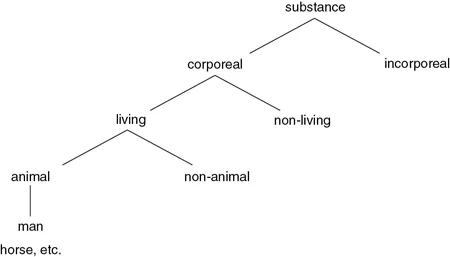
Figure 1.1
Differences may be divisive or constitutive. For example, the genus LIVING BEING is potentially divisible into the differences sensitive/insensitive, but the sensitive difference may be compounded with the genus LIVING to constitute the species ANIMAL. In its turn ANIMAL becomes a genus divisible into rational/irrational, but the rational difference is constitutive, with the genus that it divides, of the species RATIONAL ANIMAL. Differences, then, divide a genus (and the genus contains them as potential opposites) and they are selected to constitute in practice a subordinate species, destined to become in its turn a genus divisible into new differences.
The Isagoge suggests the idea of the tree only verbally, but medieval tradition visualized the project as seen in Figure 1.2.
In the tree in Figure 1.2 the dotted lines mark the dividing differences, while the solid lines mark the constitutive differences. We remind the reader that the god appears both as an animal and as a body because, in the Platonic theology that constitutes Porphyry’s frame of reference, the gods are intermediary natural forces and not to be identified with the One.5
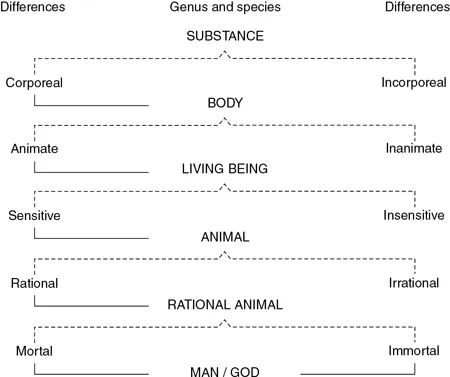
Figure 1.2
From the contemporary point of view of a distinction between dictionary and encyclopedia, the Porphyrian tree certainly introduces, with its differences, encyclopedic properties into a dictionary structure. In fact, being Sensitive, Animate, Rational, and Mortal are accidents identifiable in terms of knowledge of the world, and it is on the basis of its behavior that we decide whether a being is animate or rational, whether, in other words, it expresses ratiocinative capabilities by means of language. In any case, the end purposes of the tree are those of a dictionary, in which the differences are necessary and sufficient conditions to distinguish one being from another and to make the definiens or definer coextensive with the definiendum or definee, so that, if ANIMAL RATIONAL MORTAL, therefore of necessity human, and vice versa.
Once more, however, in its canonical version, this tree reveals its inadequacy, because it distinguishes, in a logically satisfactory fashion, God from man, but not, let’s say, a...
Table of contents
- Cover
- Half Title
- Title Page
- Copyright
- Contents
- Introduction
- 1. From the Tree to the Labyrinth
- 2. Metaphor as Knowledge: Aristotle’s Medieval (Mis)Fortunes
- 3. From Metaphor to Analogia Entis
- 4. The Dog That Barked (and Other Zoosemiotic Archaeologies)
- 5. Fakes and Forgeries in the Middle Ages
- 6. Jottings on Beatus of Liébana
- 7. Dante between Modistae and Kabbalah
- 8. The Use and Interpretation of Medieval Texts
- 9. Toward a History of Denotation
- 10. On Llull, Pico, and Llullism
- 11. The Language of the Austral Land
- 12. The Linguistics of Joseph de Maistre
- 13. On the Silence of Kant
- 14. Natural Semiosis and the Word in Alessandro Manzoni’s The Betrothed (I promessi sposi)
- 15. The Threshold and the Infinite: Peirce and Primary Iconism
- 16. The Definitions in Croce’s Aesthetic
- 17. Five Senses of the Word “Semantics,” from Bréal to the Present Day
- 18. Weak Thought versus the Limits of Interpretation
- References
- Index
Trusted by 375,005 students
Access to over 1.5 million titles for a fair monthly price.
Study more efficiently using our study tools.
Frequently asked questions
Yes, you can cancel anytime from the Subscription tab in your account settings on the Perlego website. Your subscription will stay active until the end of your current billing period. Learn how to cancel your subscription
No, books cannot be downloaded as external files, such as PDFs, for use outside of Perlego. However, you can download books within the Perlego app for offline reading on mobile or tablet. Learn how to download books offline
Perlego offers two plans: Essential and Complete
- Essential is ideal for learners and professionals who enjoy exploring a wide range of subjects. Access the Essential Library with 800,000+ trusted titles and best-sellers across business, personal growth, and the humanities. Includes unlimited reading time and Standard Read Aloud voice.
- Complete: Perfect for advanced learners and researchers needing full, unrestricted access. Unlock 1.5M+ books across hundreds of subjects, including academic and specialized titles. The Complete Plan also includes advanced features like Premium Read Aloud and Research Assistant.
We are an online textbook subscription service, where you can get access to an entire online library for less than the price of a single book per month. With over 1.5 million books across 990+ topics, we’ve got you covered! Learn about our mission
Look out for the read-aloud symbol on your next book to see if you can listen to it. The read-aloud tool reads text aloud for you, highlighting the text as it is being read. You can pause it, speed it up and slow it down. Learn more about Read Aloud
Yes! You can use the Perlego app on both iOS and Android devices to read anytime, anywhere — even offline. Perfect for commutes or when you’re on the go.
Please note we cannot support devices running on iOS 13 and Android 7 or earlier. Learn more about using the app
Please note we cannot support devices running on iOS 13 and Android 7 or earlier. Learn more about using the app
Yes, you can access From the Tree to the Labyrinth by Umberto Eco, Anthony Oldcorn in PDF and/or ePUB format, as well as other popular books in Literature & Literary Essays. We have over 1.5 million books available in our catalogue for you to explore.