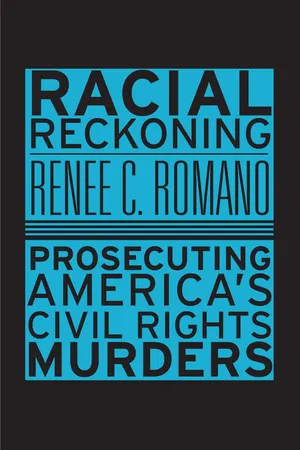
Few whites who violently resisted the civil rights struggle were charged with crimes in the 1950s and 1960s. But the tide of a long-deferred justice began to change in 1994, when a Mississippi jury convicted Byron De La Beckwith for the 1963 murder of Medgar Evers. Since then, more than one hundred murder cases have been reopened, resulting in more than a dozen trials. But how much did these public trials contribute to a public reckoning with America's racist past? Racial Reckoning investigates that question, along with the political pressures and cultural forces that compelled the legal system to revisit these decades-old crimes.
Renee C. Romano brings readers into the courthouse for the trials of the civil rights era's most infamous killings, including the Birmingham church bombing and the triple murder of Andrew Goodman, James Chaney, and Mickey Schwerner. The activists who succeeded in reopening these cases hoped that bringing those responsible to justice would serve to highlight the state-sanctioned racism that had condoned the killings and the lingering effects of racial violence. Courtroom procedures, however, worked against a deeper exploration of the state's complicity in murder or a full accounting of racial injustices, past or present. Yet the media and a new generation of white southerners—a different breed from the dying Klansmen on trial—saw the convictions as proof of the politically rehabilitated South and stamped "case closed" on America's legacy of violent racism. Romano shows why addressing the nation's troubled racial past will require more than legal justice.
- 268 pages
- English
- ePUB (mobile friendly)
- Available on iOS & Android
eBook - ePub
About this book
Information
Publisher
Harvard University PressYear
2014Print ISBN
9780674976030
9780674050426
eBook ISBN
9780674966888
Topic
StoriaSubtopic
Storia nordamericana1
Crimes and Complicity during the Civil Rights Era
Nations and communities, by the standards of conduct they establish and which their citizens stand up and speak up to defend, create the social atmosphere which can breed atrocities—or respect for fellow man.—Charles Morgan Jr., A Time to Speak, 1964
ON MARCH 15, 1965, Martin Luther King Jr. took the stage at the packed Brown Chapel in Selma, Alabama, to deliver a eulogy for Reverend James Reeb. Reeb, a thirty-five-year-old white Boston minister, had come to Alabama to participate in the 1965 voting rights march from Selma to Montgomery. He died after being attacked by a group of white men outside a Selma restaurant. Addressing the grieving audience at the memorial ceremony, King insisted that the important question was not who killed Reeb; the answer was clearly a “few sick, demented, and misguided men who have the strange notion that you express dissent through murder.” The more desperate question, King argued, was what killed James Reeb. “When we move from the who to the what, the blame is wide and the responsibility grows.” King had made this point before. Two years earlier, at the funeral for the four young victims of the 1963 Birmingham church bombing, he laid the responsibility for the murders at the feet of ministers who remained silent in the face of injustice, politicians who spewed racial hatred, and a federal government that compromised with segregationists. Society must focus not only on catching the murderers, he insisted, but also “the system, the way of life, the philosophy which produced the murderers.”1
Few whites in the South actually planted bombs in churches or committed acts of violence themselves. But as King recognized, the endemic violence of the civil rights era was not best understood as the acts of a few bad men. Those who bombed churches and beat and killed protestors were produced and enabled by a social and political environment in, and often beyond, the South that tolerated violence directed at blacks and their white allies. The terror campaign that took place in the South in the civil rights era reflected a much broader community willingness to condone violence in the name of defending and maintaining the system of segregation.
Most white Southerners refused to consider the ways in which the racial violence of the era was supported by the institutions of white society or the defensiveness of southern communities in response to any criticism of their racial practices. More typically, whites assumed the mantle of aggrieved victims, blaming protestors for instigating violence or outsiders for exposing it, rather than considering the ways in which they may have contributed to a political environment that cultivated it. “All of us are victims, and most of us are innocent victims,” Birmingham mayor Albert Boutwell declared in the aftermath of the 1963 church bombing.2 But the terror campaign that took place in the South in the 1950s and 1960s could not have continued without the tacit, and often open, support of police, political officials, community leaders, and white bystanders, who did little to rein in violence or to condemn murder.
In the twenty-first century, terrorism has become nearly synonymous with Islamic fundamentalism, associated almost unconsciously by many Americans with turbans and burkas. But for most of this nation’s history, violence served as a crucial means to construct, maintain, and uphold white supremacy. During the colonial era, the violent treatment of blacks through whippings, brandings, torture, and castration—brutalization that by the mid-eighteenth century was no longer socially acceptable for whites—became one of the key markers of racial status and a cornerstone of slavery. After the Civil War, violence became one of the most important tools in southern whites’ struggle to reassert economic and political domination over a newly freed labor force. Violence served not only as a tool for seeking power, but as a symbolic act with cultural meanings that helped whites “mark the inferiority of blackness.”3 Lynching, the form of racial violence most associated with the period between the end of Reconstruction and the beginnings of the civil rights movement, served as a practical and symbolic tool of racial domination. Lynchings offered theatrical spectacles of white supremacy, as whites claimed their economic, cultural, and social dominance over blacks through ritualized forms of mob violence often carried out in official public spaces. This was a systematic form of racial terrorism, an assertion of whites’ power and their economic, social, political, and psychological domination over African Americans.4
In the 1950s and 1960s, the bombings, beatings, and murders of the civil rights era would, like earlier articulations of racial violence, serve both the instrumental and symbolic ends of asserting white supremacy at a time of racial flux and challenge. A host of changes in the wake of World War II threatened to undermine the South’s system for maintaining white supremacy. Claims about the biological superiority of whites and of black genetic inferiority lost respectability and legitimacy in the wake of the racial genocide of the Holocaust. The mass migration of black Southerners to northern and western cities helped create a new political dynamic as more African Americans could vote and exert some influence on national political parties. The Cold War with the Soviet Union stifled many forms of radical activism, but it also held a mirror up to U.S. practices that failed to live up to the nation’s rhetoric about democracy and equality. These intellectual, political, and global shifts would begin to undermine the legitimacy of an order based on essentialist claims of black inferiority and government-sanctioned discrimination, reflected in early Supreme Court rulings like the 1944 Smith v. Allwright decision, which ended the white primary, and Brown v. Board of Education, which declared segregation of public schools unconstitutional in 1954.
African Americans responded to the changing dynamics by intensifying their struggle to overturn the Jim Crow system and to gain full economic and political equality. Black veterans who came back to the South after World War II, a war supposedly fought to guarantee freedom around the world, became more insistent in their demands for racial equality and the right to vote. In Montgomery, Alabama, in 1955, Martin Luther King Jr. would emerge as a charismatic spokesperson and leader of what would become a nonviolent movement to win blacks’ civil rights. Black students emerged as a powerful force for change in 1960 as they staged sit-ins across the South to demand the integration of stores and restaurants. The Student Nonviolent Coordinating Committee, borne of the sit-in movement, would pioneer new forms of community organizing in grassroots campaigns to challenge the racial caste system. African Americans outside the South joined in as well, demanding an end to discrimination in employment and housing, to segregation in schools, and to the violence inflicted on them by police in their everyday lives. Although not all of the goals of the movement would be achieved, by the mid-1960s protestors had succeeded in forcing passage of new federal laws that outlawed segregation in public accommodations and that protected blacks’ right to vote.
Many whites fought back against this challenge to the laws and customs that protected their privileges. They staged political revolts, bolting from the Democratic Party to support their own third-party candidates. Community leaders organized themselves to resist what they saw as unwarranted federal encroachments on southern customs and traditions. Within months of the Brown decision, whites in Indianola, Mississippi, created the first White Citizens’ Council, hoping “to stop desegregation before it begins.”5 Blacks who tried to start or revive branches of the NAACP, who fought for better conditions in their schools, or who tried to register to vote found themselves facing a newly energized wall of white resistance. And the Ku Klux Klan, a group that had been somewhat dormant in the South in previous decades, reemerged and gained new members as it took on the role of violent guardians of the racial status quo, men who would use whatever means necessary, from burning churches to bombing houses to murder, to protect the privileges accorded whites. White Southerners understood that economic intimidation, legal persecution, and political counterorganizing would not be enough to stem the burgeoning movement among blacks. As John Satterfield, the president of the Mississippi Bar Association, explained in a speech after the Brown decision, Southerners would likely have to turn to “the gun and torch” in order to protect segregation.6
No one knows for sure how many people were killed during the terror campaigns of the civil rights era. The FBI estimates that approximately one hundred people died in politically and racially motivated murders in the years from 1950 to 1970, while advocacy organizations point to as many as 200 killings that they believe were part of an effort to uphold and maintain the racial order in the South.7 The scope and nature of civil rights–era violence has sometimes been hard to see, in part because the killings of the 1950s and 1960s took place at a time when the number of lynchings—a special category of racial crimes usually defined as ritualized public murder by a mob—was decreasing. The language of lynching had provided a familiar way to understand violence as a tool of racial intimidation and terror; without it, many Americans assumed that violence was falling out of favor as a means of enforcing racial subordination.8 But like lynchings, the racial murders of the 1950s and ’60s operated as a tool of racial terrorism, driven by a desire to stifle black protest and to uphold white supremacy. And although the number of perpetrators was fewer than in traditional lynchings, the relatively small group of men who committed most of these racially motivated murders could not have acted with such impunity without the broader implicit, and sometimes explicit, support of the white community.
The murders of the civil rights era were not random acts of violence, even if the victims were sometimes chosen randomly. Some of the killings are best understood as assassinations—the murder of someone regarded as a leader to further a political cause. Many of the people who first demanded political and economic equality in the years after World War II died at the hands of whites. A bomb placed under their house killed Harry Moore and his wife, Harriette, as they slept on Christmas night 1951. As leader of the Florida state NAACP, Moore had led efforts to register black voters and to equalize pay for black teachers. In a state with a very active Ku Klux Klan, Moore’s activities were, in the words of a later Florida NAACP chapter president, “extremely suicidal.”9 Others who shared Moore’s fate included voting rights advocate Reverend George Lee, who was murdered in Belzoni, Mississippi, in May 1955, and Lamar Smith, gunned down on the lawn of the local courthouse in Brookhaven, Mississippi, in 1955 after encouraging local blacks to vote. Herbert Lee, a local leader who helped the Student Nonviolent Coordinating Committee organize a voting rights campaign in Amite, Mississippi, died after being shot by a Mississippi state legislator in 1961. The lone witness to that murder was killed three years later. As the movement gained national attention and some legislative successes, more leaders would be assassinated, including not only Medgar Evers and Vernon Dahmer, but most famously, Dr. Martin Luther King Jr., gunned down on the balcony of a Memphis hotel in 1968.
Whites who came to the South to join the fight for civil rights in the 1960s, like slain Freedom Summer volunteers Mickey Schwerner and Andrew Goodman, frequently became targets of those fighting to maintain segregation. In April 1963, New York postal worker William Moore was gunned down on an Alabama highway while on a one-man crusade to hand the Mississippi governor a letter urging him to support integration. Two other white volunteers in the 1965 Selma-to-Montgomery voting rights march suffered the same fate as the murdered Boston minister James Reeb. Two weeks after Reeb’s murder, Klansmen shot and killed Viola Liuzzo, a white housewife from Detroit, as she ferried marchers in her car between Selma and Montgomery. Jonathan Daniels, a young seminary student from Vermont who had also come for the Selma march, decided to stay in Alabama after the murders of Reeb and Liuzzo. He became the first white volunteer in Lowndes County, an area known for its particularly violent resistance to integration. On August 20, 1965, after being released from jail following a protest, Daniels and several other civil rights workers went to the general store in Fort Armstrong, Alabama, to buy some sodas. Tom Coleman, a local man rumored to be a member of the Klan, met them at the door and shot Daniels at point-blank range.
But it was not just those who were actively engaged in the fight against segregation who proved vulnerable. Many others got caught up in the violence unleashed by black protests and the challenges to the racial order. A group of white men in Gregg County in east Texas, intent on sending a message to blacks who might expect to go to school with whites as a result of the Brown decision, killed sixteen-year-old John Earl Reese when they sprayed gunfire at a local café crowded with dancing black teenagers one night in October 1955. In 1963, on the same day four black girls died in the Birmingham church bombing, two other black teenagers were killed in Birmingham. Two white teenagers seeking to “scare” someone on their way home from a segregationist rally shot and killed thirteen-year-old Virgil Ware as he rode on the handlebars of his brother’s bike.10 Birmingham police shot sixteen-year-old Johnny Robinson in the back when they fired into a crowd of black teenagers who were throwing stones at a white segregationist’s car.

An unknown number of African Americans became victims of Klan “nightriders,” Klansmen who went out at night looking to terrorize black communities. Perhaps the best-known victim of nightriders was Lemuel Penn, a forty-nine-year-old army reservist from Washington, D.C., who was killed on July 11, 1964, while driving back home from two weeks of reserve training at Fort Benning, Georgia. Penn, an assistant superintendent of schools in D.C., had not left the army base during his two-week stay specifically because he wanted to avoid any “racial unpleasantness.” Klansmen saw Penn and his two companions on the road and targeted them because of their Washington, D.C., license plates. They shot into the car, one later explained, because they thought that the “out-of-town niggers” might be there to stir up trouble. “We thought he might’ve been one of President Johnson’s boys.”11 Other victims of nightriders included Willie Brewster, gunned down on a July night in 1965 on his way home from his shift at an Anniston, Alabama, foundry, and Johnnie Mae Chappell, a mother of ten shot by white men in a passing car as she walked along the road in Florida in 1964.
Blacks perceived as transgressing customary racial boundaries—like the rules that barred any intimacy between black men and white women, or customs that demanded blacks be subservient or that they not seek jobs traditionally reserved for whites—also became common victims of violent retaliation, reflecting the ways in which violence served as a tool of racial and social control to maintain whites’ status and privilege. Emmett Till’s murderers defended their brutal slaying of the teenager on the grounds that they needed to make an example of what happened to blacks who didn’t remember their place. “It was time a few people got put on notice,” one of them insisted, “. . . just so everybody can know how me and my folks stand.”12 Two years after Till’s 1955 murder, Klansmen forced twenty-five-year-old truck driver Willie Edwards to jump to his death off an Alabama bridge because they mistakenly believed he was having an affair with a white woman. Oneal Moore and Wharlest Jackson became targets after taking jobs that had traditionally been reserved for whites. Moore, killed in a drive-by shooting in 1965, was the first black deputy sheriff appointed in Washington Parish, Louisiana, while Jackson died in a car bombing in Natchez, Mississippi, in 1967 after accepting...
Table of contents
- Cover
- Title Page
- Copyright
- Dedication
- Contents
- Introduction. Exhuming the Past
- 1. Crimes and Complicity during the Civil Rights Era
- 2. “Jim Crow” Justice
- 3. Reopening Civil Rights–Era Murder Cases
- 4. Civil Rights Crimes in the Courtroom
- 5. Civil Rights Trials and Narratives of Redemption
- 6. From Legal Justice to Social Justice
- Conclusion: “We Are All Mississippians”
- Notes
- Acknowledgments
- Index
Trusted by 375,005 students
Access to over 1.5 million titles for a fair monthly price.
Study more efficiently using our study tools.
Frequently asked questions
Yes, you can cancel anytime from the Subscription tab in your account settings on the Perlego website. Your subscription will stay active until the end of your current billing period. Learn how to cancel your subscription
No, books cannot be downloaded as external files, such as PDFs, for use outside of Perlego. However, you can download books within the Perlego app for offline reading on mobile or tablet. Learn how to download books offline
Perlego offers two plans: Essential and Complete
- Essential is ideal for learners and professionals who enjoy exploring a wide range of subjects. Access the Essential Library with 800,000+ trusted titles and best-sellers across business, personal growth, and the humanities. Includes unlimited reading time and Standard Read Aloud voice.
- Complete: Perfect for advanced learners and researchers needing full, unrestricted access. Unlock 1.5M+ books across hundreds of subjects, including academic and specialized titles. The Complete Plan also includes advanced features like Premium Read Aloud and Research Assistant.
We are an online textbook subscription service, where you can get access to an entire online library for less than the price of a single book per month. With over 1.5 million books across 990+ topics, we’ve got you covered! Learn about our mission
Look out for the read-aloud symbol on your next book to see if you can listen to it. The read-aloud tool reads text aloud for you, highlighting the text as it is being read. You can pause it, speed it up and slow it down. Learn more about Read Aloud
Yes! You can use the Perlego app on both iOS and Android devices to read anytime, anywhere — even offline. Perfect for commutes or when you’re on the go.
Please note we cannot support devices running on iOS 13 and Android 7 or earlier. Learn more about using the app
Please note we cannot support devices running on iOS 13 and Android 7 or earlier. Learn more about using the app
Yes, you can access Racial Reckoning by Renee C. Romano in PDF and/or ePUB format, as well as other popular books in Storia & Storia nordamericana. We have over 1.5 million books available in our catalogue for you to explore.