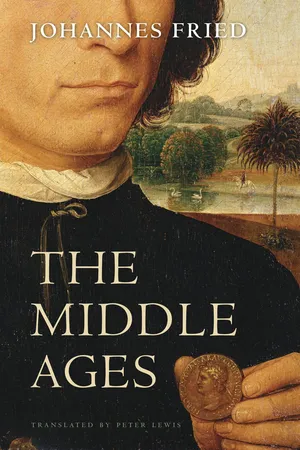
Since the fifteenth century, when humanist writers began to speak of a "middle" period in history linking their time to the ancient world, the nature of the Middle Ages has been widely debated. Across the millennium from 500 to 1500, distinguished historian Johannes Fried describes a dynamic confluence of political, social, religious, economic, and scientific developments that draws a guiding thread through the era: the growth of a culture of reason.
Beginning with the rise of the Franks, Fried uses individuals to introduce key themes, bringing to life those who have too often been reduced to abstractions of the medieval "monk" or "knight." Milestones encountered in this thousand-year traversal include Europe's political, cultural, and religious renovation under Charlemagne; the Holy Roman Empire under Charles IV, whose court in Prague was patron to crowning cultural achievements; and the series of conflicts between England and France that made up the Hundred Years' War and gave to history the enduringly fascinating Joan of Arc. Broader political and intellectual currents are examined, from the authority of the papacy and impact of the Great Schism, to new theories of monarchy and jurisprudence, to the rise of scholarship and science.
The Middle Ages is full of people encountering the unfamiliar, grappling with new ideas, redefining power, and interacting with different societies. Fried gives readers an era of innovation and turbulence, of continuities and discontinuities, but one above all characterized by the vibrant expansion of knowledge and an understanding of the growing complexity of the world.
- 580 pages
- English
- ePUB (mobile friendly)
- Available on iOS & Android
eBook - ePub
The Middle Ages
About this book
Information
1
Boethius and the Rise of Europe
BOETHIUS, the most learned man of his time, met his death in the hangman’s noose. He came from one of the most noble senatorial families of Rome and was a patrician, a consul, and a minister at the court of the Ostrogoth King Theodoric in Ravenna. Nevertheless, he fell victim to this same barbarian ruler; neither Theodoric himself nor his realm was to survive for long following the demise of his minister. Contemporary commentators believed that this tyrant had descended to the bowels of Mount Etna, into Hell itself, whence he would occasionally return as a wild horseman and a harbinger of doom. In truth, Theodoric simply passed away in 526. The precise reasons for the fall of his first minister have been lost in the mists of time. No proof of guilt for a crime was ever brought forth. It appears that this famous Roman was toppled purely by the mistrust of his king. This turned out to be a serious misjudgment, which the Goth ruler must instantly have regretted, albeit not soon enough to save himself.
And yet the life of Boethius was a triumph! The West owes this individual, Anicius Manlius Severinus Boethius, nothing less than its progression toward a culture of reason. Such a culture may be regarded as a blessing or a curse. Alongside many other gifts, Boethius left the Latin West, which was not familiar with Greek culture, a translation of one of the most seminal didactic texts in history, nothing less than a primer for the application of reason. This slim volume, really only a pamphlet, comprising the first three texts from Aristotle’s Organon, provided an introduction to a mode of thinking that was subject to learnable rules and therefore susceptible to scrutiny and correction, was logically comprehensible, and obeyed the principle of causality. Coming at just the right moment, just as the tenth century was rediscovering and becoming enthralled with the concept of reason, these short tracts supplied a vital tool kit worth more than its weight in gold. They were a constant throughout the centuries that made up the Middle Ages, helping to shape scholars of the age from Scotland to Sicily, Portugal to Poland, and facilitating the growth of Western scholarship as a whole. It wasn’t emperors and kings that made Europe great, but the categorical mode of thinking inspired by this translation, and the application of reason that ensued as a result.
Boethius added a number of writings to this body of work, notably a brief account of the “distinctions,” his Liber de divisione, which dealt with the systematically arranged and logically “divided” order of the world and the sovereign principle guiding it. A similarly short treatise on arithmetic and a series of observations on music completed the literary legacy of the Roman; both of these likewise drew on ancient Greek sources and were instrumental in pointing the way forward for the future development of Western thought. It was Boethius who was responsible for introducing fundamental concepts such as “principle,” “subject,” or “substance” to European scholarly discourse. The decisive factor for the future was not that he had coined these terms himself, but that he employed them and taught others how to use them. He reminded people that knowledge is not some property that issues from the object of contemplation, but rather one that is inherent in the cognitive faculty of the thinking and perceiving subject. Boethius also, it seems, coined the term quadrivium, which in contrast to the trivium of grammar, rhetoric, and dialectics was an umbrella term for the four mathematical/arithmetical disciplines in the canon of the “liberal arts.”
In his dungeon, however, so tradition relates, having been subjected to the cruelest torture, Boethius wrote his principal work, the Consolation of Philosophy in the last few months before his execution. This slim but profound volume bears witness to a final brilliant flash of ancient learning before its ultimate extinction. During the Middle Ages and the Modern Period it was transcribed hundreds of times, read and reread time and again, annotated, deliberated on, and made one of the first books to be set in printed type. It was also the impetus for Dante to portray himself meeting Boethius in the sunlit heaven of Paradise, together with the great heroes of Christian thought, such as Thomas Aquinas, Albertus Magnus, and the Venerable Bede, along with Solomon and other outstanding wise men (Paradise X, 124–129). And it has continued to resonate up to the present day, for example in the Moabit Sonnets written by the poet Albrecht Haushofer, a victim of the Nazi dictatorship. Nevertheless, this Consolation of Boethius dispensed with all specifically Christian content and remained strictly within the Neoplatonic tradition of which its author was a part.
The prisoner conducted an “internal dialogue.” The embattled soul freed itself from all its bonds through conversations with Philosophia and Fortune—the personifications of wisdom and fate—and through meditations on God’s foreknowledge, predestination, “intention,” “reason,” human emotions and free will, on “chance” and “necessity,” and finally on the nature of true happiness the soul helped dispel all cares. Now all earthly prosperity and success and fame evaporated; true blessedness was only to be found in God and (in the approved Neoplatonist manner) in the liberating ascent to gaze upon God’s countenance. “Hopes are not vainly put in God, nor prayers in vain offered.… If you would be honest, great is the necessity enjoined upon your goodness,” the condemned man finally admonishes his readers with the words of Philosophy, “since all you do is done before the eyes of an all-seeing Judge.” Here Boethius was broaching themes that were to underpin Christianity for many centuries to come, indeed over the whole of the following millennium. These themes were subject to constant adaptation and extrapolation, and have lost none of their relevance—note, for instance, his reference to free will—even in the twenty-first century.
The Consolation was a linguistic masterpiece. In both substance and form, it provided numerous literary models, musical and rhythmic patterns, and presented ancient metrical forms in all their beauty, which served as a template for the prosodic education of medieval poets:
Ó qui pérpetuá mundúm ratione gubérnasTérrarum caelíque satór, qui témpus ab aévoIúre iubés stabilísque manens das cúncta movéri.
“O Thou, who by eternal Reason’s law / The World dost rule! Great parent of the heavens / And of the Earth! By whose command supreme, / Time flows from birth of ages!” Thus begins one of the most famous, constantly translated and reworked “hymns” of the “Consolation.” The work as a whole reminded the reader of the unity of scholarship and life and through its Neoplatonist approach made great play of the dispute between theology and philosophy. The yawning chasm that was time and again to force apart reason and faith over the course of the Middle Ages and the Modern Period first began to open up here. The Anglo-Saxon monk Alcuin was responsible for disseminating the work to the court of Charlemagne and to the kingdom of the Franks, where its effect soon began to be felt. As a monk from St. Gallen asserted in the tenth century, Boethius’ teachings were “more philosophical than Catholic.”1 Still, the stimulus provided by his Consolation prompted the West to critique his specifically theological writings—On the Trinity and others—which had been known since the ninth century and by the twelfth century were instrumental in helping transform theology into a rational, reason-led discipline worthy of study at the leading universities. At the time, Peter Abelard, one of the greatest philosophers of his age, praised Boethius as the “greater Latin philosopher.”2
Boethius, then, was the last Neoplatonist of note in late antiquity. The deaths of Boethius and his contemporary Cassiodorus spelled the end of an era. The abundance of schools of philosophy, educational institutions, and religions that the ancient world and Late Antiquity boasted, even in the Latin West of the Roman Empire, had all dissipated by now. Most of the academies had lost their patrons; even the School of Athens, where Plato had once been active, had just closed. The Byzantine restoration in Africa, Italy, and Spain extinguished the last few flickerings of life. Stoicism, Aristotelianism, New Pythagoreanism, mysticism, skepticism, mystery religions, and Mithraic and Dionysian cults (Manichaeism)—to name just the most significant belief systems—were all banned, or had fallen silent, died out, or become alien concepts. The few remaining writers adopted an overblown style in place of former clarity, while visual art ossified into the formalism of icon painting. The only thing left was Christianity, with its established church and its heresies. For all its growing hostility and opposition to Judaism, it could not deny its roots in the Jewish faith and in gentile adaptations of Judaic practice. But Judaism itself had also survived; forced in the Diaspora to come to terms with many and varied surroundings, it began to split into Sephardic and Ashkenazi traditions. Only in the East, in Byzantium and in the Arabic koine lingua franca that originated there, did the last isolated vestiges survive of the Ancient Greek body of knowledge comprising philosophy, medicine, cosmology or geography. And only there were Greek original texts or their Arabic translations passed on and preserved for posterity.
The church fathers of the Latin West—among whom Boethius, despite being a Christian, is not usually counted—made not the slightest attempt to style themselves as philosophers, despite the fact that many had been schooled in grammar and rhetoric or even—as in the case of Saints Augustine of Hippo or Jerome—had originally pursued careers as rhetoricians and lawyers. Taking issue with the Old and New Testament orthodoxy on the question of revelation, and in express opposition to the old modes of teaching, they developed their own form of literature, which consisted of apologias, exegetical and paraenetic works, and texts with a didactic or improving function, rather than scholarly research and experimentation. Their language, knowledge, thinking, and beliefs were to establish norms for the following centuries. Last, they preached a literary “simplicity” that shunned the traditional educational canon. Over a long period, great poets who continued to evoke the heathen pantheon were pilloried. After all, what did Christ have to do with Jupiter? Christian writers instead adopted a tone of lamentation or chiding. Later, the despised verses of, say, Virgil, Ovid, or Horace, had to be painstakingly sought out and copied from the dispersed remains of ancient libraries before they could begin, from the tenth century onward, to exert a renewed influence on the language of a blossoming renaissance among medieval writers and poets.
Accordingly, only a very sparse educational canon, a thin trickle of knowledge that carried little with it, flowed from Late Antiquity down to the Middle Ages. It comprised four, maybe five, books, no more. In any event, the earliest of these can only be deduced—an “instructional text for the study of the Arts, reworked in the Christian mode,” written around 400; its influence can be surmised in the writings of Saints Augustine and Jerome and later in those of Cassiodorus and sundry excerpts from other writers.3 With his treatise De doctrina Christiana, which was constantly read and reread from the Carolingian period onward, Saint Augustine had at least provided the basis for a theory of learning geared toward the Holy Gospel, while at the same time vindicating the “Liberal Arts”; but however important this tract was, it was by no means enough. In it, the bishop of Hippo Regius in North Africa directed his readers’ attention to “things” and their “signs,” in other words to semiotics and the questions of comprehension and expression. “Things are learned through signs” (I, 2.2.4). In time, medieval textual exegesis and interpretation of the world were to be imbued with the spirit of this work. Only from the twelfth and thirteenth centuries, however, do new, Aristotelian ways of interpreting knowledge begin to assert themselves. By contrast, in addition to the writings of Saint Augustine, the considerably shortened and simplified textbook written by Cassiodorus—which clearly drew on Augustine’s works for inspiration, and which has come down to us via numerous manuscripts from the High Middle Ages—conveyed a Christian educational program and quite an extensive overview of the disciplines. In just a few succinct sentences, his Institutions outlined each and every one of the “Liberal Arts,” which by this time—at variance with older textbooks—numbered just seven. Ultimately, the Middle Ages was also to have one further outline of the ancient canon of learning to draw upon: De nuptiis Philologiae et Mercurii, a work written in the fourth or fifth century by Martinus Capella, which he couched in verse form in the guise of a wedding present to celebrate the betrothal of Philology to Mercury. The Middle Ages took this allegorically framed foundation course in the arts to its heart, and following the rediscovery of the single surviving manuscript of the text in the ninth century, accorded it the status of one of its primary textbooks.
By the time Boethius fell victim to intrigue and mistrust, Europe was a conglomerate of formerly flourishing provinces that were now faced with decline. The ancient civilizations—Athens and Rome—had grown old and weak and collapsed. Just a century earlier (410), Alaric had overrun Rome—the first time this had happened for more than 700 years. The incident was both shocking and emblematic. The city was to suffer two further sackings by barbarian hordes during the course of the fifth century. Yet “what will remain standing if Rome falls?” as Saint Jerome asked presciently, in far-off Palestine, even prior to the first sacking, in 409 (Epistle 123). At that time, Augustine was moved to put pen to paper to write an apologia in defiance of the empire’s collapse. This work—The City of God—became a comprehensive blueprint for the whole story of Christian salvation, and its effects are still felt today. In it, Augustine maintained that it was not, as the last pagans had claimed, the neglect of the old cult of the Roman gods that had brought about the city’s downfall but rather the Romans’ own failings. A thousand years later, fifteenth-century humanists would shun this insight, preferring instead to ascribe the empire’s decline to the conquering Goths.
Wherever one looked, the land was ravaged by recurrent bouts of war, in the East and West alike. The great cities, including Roma aeterna (eternal Rome), and their public buildings crumbled into ruins. Over time, except for the stone that was reused to erect new churches, marble from the ancient palaces and temples and from the statues of the gods and heroes migrated into the lime kilns of a populace who were increasingly eking out a desperate existence. It was not some great rupture in cultural life that plagued people’s lives, but rather bitter adversity, which eroded and destroyed all vestiges of civilization. Hunger and anxiety divested people of any aesthetic appreciation of beauty or of the “golden Rome” once hymned by the great poets. Roma fuit—Rome is at an end—sang Hildebert von Lavardin, one of the foremost poets of the eleventh century, when contemplating the ruins and rubble of the city on the banks of the Tiber. However, as he gazed at the buildings still standing and the works of art still in evidence, he saw himself looking on in awe and wonder as Rome rose again. Nothing, he claimed, was the equal of Rome: Par tibi, Roma, nihil. To be sure, at first large parts of the shrinking, decrepit Imperium Romanum were under the sway of barbarian rulers. And the city’s last vestiges of vigor were swept away by the plague, which ravaged it in the sixth century, carrying off people and cities, life and culture alike.
It was only in the shadow of Rome that ancient groups and small confederations speaking a variety of Germanic dialects, who were not attuned to the cultural diversity of the Mediterranean world, finally coalesced into identifiable peoples such as the Goths, Franks, or Lombards. They began the arduous task of taking possession of Rome’s treasures and institutions, assimilating its values and the relics of its spiritual legacy. With their arrival, a culture entirely devoted to the oral tradition met the highly literate ancient world, which could do nothing to counter this development, and in fact found itself increasingly dependent upon the barbarian culture. Research conducted in the twentieth century into preliterate nations has given us a new insight into what these barbarians brought with them. One key factor to emerge was that they displayed an additive rather than a subordinative way of thinking, approached things in an aggregative rather than analytical manner, essentially took cognizance of surroundings on the spur of the moment, and were incapable of abstraction. In other words, this way of thinking did not organize its environment systematically or according to categories, but instead preferred to cling tenaciously to familiar, traditional modes of thought and action.4 These same observations may, with all due caution, also be applied to the so-called period of the barbarian invasions and the early Middle Ages. It entailed intensive learning processes—which, thanks to more challenging conditions regarding communications, were far more protracted than any comparable acquisition of cognitive skills nowadays—for societies such as these, which in any case were exposed to revolutionary changes, to advance to the high culture of Late Antiquity. Initially, as modern studies in developmental psychology have shown when comparing different civilizations, their traditional knowledge and their intellectual make-up must have been unsuited for the moment to progress toward a highly evolved form of culture and to the refined modes of living that prevailed in the Roman world.
And yet these outsiders brought with them the determination—manifested by all “barbarian” peoples who overrun advanced civilizations—to imitate those whom they conquered: a fact we know for sure thanks to the testimony of the Visigoth king Athaulf, which has been preserved for posterity. Like his brother-in-law and predecessor, the notorious Alaric, who sacked Rome in 410 and shortly thereafter died and was buried in the river Busento (near Cosenza), Athaulf severely harassed the Western Roman Empire. Yet having plundered Italy, he suddenly turned his back on it and embarked on an invasion of grain-rich Africa via Spain. Although this adventure eventually foundered, advancing no further than Gaul and northern Spain, Toulouse now became the center of a new Visigoth kingdom, which proceeded to put down firm roots there.
Having grown unaccustomed to agricultural labor over the long years of migration and warfare, Athaulf’s warriors found themselves unable to cultivate the devastated fields of the lands they overran. The populace was hit by starvation and destitution. Sword in hand, the king sought help from the Roman emperor, a request he reluctantly agreed to, but which was never fulfilled. The Visigoths once more fell back on their own resources and came to an accommodation with the local populace. Athaulf forced the emperor’s daughter Galla Placidia, who had fallen into his hands (and who would later be interred in the imperial city of Ravenna in a sarcophagus that is still admired today) to marry him. It is from his wedding speech that the famous passage comes down to us, in which Athaulf relates that he was eager to expunge the name of Rome and to transform the Roman Empire into a Visigoth Empire, before it suddenly dawned on him that the unchecked barbarity (effrenata barbaries) of his own kinsmen refused to be reined in by laws; realizing that no polity without laws could endure, he now sought to restore the empire, exalt the name of Rome once again, and secure his place in history as the instigator of Ro...
Table of contents
- Cover
- Title Page
- Copyright
- Contents
- Preface
- 1. Boethius and the Rise of Europe
- 2. Gregory the Great and the New Power of the Franks
- 3. Charlemagne and the First Renewal of the Roman Empire
- 4. Consolidation of the Kingdoms
- 5. The End of Days Draws Menacingly Close
- 6. “The True Emperor Is the Pope”
- 7. The Long Century of Papal Schisms
- 8. The Vicar of God
- 9. The Triumph of Jurisprudence
- 10. The Light of Reason
- 11. The Monarchy
- 12. Waiting for Judgment Day and the Renaissance
- Epilogue: The Dark Middle Ages?
- Illustrations
- Abbreviations
- Notes
- Selected Bibliography
- Index
Trusted by 375,005 students
Access to over 1.5 million titles for a fair monthly price.
Study more efficiently using our study tools.
Frequently asked questions
Yes, you can cancel anytime from the Subscription tab in your account settings on the Perlego website. Your subscription will stay active until the end of your current billing period. Learn how to cancel your subscription
No, books cannot be downloaded as external files, such as PDFs, for use outside of Perlego. However, you can download books within the Perlego app for offline reading on mobile or tablet. Learn how to download books offline
Perlego offers two plans: Essential and Complete
- Essential is ideal for learners and professionals who enjoy exploring a wide range of subjects. Access the Essential Library with 800,000+ trusted titles and best-sellers across business, personal growth, and the humanities. Includes unlimited reading time and Standard Read Aloud voice.
- Complete: Perfect for advanced learners and researchers needing full, unrestricted access. Unlock 1.5M+ books across hundreds of subjects, including academic and specialized titles. The Complete Plan also includes advanced features like Premium Read Aloud and Research Assistant.
We are an online textbook subscription service, where you can get access to an entire online library for less than the price of a single book per month. With over 1.5 million books across 990+ topics, we’ve got you covered! Learn about our mission
Look out for the read-aloud symbol on your next book to see if you can listen to it. The read-aloud tool reads text aloud for you, highlighting the text as it is being read. You can pause it, speed it up and slow it down. Learn more about Read Aloud
Yes! You can use the Perlego app on both iOS and Android devices to read anytime, anywhere — even offline. Perfect for commutes or when you’re on the go.
Please note we cannot support devices running on iOS 13 and Android 7 or earlier. Learn more about using the app
Please note we cannot support devices running on iOS 13 and Android 7 or earlier. Learn more about using the app
Yes, you can access The Middle Ages by Johannes Fried, Peter Lewis in PDF and/or ePUB format, as well as other popular books in History & European History. We have over 1.5 million books available in our catalogue for you to explore.