There have been many studies of George Orwell's life and work, but nothing quite like this book by Alex Woloch—an exuberant, revisionary account of Orwell's writing.
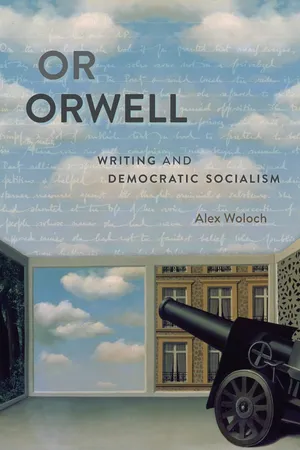
"Good prose is like a window-pane," Orwell famously avers. But what kind of literary criticism is possible, face-to-face with Orwell's plain-style prose? Too often this style has been either dismissed by a seemingly more savvy critical theory, or held up as a reprimand against the enterprise of theory. In a series of unusually close and intensive readings—focused on the unstable event of writing itself—Woloch recovers the radical and experimental energies of Orwell's prose. Against accounts that would quickly naturalize Orwell's truthfulness or reduce his window-pane prose to bad faith, Woloch's study bears down on a propulsive irony and formal restlessness that have always been intertwined with Orwell's plain-style. Such restlessness, far from diluting Orwell's democratic and socialist politics, is at its aesthetic and conceptual core.
The first half of Or Orwell ranges across his nonfiction prose, including new readings of "A Hanging," The Road to Wigan Pier, and Inside the Whale. The second half develops an extended analysis of a single writing project: Orwell's eighty "As I Please" newspaper columns, written for the Socialist weekly Tribune. Moving through multiple forms and genres, testing the limits of each, Orwell emerges in Woloch's fine-grained account as a boldly unconventional writer and a central figure in twentieth-century literature and political thought.
- 410 pages
- English
- ePUB (mobile friendly)
- Available on iOS & Android
eBook - ePub
About this book
Information
Topic
LiteraturaSubtopic
Crítica literaria inglesaPART ONE
Paradoxes of the Plain Style
The 1930s
1
“Quite Bare”
(“A Hanging”)
Orwell’s “Power”
The political scientist Stephen Ingle grounds his important recent study of Orwell in the need to consider him as a writer rather than merely a political thinker, but he stops surprisingly short at the actual prose. Despite his stated goal—of “shifting the traditional focus of Orwell studies more squarely onto Orwell the writer” (23)—Ingle’s analysis repeatedly glances off the burnished surface of Orwell’s plain style, as though there were little to say about the texts as texts. His descriptions of the qualities of the writing, while glowing, thus tend to be both brief and almost tautological. Orwell’s political impact, Ingle avers in his concluding remarks, rests in “the sheer power of his prose” (170). And again, at the end of his book: “[a]s a writer of exceptional power and an exponent of lucid prose, he was unsurpassed” (181). (Transposing “exceptional” and “unsurpassed” here, we can quickly see the circular shape of this praise.) An equally circular structure informs the first discussion of specific works. “A Hanging,” Ingle claims, “is told with force and an economy of style” (36); “Shooting an Elephant,” he remarks in the next paragraph, is “just as forcefully written” as the earlier text (36, emphasis added).1
What constitutes the “power” or the “force” that, in each of these comments, distinguishes Orwell’s prose? On this in Ingle there is essentially “dead silence” (to quote a central phrase from “A Hanging” [10.209]). Such silence, I want to argue, is not the product of one critic’s neglect but is solicited by the terms of Orwell’s writing itself. “Powerful” is a recurrent adjective in readings of Orwell, and of the early text “A Hanging” in particular. It is a descriptor that simultaneously seems to encapsulate the text’s core qualities and, ironically, to block or stall the critical analysis. “Powerful”—in this way perhaps like “beautiful,” “interesting,” or “great”—is a seductive resting point for critical evaluation, and one that often produces a tautological sufficiency. Many of Orwell’s biographers praise and slight “A Hanging” in a similar manner, each discussion both drawn to and suspended by the plain-style power of the text. Gordon Bowker—comparing Orwell’s text to an earlier Somerset Maugham short story—calls “A Hanging” a “far more powerful and effective piece of writing,” “sharply observed” and “remarkable for its freshness” and “its vividness” (89). Michael Shelden describes “a riveting piece whose emotional power comes from a slow but steady accumulation of details” (121). Bernard Crick introduces it as “the first piece of writing that shows the distinctive style and powers of Orwell,” full of “the precise, mundane observation of a Sickert” (151). The ubiquitous recourse to this term of praise—here by Shelden, Crick, Bowker, and Ingle—registers a crucial quality of Orwell’s text. But lined up in this way, such repetition also inevitably feels like a loss. Not just as it travels from one critical response to another, but intrinsically, this evaluative assessment can lose hold of the object that it means to recognize.
This play of recognition and resistance is significant and worth considering. Even Ingle’s minimal terms give the reader something to work with. The power of Orwell’s prose, in Ingle’s encapsulation, consists largely of its “lucidity,” which in turn is rooted in its sparseness or “economy.” “Force,” linguistic clarity, and formal compression are thus aligned here. Orwell’s aesthetic “power” is intertwined with a circumspection that is noted by but also echoed in his critical refraction. The economy of the text would be diminished if it were further elaborated, its “force” diluted. Ironically, Orwell’s simple or plain prose is inapproachable, resistant to critical interpretation. The meaning of such a text, welded to the concise language through which it is conveyed (“vivid,” “sharp,” and “precise”), cannot be amplified without losing these core qualities: in this way, the “plainspoken” text is sealed into itself, even verging on meaninglessness. The “sheer power” of Orwell’s crystalline prose leaves it enigmatic: “A Hanging,” as we’ll see, invokes the “unspeakable” (208) as well as “dead silence,” at its core.2
Reading Plain Style: “It,” “Bare,” “Plank”
What is so striking about “A Hanging,” particularly when we remember its status as such an early Orwell text (still signed “Eric A. Blair”), is how fully it inhabits and knows this condition of the plain style. The opening paragraph makes clear the strange negativity that underlies the economy and lucidity of the prose. A critique of the style is hidden in plain view in this Orwell text—somewhat like the violence of the execution in the story itself—and evident already at the start.
It was in Burma, a sodden morning of the rains. A sickly light, like yellow tinfoil, was slanting over the high walls into the jail yard. We were waiting outside the condemned cells, a row of sheds fronted with double bars, like small animal cages. Each cell measured about ten feet by ten and was quite bare within except for a plank bed and a pot for drinking water. In some of them brown silent men were squatting at the inner bars, with their blankets draped round them. These were the condemned men, due to be hanged within the next week or two.One prisoner had been brought out of his cell. He was a Hindu, a puny wisp of a man. . . . (10.207)
What I’d first call attention to in this opening description is one term that could be deployed on the description: not lucid, economic, or forceful but “bare.” In 1937, for example, Victor Gollancz’s important foreword to The Road to Wigan Pier praises the documentary component of Orwell’s text for the way that it “lays bare” the terrible social and working conditions of the coal-mining areas of northern England (xxii). This paragraph, too, strives to be “quite bare”: shorn of ornament, extraneousness, or distortion. Other descriptive terms, applied belatedly by critics to “A Hanging” (“force,” “economy”), do not appear already in the opening of the text, but “bare” does. Viewed in this light, the opening paragraph conveys an unexpected sense of self-consciousness, as though it weren’t only narrating the story to the reader—as directly as possible—but also functioning, conversely, as a commentary or reflection on itself.3
If we want to ignore this salient word, the text makes that difficult. “Bare” is repeated twice more in the text:
I watched the bare brown back of the prisoner marching in front of me. (208)The superintendent reached out with his stick and poked the bare brown body; it oscillated slightly. (209)
These subsequent occurrences heighten the ironic import of “bare,” in its first use, as a term that also reflects back on the text in which it appears.4 The opening paragraph itself aspires both to “lay bare,” as Gollancz would say (directly presenting the referenced world, as in the sequence of denotative phrases, “[i]t was in Burma,” “we were waiting outside,” “these were the prisoners”) and to attain a condition of bareness, with language stripped down to its least ornate form. This sense of linguistic austerity runs through the paragraph but takes on its most “realized” (i.e., bluntest) form in the sentence that actually includes this term: “Each cell measured about ten feet by ten and was quite bare within except for a plank bed and a pot for drinking water.” The shorn prose is at its most minimal—and thus, paradoxically, most extreme—here. It aims for, and projects, efficiency, external precision (“ten feet by ten”) and tactile directness. The adjective, “plank,” is a crucial one for this crystallization of the plain style—not just phonetically but also semantically. A plank bed is a bed on the verge of being merely a slab of wood (and not a bed at all). The blunt description “plank bed” succeeds at conveying the materiality of the room (its hard surfaces) and, ironically, the inappropriateness of this materiality (a bed should be more than simply a piece of wood). In other words, the plain style at once exploits and registers a dissent against such stark materiality.
This is more than effective reportage. The prose relies on the same deprivation it condemns in order to amplify its own stylistic integrity.5 This sentence, I’ve argued, ratchets up the plainness of the “plain style.” The spare, material sense of the phrase “plank bed” signals the efficacy of the language, its desire to accurately convey this bare world. As a term, “plank bed” wants to be, and seems to be, static free. But as a thing, the plank bed, because of this same bare quality, is glaringly inadequate. The simple phrase pushes the reader into a monstrous, almost oxymoronic world: a world where the material that should constitute an (instrumentally defined) object threatens to simply overwhelm the object. That there is something disturbing about the description, as it confers more stylistic valence (on the writing) in inverse proportion to the deprivation it registers (in the story), is reinforced by other aspects of the plain-style opening. A jarring sense already is triggered by the subtly off-kilter opening sentence and phrase: “It was in Burma, a sodden morning of the rains.” (The correct, or more syntactically seamed, version of this opening would simply read: “It was a sodden morning of the rains in Burma”). Instead, Orwell begins with a latent sentence fragment that foregrounds, but also isolates, the initial pronoun. The “it” here is again ostensibly “bare,” shorn of ornament or extension, direct and simple. (“It” and “bare” have a particularly intimate relationship in the opening.) But the opening word is also, of course, enigmatic and imprecise. (What was in Burma?) “It” points to a thingness but not yet to a specific thing. The pronoun conveys neutrality and thus reliability, yet also seems problematically remote.
As we’ve already seen, the same quiet term, “it,” is deployed in a charged and disturbing manner later in the text (where “it” is once again conjoined with “bare”):
The superintendent reached out with his stick and poked the bare brown body; it oscillated slightly. (19)
Here the pronoun marks the conversion of a person into a “body,” and a body into a thing. “It” replaces “he.” When Orwell writes of the prisoner, now become a corpse, that “it oscillated slightly,” the three words (set off as a freestanding phrase) rehearse the essential brutality that underlies the text. In this process the pronoun’s own semantic nature shifts: pushed beyond an instrumental role, within a channeled system of meaning, “it” becomes a disconcertingly focal point of attention. This reframing of the term at once strains against the subordinate function of any pronoun and brings out the strange materiality of this particular, impersonal pronoun (“it”), which here loses an instrumental sense and forces our attention in and of itself (even as the woodenness of the “plank bed” puts it on the brink of not being a bed at all). Of course, this same unnerving emphasis is also apparent in the opening phrase, as Orwell—already playing on the semantic instability of this thing-like pronoun—gives us the hint of a sentence fragment, and thus a hint of this same arrest. From the very start of this early text, Orwell makes the stakes, and intricacies, of the plain style explicit.
Empty and Full: “Each Cell Was . . . Quite Bare”
My reading of Orwell begins by highlighting these simple words—“it,” “plank,” and “bare”—in the opening paragraph of his very early text. With this focus, I mean to emphasize the curious combination of directness and obstruction entailed by the intensification of the plain style. Despite and because of being so absolute, the style also seems both unnerving and deficient. The text registers not only the aspirations but the costs of such plainness. The insufficiencies of this orientation constellate around a telling trick that the opening plays on the reader, at the hinge of its plainspokenness: the description first empties the cells of persons (the rooms are “quite bare” except for bed and drinking water) and only then notices or inscribes the prisoners. The cells are not, we quickly discover, so bare. This delayed representation of the prisoners might be brief, but the effect of this delay—the misleading, momentary “emptying” of the cells—is pivotal to the opening’s style.
Such a delay works to put what I’m considering the “bare” orientation of this style on an almost inhuman register of description. This register doesn’t so much deliberately or maliciously elide the prisoners who are contained within the cell as (perhaps more disturbingly) fail to discern the distinctively human against mere organic or material form. The opening of “A Hanging” plays with this point of view—a view that would be so remote from a human perspective that it couldn’t draw distinctions between animals, persons, and things. (This is somewhat like the disorienting perspective conjured up in the opening of Dickens’s Bleak House, which features an impersonal narrative attached so closely to the unnatural duration of legal time that it miniaturizes the scale of a human life: “The little plaintiff or defendant who was promised a new rocking-horse when Jarndyce and Jarndyce should be settled has grown up, possessed himself of a real horse, and trotted away into the other world” [16].)
In the rest of this chapter I’m going to focus on this lapse—pressing the analysis in a way that might seem inordinately elaborated in relation to such a small moment. The inversion at the opening of “A Hanging” is an important crux in Orwell. I want to insist on this device—this deception—and foreground its privileged place at the start of Orwell’s first major piece of writing. The deception doesn’t only pose an aesthetics of withholding as an alternative or supplement to Orwell’s empirically committed plain style but places such withholding at the center of this style, even in its earliest manifestation. (All the texts I look at in this book will bear a resonance with the poetics of exclusion—and thus with this particular moment—at the opening of “A Hanging.”)
Couldn’t Orwell simply have meant to do a physical inventory, and not intended the description of the empty cells to carry over to the human population? I want to offer several registers of evidence for the deliberateness of this dissonant reversal (where what is initially described as bare is then reversed to become full). We can point first to the other, more explicit deception of the opening: its postponement of the first-person voice. The self-consciously “bare” introduction does not only elide the object of the text (i.e., the prisoners) but also the narrating subject. There are two things hidden at the start of the story, each reinforcing the other. The reader thus has to reframe the opening two sentences of the essay, which seem as though they are in the third person, after the belated introduction of an anonymous (and still not fully ind...
Table of contents
- Cover
- Title Page
- Copyright
- Dedication
- Contents
- Prologue: Reagan and Theory
- Introduction: Orwell’s Formalism, or A Theory of Socialist Writing
- Part One. Paradoxes of the Plain Style: The 1930s
- Part Two. On the Threshold of Liberty: A Close Reading of “As I Please”
- Conclusion: Happy Orwell
- Notes
- Works Cited
- Acknowledgments
- Index
Trusted by 375,005 students
Access to over 1.5 million titles for a fair monthly price.
Study more efficiently using our study tools.
Frequently asked questions
Yes, you can cancel anytime from the Subscription tab in your account settings on the Perlego website. Your subscription will stay active until the end of your current billing period. Learn how to cancel your subscription
No, books cannot be downloaded as external files, such as PDFs, for use outside of Perlego. However, you can download books within the Perlego app for offline reading on mobile or tablet. Learn how to download books offline
Perlego offers two plans: Essential and Complete
- Essential is ideal for learners and professionals who enjoy exploring a wide range of subjects. Access the Essential Library with 800,000+ trusted titles and best-sellers across business, personal growth, and the humanities. Includes unlimited reading time and Standard Read Aloud voice.
- Complete: Perfect for advanced learners and researchers needing full, unrestricted access. Unlock 1.5M+ books across hundreds of subjects, including academic and specialized titles. The Complete Plan also includes advanced features like Premium Read Aloud and Research Assistant.
We are an online textbook subscription service, where you can get access to an entire online library for less than the price of a single book per month. With over 1.5 million books across 990+ topics, we’ve got you covered! Learn about our mission
Look out for the read-aloud symbol on your next book to see if you can listen to it. The read-aloud tool reads text aloud for you, highlighting the text as it is being read. You can pause it, speed it up and slow it down. Learn more about Read Aloud
Yes! You can use the Perlego app on both iOS and Android devices to read anytime, anywhere — even offline. Perfect for commutes or when you’re on the go.
Please note we cannot support devices running on iOS 13 and Android 7 or earlier. Learn more about using the app
Please note we cannot support devices running on iOS 13 and Android 7 or earlier. Learn more about using the app
Yes, you can access Or Orwell by Alex Woloch in PDF and/or ePUB format, as well as other popular books in Literatura & Crítica literaria inglesa. We have over 1.5 million books available in our catalogue for you to explore.