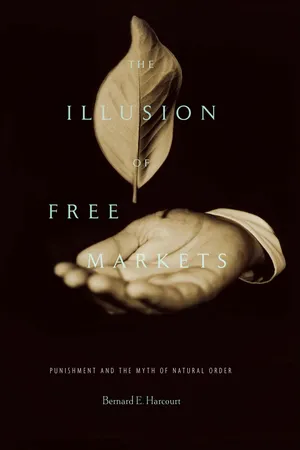
It is widely believed today that the free market is the best mechanism ever invented to efficiently allocate resources in society. Just as fundamental as faith in the free market is the belief that government has a legitimate and competent role in policing and the punishment arena. This curious incendiary combination of free market efficiency and the Big Brother state has become seemingly obvious, but it hinges on the illusion of a supposedly natural order in the economic realm. The Illusion of Free Markets argues that our faith in "free markets" has severely distorted American politics and punishment practices.
Bernard Harcourt traces the birth of the idea of natural order to eighteenth-century economic thought and reveals its gradual evolution through the Chicago School of economics and ultimately into today's myth of the free market. The modern category of "liberty" emerged in reaction to an earlier, integrated vision of punishment and public economy, known in the eighteenth century as "police." This development shaped the dominant belief today that competitive markets are inherently efficient and should be sharply demarcated from a government-run penal sphere.
This modern vision rests on a simple but devastating illusion. Superimposing the political categories of "freedom" or "discipline" on forms of market organization has the unfortunate effect of obscuring rather than enlightening. It obscures by making both the free market and the prison system seem natural and necessary. In the process, it facilitated the birth of the penitentiary system in the nineteenth century and its ultimate culmination into mass incarceration today.
- 337 pages
- English
- PDF
- Available on iOS & Android
eBook - PDF
About this book
Information
Publisher
Harvard University PressYear
2011Print ISBN
9780674066168
9780674057265
eBook ISBN
9780674059368
Table of contents
- Contents
- The Paris Marais and the Chicago Board of Trade
- 1. Beccaria on Crime and Punishment
- 2. Policing the Public Economy
- 3. The Birth of Natural Order
- 4. The Rise of Legal Despotism
- 5. Bentham’s Strange Alchemy
- 6. The Chicago School
- 7. The Myth of Discipline
- 8. The Illusion of Freedom
- 9. The Penitentiary System and Mass Incarceration
- 10. Private Prisons, Drugs, and the Welfare State
- A Prolegomenon
- Bibliography
- Acknowledgments
- Index
Trusted by 375,005 students
Access to over 1.5 million titles for a fair monthly price.
Study more efficiently using our study tools.
Frequently asked questions
Yes, you can cancel anytime from the Subscription tab in your account settings on the Perlego website. Your subscription will stay active until the end of your current billing period. Learn how to cancel your subscription
No, books cannot be downloaded as external files, such as PDFs, for use outside of Perlego. However, you can download books within the Perlego app for offline reading on mobile or tablet. Learn how to download books offline
Perlego offers two plans: Essential and Complete
- Essential is ideal for learners and professionals who enjoy exploring a wide range of subjects. Access the Essential Library with 800,000+ trusted titles and best-sellers across business, personal growth, and the humanities. Includes unlimited reading time and Standard Read Aloud voice.
- Complete: Perfect for advanced learners and researchers needing full, unrestricted access. Unlock 1.5M+ books across hundreds of subjects, including academic and specialized titles. The Complete Plan also includes advanced features like Premium Read Aloud and Research Assistant.
We are an online textbook subscription service, where you can get access to an entire online library for less than the price of a single book per month. With over 1.5 million books across 990+ topics, we’ve got you covered! Learn about our mission
Look out for the read-aloud symbol on your next book to see if you can listen to it. The read-aloud tool reads text aloud for you, highlighting the text as it is being read. You can pause it, speed it up and slow it down. Learn more about Read Aloud
Yes! You can use the Perlego app on both iOS and Android devices to read anytime, anywhere — even offline. Perfect for commutes or when you’re on the go.
Please note we cannot support devices running on iOS 13 and Android 7 or earlier. Learn more about using the app
Please note we cannot support devices running on iOS 13 and Android 7 or earlier. Learn more about using the app
Yes, you can access The Illusion of Free Markets by Bernard E. Harcourt in PDF and/or ePUB format, as well as other popular books in Business & Military Biographies. We have over 1.5 million books available in our catalogue for you to explore.