For much of history, strangers were routinely classified as barbarians and inferiors, seldom as fellow human beings. The notion of a common humanity was counterintuitive and thus had to be invented. Siep Stuurman traces evolving ideas of human equality and difference across continents and civilizations from ancient times to the present.
Despite humans' deeply ingrained bias against strangers, migration and cultural blending have shaped human experience from the earliest times. As travelers crossed frontiers and came into contact with unfamiliar peoples and customs, frontier experiences generated not only hostility but also empathy and understanding. Empires sought to civilize their "barbarians," but in all historical eras critics of empire were able to imagine how the subjected peoples made short shrift of imperial arrogance.
Drawing on the views of a global mix of thinkers—Homer, Confucius, Herodotus, the medieval Muslim scholar Ibn Khaldun, the Haitian writer Antenor Firmin, the Filipino nationalist Jose Rizal, and more—The Invention of Humanity surveys the great civilizational frontiers of history, from the interaction of nomadic and sedentary societies in ancient Eurasia and Africa, to Europeans' first encounters with the indigenous peoples of the New World, to the Enlightenment invention of universal "modern equality." Against a backdrop of two millennia of thinking about common humanity and equality, Stuurman concludes with a discussion of present-day debates about human rights and the "clash of civilizations."
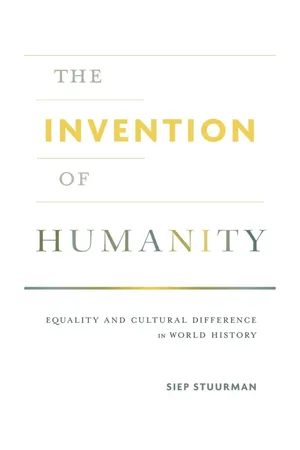
eBook - ePub
The Invention of Humanity
Equality and Cultural Difference in World History
- 665 pages
- English
- ePUB (mobile friendly)
- Available on iOS & Android
eBook - ePub
About this book
Information
1
VISIONS OF A COMMON HUMANITY
BEFORE MODERN TIMES no one was able to survey the entire surface of the globe. Consequently, a community including all the inhabitants of the earth could not be empirically verified. Many learned men in ancient Eurasia and North Africa believed that the Southern Hemisphere was not fit for human habitation and perhaps inaccessible because of the extreme heat in the tropics. Even so, myths, epics, religions, and philosophies imagined an overarching human community long before anyone was able to draw up a global ethnography. Poets, priests, and philosophers devised powerful visions of common humanity and ideas of what it meant to be human. As the creators of these “imagined humanities” were members of definite civilizations, it is not surprising that their ideas bore the imprint of their local origins. Set against that background, it is all the more impressive that these texts are replete with comprehensive concepts and discourses of human nature, laying the groundwork for universalistic visions of common humanity.
Apart from their universalistic potential these writings have something else in common. Many of them are still with us today. The groundwork for universal visions of the human condition was laid in the last millennium before the Common Era. The German philosopher Karl Jaspers regarded this period as one of the major intellectual breakthroughs in the history of humanity and christened it the Axial Age. The Axial Age, he contended, invented the philosophical notion of the human: in that historical juncture “the human being as we still conceive of it today made its appearance.” According to Jaspers, writing in the aftermath of the Second World War, twentieth-century humanity was still drawing on what was conceived and thought in that distant age.1
Hellenism, Christianity, and Islam, which came to dominate late antiquity in North Africa and western Eurasia, as well as the canonization of Confucianism and Buddhism in South and East Asia, are sometimes seen as belonging to a secondary Axial breakthrough. Not all the religious and philosophical doctrines of the Axial Age have survived into our post-Enlightenment modernity, but enough of them have to make them essential to a world history of common humanity. Numerous later thinkers have drawn upon the great texts of the Axial Age, while those who explored new lines of thought frequently felt the need to reappraise, revise, and criticize the Axial doctrines of their civilizations.
The Ambiguities of Common Humanity in the Axial Age
The founders of the Axial Age embraced inclusive visions of humanity as an overarching moral community. We should not, however, assume that they countenanced egalitarian social and political ideas. Most of them combined notions of the moral and spiritual dignity of all humans with strongly hierarchical views of the social order. The move from common humanity to a critique of the prevailing hierarchies of gender, rank, ethnos, and politics was rarely made. Nonetheless, the Axial texts are replete with admonitions to the high and the mighty not to overstep the divine and human boundaries set for them. Likewise, they warn them not to abuse their power, lest they become oppressors of the common people and might have to face popular revolt and divine retribution.
The language of the Axial texts made it thinkable to censure kings and great lords, and it gave a voice to prophets and popular leaders desiring to secure some safeguards for ordinary people. Even so, the same texts justified the basic hierarchies of the social order enshrined in the traditional codes of rank and gender, in most cases including slavery. Consequently, these texts often allow for widely diverging interpretations. The apostle Paul’s Letter to the Romans, to take a well-known example, was often cited in defense of a strict submission to the powers that be, but his affirmation that the ruler is “the minister of God”2 also opened the door to a critique of rulers who manifestly did not live up to the demanding standards associated with a minister of the Lord. Confucius, another classical example, is noted for his conviction that a civilized human community should be ordered according to the “five relationships,” four of which are starkly hierarchical. However, the sage also asserted that for the ruler of a state the support of the people was of even greater import than food and arms, for it was thinkable to survive without arms and food for some time, but “without the trust of the people no government can stand.”3 Though written in widely different languages of politics and cosmic order, the New Testament and the Analects convey a similar tension between acceptance and questioning of the social order.
When it comes to cultural boundaries we face a more complex situation. To begin with, all canons of religion and wisdom originated in definite societies and states, often grafted upon communities of lineage and ethnic descent. The canonization of written texts we associate with the onset of the Axial Age began in sedentary agrarian societies ruled from urban centers. Cities, government centers, and scribes are an important presence in all of the great Axial Age texts. It follows that the image of “civilization” in most of those texts has a definite urban-agrarian flavor. The wandering tribes of Israel in the Hebrew Bible tell the story of a nomadic past, but the scribes who put together the canon of the Tenach were priests working in an urban environment. The story of Exodus is not a vindication of the nomadic way of life but a narrative of escape from oppression followed by the arduous trek through the desert to the Promised Land where the scribes themselves were living or hoped to return. The symbolic terminus of the story is not the Sinai but the future city of Jerusalem. In such texts, the validity of the civilizing mission of prophets and sages is always assumed. One of its most impressive testimonies is in Confucius. The sage is about to depart for the remote lands of “the nine barbarian tribes of the East.” One of his disciples inquires if he is not terrified by the prospect of sojourning in such a wild place. Confucius’s laconic reply says it all: “How could it be wild, once a gentleman [Junzi] has settled there?”4
We do well to appreciate the significance of this self-confidence. It would be a mistake, I think, to dismiss it as dogmatism. Reading the life story of Confucius, one is struck by the sheer hopelessness of his enterprise. In the midst of incessant war, violence, and duplicity he sought to convince his contemporaries of the dignity of a civilized life. Without the inner certainty that his vision represented the deep truth about living a human life, he could never have mustered the courage to defy the storms of his time. His words breathe serenity rather than dogmatism. Dogmatism can only flourish with a great mass of servile followers. Confucius had few followers and those he had were not servile. Only an unshakable confidence in the inner truth of his ideas enabled him to stand against the world and to ward off the always possible descent into dread and despair.
Civilizations, Empires, and Universalisms
The example of Confucius shows that common humanity is both a given and an assignment. Once written down, such ideas partake in the magical power of language. To realize itself, humaneness has to be encoded in words, and sooner or later those words will be canonized in authoritative texts. The linkage of truth, wisdom, and civilization is both unavoidable and precarious. The fragility of the linkage stems from the intrinsic limitations of frail and fallible human beings. Living in accordance with truth and wisdom is not the same as unthinkingly following the conventions of one’s civilization. Prophets and sages have frequently marshaled the authority of truth against the facile pretensions of the complacent ideologues of a traditional social order.
Even so, the great canonized religions and philosophies usually evolved in close conjunction with the civilizations and empires that underpinned their regional or global dissemination. Over the centuries, they became associated with them and were frequently conflated with them. Confucianism was intimately connected to the civilization of imperial China, Hinduism and Buddhism to their Indian origins, Islam to its tricontinental Arabic roots, and Christianity first to Roman imperial civilization and later to Europe and its settler colonies, and beyond that to “the West.” Consequently, their discourses of common humanity were both universal and culturally specific. Historically, both poles of the dialectic are equally vital and equally “real.”
To prophets and scribes, universal truths were also “our truths.” The God of the Tenach was portrayed as a universal deity who “in the beginning” created the entire cosmos, but also as “our God,” the God of Abraham, Isaac, and Jacob. A basic tension lay at the core of the universal visions of the Axial Age. Defined by shared bodily and mental faculties and limitations, by common duties and needs, and unified by universal values, humanity was imagined as one meta-community. But at the same time the particular standards of truth, virtue, and proper conduct proclaimed by the “wise men,” and an occasional “wise woman,” of particular civilizations tended to produce a duality of “we” versus “them.”
Most, perhaps all, conceptions of humanity were therefore universalistic as well as dualistic, setting forth the unity of humanity but also affirming a dichotomy of “we” and “them.” When these religions and philosophies crossed boundaries, as most of them did sooner or later, the dialectic of the universal and the particular had to be renegotiated. New peoples adopting a creed that comes from “elsewhere” always have to reinterpret and rework it in order to make it their own. To take a rather extreme example, the Japanese minorities converted by the Jesuits in the sixteenth century CE appropriated the biblical stories in original ways, situating them in an imaginary geography that was in Jacques Proust’s apt formulation “neither Japan nor Judea.” They opened the narrative of the Deluge with God sending a message to the pious king Happamaruji, warning him that when the eyes of the temple dog turned red, the world would be submerged by a devastating flood.5 Admittedly, this is a fairly extreme case, brought about by the involuntary autonomy of the Japanese Christians when the Tokugawa state’s anti-Christian persecution severed their links with Rome. Nonetheless, it exemplifies a tendency that was at work wherever universal religions entered new territories.
But that is not all. When we investigate the cognitive and emotional core of religions and philosophies, we become aware of a deeper dialectic that springs from the ontological status of “deep truth.” As evinced by the imperturbable confidence of Confucius in the power of the sage, these texts claim an absolute authority. Their serene composure sometimes baffles the modern reader. The aggressive denunciations of the “untruth” and the imposture of other creeds in several religious texts is only the other, less pleasant face of this supreme self-confidence. Even the gentle words of Confucius are predicated on a distinction between those who understand and follow the Way and those who fail to do so. Whoever professes to speak in the name of philosophical or divine Truth ipso facto claims the authority to offer guidance and instruction to the benighted multitudes still dwelling in the darkness of Untruth.
Such authority could be exercised within the perimeter of a core state and its civilization, but it could also be projected outward, to distant and foreign lands. In such cases, the superiority of truth over untruth was easily equated with the justification of imperial rule over cities and peoples who had not yet seen the light of the imperial creed. Moving outward, universal belief systems abstracted from “home,” all the while extending the moral and intellectual power of “home” to its imperial domains. The case for empire could be so powerful precisely because its religions and philosophies were universal as well as imperial. As Joseph Conrad famously put it in Heart of Darkness: “The conquest of the earth, which mostly means the taking it away from those who have a different complexion or slightly flatter noses than ourselves, is not a pretty thing when you look into it too much. What redeems it is the idea only.”6 The tension between common humanity and imperial hegemony was lodged at the heart of the universal religions and philosophies of the Axial Age. When empires were organized around a dominant ethnos and its myth of descent, that tension paralleled an equally portentous strain between universalism and ethnocentrism.
In the final analysis, the dialectic of universalism and ethnocentrism inflected thought and structures of feeling in two directions. The empires with their ethnic cores and myths of descent were awesome historical realities, giving rise to a hard, and frequently deadly, clash between “our truth” and “their darkness.” The other side of the dialectic was that it was precisely the attempt to enshrine the contingent reality of empire in an aura of absolute truth that could contrive universalistic ideas that transcended the frontiers of the empire and might ultimately be turned against it.
Homer and the Notion of Civilized People
Our story begins with Homer because the Homeric epics are aristocratic texts in which liminal notions of common humanity and equality make their appearance. A generic concept of “humanity” and a universalistic idea of equality were not available to Homer, but we shall shortly see that his stories contain norms and ideals of moral rectitude and right conduct that suggest an emergent idea of common humanity and universal justice. In the transition from the Iliad to the Odyssey we can document the universalization of the Justice of Zeus as the foundation of common humanity. In the travelogue of Odysseus we can also document the invention of the “savage” as the antonym of the “civilized.” Moreover, Homer was at the core of the Greek and later the Hellenistic canon. Probably recorded in writing in the seventh century BCE, the Iliad and the Odyssey had attained the status of supreme literary authorities by Plato’s time. Later still, when numerous cities of the Roman Empire established their own libraries, scrolls of the two works were among their most prized possessions.
The world of the Iliad and the Odyssey is dominated by th...
Table of contents
- Cover
- Title Page
- Copyright
- Contents
- Introduction: How Cross-Cultural Equality Became Thinkable
- 1. Visions of a Common Humanity
- 2. Religious and Philosophical Universalisms
- 3. History, Ethnography, and the Anthropological Turn
- 4. Thinking across Frontiers in Medieval Islam
- 5. The Atlantic Frontier and the Limits of Christian Equality
- 6. Global Equality and Inequality in Enlightenment Thought
- 7. Modern Equality and Scientific Racism in the Nineteenth Century
- 8. The Globalization of Equality
- 9. The Age of Human Rights
- Epilogue: The Future of Global Equality
- Notes
- Acknowledgments
- Index
Trusted by 375,005 students
Access to over 1.5 million titles for a fair monthly price.
Study more efficiently using our study tools.
Frequently asked questions
Yes, you can cancel anytime from the Subscription tab in your account settings on the Perlego website. Your subscription will stay active until the end of your current billing period. Learn how to cancel your subscription
No, books cannot be downloaded as external files, such as PDFs, for use outside of Perlego. However, you can download books within the Perlego app for offline reading on mobile or tablet. Learn how to download books offline
Perlego offers two plans: Essential and Complete
- Essential is ideal for learners and professionals who enjoy exploring a wide range of subjects. Access the Essential Library with 800,000+ trusted titles and best-sellers across business, personal growth, and the humanities. Includes unlimited reading time and Standard Read Aloud voice.
- Complete: Perfect for advanced learners and researchers needing full, unrestricted access. Unlock 1.5M+ books across hundreds of subjects, including academic and specialized titles. The Complete Plan also includes advanced features like Premium Read Aloud and Research Assistant.
We are an online textbook subscription service, where you can get access to an entire online library for less than the price of a single book per month. With over 1.5 million books across 990+ topics, we’ve got you covered! Learn about our mission
Look out for the read-aloud symbol on your next book to see if you can listen to it. The read-aloud tool reads text aloud for you, highlighting the text as it is being read. You can pause it, speed it up and slow it down. Learn more about Read Aloud
Yes! You can use the Perlego app on both iOS and Android devices to read anytime, anywhere — even offline. Perfect for commutes or when you’re on the go.
Please note we cannot support devices running on iOS 13 and Android 7 or earlier. Learn more about using the app
Please note we cannot support devices running on iOS 13 and Android 7 or earlier. Learn more about using the app
Yes, you can access The Invention of Humanity by Siep Stuurman in PDF and/or ePUB format, as well as other popular books in History & World History. We have over 1.5 million books available in our catalogue for you to explore.