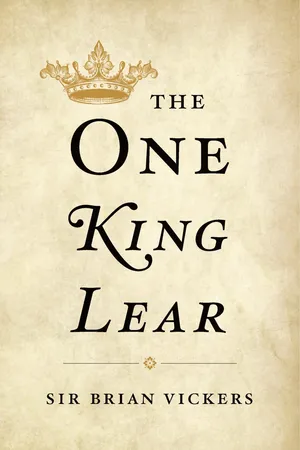
King Lear exists in two different texts: the Quarto (1608) and the Folio (1623). Because each supplies passages missing in the other, for over 200 years editors combined the two to form a single text, the basis for all modern productions. Then in the 1980s a group of influential scholars argued that the two texts represent different versions of King Lear, that Shakespeare revised his play in light of theatrical performance. The two-text theory has since hardened into orthodoxy. Now for the first time in a book-length argument, one of the world's most eminent Shakespeare scholars challenges the two-text theory. At stake is the way Shakespeare's greatest play is read and performed.
Sir Brian Vickers demonstrates that the cuts in the Quarto were in fact carried out by the printer because he had underestimated the amount of paper he would need. Paper was an expensive commodity in the early modern period, and printers counted the number of lines or words in a manuscript before ordering their supply. As for the Folio, whereas the revisionists claim that Shakespeare cut the text in order to alter the balance between characters, Vickers sees no evidence of his agency. These cuts were likely made by the theater company to speed up the action. Vickers includes responses to the revisionist theory made by leading literary scholars, who show that the Folio cuts damage the play's moral and emotional structure and are impracticable on the stage.
- English
- ePUB (mobile friendly)
- Available on iOS & Android
eBook - ePub
The One King Lear
About this book
Trusted by 375,005 students
Access to over 1 million titles for a fair monthly price.
Study more efficiently using our study tools.
Information
Topic
LetteraturaSubtopic
Teatro shakespearianoPART 1
The Quarto, 1608
1
King Lear at the Printer
IN THIS CHAPTER I aim to give a brief description of the standard printing procedures in the age of hand-press books and how they affected the text of King Lear. It describes the mechanics of printing and the routines with which books were printed in this period, and is based on the standard scholarship, which I synthesize as clearly as I can.1 In the next chapter I discuss what I call the “dynamics of typesetting,” the human choices by which the compositor adjusted text space, the extent and makeup of the author’s text, to print space, as defined by each page within the total amount of pages estimated. At the risk of boring those familiar with bibliography and textual criticism, I need to be sure that readers understand the terms and technical processes that feature in subsequent discussions.
The Manuscript
In the sixteenth and seventeenth centuries dramatists would sell their work to a theater company, which then effectively owned the play. In order to be performed legally the text would have to be approved by the Master of the Revels. For the printing of plays and of most other texts as well, the authorization for printing between 1586 and 1606 was done by sixteen disparate men employed by either the Archbishop of Canterbury or the Bishop of London for this task. However, in 1607 the Master of the Revels won the right to exclusively authorize the texts of plays for printing.2 Although some unauthorized transactions took place, the vast majority of play books were legitimately sold by a theater company to a stationer (a term that then combined, in varying proportions, the roles of printer, bookseller, and publisher). Having bought a play, stationers could protect their right to print it by entering it in the Register of Copies kept by the Stationers’ Company, their guild organization. This step was not essential, but approximately two-thirds of all books in the period from 1557 to 1642 were formally registered.
Shakespeare had written King Lear for his theater company, the King’s Men, which, according to the conventions of early modern publishing, thus owned the right in the copy. Companies often released plays for publication about two years after their performance for the small but loyal reading public that bought play texts and, in some cases, to promote a revival.3 The first recorded performance of King Lear was on December 26, 1606, as is shown by its entry in the Stationers’ Register on November 26, 1607, on behalf of Nathaniel Butter (the main partner) and John Busby, with Sir George Buc as the licenser:
a booke called Mr. William Shakespeare his historye of Kynge Lear, as yt was played before the Kinges majestie at Whitehall uppon St. Stephans night at Christmas last, by his Majesties servantes playing usually at the Globe on the Banksyde.4
This has all the signs of a legal entry, given that Buc was Master of the Revels, but for an absurdly long period scholars doubted its authenticity and that of the play. In their Preface to the First Folio, John Heminge and Henry Condell, actors who had been colleagues of Shakespeare since 1594, described themselves as friends who had taken on themselves the “care, and paine, to have collected & publish’d” his writings. Whereas readers previously had been “abus’d [deceived] with diverse stolne, and surreptitious copies, maimed, and deformed by the frauds and stealthes of injurious impostors,” his works “are now offer’d to your view cur’d, and perfect of their limbes; and all the rest, absolute in their numbers, as he conceived them.”5 We know much more about the provenance of Shakespeare’s plays than his fellow actors did, who may have been unaware that several of the plays in the Folio were co-authored.6 With the phrase “stolne, and surreptitious copies” Heminge and Condell were referring to a small group of unauthorized publications, such as the spurious First Quartos of Romeo and Juliet (1597) and Hamlet (1603), for which Shakespeare’s theater company released authorized texts in 1599 and 1604–1605, respectively. Unfortunately, some eighteenth-century editors misunderstood their diatribe as referring to the whole class of Shakespeare Quartos, most of which were perfectly authentic. It is much to A. W. Pollard’s credit that he realized that the phrase referred only to this small group of what he called “Bad Quartos,” comprising Romeo and Juliet, Hamlet, Henry V (1600), The Merry Wives of Windsor (1602), and Pericles (1609), although the narrative of piracy by which he accounted for their appearance is no longer accepted.7
The 1608 Quarto of King Lear was not among Pollard’s group of “Bad Quartos,” but the poor quality of its printing led some scholars to tar it with that brush. Pollard had speculated that these unauthorized texts were put together by memory by actors who had taken part in or witnessed performances, a theory that Tycho Mommsen had proposed in 1857. In 1879 another German scholar, Alexander Schmidt, theorized that the 1608 Quarto of Lear was taken down by shorthand during performance.8 As Henry Furness summarized Schmidt’s essay, with his usual deference to German scholarship (largely justified at that time), “1. The Quartos make no distinction between verse and prose; not even when the lines rhyme at the end of a scene. 2. Many errors of the Quartos are mistakes of the ear, not of the eye. Capriciousness of the actors’ diction is noticeable in the use of expletives, like ‘come’, ‘do’, ‘go to’, ‘how’, ‘sir’, &c. In common life Englishmen are fond of beginning their sentences with such little words, which, like tuning-forks, give the key in which they intend to speak.” These and other reasons, Schmidt concluded, “prove that the Quarto-text of King Lear lacks authority, and that its various readings are to be expunged from our editions.”9 There’s the rub, for such a verdict sets the text in a no-man’s-land of indeterminable authenticity.
Unfortunately, two scholars who enjoyed unqualified respect during the twentieth century endorsed Schmidt’s explanation. E. K. Chambers, writing in 1930, suggested that shorthand might have been used for the 1608 Quarto, which has “long continuous passages of verse printed as prose” that are “almost entirely punctuated by commas. They look to me like the result of shorthand notes well taken, but not properly worked upon at the stage of transcription.”10 W. W. Greg lent it his support in a series of essays and books from the 1930s on, culminating in his study of the Folio in 1955, where he repeated the same supposed signs of reported texts, including “grotesque mishearings,” printing verse as prose, mis-lining verse, and “helpless punctuation.”11 The stigma of the label “reported text” clung persistently to the Lear Quarto, although the feasibility of any report using the systems of Elizabethan shorthand to take down such a complex play during performance had been thoroughly disproved.12 Reputable scholars came up with varying theories to explain the mistakes in the Quarto: G. I. Duthie (1949) suggested that the Quarto had been put together as a collective act of memory by the whole company; Alice Walker (1953) thought that the boy actors playing Goneril and Regan had been responsible; and W. W. Greg (1955) partly endorsed both theories.13 As late as 1968, in his Introduction to the Norton Facsimile of the First Folio, Charlton Hinman classified King Lear among “Plays first published in ‘doubtful’ quartos,’ ” along with Richard III (1597) and Othello (1622), and declared that in all three cases the Folio and Quarto “are not independent witnesses to the true text: readings in which they both agree, far from being doubly authenticated, may both be wrong.”14 In 1980, a century after Schmidt, P. W. K. Stone suggested that reporters could have taken the text down in repeated visits to the theater.15 The collective impact of these theories was to sow doubt and uncertainty concerning the authenticity of the 1608 Quarto. In the chapters that follow I return to all these supposed signs of a reported text (mishearings, confusion of verse and prose, actors’ expletives) and offer better explanations for their occurrence in Q1 Lear. For the moment, though, it is worth underlining the fact that in the austere world of bibliographical scholarship, like any other, mistaken theories and assumptions can persist for an improbably long time.
Their persistence beyond 1931 was already unjustified, because in that year a young American scholar, Madeleine Doran, had published a pioneering study that largely vindicated the 1608 Quarto from these mistaken assumptions.16 Taking issue with Chambers, she refuted Schmidt’s theory of a text “taken down by stenographers in the theatre” by describing some general features of the unauthorized or “Bad Quartos” put together by actors from memories of performances fleshed out with one or more actor’s “parts.” Such texts (the 1603 Hamlet is a good example)
are considerably shorter than the authentic texts...
Table of contents
- Cover
- Title Page
- Copyright
- Dedication
- Contents
- Preface
- A Note on References
- Part 1: The Quarto, 1608
- Part 2: The Folio, 1623
- Part 3: The One King Lear
- Conclusion: Toward a New Consensus
- Appendix 1: Illustrations and Commentary
- Appendix 2: Space Saving in Q1 King Lear
- Notes
- Index
Frequently asked questions
Yes, you can cancel anytime from the Subscription tab in your account settings on the Perlego website. Your subscription will stay active until the end of your current billing period. Learn how to cancel your subscription
No, books cannot be downloaded as external files, such as PDFs, for use outside of Perlego. However, you can download books within the Perlego app for offline reading on mobile or tablet. Learn how to download books offline
Perlego offers two plans: Essential and Complete
- Essential is ideal for learners and professionals who enjoy exploring a wide range of subjects. Access the Essential Library with 800,000+ trusted titles and best-sellers across business, personal growth, and the humanities. Includes unlimited reading time and Standard Read Aloud voice.
- Complete: Perfect for advanced learners and researchers needing full, unrestricted access. Unlock 1.4M+ books across hundreds of subjects, including academic and specialized titles. The Complete Plan also includes advanced features like Premium Read Aloud and Research Assistant.
We are an online textbook subscription service, where you can get access to an entire online library for less than the price of a single book per month. With over 1 million books across 990+ topics, we’ve got you covered! Learn about our mission
Look out for the read-aloud symbol on your next book to see if you can listen to it. The read-aloud tool reads text aloud for you, highlighting the text as it is being read. You can pause it, speed it up and slow it down. Learn more about Read Aloud
Yes! You can use the Perlego app on both iOS and Android devices to read anytime, anywhere — even offline. Perfect for commutes or when you’re on the go.
Please note we cannot support devices running on iOS 13 and Android 7 or earlier. Learn more about using the app
Please note we cannot support devices running on iOS 13 and Android 7 or earlier. Learn more about using the app
Yes, you can access The One King Lear by Brian Vickers,Sir Brian Vickers in PDF and/or ePUB format, as well as other popular books in Letteratura & Teatro shakespeariano. We have over one million books available in our catalogue for you to explore.