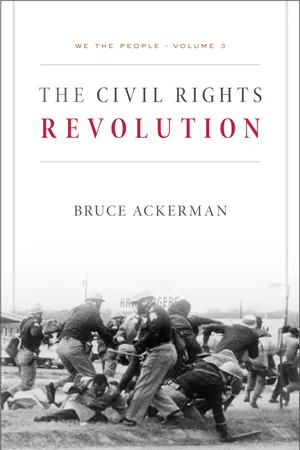
The Civil Rights Revolution carries Bruce Ackerman's sweeping reinterpretation of constitutional history into the era beginning with Brown v. Board of Education. From Rosa Parks's courageous defiance, to Martin Luther King's resounding cadences in "I Have a Dream," to Lyndon Johnson's leadership of Congress, to the Supreme Court's decisions redefining the meaning of equality, the movement to end racial discrimination decisively changed our understanding of the Constitution.
"The Civil Rights Act turns 50 this year, and a wave of fine books accompanies the semicentennial. Ackerman's is the most ambitious; it is the third volume in an ongoing series on American constitutional history called We the People. A professor of law and political science at Yale, Ackerman likens the act to a constitutional amendment in its significance to the country's legal development."
—Michael O'Donnell, The Atlantic
"Ackerman weaves political theory with historical detail, explaining how the civil rights movement evolved from revolution to mass movement and then to statutory law…This fascinating book takes a new look at a much-covered topic."
—Becky Kennedy, Library Journal
eBook - ePub
We the People
About this book
Trusted by 375,005 students
Access to over 1 million titles for a fair monthly price.
Study more efficiently using our study tools.
Information
PART ONE
Defining the Canon
CHAPTER 1
Are We a Nation?
THE TELEPHONE RANG, and a familiar conversation began. Since 1989, the State Department had been badgering me to serve on delegations to advise one or another country on its constitutional transition to democracy. I had refused, and refused, and refused: no junketing for me, no ignorant professing in front of politicians I did not know in countries I barely understood.
Once again I heard an earnest midwestern voice at the end of the line, speaking self-importantly in the name of the Special Assistant to the Assistant to the Deputy Assistant Secretary of State. This time, he assured me, it was going to be completely different.
The State Department wasn’t asking me to help write a constitution in a language I couldn’t read. It was inviting me to engage in a one-on-one tutorial with the great Akhil Alfarabi, a master of both the European and Islamic legal traditions, who wished to extend his understanding to American constitutional law. Nothing but mutual enlightenment, the cheery voice guaranteed: it was past time to bridge the fearsome cavern separating the great legal systems of the world. And they were asking for only a week of my time.
Why not? I asked, and soon I found myself, jet-lagged, greeting a smiling Alfarabi at an undisclosed location. After drinking endless cups of tea, we began a serious conversation where I always begin: with the written Constitution, starting from the words “We the People” and working our way to the end of the text.
A DIALOGUE
Alfarabi was indeed a master of the art of elaborating profound legal principles out of lapidary texts, and he listened intently as I presented the famous words left behind by the American Founding and Reconstruction. After a couple of days of joyful conversation, we moved into our final lap: the texts of the twentieth century. But Alfarabi was getting impatient, and a bit resentful, at my treating him like a brilliant first-year student. “How about changing places,” he suggested, “and let me take the lead in interpreting the last few constitutional amendments?”
Truth to tell, I was a bit doubtful: for all his learning, he didn’t have the foggiest idea of American history. But after all, I didn’t have any idea of his country’s history either, and that hadn’t stopped us from having a great conversation.
Why not? I asked myself, glimpsing the ghost of John Dewey energetically nodding his approval. “We have reached the Twenty-First Amendment. What do you think it means?”
“Well, the year is 1933, and Franklin Roosevelt is coming into office—he’s the one who announced the New Deal, no?”
I responded enthusiastically, as is my habit, and was greatly relieved to learn that the guy knew more about my country’s history than I knew of his.
“And looking at the amendment,” said Akhil, “I can see why they call it the New Deal. As a Muslim, I find it deeply regrettable that the ban on alcohol is repealed, but from the perspective of a lawyer, it’s obvious that something very new is happening: We the People are demanding a sharp cutback in overly ambitious federal regulatory schemes. The larger constitutional principle is clear: the era of big government is over,” Alfarabi said with confidence, for great lawyers never lack self-confidence.
Before I could figure out what to say, Akhil was moving on to the next amendment. “This Twenty-Second Amendment,” he explained triumphantly, “only confirms my interpretation. It was enacted when Harry Truman was in the White House—wasn’t he a loyal follower of Roosevelt?—and the text shows that the people are moving right along in the direction marked by Roosevelt’s New Deal. In 1933, they repudiated big government; now they are cutting back the imperial presidency by limiting incumbents to two terms in office. There can be no doubt about the larger point: goodbye big government, goodbye imperial presidency—a New Deal indeed.”
He beamed brightly, secure in his mastery of the interpretive techniques I had taught him when reading the great American texts of the eighteenth and nineteenth centuries. But I paused once again before responding, and Alfarabi raced ahead.
As he mumbled something about the District of Columbia, I glanced apprehensively at the Twenty-Fourth Amendment, prohibiting the states and the national government from imposing poll taxes in federal elections. This is the only modern text that hints at the civil rights revolution’s preoccupation with racial justice. Would Alfarabi catch the point?
Yes, nothing escaped his inquiring mind, but his reading emphasized the plain meaning of the text. For the only time in American history, this amendment explicitly condemns wealth discrimination, and Alfarabi took the ball and ran with it: “If the government can’t impose a tax when it comes to voting, surely it can’t burden other fundamental rights of citizenship. So the key question raised by Twenty-Four is obvious: how to define the range of basic interests protected against invidious economic discrimination?”
“Never thought of that,” I muttered, but Akhil was already moving on, and when he encountered the Twenty-Sixth Amendment, guaranteeing the right to vote for eighteen-year-olds, he began to connect the dots in the great American fashion. “What,” he asked, “is the common thread linking the ban on voting discrimination against teenagers with the ban on voting discrimination against poor people?”1
His eyes darted forward to see whether the remaining amendments contained the answer, but he was shocked to find that he had arrived at the end of his journey. Almost a half century has passed since the enactment of the Twenty-Sixth Amendment in 1971, and the American people have added absolutely nothing to the text—unless you count an odd little provision, initially proposed in 1789, forgotten for almost two centuries, and then revived and ratified by the states in 1992, forbidding members of Congress from immediately raising their own salaries.2
“Hmm,” said Alfarabi, “I guess nothing much has happened since the teenagers’ historic struggle for voting rights. Nevertheless, I can now formulate the basic question left by the modern era of development: how can a weak federal government, with a chastened presidency, do justice to the People’s repudiation of wealth discrimination and its ringing endorsement of teenage rights?”
“That’s not quite how we Americans think about our twentieth-century legacy,” I said gently.
“Really?” said Alfarabi. “Where have I gone wrong?”
“In taking these amendments so seriously and looking upon them as the source of grand new principles.”
“But that’s precisely what you Americans always do. The First Amendment doesn’t explicitly guarantee freedom of association, but you derive this right from the principles underlying the written text. Sometimes you call it a penumbra, sometimes you call it an emanation, sometimes—as in the case of freedom of association—you almost forget that the words aren’t in the Constitution. But you do it all the time with your ancient texts, and that’s just what I’ve been doing with your modern amendments. Aren’t they even more important, since they were passed more recently?”
“A good question, but no American asks it.”
“That’s curious,” said Alfarabi. “What accounts for such blindness?”
“Maybe your brilliant interpretations suggest a paradoxical answer: if we treated the recent amendments as important statements of principle, we would be falsifying the great truths about the constitutional achievements of the twentieth century. You see, the New Deal did not represent a repudiation of big government but its sweeping popular affirmation. And the civil rights era revolutionized America’s commitment to racial equality and wasn’t centrally concerned with discrimination against the poor or the young.”
“You may say anything you like, my dear Professor Ackerman, but if you will forgive me, you seem to be making up your story out of thin air. With the greatest respect, it is simply impossible to read the constitutional text to support your claims.”
THE PATH TO MODERNITY
A funny thing happened to Americans on the way to the twenty-first century. We have lost our ability to write down our new constitutional commitments in the old-fashioned way. This is no small problem for a country that imagines itself living under a written Constitution.
Eighty years of false notes and minor chords, culminating in a symphony of silence—and the twenty-first century will be no different. When Republicans controlled Congress between 1994 and 2006, they provoked great debates over abortion and religion, federalism and the war powers of the presidency. But they did not try to resolve these issues through new constitutional amendments—we saw only failed gestures on matters such as flag burning and gay marriage.
When they got serious about constitutional change, they pursued the paths marked out by the New Deal and civil rights revolutions. They demonstrated their commitment to the right to life, for example, by passing a statute that banned partial-birth abortions. This law did not express the sweeping ambitions of the Civil Rights Act or the Social Security Act. But if the Republicans had continued to dominate the presidency and Congress through 2012, they would have claimed a popular “mandate” to enact a landmark statute directly repudiating Roe v. Wade, challenging the Supreme Court to strike it down.
At the same time, Republican presidents John McCain and Mitt Romney would have continued adding right-thinking Justices to form an overwhelmingly conservative majority on the Roberts Court. Depending on the accidents of timing, it might not have been necessary for the McCain-Romney Congresses to pass a landmark statute affirming the right to life. The Roberts Court might have done the job itself, denouncing Roe as “wrong from the moment it was decided.” On this scenario, the McCain-Romney-Roberts Court would have followed in the footsteps of its New Deal predecessor—treating Roe in the same way modern courts have treated Lochner since 1937, as a symbol for a discredited era of unbridled “judicial activism.”
Recent Democratic victories have halted this dynamic for the moment. The only question is whether the conservative majority on the Court will use its remaining years in power to stage a full-scale assault on the twentieth century.
The danger signs are clear enough. In confronting the Affordable Care Act, the five conservative justices thundered their disapproval of the New Deal’s revolutionary reinterpretation of the Commerce Clause.3 But Chief Justice Roberts lacked the courage of his convictions and devised an alternative rationale to support the statute, saving his Court from a dangerous confrontation with a resurgent Obama during an election year. Having avoided a high-stakes conflict reminiscent of the struggle between President Roosevelt and the Old Court during the New Deal, the Chief Justice has now renewed the conservative offensive—striking down a key provision of the Voting Rights Act. I will be discussing this remarkable decision in Chapter 14. It remains an open question whether the five conservatives will seize short-term opportunities to broaden their assault on the New Deal–Civil Rights regime before death and disability loosen their grip on power.
Whatever the future may hold, one thing is clear: don’t expect big changes through formal amendments. We the People can’t seem to crank out messages in the way described by Article V of our Constitution. Our writing machine has gone the way of the typewriter.
Why?
There are three possibilities: there is something wrong with the machine, something wrong with the American people, or nothing wrong with either. Conventional wisdom gives the happy answer: it’s a good thing that formal amendment is so hard, for otherwise the Constitution would become a mess, full of details signifying little.
The happy answer is half right: yes, it should be hard to amend the Constitution, but there are plenty of different ways to make things hard. The question is whether the Founders’ way makes sense.
My answer is yes and no: it made sense for them, but it no longer makes sense for us. After two centuries of development, America’s political identity...
Table of contents
- Cover
- Half Title
- Title Page
- Copyright
- Dedication
- Contents
- Acknowledgments
- Introduction: Confronting the Twentieth Century
- Part One: Defining the Canon
- Part Two: Landmarks of Reconstruction
- Part Three: Dilemmas of Judicial Leadership
- Notes
- Index
Frequently asked questions
Yes, you can cancel anytime from the Subscription tab in your account settings on the Perlego website. Your subscription will stay active until the end of your current billing period. Learn how to cancel your subscription
No, books cannot be downloaded as external files, such as PDFs, for use outside of Perlego. However, you can download books within the Perlego app for offline reading on mobile or tablet. Learn how to download books offline
Perlego offers two plans: Essential and Complete
- Essential is ideal for learners and professionals who enjoy exploring a wide range of subjects. Access the Essential Library with 800,000+ trusted titles and best-sellers across business, personal growth, and the humanities. Includes unlimited reading time and Standard Read Aloud voice.
- Complete: Perfect for advanced learners and researchers needing full, unrestricted access. Unlock 1.4M+ books across hundreds of subjects, including academic and specialized titles. The Complete Plan also includes advanced features like Premium Read Aloud and Research Assistant.
We are an online textbook subscription service, where you can get access to an entire online library for less than the price of a single book per month. With over 1 million books across 990+ topics, we’ve got you covered! Learn about our mission
Look out for the read-aloud symbol on your next book to see if you can listen to it. The read-aloud tool reads text aloud for you, highlighting the text as it is being read. You can pause it, speed it up and slow it down. Learn more about Read Aloud
Yes! You can use the Perlego app on both iOS and Android devices to read anytime, anywhere — even offline. Perfect for commutes or when you’re on the go.
Please note we cannot support devices running on iOS 13 and Android 7 or earlier. Learn more about using the app
Please note we cannot support devices running on iOS 13 and Android 7 or earlier. Learn more about using the app
Yes, you can access We the People by Bruce Ackerman in PDF and/or ePUB format, as well as other popular books in Law & North American History. We have over one million books available in our catalogue for you to explore.