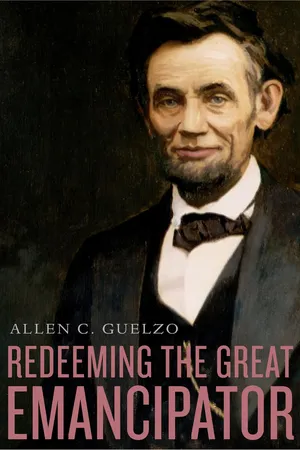
The larger-than-life image Abraham Lincoln projects across the screen of American history owes much to his role as the Great Emancipator during the Civil War. Yet this noble aspect of Lincoln's identity is precisely the dimension that some historians have cast into doubt. In a vigorous defense of America's sixteenth president, award-winning historian and Lincoln scholar Allen Guelzo refutes accusations of Lincoln's racism and political opportunism, while candidly probing the follies of contemporary cynicism and the constraints of today's unexamined faith in the liberating powers of individual autonomy.
Redeeming the Great Emancipator enumerates Lincoln's anti-slavery credentials, showing that a deeply held belief in the God-given rights of all people steeled the president in his commitment to emancipation and his hope for racial reconciliation. Emancipation did not achieve complete freedom for American slaves, nor was Lincoln entirely above some of the racial prejudices of his time. Nevertheless, his conscience and moral convictions far outweighed political calculations in ultimately securing freedom for black Americans.
Guelzo clarifies the historical record concerning what the Emancipation Proclamation did and did not accomplish. As a policy it was imperfect, but it was far from ineffectual, as some accounts of African American self-emancipation imply. To achieve liberation required interdependence across barriers of race and status. If we fail to recognize our debt to the sacrifices and ingenuity of all the brave men and women of the past, Guelzo says, then we deny a precious part of the American and, indeed, the human community.
- 189 pages
- English
- ePUB (mobile friendly)
- Available on iOS & Android
eBook - ePub
Redeeming the Great Emancipator
About this book
Information
1
THE UNWANTING OF ABRAHAM LINCOLN
EVERY REPUTATION has a shelf life. Abraham Lincoln thought that the reputation of George Washington was nearly as resistant to decay as any reputation could be: “Washington is the mightiest name of earth—long since mightiest in the cause of civil liberty; still mightiest in moral reformation,” he said in 1842. “To add brightness to the sun, or glory to the name of Washington, is alike impossible.”1 Or if not Washington, then certainly the reputation of the Union soldiers whose cemetery he dedicated at Gettysburg in 1863 was beyond “our poor power to add or detract.” So for Lincoln himself. George Boutwell (Massachusetts congressman, senator, cabinet secretary, drafter of the Fourteenth Amendment, member of the Harvard Board of Overseers) claimed for Lincoln “the place next to Washington, whether we have regard to private character, to intellectual qualities, to public services, or to the weight of obligation laid upon the country and upon mankind.” Boutwell rested that claim on “three great papers” from Lincoln’s hand—“the proclamation of emancipation, his oration at Gettysburg, and his second inaugural address.” But especially the Emancipation Proclamation. Lincoln “was personally the enemy of slavery, and he ardently desired its abolition.” Emancipation was his path, “and he walked fearlessly in it.” The proclamation thus became his passport to immortality. “If all that Lincoln said and was should fail to carry his name and character to future ages, the emancipation of four million human beings by his single official act is a passport to all of immortality that earth can give.”2
Boutwell was far from the only one of Lincoln’s contemporaries to draw this conclusion. “Looking at the history of the world,” concluded Edward F. Bullard, “the PROCLAMATION of January 1, 1863, is the greatest event within the last eighteen hundred years.” Massachusetts governor John Albion Andrew, who had repeatedly criticized Lincoln’s slowness in issuing the proclamation, hailed its appearance in September, 1862, as “a mighty act … grand and sublime after all.” The abolition journalist Moncure Daniel Conway thought he “had witnessed the final combat between Jesus and Satan in America,” that “in the proclamation … a victorious sun appeared about to rise upon the New World of free and equal men.” The philosopher-general, Ethan Allan Hitchcock, called the proclamation “the most important paper that has emanated from this government since the foundation of the Constitution.” And Missouri politician Charles D. Drake, who had been as reluctant for emancipation as John Andrew had been impatient, assured his hearers in January 1863, “My friends, if any words have, in the history of the world, emanated from the ruler of any people, which had a more august and enduring import than those, I know not of them. An involuntary feeling of awe rises within me as I read them, and endeavor to scan their probable influence upon the future of America and of humanity. They ring out the glad peal of this nation’s deliverance.” Lincoln’s vice president, the Maine abolitionist Hannibal Hamlin, wrote Lincoln as soon as the preliminary version of the proclamation was released to say that “it will stand as the great act of the age,” and like Boutwell, Hamlin predicted that “future generations will, as I do, say God bless you this great and noble act.”3
Boutwell, Hamlin, and the others were, as we know, wrong; and so was Lincoln about Washington. We live in a “world come of age,” a world in which any and all questions of significance are answered without resorting to authority, and in which our lives are perfectly manageable on a day-to-day basis without reference to the leading strings of ethics, religion, law, or history. In such a world, heroic reputations of the sort Lincoln, Hamlin, and Boutwell described seem as bizarre as the heroic statuary of Lenin and Saddam Hussein; only those still in their cultural adolescence will accept the condescending pennies of the past for guidance or gift, or even care enough to make the adolescent’s conventional statement of prematurity, by pulling the statuary down. In a world come of age, space is won by demonstrations of weakness and suffering, not strength and genius; seriousness is mocked as inauthenticity and surface. Dietrich Bonhoeffer, who may be said to have authored the concept of a world come of age, spoke of how pointless it is in such a world to expect acknowledgments of intellectual or moral indebtedness: “Pointless, because it seems to me like an attempt to put a grown-up man back into adolescence, i.e. to make him dependent on things on which he is, in fact, on longer dependent, and thrusting him into problems that are, in fact, no longer problems for him.” There are no otherworldly qualities which lift individuals above the flux of human events, and we become radically suspicious of the present, without illusions but also without hope.4 This viewpoint has been particularly to the advantage of reductionists who believe that nothing else explains human behavior except the will to power—that literature, music, art, politics, and life are but the disguises and strategies worn by oppressors. These putative oppressors have been as various and numerous as they have been vapid—Jews, kulaks, intellectuals, infidels, Masons, Bilderbergs, Trilaterals, space aliens—but the description of them has in common this single theme, that what we once, in our innocence, mistook as innocence is in fact a concatenation of the cunning and disreputable, such as only adults can understand. We are compelled to live, said Bonhoeffer, “in the world etsi deus non daretur,” as if God were “weak and powerless in the world.” Every foot is clay; every glass seen through darkly. You got to break your own chains, we say, you got to walk that lonesome valley. Nobody here can walk it with you.
There is a certain congeniality of this discount cynicism to the American grain. John Winthrop stepped off the Arbella, fully convinced that everyone had to grapple personally, without the intervention of priest or sacrament, with the demon of total depravity; the Great Awakening demanded absolute and immediate conversion, and the separation of personal experience from a natural law shared with the rest of the world; the singularity of the American founding as a republic in a universe of monarchies made every nonrepublican gesture suspect. Even Lincoln entertained a certain amount of suspicion of heroic biography. “Biographies as written are false and misleading,” Lincoln told his law partner William Henry Herndon.
“The author of the Life of his love paints him as a perfect man, magnifies his perfections and suppresses his imperfections, describes the success of his love in glowing terms, never once hinting at his failures and his blunders. Why do not,” said Lincoln, “book merchants and sellers have blank biographies on their shelves always ready for sale, so that, when a man dies, if his heirs, children, and friends wish to perpetuate the memory of the dead, they can purchase one already written, but with blanks, which they can fill up eloquently and grandly at pleasure, thus commemorating a lie, an injury to the dying and to the name of the dead?”5
But occasional splashes of suspicion and cynicism are one thing; an entire cultural hermeneutic of suspicion is another, and it is that to which we have come, along with the apprehension that the discovery of woundedness is the modern coming-of-age ritual.
Suspicion should be distinguished from prudence, but making this distinction is not as easy as it sounds. For the twelve million or so blacks torn from their African homelands during the long midnight of the transatlantic slave trade, and their four million descendants who labored without recompense and without hope as slaves in the American republic in 1860, prudence required the deployment of suspicion on a daily, even hourly basis, simply in the interest of survival. That suspicion was directed at white people—not just the whites who, putatively, owned them in the same way they owned cattle and horses, but all white people, North or South, blue or gray, American or foreign. A Union officer on Sherman’s march through Georgia did not understand why black slaves did not turn out enthusiastically to greet their liberators. Because, explained one elderly Georgia slave, someone might be taking notes. It was all well and good that the Union armies had come all this way to defeat Johnny Reb, “But, massa, you’se’ll go way to-morrow, and anudder white man’ll come.” The officer could only nod in agreement: “He had never known anything but persecutions and injury from the white man,” and he saw no reason “to put faith in any white man.” The “Gideonite” white missionaries who descended on the occupied Port Royal Sound (South Carolina) to educate and uplift the freedpeople discovered that “nothing is more evident to those who actually know the Colored, than that while they respect, value, and revere, the good, they want little companionship with the whites.” They might “honor and reverence” the idealistic Gideonites as well meaning and well intentioned, “still, when all is done, they fall into their own circle of color for companionship.” In Savannah, freedpeople trusted only “people of their own color, and believe that the [white officers] who have addressed them are rebels in disguise.” In Fayetteville, “they prayed about as hard for Sherman to go as they had prayed for him to come,” since hardly an African American house in the town escaped looting by Sherman’s men. The experience “produced this good effect on the minds of the Fayetteville negroes—they no longer believed that every man of Northern birth was necessarily their friend, and they more clearly saw the need of looking to themselves for their own elevation.”6
Sometimes, suspicion was mistaken for apathy by whites who had difficulty reading the contours of black community. “It was thought at the commencement of the work” of recruiting black Union soldiers that “a brigade would be formed by this time,” complained the Washington National Intelligencer in June 1863. But despite “a colored population of six or seven thousand men” in the contraband camps around the capital, “enlistments are few,” and the first conclusion was that blacks “seem perfectly willing that the ‘white folks’ may do every thing for them”—that is, until it occurred to the Intelligencer that the real problem was the “jealousy existing between the resident free colored people” of the District of Columbia “and the contrabands,” the former expecting to receive commissions to command the latter, and the latter not particularly wanting such officers. And white Northerners who expected to be hailed by African Americans with thankful cringes sometimes got a rude awakening: “They are,” wrote one astonished white soldier in the 46th New York, the “most impudent Set that I have ever seen. When they meet a Yankee on the street they will hoop at you and hollow, ‘Their goes one of Lincolns hirelings he gets his hard crackers, Salt horse and $13 per Month.’ This is the thanks we get from the black rascals.… They would cut the throats of Every Yankee for five cents per head.” When a desperate Confederate Congress, in the Confederacy’s last weeks of life, voted to authorize the recruitment of black soldiers with the lure of emancipation as the reward, there were actually black volunteers. Not out of love, loyalty, or fidelity to the old massa, or with the straw hat held subserviently in the hand, but out of frank, unadulterated calculation. “Freedom and liberty is the word with the Collered people,” wrote a free black Louisianan; if fighting for the Confederacy “makes us free we are happy to hear it.”7 All white promises were equally incredible, and therefore equally credible, to be picked up and used as seemed most opportune.
Yet, as much as black prudence justified black suspicion, what is noticeable in these encounters is the relief with which suspicion could also be laid by, and especially in the case of Abraham Lincoln. Frederick Douglass greeted Lincoln’s inauguration in 1861 with something much less than enthusiasm: “Mr. Lincoln opens his address by announcing his complete loyalty to slavery in the slave States … and how he regards the right to recapture fugitive slaves a constitutional duty.” He snarled at Lincoln’s speech in August 1862, to “a committee of colored men,” asking them to support colonization: “In this address Mr. Lincoln assumes the language and arguments of an itinerant Colonization lecturer, showing all his inconsistencies, his pride of race and blood, his contempt for Negroes and his canting hypocrisy.” But Douglass was writing as a provocateur, reaching for hyperbole as the lever to move the indifferent into action. His actual encounters with Lincoln, beginning in the summer of 1863, had quite a different effect on him. John Eaton met Douglass at the home of “a wealthy colored man in the city” of Washington, where he found Douglass
pacing the long, old-fashioned parlors in a state of extreme agitation. “I have just come from President Lincoln,” he said, making no attempt to suppress his excitement. “He treated me as a man; he did not let me feel for a moment that there was a difference in the color of our skins! The President is a most remarkable man. I am satisfied now that he is doing all that circumstances will permit him to do. He asked me a number of questions, which I am preparing to answer in writing,” and he pointed to the writing materials on a table near him.
In the end, Douglass conceded that Lincoln was “the one man of all the millions of our countrymen to whom we are more indebted for a United Nation and for American liberty than to any other.”8
Douglass was not the only one. John McCline, a Louisiana slave, recalled that in 1860, “there was much excitement and political talk” among his fellow slaves “over the possible election of Abraham Lincoln as President of the United States.” Apart from the unnoticed tribute this paid to the slaves’ grape-vine telegraph, even as far away as the sugar-cane fields, what was peculiar was the automatic assumption that “if Lincoln was elected … he was against slavery and would use every means in his power to crush it.” Slaves in Beaufort, South Carolina, invented stories about Lincoln visiting “Beaufort befo’ de war and et dinner to Col. Paul Hamilton” and “left his gold-headed walking cane deer and ain’t nobody know de president of de United States been to Beaufort ’till he write back and tell um to look behind de door and send um his gold-headed walking cane.…” In another version, Lincoln “come to Beaufort ’fore de war … as uh rail-splitter and spy ’round.” Charity Austin claimed to have seen Lincoln in disguise before the war, spying on Georgia’s slaveholders.
Abraham Lincoln come through once, but none of us knew who he was. He wus just the raggedest man you ever saw. The white children and me saw him out at the railroad. We were sittin’ and waitin’ to see him. He said he wus huntin’ his people; and dat he had lost all he had. Dey give him somethin’ to eat and tobacco to chew and he went on. Soon we heard he wus in de White House then we knew who it wus come through. We knowed den it wus Abraham Lincoln.9
One of the blue-blood Gideonites at Port Royal was puzzled to find that “it was with difficulty...
Table of contents
- Cover
- Title Page
- Copyright
- Dedication
- Contents
- Preface
- Epigraph
- 1. The Unwanting of Abraham Lincoln
- 2. The Antislavery World of Abraham Lincoln
- 3. Lincoln’s God and Emancipation
- Notes
- Index
Trusted by 375,005 students
Access to over 1.5 million titles for a fair monthly price.
Study more efficiently using our study tools.
Frequently asked questions
Yes, you can cancel anytime from the Subscription tab in your account settings on the Perlego website. Your subscription will stay active until the end of your current billing period. Learn how to cancel your subscription
No, books cannot be downloaded as external files, such as PDFs, for use outside of Perlego. However, you can download books within the Perlego app for offline reading on mobile or tablet. Learn how to download books offline
Perlego offers two plans: Essential and Complete
- Essential is ideal for learners and professionals who enjoy exploring a wide range of subjects. Access the Essential Library with 800,000+ trusted titles and best-sellers across business, personal growth, and the humanities. Includes unlimited reading time and Standard Read Aloud voice.
- Complete: Perfect for advanced learners and researchers needing full, unrestricted access. Unlock 1.5M+ books across hundreds of subjects, including academic and specialized titles. The Complete Plan also includes advanced features like Premium Read Aloud and Research Assistant.
We are an online textbook subscription service, where you can get access to an entire online library for less than the price of a single book per month. With over 1.5 million books across 990+ topics, we’ve got you covered! Learn about our mission
Look out for the read-aloud symbol on your next book to see if you can listen to it. The read-aloud tool reads text aloud for you, highlighting the text as it is being read. You can pause it, speed it up and slow it down. Learn more about Read Aloud
Yes! You can use the Perlego app on both iOS and Android devices to read anytime, anywhere — even offline. Perfect for commutes or when you’re on the go.
Please note we cannot support devices running on iOS 13 and Android 7 or earlier. Learn more about using the app
Please note we cannot support devices running on iOS 13 and Android 7 or earlier. Learn more about using the app
Yes, you can access Redeeming the Great Emancipator by Allen C. Guelzo in PDF and/or ePUB format, as well as other popular books in Politics & International Relations & Political Biographies. We have over 1.5 million books available in our catalogue for you to explore.