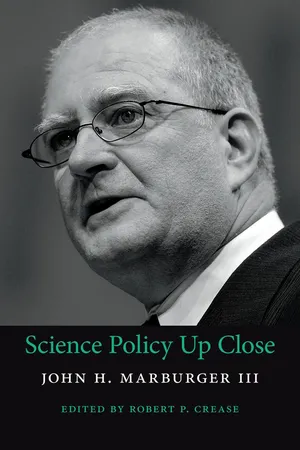
In a career that included tenures as president of Stony Brook University, director of Brookhaven National Laboratory, and science advisor to President George W. Bush, John Marburger (1941–2011) found himself on the front line of battles that pulled science ever deeper into the political arena. From nuclear power to global warming and stem cell research, science controversies, he discovered, are never just about science. Science Policy Up Close presents Marburger's reflections on the challenges science administrators face in the twenty-first century.
In each phase of public service Marburger came into contact with a new dimension of science policy. The Shoreham Commission exposed him to the problem of handling a volatile public controversy over nuclear power. The Superconducting Super Collider episode gave him insights into the collision between government requirements and scientists' expectations and feelings of entitlement. The Directorship of Brookhaven taught him how to talk to the public about the risks of conducting high-energy physics and about large government research facilities. As Presidential Science Advisor he had to represent both the scientific community to the administration and the administration to the scientific community at a time when each side was highly suspicious of the other.
What Marburger understood before most others was this: until the final quarter of the twentieth century, science had been largely protected from public scrutiny and government supervision. Today that is no longer true. Scientists and science policy makers can learn from Marburger what they must do now to improve their grip on their own work..
- 248 pages
- English
- ePUB (mobile friendly)
- Available on iOS & Android
eBook - ePub
Science Policy Up Close
About this book
Information
1
The Shoreham Commission
John Marburger assumed the presidency of Stony Brook University in 1980. An article about him that appeared in Newsday a few years after his arrival, titled “Tact Is a Science for Marburger,” described him as having “graying dark hair and a movie star’s blue eyes and square jaw” but observed that a key to his success was that “he is not afraid to be boring.” The article said most faculty members appreciated that Marburger was not as confrontational as the previous president but reported that a few professors did not like the fact that he appeared “cold and unemotional” and overly formal, never without jacket and tie.1
At Stony Brook, Marburger faced yet more volatile controversies than he had at his previous position as dean of the College of Letters, Arts and Sciences at the University of Southern California. One began when an African studies professor equated Zionism with racism, inciting calls from the conservative Jewish community in the New York metropolitan area for the professor’s firing and for Jewish students to arm themselves in self-defense when on campus; this provoked angry replies from the African-American community. Eventually, Marburger managed to defuse this crisis with a miniature version of the aggressive listening that would mark his later style, which left all sides feeling understood. He denounced the equating of Zionism and racism, but also, after a formal investigation, refused to fire the faculty member, though advising him to include more balance about the issue in his lectures and assignments. As the Newsday article reported, “Marburger crafted public statements that reflected both the concerns of Jewish leaders outside the university and academics within. He brought the faculty Senate into the debate and met repeatedly with Jewish leaders, eventually caucusing with from 30 groups [sic] in a single meeting. The result was a declaration that both satisfied Jewish groups and reassured professors who were concerned about protecting [the faculty member’s] academic freedom.”2
Marburger’s skill at handling conflicts did not go unnoticed, including by New York State’s new governor, Mario Cuomo. In 1982, Cuomo was elected governor of New York and took office on January 1, 1983. One of the first crises involved the Shoreham Nuclear Power Plant. The Long Island Lighting Company (LILCO) was in the process of building this facility near the town of Shoreham, about a dozen miles farther east on Long Island than Stony Brook. Hearings on the construction permit began in 1970, the permit was approved in 1973, and the reactor pressure vessel was set in place in December 1975, amid growing opposition. Demonstrations against the plant commenced the following year and gained momentum after the 1979 Three Mile Island accident. When Cuomo took over in 1983, the controversy was still continuing without a resolution in sight. Cuomo created a fact-finding commission and appointed Marburger to head it.
Heading the Shoreham Commission was Marburger’s first exposure to a major political crisis involving a scientific and technological dimension. It thrust him, Marburger writes in this chapter, into “the universe of public action” and “opened my eyes to the world of policy.” A common reaction for a manager facing a crisis is to figure out a solution, discover who opposes that solution, and then do battle with them. That approach was not Marburger’s. His attitude was to say, “Isn’t it amazing that reasonable people have such different points of view on this issue! How is that possible?” He would then set out to address that question, which often opened up new, unanticipated opportunities for a solution.
Marburger’s experience as head of the Shoreham Commission would shape the way he handled later crises. It would also give him a reputation as an impartial and calm leader. The following is a chapter, printed in its entirety, that Marburger completed for this book. It consists of his comments on the Shoreham episode, interspersed with three inserts that he had selected: a draft he wrote in August 1983 of an introduction to the Shoreham Report, which was partly included in the final report of the Shoreham Commission; a memo to himself he wrote in December 1983 after the report was released; and an article about him that appeared about the same time in the New York Times.3
—RPC
In the Beginning, There Was Shoreham
Telephone conversation, President’s Office, Stony Brook University, March 15, 1983
“Jack, this is Hank Dullea” [director of state operations for newly elected New York governor Mario Cuomo]. “You know that LILCO has asked the state to substitute for Suffolk County in the Shoreham nuclear plant’s off-site emergency plan. The governor wants to form a fact-finding commission, and he wants you to chair it.”
“Hank, that’s very flattering, but this is a hugely controversial issue here on Long Island, a real lose-lose situation. My involvement in something like this is bound to have an impact on Stony Brook [University].”
Pause.
“Jack, the governor can have an impact on the university, too.”
Pause.
“Hank, I think you’re speaking my language.”
Thus are scientists called to public roles.
I accepted the task, worked with the commission from May to December 1983, and produced a report that, in its complex tangle of answers to questions, consensus points, huge digressive minority reports, staff reports, lists, and tables, invites comparison with Goethe’s Faust. Like Faust, the report had drama and a thread of philosophical reflection, the latter resulting from a habit of mine to generalize immediately from experience to fit real-time action into a broader picture to guide my own next steps. The report is available in the archives of the Stony Brook University Library, and I will not attempt to summarize it (my draft introduction follows). But it was the Shoreham Commission that opened my eyes to the world of policy, and I reproduce some documents below—interviews, excerpts from reports I wrote, and memos to myself—that will shed some light on this, my introduction to a universe of public action entirely new to me.
Dullea’s call came early in my term as Stony Brook’s president, but it was not the first such. Suffolk County’s executive Peter Cohalan had twisted my arm in August 1980 to head a committee on the future of county finances. Just a few months before, as an active scientist and dean of Letters, Arts and Sciences at the University of Southern California, my head was full of physics. I knew nothing of public finance, but I saw Cohalan’s offer as a chance to learn the new territory that would turn out to be my base for the rest of my active life. I managed the meetings as I had attempted to manage faculty meetings—with fairness and patience, counting on expert advice but knowing I would be interpreting the history of the event. My good fortune in this case was having an experienced guide, a senior colleague on the committee with deep knowledge of the county and its politics and economics.4
Luck in counsel helped again when Governor Hugh Carey, Mario Cuomo’s predecessor, prevailed upon me in December to chair a “sunset commission” on New York’s State Energy Office. I had excellent staff support from the relevant state agencies and from the highly competent director of the office itself, whose continuation the commission unanimously recommended.5 These early experiences brought me into direct contact with the issues and the politics into which I would plunge in just a few months with the Shoreham Commission. Who could guess then that I would be dealing with much the same community fourteen years later, exercised by safety issues once again at yet another nuclear reactor at Brookhaven National Laboratory?
Draft Introduction to the Shoreham Report
[August 1983, written for the commission members, partly incorporated in the report]
The Shoreham Nuclear Power facility is the focus of an extraordinary and debilitating controversy in the two eastern counties of Long Island. Of the hundreds of questions raised about it during the fifteen years since it was first conceived by the Long Island Lighting Company, there are three basic ones that now demand resolution.
- Should the Shoreham facility, now essentially complete, be allowed to operate?
- Whether it operates or not, who should pay for it?
- How will these questions be answered?
That such questions should be voiced at all is extraordinary. There is no precedent for the abandonment of a $3.4 billion facility that produces a useful commodity. There is usually no doubt in the utility industry about who should pay for what. And the decision-making structure for deciding these issues has seemed until now very well defined.
The reason these questions are being taken seriously is that those asking them know that they will suffer financially as a result of the usual decision-making process, and many of them believe in addition that their health and that of their descendants will be endangered if the facility operates. They see the Shoreham plant as having been thrust upon them unnecessarily by a profit-seeking entity, and they are attempting to deflect its consequences through the power that they believe they should have in a democratic society. They believe that their elected leaders should heed their concerns and alter the normal processes, if necessary, to abort the certain financial impact and the possible health impact to which those processes appear to be leading.
The governor’s fact-finding panel was formed to disentangle and clarify the issues contributing to the Shoreham controversy, and thus to assist the governor in choosing a course of action for the state of New York. In performing this task, the panel must attempt to distinguish between what the various parties assert and what is actually the case. That is, unfortunately, not an easy task. It is complicated, first of all, by the universal tendency of those who seek an end to advance all possible arguments toward that end, regardless of the quality of the argument, and second, by the fact that, while most assertions are about what will happen in the future, the future is very difficult to predict.
It was certainly the difficulty of predicting the future that led LILCO to embark upon and then pursue the course that will lead to the highest electricity rates in the country for its consumers. No one anticipated the oil crises of the ’70s and the rapid global realignments of industrial activity that brought regional growth to a halt while the power plant that was to serve it was under construction. And no one predicted either the fact or the consequences of the accident at the Three Mile Island nuclear facility, an incident that contributed enormously to the direct costs of the Shoreham plant and to the uneasiness of its neighbors.
The difficulty of predicting the future weakens the usefulness of the most common criterion for public action: choose the course that brings the most benefit to the most people. Utility planning extends over such long periods of time that benefit assessments are unreliable in the extreme. All that can be done is to assume that the future will be much like the present and the immediate past and make the best guesses that one can.
In the natural sciences, prediction is more reliable and better defined than in economics, but it is also a more technical concept. Scientific prediction is nearly always statistical prediction, whose accuracy depends upon the weight of experience and the completeness of the predictive model. And yet there are great laws of science, exceptions to which have never been observed. The mix of certainty and uncertainty in science is a source of confusion to a public whose view of science is idealized. Much of the debate over the safety of nuclear power plants in general, and Shoreham in particular, centers upon the significance of a wide variety of statistical predictions.
The broad issues of economics and safety affect each other to some extent, but can be analyzed separately. The time of the panel was divided among these topics, and our report will also treat them separately.
The panel met twelve times and conducted four public hearings in Albany and across Long Island. As the hearings moved from west to east, nearer the proposed facility, they became more heated and contentious, challenging my ability to keep order. At one point I seized a microphone from the hands of a panelist; at another, in Riverhead, a few members of opposing factions rose from their seats, shouting and shoving at each other. My aide, Patricia Roth, a woman of impressive determination, defused the situation by striding down the aisle between them, elbows out.
The meetings were no less passionate than the hearings and were plagued by leaks that spun toward the opposition as the report neared completion. County executive Peter Cohalan was running for reelection on November 8, stressing his opposition position, and I shut the committee down to ride out the elections, scheduling the release of the report for mid-December. On November 21 news of a massive leak appeared on the front page of the New York Times, complete with my picture above the fold, slanted toward the opposition view. When the report appeared, the press was puzzled by the absence of recommendations.
Remarks on the Reception of the Shoreham Report
[December 20, 1983, JHM memo to file]
That the governor’s fact-finding panel on Shoreham was divided is the least surprising thing that could be said a...
Table of contents
- Cover
- Title Page
- Copyright
- Contents
- Preface
- Introduction by Robert P. Crease
- 1. The Shoreham Commission
- 2. The Superconducting Super Collider and the Collider Decade
- 3. Managing a National Laboratory
- 4. Presidential Science Advisor I: Advice and Advocacy in Washington
- 5. Presidential Science Advisor II: Measuring and Prioritizing
- 6. The Science and Art of Science Policy
- Acknowledgments
- Index
Trusted by 375,005 students
Access to over 1.5 million titles for a fair monthly price.
Study more efficiently using our study tools.
Frequently asked questions
Yes, you can cancel anytime from the Subscription tab in your account settings on the Perlego website. Your subscription will stay active until the end of your current billing period. Learn how to cancel your subscription
No, books cannot be downloaded as external files, such as PDFs, for use outside of Perlego. However, you can download books within the Perlego app for offline reading on mobile or tablet. Learn how to download books offline
Perlego offers two plans: Essential and Complete
- Essential is ideal for learners and professionals who enjoy exploring a wide range of subjects. Access the Essential Library with 800,000+ trusted titles and best-sellers across business, personal growth, and the humanities. Includes unlimited reading time and Standard Read Aloud voice.
- Complete: Perfect for advanced learners and researchers needing full, unrestricted access. Unlock 1.5M+ books across hundreds of subjects, including academic and specialized titles. The Complete Plan also includes advanced features like Premium Read Aloud and Research Assistant.
We are an online textbook subscription service, where you can get access to an entire online library for less than the price of a single book per month. With over 1.5 million books across 990+ topics, we’ve got you covered! Learn about our mission
Look out for the read-aloud symbol on your next book to see if you can listen to it. The read-aloud tool reads text aloud for you, highlighting the text as it is being read. You can pause it, speed it up and slow it down. Learn more about Read Aloud
Yes! You can use the Perlego app on both iOS and Android devices to read anytime, anywhere — even offline. Perfect for commutes or when you’re on the go.
Please note we cannot support devices running on iOS 13 and Android 7 or earlier. Learn more about using the app
Please note we cannot support devices running on iOS 13 and Android 7 or earlier. Learn more about using the app
Yes, you can access Science Policy Up Close by John H. Marburger III,John H. Marburger, Robert P. Crease in PDF and/or ePUB format, as well as other popular books in Politics & International Relations & North American History. We have over 1.5 million books available in our catalogue for you to explore.