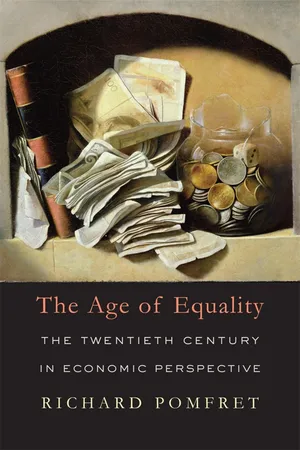
In 1900 the global average life expectancy at birth was thirty-one years. By 2000 it was sixty-six. Yet, alongside unprecedented improvements in longevity and material well-being, the twentieth century also saw the rise of fascism and communism and a second world war followed by a cold war. This book tells the story of the battles between economic systems that defined the last century and created today's world.
The nineteenth century was a period of rapid economic growth characterized by relatively open markets and more personal liberty, but it also brought great inequality within and between nations. The following century offered sharp challenges to free-wheeling capitalism from both communism and fascism, whose competing visions of planned economic development attracted millions of people buffeted by the economic storms of the 1930s. The Age of Equality describes the ways in which market-oriented economies eventually overcame the threat of these visions and provided a blueprint for reform in nonmarket economies. This was achieved not through unbridled capitalism but by combining the efficiency and growth potential of markets with government policies to promote greater equality of opportunity and outcome. Following on the heels of economic reform, rapid catch-up growth in countries such as China, India, Indonesia, Brazil, and Poland helped to reduce global inequality.
At a time when inequality is on the rise in nations as disparate as the United States and Egypt, Pomfret's interpretation of how governments of market economies faced the challenges of the twentieth century is both instructive and cautionary.
- 296 pages
- English
- PDF
- Available on iOS & Android
eBook - PDF
About this book
Information
Topic
EconomíaSubtopic
Economía comparadaTable of contents
- Cover
- Title Page
- Copyright
- Contents
- Preface
- Introduction
- Chapter 1. The Age of Liberty
- Chapter 2. War and Depression
- Chapter 3. The Soviet Economic Model
- Chapter 4. Multilateralism and Welfare State in the First World
- Chapter 5. Decolonization and Cold War
- Chapter 6. The Conservative Reaction in the West
- Chapter 7. The Collapse of Central Planning
- Chapter 8. The End of the Third World
- Chapter 9. From the Age of Equality to the Age of Fraternity
- Glossary and Abbreviations
- Notes
- References
- Index
Trusted by 375,005 students
Access to over 1.5 million titles for a fair monthly price.
Study more efficiently using our study tools.
Frequently asked questions
Yes, you can cancel anytime from the Subscription tab in your account settings on the Perlego website. Your subscription will stay active until the end of your current billing period. Learn how to cancel your subscription
No, books cannot be downloaded as external files, such as PDFs, for use outside of Perlego. However, you can download books within the Perlego app for offline reading on mobile or tablet. Learn how to download books offline
Perlego offers two plans: Essential and Complete
- Essential is ideal for learners and professionals who enjoy exploring a wide range of subjects. Access the Essential Library with 800,000+ trusted titles and best-sellers across business, personal growth, and the humanities. Includes unlimited reading time and Standard Read Aloud voice.
- Complete: Perfect for advanced learners and researchers needing full, unrestricted access. Unlock 1.5M+ books across hundreds of subjects, including academic and specialized titles. The Complete Plan also includes advanced features like Premium Read Aloud and Research Assistant.
We are an online textbook subscription service, where you can get access to an entire online library for less than the price of a single book per month. With over 1.5 million books across 990+ topics, we’ve got you covered! Learn about our mission
Look out for the read-aloud symbol on your next book to see if you can listen to it. The read-aloud tool reads text aloud for you, highlighting the text as it is being read. You can pause it, speed it up and slow it down. Learn more about Read Aloud
Yes! You can use the Perlego app on both iOS and Android devices to read anytime, anywhere — even offline. Perfect for commutes or when you’re on the go.
Please note we cannot support devices running on iOS 13 and Android 7 or earlier. Learn more about using the app
Please note we cannot support devices running on iOS 13 and Android 7 or earlier. Learn more about using the app
Yes, you can access The Age of Equality by Richard Pomfret in PDF and/or ePUB format, as well as other popular books in Economía & Economía comparada. We have over 1.5 million books available in our catalogue for you to explore.