Following a vast expansion in the twentieth century, government is beginning to creak at the joints under its enormous weight. The signs are clear: a bloated civil service, low approval ratings for Congress and the President, increasing federal-state conflict, rampant distrust of politicians and government officials, record state deficits, and major unrest among public employees.
In this compact, clearly written book, the noted legal scholar Richard Epstein advocates a much smaller federal government, arguing that our over-regulated state allows too much discretion on the part of regulators, which results in arbitrary, unfair decisions, rent-seeking, and other abuses. Epstein bases his classical liberalism on the twin pillars of the rule of law and of private contracts and property rights—an overarching structure that allows private property to keep its form regardless of changes in population, tastes, technology, and wealth. This structure also makes possible a restrained public administration to implement limited objectives. Government continues to play a key role as night-watchman, but with the added flexibility in revenues and expenditures to attend to national defense and infrastructure formation.
Although no legal system can eliminate the need for discretion in the management of both private and public affairs, predictable laws can cabin the zone of discretion and permit arbitrary decisions to be challenged. Joining a set of strong property rights with sound but limited public administration could strengthen the rule of law, with its virtues of neutrality, generality, clarity, consistency, and forward-lookingness, and reverse the contempt and cynicism that have overcome us.
eBook - PDF
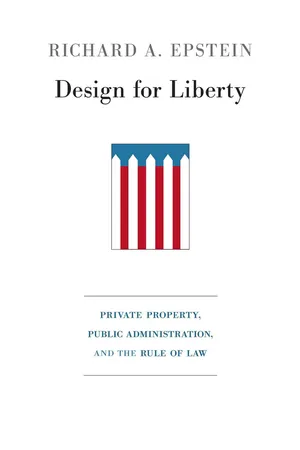
Design for Liberty
Private Property, Public Administration, and the Rule of Law
- 247 pages
- English
- PDF
- Available on iOS & Android
eBook - PDF
About this book
Information
Table of contents
- Contents
- Preface
- Introduction: From Small to Large Government
- 1. The Traditional Conception of the Rule of Law
- 2. Reasonableness Standards and the Rule of Law
- 3. Where Natural Law and Utilitarianism Converge
- 4. Where Natural Law and Utilitarianism Diverge
- 5. Property Rights in the Grand Social Scheme
- 6. The Bundle of Rights
- 7. Eminent Domain
- 8. Liberty Interests
- 9. Positive-SumProjects
- 10. Redistribution Last
- 11. The Rule of Law Diminished
- 12. Retroactivity
- 13. Modern Applications: Financial Reform and Health Care
- 14. Final Reflections
- Notes
- Index of Cases
- General Index
Trusted by 375,005 students
Access to over 1.5 million titles for a fair monthly price.
Study more efficiently using our study tools.
Frequently asked questions
Yes, you can cancel anytime from the Subscription tab in your account settings on the Perlego website. Your subscription will stay active until the end of your current billing period. Learn how to cancel your subscription
No, books cannot be downloaded as external files, such as PDFs, for use outside of Perlego. However, you can download books within the Perlego app for offline reading on mobile or tablet. Learn how to download books offline
Perlego offers two plans: Essential and Complete
- Essential is ideal for learners and professionals who enjoy exploring a wide range of subjects. Access the Essential Library with 800,000+ trusted titles and best-sellers across business, personal growth, and the humanities. Includes unlimited reading time and Standard Read Aloud voice.
- Complete: Perfect for advanced learners and researchers needing full, unrestricted access. Unlock 1.5M+ books across hundreds of subjects, including academic and specialized titles. The Complete Plan also includes advanced features like Premium Read Aloud and Research Assistant.
We are an online textbook subscription service, where you can get access to an entire online library for less than the price of a single book per month. With over 1.5 million books across 990+ topics, we’ve got you covered! Learn about our mission
Look out for the read-aloud symbol on your next book to see if you can listen to it. The read-aloud tool reads text aloud for you, highlighting the text as it is being read. You can pause it, speed it up and slow it down. Learn more about Read Aloud
Yes! You can use the Perlego app on both iOS and Android devices to read anytime, anywhere — even offline. Perfect for commutes or when you’re on the go.
Please note we cannot support devices running on iOS 13 and Android 7 or earlier. Learn more about using the app
Please note we cannot support devices running on iOS 13 and Android 7 or earlier. Learn more about using the app
Yes, you can access Design for Liberty by Richard A. Epstein in PDF and/or ePUB format, as well as other popular books in Law & North American History. We have over 1.5 million books available in our catalogue for you to explore.