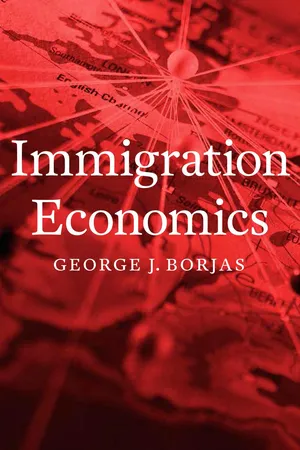
Millions of people—nearly 3 percent of the world's population—no longer live in the country where they were born. Every day, migrants enter not only the United States but also developed countries without much of a history of immigration. Some of these nations have switched in a short span of time from being the source of immigrants to being a destination for them. International migration is today a central subject of research in modern labor economics, which seeks to put into perspective and explain this historic demographic transformation.
Immigration Economics synthesizes the theories, models, and econometric methods used to identify the causes and consequences of international labor flows. Economist George Borjas lays out with clarity and rigor a full spectrum of topics, including migrant worker selection and assimilation, the impact of immigration on labor markets and worker wages, and the economic benefits and losses that result from immigration.
Two important themes emerge: First, immigration has distributional consequences: some people gain, but some people lose. Second, immigrants are rational economic agents who attempt to do the best they can with the resources they have, and the same holds true for native workers of the countries that receive migrants. This straightforward behavioral proposition, Borjas argues, has crucial implications for how economists and policymakers should frame contemporary debates over immigration.
- English
- ePUB (mobile friendly)
- Available on iOS & Android
eBook - ePub
Immigration Economics
About this book
Information
Table of contents
- Cover
- Half Title
- Title Page
- Copyright
- Dedication
- Contents
- Introduction
- 1. The Selection of Immigrants
- 2. Economic Assimilation
- 3. Immigration and the Wage Structure: Theory
- 4. The Wage Effects of Immigration: Descriptive Evidence
- 5. The Wage Effects of Immigration: Structural Estimates
- 6. Labor Market Adjustments to Immigration
- 7. The Economic Benefits from Immigration
- 8. High-Skill Immigration
- 9. The Second Generation
- Conclusion
- Appendix A: Mathematical Notes
- Appendix B: Construction of Data Extracts
- Notes
- References
- Acknowledgments
- Index
Trusted by 375,005 students
Access to over 1.5 million titles for a fair monthly price.
Study more efficiently using our study tools.
Frequently asked questions
Yes, you can cancel anytime from the Subscription tab in your account settings on the Perlego website. Your subscription will stay active until the end of your current billing period. Learn how to cancel your subscription
No, books cannot be downloaded as external files, such as PDFs, for use outside of Perlego. However, you can download books within the Perlego app for offline reading on mobile or tablet. Learn how to download books offline
Perlego offers two plans: Essential and Complete
- Essential is ideal for learners and professionals who enjoy exploring a wide range of subjects. Access the Essential Library with 800,000+ trusted titles and best-sellers across business, personal growth, and the humanities. Includes unlimited reading time and Standard Read Aloud voice.
- Complete: Perfect for advanced learners and researchers needing full, unrestricted access. Unlock 1.5M+ books across hundreds of subjects, including academic and specialized titles. The Complete Plan also includes advanced features like Premium Read Aloud and Research Assistant.
We are an online textbook subscription service, where you can get access to an entire online library for less than the price of a single book per month. With over 1.5 million books across 990+ topics, we’ve got you covered! Learn about our mission
Look out for the read-aloud symbol on your next book to see if you can listen to it. The read-aloud tool reads text aloud for you, highlighting the text as it is being read. You can pause it, speed it up and slow it down. Learn more about Read Aloud
Yes! You can use the Perlego app on both iOS and Android devices to read anytime, anywhere — even offline. Perfect for commutes or when you’re on the go.
Please note we cannot support devices running on iOS 13 and Android 7 or earlier. Learn more about using the app
Please note we cannot support devices running on iOS 13 and Android 7 or earlier. Learn more about using the app
Yes, you can access Immigration Economics by George J. Borjas in PDF and/or ePUB format, as well as other popular books in Economics & Economic Conditions. We have over 1.5 million books available in our catalogue for you to explore.