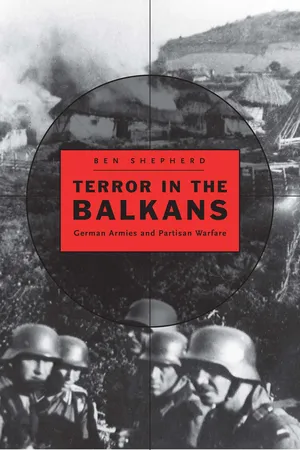
Germany's 1941 seizure of Yugoslavia led to an insurgency as bloody as any in World War II. The Wehrmacht waged a brutal counter-insurgency campaign in response, and by 1943 German troops in Yugoslavia were engaged in operations that ranked among the largest of the entire European war. Their actions encompassed massive reprisal shootings, the destruction of entire villages, and huge mobile operations unleashed not just against insurgents but also against the civilian population believed to be aiding them. Terror in the Balkans explores the reasons behind the Wehrmacht's extreme security measures in southern and eastern Europe.
Ben Shepherd focuses his study not on the high-ranking generals who oversaw the campaign but on lower-level units and their officers, a disproportionate number of whom were of Austrian origin. He uses Austro-Hungarian army records to consider how the personal experiences of many Austrian officers during the Great War played a role in brutalizing their behavior in Yugoslavia. A comparison of Wehrmacht counter-insurgency divisions allows Shepherd to analyze how a range of midlevel commanders and their units conducted themselves in different parts of Yugoslavia, and why. Shepherd concludes that the Wehrmacht campaign's violence was driven not just by National Socialist ideology but also by experience of the fratricidal infighting of Yugoslavia's ethnic groups, by conditions on the ground, and by doctrines that had shaped the military mindsets of both Germany and Austria since the late nineteenth century. He also considers why different Wehrmacht units exhibited different degrees of ruthlessness and restraint during the campaign.
- 333 pages
- English
- ePUB (mobile friendly)
- Available on iOS & Android
eBook - ePub
About this book
Information
CHAPTER 1
Before the Great War
Changes in the Officer Corps
THE MEN WHO COMPRISED the officer corps of the army that served under the Third Reich did not share a common heritage. During the years following the German Empire’s founding in 1871, the needs of an expanded army—unifying the armies of the kingdoms of Prussia, Saxony, Bavaria, and Württemberg—compelled the German officer corps to dilute its social exclusivity and accept growing numbers of entrants from across the spectrum of the German middle classes. This process accelerated with the continental arms race that preceded the outbreak of the Great War in 1914. Following the Great War, such was the diminished size of the post-1918 Reichswehr that the leadership of the new army was able to restore much of its earlier social exclusivity. But in 1935, Hitler declared the Versailles disarmament clauses dead and announced the Reichswehr’s replacement with a vastly enlarged, conscript-based Heer, together with a new air force and an expanded navy. Now the officer corps’ social base grew once more. Then, from 1938 onward, ethnic Germans outwith the Reich’s borders swelled the officer corps even further. The biggest intake came from the German-speaking lands of the old Austro-Hungarian Empire, Germany’s erstwhile ally during the Great War. Of these, the biggest intake of all came from the post-1918 Republic of Austria.
The nine generals who are this study’s main focus all commanded German army divisions that fought insurgents in Axis-occupied Yugoslavia. All were born between 1880 and 1890, either in the German Reich or in the German-speaking parts of the Austro-Hungarian Empire. All, Reich Germans and German-speaking Austrians alike, belonged to institutions that, during the first years of the twentieth century, were being challenged by powerful forces of social and political change. The forces themselves, and the mix of resistance and accommodation with which the two officer corps responded to them, would increasingly influence the officer corps’ character and the attitudes of young men embarking upon service within them. Some of the effects were beneficent; rather more would prove pernicious. Nevertheless, new officers were in no sense already set on an ineluctable path towards National Socialist–style warfare during this period; it was the events of later years that would ensure that particular outcome. But important seeds were planted nonetheless.1
The arch-conservatives who headed the imperial German officer corps, whether the general staff or the senior-most field commanders, recognized that a necessarily large, technically proficient Imperial German Army necessitated a large, technically proficient officer corps. It would need to be an officer corps whose members were drawn not just from the centuries-old bastions of service to the Prussian state—the families of Junker aristocrats and landowners, of Protestant clerics, of senior civil servants, and of officers themselves—but from a much wider middleclass social spectrum.2
But with expansion came risk. The officer corps saw itself as a bulwark against disruptive and dangerous social change. Traditionally aloof from mainstream society, it had long distrusted the bourgeois middle class, albeit nothing like as intensely as it feared Germany’s emerging industrial working class.3 Though the army leadership could countenance a necessarily expanded officer corps, then, it sought to minimize the dangers of social dilution by drawing its officer candidates from what it regarded as the “desired circles” of middle-class German society. The new emperor, Wilhelm II, elaborated on the concept of “desired circles” in 1890: “In addition to the sons of noble families of the country, and the sons of my loyal officers and civil servants, who according to old tradition constitute the main pillars of the officer corps, I see the future standard-bearers of my army in the sons of those honorable bourgeois families in which love for the king and fatherland and respect for the military and Christian morals are cultivated and handed down.”4
Southeast of the German Reich lay the multiethnic Austro-Hungarian Empire. Here, Magyars and ethnic German Austrians administered a polyglot empire whose population also comprised Poles, Ruthenes, Czechs, Slovaks, Italians, Rumanians, Croats, Albanians, Serbs, and Jews. There were three separate armies under the Emperor’s command— home armies for the Austrian and Hungarian halves of the monarchy, and a more powerful joint army. It was the joint army, properly titled the Royal-Imperial Army, that, in the years before the empire’s collapse in 1918, was principal home to all the Austrian-born officers in this study.
Like the German officer corps, the Royal-Imperial Army’s officer corps was deeply conservative by tradition, socially selective—though the majority of its personnel came from the families of officers, NCOs, or officials, rather than from traditional aristocratic families—and anxious to remain separate from civil society.5 But like the German officer corps, it needed to reach some sort of accommodation with the imperatives of change during the late nineteenth and early twentieth centuries. Most pressingly, it needed to try and remedy a serious, ongoing shortage of officers in an army that, due to the empire’s relative economic backwardness and the parsimony of the Austrian and Hungarian parliaments, was undersized and underresourced.6 One partial solution was, again, to open the officer corps to candidates from a wider range of social backgrounds. This drive to greater egalitarianism was further abetted by the system of military schooling open to officer candidates.7
Within the Royal-Imperial Army’s rank and file, the empire’s full ethnic kaleidoscope was properly represented. But within the officer corps, the ethnic Germans dominated—even if this had less to do with their ethnicity as such than with the superior education they enjoyed.8
The different branches of both armies maintained a distinct pecking order. Most sought after was the cavalry, followed by the artillery and finally the infantry.9 For Austro-Hungarian officers particularly, going into the infantry was a lottery, contingent upon a regiment’s location, the quality of its officers, and the literacy level of its men. The last of these was contingent upon a unit’s ethnic composition; only a fraction of the army’s units were monolingual, and of these only a smaller fraction still spoke German.10
Equally rigid were the social conditions in which new officers found themselves. While some German officers stationed within the Reich’s cosmopolitan urban centers were able to pursue some sort of intellectual existence,11 the German lieutenant’s life was usually deeply conformist. In the Imperial German Army, most officers were still required to train even after receiving their lieutenant’s commission, by attending the War School (Kriegsschule)—eight months’ cram-learning of subjects including battle tactics, weaponry, fortifications, terrain, and military organization.12 Social life centered on the officers’ mess, and socially conservative, aristocratic values governed virtually every aspect of an officer’s existence, irrespective of his own social origin.
All this made for an existence that, privileged though it was, was also intensive, narrow, and isolated from society. Not only was there no place in the curriculum in which to instruct officers on the social, political, and economic context of that wider society; such was the narrow pattern of their lives, and the strength of the socially conservative programming to which they were subjected, they were likely to be disinclined to learn about such things anyway.13 Stunting officers’ critical faculties in this way would have ominous implications for their later development.14
The Austro-Hungarian officer corps similarly sought to isolate its members from society. Given the army’s experience of civilians since 1848—violent revolution that year, frequent ethnic unrest throughout the empire in the decades that followed, parsimonious civilian parliaments, and stifling state bureaucracy—it is small wonder that the army leadership sought to instill within its officers a feeling of aloofness from, indeed aversion to, civilian influences.15 In one respect at least, however, Austro-Hungarian officers were less straitjacketed than their German colleagues. Thanks to Austria-Hungary’s sheer diversity, the course of a Habsburg junior officer’s military service exposed him to a far greater variety of peoples and environments than his German counterpart. The historian Gunther Rothenburg elaborates:
The large territorial expanse of the Dual Monarchy, which included the gentle landscapes of Lower Austria and Bohemia, the mighty ranges of the Alps and the Carpathians, the rich lands of Slovenia and the plains of Galicia, the wild forests of Bosnia and Transylvania, as well as the barren crags of the Dalmatian coast, with garrisons ranging from cities of culture and refinement like Vienna, Budapest, and Prague, provincial towns like Graz, Agram, or Budweis, to small, isolated hamlets, gave service in the joint army a special character. An officer might serve a tour in a big city and find himself during the next in an isolated fort in Bosnia or in the mud of a small Galician hamlet. Described by one English journalist “as hard-working, hard-living men,” the average Austro-Hungarian regimental officer was judged the “superior of the average German officer . . . more intelligent, more readily adaptable, in closer touch with his men, less given to dissipation, and remarkably free from arrogance.”16
Rothenburg’s English eyewitness is overgeneralizing about the German officer of the period.17 Yet there is something in the argument that the German officer’s Austro-Hungarian counterpart was, on the whole, more open-minded. But the argument should not be taken too far. Ultimately, how far an Austro-Hungarian officer chose to absorb a better-developed worldview was down to him individually. Like his German counterpart, he could expect no meaningful education on wider social, political, and economic realities from his superiors.
Within both officer corps, meanwhile, the years before the Great War portended ominous changes. During the late nineteenth and early twentieth centuries, technical and industrial change made it possible for major powers to recruit, equip, and supply mass conscript-based armies. The scale of warfare that the Europe-wide emergence of mass armies presaged required a hitherto unparalleled degree of technical prowess and operational planning. This was also an era in which the revolution in defensive firepower, advances in communication, and the advent of airpower on the battlefield were transforming warfare fundamentally.18
In the new reality these converging elements created, it was incumbent upon the ambitious young officer to gain expertise not just in a traditional branch of the army, but also, eventually, in one of the cutting-edge fields of military planning and technology. The most sought-after route was to qualify as a staff officer. This presented the ambitious young officer with the perfect opportunity to master the entire technical, organizational, and operational foundation upon which the new warfare was based. Only the very ablest officers—many of whom, in the case of the German and Austro-Hungarian officer corps, would eventually fill the Wehrmacht’s senior-most positions—were granted such an opportunity. But many other future Wehrmacht officers were at least able to pursue their ambitions further by transferring to one of the rapidly developing technology-oriented branches of their respective armies—airships, machine-gunnery, or battlefield communications, for instance—before, during, or after the Great War.19
The emergence of the technically minded military planner would culminate during the interwar years in the advent of the “specialist in mass destruction.” This was a badge the Reichswehr officer corps would come to sport with particular pride. But even before the outbreak of the Great War, officers’ increasing professional specialization could bring baleful implications. For it encouraged ambitious young officers with new professional preoccupations to work and think in a way more specialized, focused, and intensive than ever before. This discouraged out-of-the-box thinking on military matters. And, more importantly for this study, such narrowness could further deprive an officer of the opportunity to develop societal awareness, political maturity, and general openness to the world.20 Though increasing professional specialization did not make such an outcome inevitable, it did make it more likely.
All the more likely given some of the still more disturbing developments that were now in train. Whether in Wilhelm II’s Germany or in the Austro-Hungarian Empire, brutal worldviews were already emerging across wider society. And such was the level of social and political illiteracy that afflicted both officer corps that a great many officers, though not yet automatic prey to such worldviews, were morally and intellectually ill-equipped to resist them as fully as they might have done. One of the most influential ideas of the age across Europe, and quite possibly the most noxious, was Social Darwinism. Social Darwinists believed that the struggle between the “superior” and the “inferior,” and the extinction or subjugation of the weak in favor of the strong, were the natural order of things not just in the animal kingdom, but in human affairs also. During the 1880s, those who believed it was the Germans themselves who, by dint of their cultural, scientific, and military achievements, occupied the foremost position among all the “races” of humanity, merged into the Pan-German movement.
Pan-Germans in Germany itself clustered around the Pan-German League, and in German-speaking Austria around the Greater German People’s Party (GDVP). Both groups drew support from particular middle-class circles. For the Pan-German League it was teachers, civil servants, doctors, lawyers, and other professionals who saw themselves as pillars of social authority and custodians of German culture. For the GDVP it was right-wing university students, and artisans and shopkeepers who felt threatened by technological change.21
As the German and Austro-Hungarian officer corps expanded, officers who hailed from such backgrounds became much more numerous. If they did indeed subscribe to Pan-German sentiment, they could not necessarily expect a particularly warm reception in the traditionalistic climat...
Table of contents
- Cover
- Title Page
- Copyright
- Content
- Introduction
- 1. Before the Great War: Changes in the Officer Corps
- 2. Forging a Wartime Mentality: The Impact of World War I
- 3. Bridging Two Hells: The 1920s and 1930s
- 4. Invasion and Occupation: Yugoslavia, 1941
- 5. Islands in an Insurgent Sea: The 704th Infantry Division in Serbia
- 6. Settling Accounts in Blood: The 342d Infantry Division in Serbia
- 7. Standing Divided: The Independent State of Croatia, 1942
- 8. Glimmers of Sanity: The 718th Infantry Division in Bosnia
- 9. The Morass: Attitudes Harden in the 718th Infantry Division
- 10. The Devil’s Division: The 369th Infantry Division in Bosnia, 1943
- Conclusion
- Appendix A: Source References for Featured Officers
- Appendix B: Note on the Primary Sources
- Abbreviations
- Notes
- Acknowledgments
- Index
Trusted by 375,005 students
Access to over 1.5 million titles for a fair monthly price.
Study more efficiently using our study tools.
Frequently asked questions
Yes, you can cancel anytime from the Subscription tab in your account settings on the Perlego website. Your subscription will stay active until the end of your current billing period. Learn how to cancel your subscription
No, books cannot be downloaded as external files, such as PDFs, for use outside of Perlego. However, you can download books within the Perlego app for offline reading on mobile or tablet. Learn how to download books offline
Perlego offers two plans: Essential and Complete
- Essential is ideal for learners and professionals who enjoy exploring a wide range of subjects. Access the Essential Library with 800,000+ trusted titles and best-sellers across business, personal growth, and the humanities. Includes unlimited reading time and Standard Read Aloud voice.
- Complete: Perfect for advanced learners and researchers needing full, unrestricted access. Unlock 1.5M+ books across hundreds of subjects, including academic and specialized titles. The Complete Plan also includes advanced features like Premium Read Aloud and Research Assistant.
We are an online textbook subscription service, where you can get access to an entire online library for less than the price of a single book per month. With over 1.5 million books across 990+ topics, we’ve got you covered! Learn about our mission
Look out for the read-aloud symbol on your next book to see if you can listen to it. The read-aloud tool reads text aloud for you, highlighting the text as it is being read. You can pause it, speed it up and slow it down. Learn more about Read Aloud
Yes! You can use the Perlego app on both iOS and Android devices to read anytime, anywhere — even offline. Perfect for commutes or when you’re on the go.
Please note we cannot support devices running on iOS 13 and Android 7 or earlier. Learn more about using the app
Please note we cannot support devices running on iOS 13 and Android 7 or earlier. Learn more about using the app
Yes, you can access Terror in the Balkans by Ben H. Shepherd,Ben Shepherd in PDF and/or ePUB format, as well as other popular books in History & European History. We have over 1.5 million books available in our catalogue for you to explore.