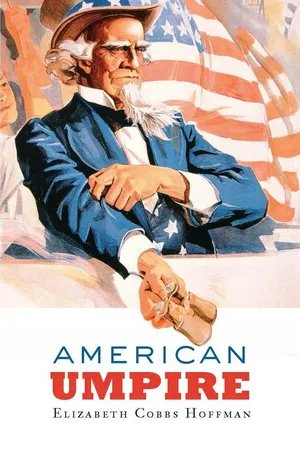
Commentators frequently call the United States an empire: occasionally a benign empire, sometimes an empire in denial, and often a destructive empire. Elizabeth Cobbs Hoffman asserts instead that, because of its unusual federal structure, America has performed the role of umpire since 1776, compelling adherence to rules that gradually earned collective approval.
This provocative reinterpretation traces America's role in the world from the days of George Washington, Abraham Lincoln, and Franklin D. Roosevelt to the present. Cobbs Hoffman argues that the United States has been the pivot of a transformation that began outside its borders and before its founding, in which nation-states replaced the empires that had dominated history. The "Western" values that America is often accused of imposing were, in fact, the result of this global shift. American Umpire explores the rise of three values—access to opportunity, arbitration of disputes, and transparency in government and business—and finds that the United States is distinctive not in its embrace of these practices but in its willingness to persuade and even coerce others to comply. But America's leadership is problematic as well as potent. The nation has both upheld and violated the rules. Taking sides in explosive disputes imposes significant financial and psychic costs. By definition, umpires cannot win.
American Umpire offers a powerful new framework for reassessing the country's role over the past 250 years. Amid urgent questions about future choices, this book asks who, if not the United States, might enforce these new rules of world order?
- English
- ePUB (mobile friendly)
- Available on iOS & Android
eBook - ePub
American Umpire
About this book
Information
1
To Compel Acquiescence
Or, How Federalism Replaced Empire with Umpire, 1648–1789
In a peculiar way, Americans’ first foreign alliances—and thus their first foreign relations—were with one another. After the colonies collectively declared independence, each wrote and adopted a separate constitution. They knew they would have to stick together to resist Britain’s fearsome opposition, so they also passed the Articles of Confederation. This document created a permanent body to replace the emergency assemblies that had been called in 1774 and 1775 as the First and Second Continental Congresses. The resulting federation could make recommendations to the sovereign states but had no power over them or their citizens. It could not impose one penny in taxes, or regulate one item of commerce. It had no executive or judiciary. Any change to its charter required the unanimous approval of the member states. They were more like thirteen countries than one.1
It took seven bloody years for the thirteen states to achieve their independence. But once the revolutionaries climbed that peak they saw another range of obstacles stretching out before them. Within a few short years, the states combined forces even more firmly and placed what they called a “general government” over their heads. To achieve this they wrestled with age-old tensions between nation and empire: how to maintain state autonomy while reaping the advantages of belonging to a larger confederacy.
In 1789, they cobbled together the valuable traits they saw in both nations and empires, creating a hybrid. They fashioned a republic of republics. At the top was an elected government that could act, when necessary, as an “umpire” between political contestants and “compel acquiescence”—to use their terms. It was not an empire for the reason that participant states joined voluntarily and ruled collaboratively. They were not victors or victims of conquest. This atypical, often awkward arrangement gave Americans experience with the notion that one might have dual citizenship in both the state and nation, and that one government could yield to a more powerful one above it without losing dignity. The prerogatives that the federal government ultimately assumed—to reach across state borders to punish or protect individuals, and even to overrule the laws of states themselves—were the subject of ongoing controversy. They evolved gradually. Some of the founders did not get as powerful a central government as they initially wished for (and later regretted, in the case of James Madison). But passage of the Constitution propelled the federal government down the road toward “umpire.”
Europe then had nothing comparable. No higher authority could discipline the governments of, say, England or France, or arrest its citizens for a crime. Indeed, for more than a century, since 1648, Europeans had emphatically rejected any authority superior to the nation-state. Consequently, Americans developed a different feel for sovereignty from that of their cousins across the Atlantic. They became willing to grant at least some powers to an overarching government. Interventionism across state borders, in extremis, became acceptable. Each generation became more accustomed to the arrangement. By the end of the first century, they even spoke of themselves differently: as the United States, not these United States.
The American constitutional experiment was a fork in the road. In the far future, this path led to the United Nations and the European Union. But to a greater extent than the nations that joined these later bodies, perhaps because of their longer historical experience with dual sovereignty, Americans came to accept the exercise of a higher power as sometimes “necessary and proper.” They recognized the importance of an umpire, first for themselves in their domestic arrangements, and then in their international relationships.
Although it is natural to fix U.S. history on a grid marked by milestones like the founding of Jamestown or the Revolution, this can be like walking into the middle of a conversation. As historian Daniel Rodgers observes: “Every serious reader of the past instinctively knows … that nations lie enmeshed in each others’ history. Even the most isolated of nation-states is a semipermeable container, washed over by forces originating far beyond its shores.”2 The new world system in which the United States arose, and where it was initially an anomaly, began with the Reformation. This religious cataclysm fundamentally redefined the relationship among the existing European nations, making them absolutely autonomous from one another. It led them to reject any kind of outside supervision. To understand how this happened, and its significance for the American story, we must step back at least briefly into the dim and distant past.
Hunched over his desk in the dusty Roman province of Palestine, the old man worried that he was inadequate to the task of eulogizing the dead. He felt voiceless, knowing they could not hear his words. His pen seemed “rusty” and even his writing tablet wore “a sad look.” Heathens and brigands had brought down the vibrant empire in whose marble libraries he had come of age. “For twenty years and more,” Saint Jerome wrote his friend Heliodorus in 396 CE, “Roman blood has been spilt every day between Constantinople and the Julian Alps.” All that his generation knew had “been laid waste, pillaged, and plundered.” Commoners and aristocrats alike had been tormented, mocked, raped, enslaved, and slain. “Grief and lamentation are everywhere, and the image of death in its many forms.”3
Jerome’s cry from the heart was the first of many recorded during the nine centuries of Europe’s Dark Ages, when invaders and thieves made people quake in their homes and fear venturing beyond locked town gates. After Rome’s ruin, violence and pestilence stalked the land. Innocents were not safe even on distant shores, protected by the wide moat of the fierce Atlantic, or barricaded in castles on high hills. When one wave of invaders receded, another took its place. In 787, the seaborne Vikings made their first raids on England, blazing a path of destruction that took them from Scandinavia to Jerusalem, slaying defenders where they stood, looting homes, ravaging women, burning churches, and trampling holy men “like dung in the street.”4 Beginning in 1237, the Mongols swept on thundering hooves across Russia, then Hungary, then Bulgaria—while simultaneously pillaging imperial China at the other end of Asia. Then came the conquering Ottoman Turks. In 1453 they captured Constantinople, the capitol of ancient Christianity. Twice they chased Europeans to the gates of Vienna.
In these bleak centuries, the idea of empire elicited longing rather than scorn. Europeans looked back on Rome as the ideal society. Then, stern legionnaires had curbed wanton killing. The roads, bridges, walls, and aqueducts of antiquity stood firm, rather than in tumbled ruins. When the Vandals reduced the Western classical heritage to rubble, they headed a roster of names that connoted chaos. At the start of the modern era, around the time Christopher Columbus sailed into the West Indies, Europeans remembered the Pax Romana as a time of human unity, when empire had been “the guarantor of glory and of safety.”5
Religious faith reinforced this nostalgia. In the ancient world, orbis christianus and orbis romanus were intertwined.6 The empire of men and the empire of God appeared to mesh seamlessly. The identity of Christ and the temporal emperor blurred: both were the King of Kings, one in heaven, the other on earth. Once the Roman state ceased to operate, the Latin pope assumed the mantle of kingmaker. In 800 CE, he recognized the Frankish ruler Charlemagne as emperor of the Holy Roman Empire. Charlemagne began the reign that eventually passed to Otto the Great and encompassed much of central Europe. Until the Reformation, Latin Christianity was Europe’s official religion, with the pope claiming ultimate authority (often ineffectively) on any number or matters, from the marriage of royals to the division of the continents discovered by Columbus. But a general pax remained elusive. The pope’s ability to quell internal strife or halt external attack was extremely limited. The more powerful monarchs of Europe also resisted his authority, and some discordant voices (like that of poet Dante Alighieri) questioned whether secular and religious authority might be better separated.7
Then came the Reformation begun by Martin Luther in 1517, which broke Europe into pieces and gave birth to the nation-state. It dispelled forever the aspiration to unite all Christendom under a single, benevolent emperor.8 It took more than a century for the full catastrophe to become apparent, coinciding with the first European settlements in the Western Hemisphere. Between 1517 and 1648, civil and international conflict roiled the Old World. Protestants vied bitterly with Catholics for the eternal souls and earthly treasure claimed by the church. The rupture of the Christian empire under papal supervision produced the Schmalkaldic War, the Eighty Years’ War, the Spanish Armada, the English Civil War, the French Civil War, the Thirty Years’ War, and numerous other bloody battles, large and small. Roman oversight became associated with oppression by foreigners, rather than protection and salvation. Europeans finally rejected empire emphatically, turning their backs on the past.
Henry VIII of England, the hotheaded, heir-obsessed Tudor king, was among the first to declare his nation unbeholden to the pope or any other temporal authority. He appropriated the word “empire,” previously used to describe a system of linguistically dissimilar, noncontiguous peoples under an outside authority, and claimed it instead for his own nation as a coherent and autonomous assemblage. In Henry’s usage, the word meant country. And so his 1533 declaration of independence (the Act of Restraint in Appeals) read: “This realm of England is an empire … without restraint or provocation to any foreign prices or potentates of the world.” Here, stood on its head, “empire” meant that England ruled itself. As late as 1860, Englishmen equated “empire” with the United Kingdom alone and not its overseas possessions.9
Although the king’s famous difficulties with siring a male heir prompted his break with Rome’s papal authority, Henry Tudor’s 1533 pronouncement touched a deep chord in the island population’s sense of itself as distinct from continental Europeans. Parliament passed the Act of Restraint handily. The following year, the Act of Supremacy declared Henry “the only supreme head in earth of the Church of England,” and claimed for him all the privileges pertaining to “the imperial crown.” (One of which, conveniently, was the power to divorce aging Catharine of Aragon and wed comely Anne Boleyn.)
Internecine warfare and ruthless royal intrigue plagued Great Britain for most of the following two centuries, but the claim stuck. The king became head of the church, and the island of Great Britain became an “empire” unto itself, eventually uniting all the kingdoms within—some of them forcibly. Citizens had no further appeal on legal matters to any higher authority outside the country—namely, the pope. The realms of England, Wales, Scotland, and Ireland gradually came under a single central government as the United Kingdom. Despite internal diversity and outbreaks of rebellion, they were one state.
In Europe itself, wracked by religious schism, the first plank for peace was laid in Augsburg, the ancient Bavarian town built by Roman troops at the woodsy confluence of the Lech and Wertach Rivers. There in 1555, after more than a thousand years of Latin orthodoxy, Holy Roman Emperor Charles V granted the principle cuius regio, eius religio (“whose region, his religion”) to the Lutheran princes of Germany. Roughly translated, this meant the faith of the ruler would prevail within his territory. It was a stunning concession to political and religious freedom for European monarchs, after centuries of papal supervision. Of course, the common people themselves had no such freedom, being required to follow the faith of their local rulers.10
But the temptation to squelch heresy in a neighbor’s backyard proved too strong for some to resist. King Philip II of Spain, heir of Charles V, brushed aside his father’s dictum of cuius regio, eius religio. Less battle-weary than Charles, Philip II was determined not to lose western Europe to Protestantism. As he wrote his ambassador to Rome, “You may assure His Holiness, that rather than suffer the least damage to religion and the service of God, I would lose all my states and an hundred lives, if I had them; for I do not propose nor desire to be the ruler of heretics.”11
In 1588 Phillip launched the Spanish Armada against England in an effort to tow it back into the Catholic fold. Elizabeth I successfully repelled his attack—aided by a providential storm that drove Philip’s fleet onto the rocks, saved Britain, and made the Virgin Queen into England’s greatest monarch. The Spanish king simultaneously warred against his Protestant subjects in the Netherlands to make them conform, touching off a conflict there that burned for eighty years and resulted in Dutch independence. Predating a very similar American declaration by two centuries, the Dutch proclaimed in 1581 that when a monarch “oppresses” the people, infringes upon “their ancient customs and privileges,” and treats them tyrannically, they “may not only disallow his authority, but legally proceed to the choice of another prince for their defense.”12 King Philip exhibited little awareness of the full consequences of his actions, but his battles against the English and Dutch eventually exhausted the colossal fortune in silver and gold that Spain had wrested from the Aztecs and Incas only decades earlier.
Elsewhere, domestic tyrants implemented cuius regio, eius religio with a vengeance that made local self-determination hardly kinder than foreign imposition. In Trier, the oldest of all German cities, the local Catholic archbishop expelled the Protestants, then the Jews, and eventually torched 368 people as witches.13 And he was not the most merciless figure in the campaigns of religious cleansing designed to re-Catholicize dissidents, or to make Catholics into good Protestants. In the Republic of Ireland, Puritan Oliver Cromwell is reviled to this day as a genocidal maniac for the massacre of those stubborn Catholic Celts he called “barbarous wretches.”
The most infamous of all internecine feuds during the Reformation was the Thirty Years’ War. At least one-quarter of central Europe’s population died between 1618 and 1648, many killed with the new gunpowder weapons that enabled professional armies to fight more efficiently. In German-speaking areas, warfare destroyed a third of all homes. Peasants in the region suffered from robbery, murder, and starvation with horrifying regularity. Some were slaughtered where they stood, while others disappeared into the forests. Brutal punishments were used to torture captives, including the “Swedish drink”—pouring excrement down the vi...
Table of contents
- Cover
- Half Title
- Title Page
- Copyright
- Dedication
- Contents
- Introduction
- 1. To Compel Acquiescence
- 2. Umpire Attacked
- 3. Another Umpire than Arms
- 4. A Rowboat in the Wake of a Battleship
- 5. Territorial Expansion versus Saltwater Imperialism
- 6. The Open Door and the First International Rules
- 7. War against War
- 8. Up to the Neck and in to the Death
- 9. The Buck Stops Here
- 10. A Coercive Logic
- Conclusion: Good Calls, Bad Calls, and Rules in Flux
- Notes
- Acknowledgments
- Index
Trusted by 375,005 students
Access to over 1.5 million titles for a fair monthly price.
Study more efficiently using our study tools.
Frequently asked questions
Yes, you can cancel anytime from the Subscription tab in your account settings on the Perlego website. Your subscription will stay active until the end of your current billing period. Learn how to cancel your subscription
No, books cannot be downloaded as external files, such as PDFs, for use outside of Perlego. However, you can download books within the Perlego app for offline reading on mobile or tablet. Learn how to download books offline
Perlego offers two plans: Essential and Complete
- Essential is ideal for learners and professionals who enjoy exploring a wide range of subjects. Access the Essential Library with 800,000+ trusted titles and best-sellers across business, personal growth, and the humanities. Includes unlimited reading time and Standard Read Aloud voice.
- Complete: Perfect for advanced learners and researchers needing full, unrestricted access. Unlock 1.5M+ books across hundreds of subjects, including academic and specialized titles. The Complete Plan also includes advanced features like Premium Read Aloud and Research Assistant.
We are an online textbook subscription service, where you can get access to an entire online library for less than the price of a single book per month. With over 1.5 million books across 990+ topics, we’ve got you covered! Learn about our mission
Look out for the read-aloud symbol on your next book to see if you can listen to it. The read-aloud tool reads text aloud for you, highlighting the text as it is being read. You can pause it, speed it up and slow it down. Learn more about Read Aloud
Yes! You can use the Perlego app on both iOS and Android devices to read anytime, anywhere — even offline. Perfect for commutes or when you’re on the go.
Please note we cannot support devices running on iOS 13 and Android 7 or earlier. Learn more about using the app
Please note we cannot support devices running on iOS 13 and Android 7 or earlier. Learn more about using the app
Yes, you can access American Umpire by Elizabeth Cobbs Hoffman in PDF and/or ePUB format, as well as other popular books in History & North American History. We have over 1.5 million books available in our catalogue for you to explore.