Since 1955, moving from early work in psychopharmacology to studies of clinical method and the psychiatric schools, Leston Havens has been working toward a general theory of therapy. It often seems that twentieth-century psychiatry, sect-ridden, is a Tower of Babel, as Havens once characterized it. This book is the distillation of long years of thought and practice, a bold yet modest attempt to delineate an "integrated psychotherapy."
The boldness of this effort lies in its author's willingness to recognize the best that each school has to offer, to describe it cogently, and to integrate it into a full response to today's new kind of patient. Descriptive or medical psychiatry, psychoanalysis, interpersonal or behavioristic psychiatry, empathic or existential therapy-viewed in metaphors, respectively, of perceiving, thinking, managing, feeling-all have useful contributions to make to contemporary methods of treatment. But how? Havens's modest answer is through appropriate language, and he demonstrates exactly what he means: when to ask questions, when to direct or draw back, when to sympathize.
Practitioners now must deal with less dramatic, but more stubborn, problems of character and situation; lack of purpose, isolation, submissiveness, invasiveness, deep yet vague dissatisfaction. Some kind of human presence must be discovered in the patient, and Havens gives concrete, absorbing examples of ways of "speaking to absence," of making contact. The emphasis is on verbal technique, but the underlying broad, humane intent is everywhere evident. It is no less than to transform passivity, by means of disciplined therapeutic concern, into a state of being Human.
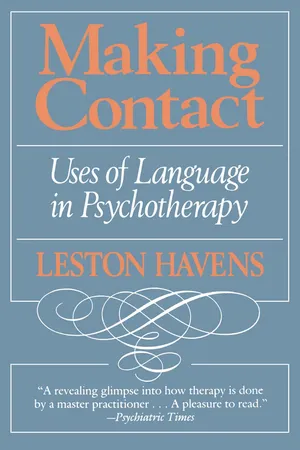
- 201 pages
- English
- ePUB (mobile friendly)
- Available on iOS & Android
eBook - ePub
About this book
Information
Publisher
Harvard University PressYear
2012Print ISBN
9780674543164
9780674543157
eBook ISBN
9780674725393
Table of contents
- Cover
- Title
- Copyright
- Preface
- Contents
- Antecedents: Speaking to Absence
- Empathic Language
- Interpersonal Language
- Performative Language
- The Languages in Action
- Notes
- Acknowledgments
- Index
Trusted by 375,005 students
Access to over 1.5 million titles for a fair monthly price.
Study more efficiently using our study tools.
Frequently asked questions
Yes, you can cancel anytime from the Subscription tab in your account settings on the Perlego website. Your subscription will stay active until the end of your current billing period. Learn how to cancel your subscription
No, books cannot be downloaded as external files, such as PDFs, for use outside of Perlego. However, you can download books within the Perlego app for offline reading on mobile or tablet. Learn how to download books offline
We are an online textbook subscription service, where you can get access to an entire online library for less than the price of a single book per month. With over 1.5 million books across 990+ topics, we’ve got you covered! Learn about our mission
Look out for the read-aloud symbol on your next book to see if you can listen to it. The read-aloud tool reads text aloud for you, highlighting the text as it is being read. You can pause it, speed it up and slow it down. Learn more about Read Aloud
Yes! You can use the Perlego app on both iOS and Android devices to read anytime, anywhere — even offline. Perfect for commutes or when you’re on the go.
Please note we cannot support devices running on iOS 13 and Android 7 or earlier. Learn more about using the app
Please note we cannot support devices running on iOS 13 and Android 7 or earlier. Learn more about using the app
Yes, you can access Making Contact by Leston Havens in PDF and/or ePUB format, as well as other popular books in Psychology & Psychiatry & Mental Health. We have over 1.5 million books available in our catalogue for you to explore.