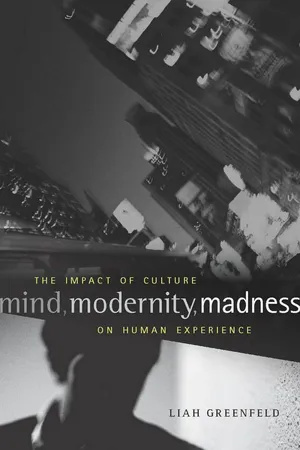
It's the American dream—unfettered freedom to follow our ambitions, to forge our identities, to become self-made. But what if our culture of limitless self-fulfillment is actually making millions desperately ill? One of our leading interpreters of modernity and nationalism, Liah Greenfeld argues that we have overlooked the connection between egalitarian society and mental illness. Intellectually fearless, encompassing philosophy, psychology, and history, Mind, Modernity, Madness challenges the most cherished assumptions about the blessings of living in a land of the free.
Modern nationalism, says Greenfeld, rests on bedrock principles of popular sovereignty, equality, and secularism. Citizens of the twenty-first century enjoy unprecedented freedom to become the authors of their personal destinies. Empowering as this is, it also places them under enormous psychic strain. They must constantly appraise their identities, manage their desires, and calibrate their place within society. For vulnerable individuals, this pressure is too much. Training her analytic eye on extensive case histories in manic depression and schizophrenia, Greenfeld contends that these illnesses are dysfunctions of selfhood caused by society's overburdening demands for self-realization. In her rigorous diagnosis, madness is a culturally constituted malady.
The culminating volume of Greenfeld's nationalism trilogy, Mind, Modernity, Madness is a tour de force in the classic tradition of Émile Durkheim—and a bold foray into uncharted territory. Often counter-intuitive, always illuminating, Mind, Modernity, Madness presents a many-sided view of humanity, one that enriches our deepest understanding of who we are and what we aspire to be.
- 670 pages
- English
- ePUB (mobile friendly)
- Available on iOS & Android
eBook - ePub
About this book
Information
III
HISTORICAL
5
The Cradle of Madness
The sixteenth century in England was a time of colossal transformations. The graves of feudal lords slain on the one side and the other in the War of the Roses contained not only these mortal remains: a whole world lay buried in them. Rigor mortis, paradoxically, was a central characteristic of that, now dead, world in its life: for it was the world of the society of orders—a stony social structure, as imposing as that of a fortified castle towering over the countryside, with its thick walls, deep dungeons, and narrow windows letting in just enough light to enable its in-dwellers to follow their assigned ways. It was built on the secure foundation of the unchanging word of God, once and for all revealed in the Holy Scriptures, which everyone was obliged to obey, but few were allowed to know, and even fewer to interpret. No part of this rigid world would change position vis-à-vis the others, nothing moved, and everyone was kept to one’s place: it was as stable as a human world can be—not, perhaps, as stable as a castle, but eminently stable in comparison to the world that came to replace it. Now it was dead, and the stability was gone.
The birth of the new world that came into being with the new dynasty and the new aristocracy, which stepped into the void left by the slain lords who fought to such bitter ends for the rights of Lancasters and Yorks, could only be compared to a volcanic eruption of Earth’s early days. This world itself was to prove a volcano. Constantly but unpredictably active, it would forever swallow aging formations and disgorge new ones and swallow them again, it would never rest still. In its bowels steely characters were tempered and softer mettle melted, and its brightly burning fires illumined humanity as it never had been illumined before. In their glow it appeared beauteous. This new world was named “modern,” and the light which would guide souls in it was no longer Holy Scripture, but the new, radically humanistic perspective which history dubbed “nationalism.”
The Cradle
The cardinal feature of nationalism—which necessarily follows from the principle of popular sovereignty and underlies every other aspect of the national reality, including the fundamental egalitarianism of the national membership—is its secularism. Popular sovereignty, which is the essence of the idea of the nation as elite, makes God defunct; with God defunct, man becomes the ruler of the universe. There emerged a completely new understanding of man (according to the first English Renaissance, Sir Thomas Elyot’s, Dictionary—a sexless and ageless concept, “a liuing creature with the capacitie of reason, subject to death: a manne, a woman, a chylde”1) as an agent, a self-governing and dignified state, the individual responsible for and capable of shaping one’s own destiny. Human life acquired a new—and supreme—value: the death of children untouched by sin was no longer a cause for celebration as augmenting the population of angels, but now represented death at its most senseless. In general, death was stripped of the sacred significance—which made it almost attractive—bestowed on it by Christianity: man was no longer dust and worm, and death was not the return of the soul to its Maker on High, the portals to the better and eternal life, but the end, incomprehensible and unacceptable, of the only existence this extraordinary double being, a body and a spirit at once, could have. The change in the meaning of life and death changed the nature of the existential experience—what moved men and women, what made them suffer or content, the essence of suffering and contentment, human desires and fears, the general character of their emotions and ways of thinking—all this was new.
This radical transformation was felt in England already in the early sixteenth century. The “modernization” of English (the addition of countless neologisms, reconceptualization of existing words, and invention of new morphological constructions)—under way by its third decade, at the latest, reflected the fact. There existed no language to describe and express the new existential experience before: coming to grips with the new life, therefore, involved creating it. What we know as modern English—one, and not the earliest one, of modern vernaculars—is, in fact, the lingua franca of modernity. It encoded the new view of reality, enabling everyone who spoke it to experience life in the new way. Henceforth translation from English changed the nature of experience in communities of other languages as well. Modern reality thus arrived in the rest of the world as translation from English.
This process of the “modernization” of English language, thinking, and experience was complete by 1600, certainly by 1610, when the King James Version of the English Bible was published. From that point on speakers (and writers) of English communicate with us directly, we share the same understanding, live in the same world, our fundamental values (by which I, obviously, do not mean political ideologies, but rather conceptions of man-in-universe and the meaning of human life) are the same. This is so even in regard to those late sixteenth- and seventeenth-century thinkers who must still be considered religious. The “Holy Mr. Herbert,” that unusual in the period “godly and painful [painstaking] divine,” included in the Temple, his collection of devotional poetry, the poem “Man,” which was addressed to God, and read:
My God, I heard this day
That none doth build a stately habitation,
But he that means to dwell therein.
What house more stately hath there been,
Or can be, than is man? To whose creation
All things are in decay.
“Man,” he continued, was “every thing and more,” “all symmetry, full of proportion,” for him (“for us,” Herbert said) the winds blew, fountains flowed, the earth and heaven themselves and “all things” existed, rendering service to his (our) mind or “flesh.” Herbert concluded:
Oh, mighty love! Man is one world, and hath
Another to attend him.
Since then, my God, thou hast
So brave a palace built, O dwell in it,
That it may dwell with thee at last!
Till then, afford us so much wit,
That, as the world serves us, we may serve thee,
And both thy servants be.2
These last lines sound very much as a reminder, even an admonition to the Almighty, urging him to honor his responsibilities toward the magnificent house He built to inhabit—man (and become, as it were, at last, a responsible house owner).
Donne’s Holy Sonnets express similarly mixed feelings: an immense pride in being human and a deep frustration with human mortality:
I am a little world made cunningly
Of elements, and an angelic sprite;
But black sin hath betrayed to endless night
My world’s both parts, and O, both parts must die.
Something is amiss, in fact illogical and unacceptable, with Providential plan:
Thou hast made me, and shall thy work decay?
Repair me now, for now mine end doth haste;
I run to death, and death meets me as fast,
And all my pleasures are like yesterday . . .3
Shakespeare, a generation ahead of Donne and Herbert, no longer questions God, but not because he still accepts His will. In fact God is altogether absent from the work of this greatest modern poet. His sonnets are not “Holy.” The world constructed in them is impersonal, it is ruled by Time, something akin to the eighteenth century idea of Nature, our idea of natural forces. Preoccupied as he is obsessively with the duality, temporality, and “sad mortality” of human existence, he nevertheless insists that immortality, physical and spiritual, is possible and within human powers. This view of immortality is dramatically different from the Christian idea of the immortality of the soul; it is our view: physically, one lives on in one’s children, spiritually in the creations of one’s mind. Thus immortality—such as there is—becomes every person’s own responsibility. One should take care not to “consume [oneself] in single life,” “to be Death’s conquest and make worms [one’s] heir.” But, if one has children: “. . . what could Death do if thou shoudst depart / Leaving thee living in posterity?” A very great poet can do more: stop time itself, giving eternal life both to oneself and objects of one’s love. Supreme confidence in human authorship, supreme self-confidence, sounds throughout the sonnets:
But thy eternal summer shall not fade,
Nor lose possession of that fair thou owest;
Nor shall Death brag thou wander’st in his shade,
When in eternal lines to time thou growest;
So long as men can breathe, or eyes can see,
So long lives this, and this gives life to thee (Sonnet 18);
Yet, do thy worst, old Time: despite thy wrong,
My love shall in my verse ever live young (Sonnet 19).
And more and more.4
Shakespeare is a genius; this—even more than religious faith in the cases of Donne and Herbert—makes him an exception. The keenness of his imagination is responsible for the play of light and shadow in his least ambivalent panegyrics to humanity. He realized that to be human in a godless world (as in a world with an imperfect God) was a tragedy, and remembered this, even as he marveled at man’s powers and gloried in his dignity. In early modern England, however, the sense of tragedy was limited to men of genius and troubled believers, while the celebration of man’s virtues was a general phenomenon. Minds less profound, whose divine spark—every man’s property and distinguishing characteristic—was but a firecracker to Shakespeare’s lustrous flame, and whose hearts, as a result, were lighter, rejoiced innocently in their human selves. Never again, in fact, the mere fact of being human was sung with such unclouded cheerfulness. A very popular broadside ballad, set to music by William Byrd in 1588, offers an example of this universal self-satisfaction:
My mind to me a kingdom is;
Such present joys therein I find
That is excels all other bliss
That earth affords or grows by kind.
No princely pomp, no wealthy store,
No force to win the victory,
No wily wit to salve a sore,
No shape to feed a loving eye;
To none of these I yield as thrall.
For why? My mind doth serve for all.5
The word “mind,” which does not appear in the last medieval English-Latin dictionary Promptorium Parvulorum of 1499, became a near synonym of the “soul” and was used almost as frequently. Shakespeare’s concordance, for instance, lists over two pages of “mind” against two-and-a-half pages of “soul.” Elyot’s Dictionary, the first to define the word “nation,” among others, translated as “the sowle” the Latin anima, but commented on animus (rendered as “the mynde, the wyl,”) that “sometime it is put for the soule,” explaining in regard to mens, tis, that it represented “the byghest and chiefe parte of the mynde.” The two words were only near synonyms, because the mind clearly belonged to, and originated with, man, while the “soul,” figuring prominently in the religious services, did not allow one to lose sight of its connection to God. Still, the near equation of the two terms could not fail to secularize the concept of the soul, just as it could not help but further elevate the idea of man.
This exhilarating realization of one’s humanity—as much a function of the new, secular vision of nationalism as was national identity itself—must have represented a central element in the early modern Englishmen’s self-understanding, reinforcing the sense of being English. Nationality implied the new concept of the human being as an autonomous agent, an author and creator in one’s own right, a meaningful, beautiful, complex world unto oneself—a godlike, dignified image and an identity in which one justifiably could take pride. Above this uplifting foundation of humanity and Englishness, an individual’s identity was left for the individual to construct. The social structure—to the extent it existed in the world in which nothing stood still—now resembled nothing less than a stone castle (indeed a rollercoaster would be a better simile) and no longer could restrain—or direct—one’s movements, leaving its human components free to wander from place to place. Both the secularism and egalitarianism of the new, nationalist, image of reality that served as its cultural foundation empowered men (and, to a lesser extent, women) to choose their social positions. Neither God’s will nor one’s birth limited these choices. Thus, travelers before, moving inexorably to the eternal Beyond, mortal men had acquired the status of permanent residents, even citizenship, on earth, and became travelers in society. They set their own destinations in life and more often than not traveled alone, leaving behind families of their origins, pulling out roots without regret. The system of social stratification, the chief mechanism of social traffic control, was opened, no impenetrable dividers existed between any of its sectors, there was none, in principle, that could not be reached from any of the others; one was in charge of one’s own itinerary. Social maps existed, but they were numerous, ambivalent, and lent themselves easily to various interpretations. As one’s social position could be legitimately changed, it did not teach with whom one belonged, what one’s expectations from life were, and how far the sphere of one’s activity extended, or, rather, its lessons could be forgotten or kept, depending on one’s wishes. The individual became master of his (sometimes her) own life and was free to create oneself. It was impossible to lose one’s humanity and Englishness (therefore fundamental equality to all other Englishmen): this double dignity of nationality was one’s to keep. This meant one could only move up: add to this dignity, become equal to the best. The possibilities were breathtaking. Indeed, the word that sixteenth-century Englishmen selected for thinking about them—to aspire—alluded to the sensation.
The verb itself, in this sense of “upward desire,” was used already in the late fifteenth century, although the OED finds only one instance of such an early use, John Fortescue’s proposition that man’s “Courage is so Noble that Naturally he aspireth to hye things and to be exaltyd.” All the derivatives of “aspire,” however—“aspiration,” “aspiring,” and “aspirer”—were products of the sixteenth, mostly late sixteenth century, “aspiration” being first used by Shakespeare.6 The experience, it was discovered, was a pleasant one, and Elyot, in his Dictionary added to its physically uplifting quality a morally elevating and even specifically intellectual dimension (consistent with his definition of man as, first and foremost, a rational being), translating aspiro as, among other senses, “to gyue all my studye and wytte to optayne a thynge.”
On the whole, aspiring, whether as a disposition, an act, or an experience, retained its original dignified connotations; when Bacon in The Advancement of Learning characterized humanity as “aspiring to be like God in Power,” he certainly was not commenting on man’s inexcusable hubris. Several other words were similarly reconceptualized, their semantic field broadened with new forms, to reflect the newly realized possibilities and scope of human creativity and, in particular, the individual’s ability to make oneself. The verb “to achieve” acquired a new meaning of gaining dignity (status)—or a symbol of dignity—by effort, as in Shakespeare’s: “Some are born great, some atchieue greatnesse.” From this were derived “achievement” (as in “great Achieuements done By English”), “achiever,” and “achievance” (as in “noble actes and atchieuances,”).7 Like the neologisms “betterance” and (the noun) “bettering,” referring to improvement by human action, the latter was not much used after the early seventeenth century, but “achievement” and “achiever,” like the verb “to better,” in the sense of “bettering oneself” or being “bettered” by someone, were permanent additions to the vocabulary. So was “success,” originally a neutral term meaning any outcome of an attempt and reconceptualized as equivalent to only “good success,” and its derivatives, “successful” and “successfully.”
It should be stressed that the new vocabulary emerged together with the new experience. It was created in order to capture it, and thus reflected and constructed it at the same time. This means that people did not aspire before, did not achieve anything, did not better themselves, and did not succeed. I am not saying that they created different “discursive artifacts,” finding themselves in the same situations, living through the same emotions, but representing them differently, calling them different names. No. A vast new area was annexed to meaningful (i.e., human) life, a new existential dimension, and modern English both mirrored and was an instrument of its formation. What we are witnessing in tracing these concepts to their sixteenth-century beginnings is the emergence of entirely new semantic space—new areas of meaning and experience—semantic space that is central to our lives today.
It is because this space itself was new that the position of ambition—its core concept—was equivocal. “Ambition” was an old word, derived from Latin and used, however rarely, in the Middle Ages, for an eager desire, among other things, specifically of honor, and for ostentation and pomp. It was a negative term. In the middle of the fifteenth century, for instance, it was as a matter of course included among “Vicis [such] as pride, ambicioun, vein...
Table of contents
- Cover
- Title Page
- Copyright
- Dedication
- Contents
- Acknowledgments
- Introduction
- I. Philosophical
- II. Psychological
- III. Historical
- Afterword
- Notes
- Index
Trusted by 375,005 students
Access to over 1.5 million titles for a fair monthly price.
Study more efficiently using our study tools.
Frequently asked questions
Yes, you can cancel anytime from the Subscription tab in your account settings on the Perlego website. Your subscription will stay active until the end of your current billing period. Learn how to cancel your subscription
No, books cannot be downloaded as external files, such as PDFs, for use outside of Perlego. However, you can download books within the Perlego app for offline reading on mobile or tablet. Learn how to download books offline
Perlego offers two plans: Essential and Complete
- Essential is ideal for learners and professionals who enjoy exploring a wide range of subjects. Access the Essential Library with 800,000+ trusted titles and best-sellers across business, personal growth, and the humanities. Includes unlimited reading time and Standard Read Aloud voice.
- Complete: Perfect for advanced learners and researchers needing full, unrestricted access. Unlock 1.5M+ books across hundreds of subjects, including academic and specialized titles. The Complete Plan also includes advanced features like Premium Read Aloud and Research Assistant.
We are an online textbook subscription service, where you can get access to an entire online library for less than the price of a single book per month. With over 1.5 million books across 990+ topics, we’ve got you covered! Learn about our mission
Look out for the read-aloud symbol on your next book to see if you can listen to it. The read-aloud tool reads text aloud for you, highlighting the text as it is being read. You can pause it, speed it up and slow it down. Learn more about Read Aloud
Yes! You can use the Perlego app on both iOS and Android devices to read anytime, anywhere — even offline. Perfect for commutes or when you’re on the go.
Please note we cannot support devices running on iOS 13 and Android 7 or earlier. Learn more about using the app
Please note we cannot support devices running on iOS 13 and Android 7 or earlier. Learn more about using the app
Yes, you can access Mind, Modernity, Madness by Liah Greenfeld in PDF and/or ePUB format, as well as other popular books in Social Sciences & Psychiatry & Mental Health. We have over 1.5 million books available in our catalogue for you to explore.