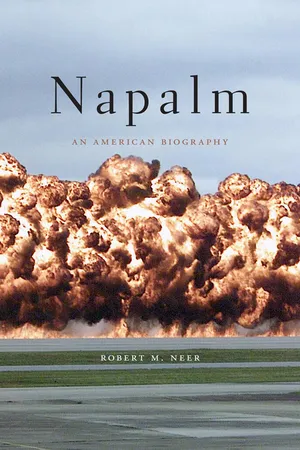
Napalm, incendiary gel that sticks to skin and burns to the bone, came into the world on Valentine's Day 1942 at a secret Harvard war research laboratory. On March 9, 1945, it created an inferno that killed over 87,500 people in Tokyo—more than died in the atomic explosions at Hiroshima or Nagasaki. It went on to incinerate sixty-four of Japan's largest cities. The Bomb got the press, but napalm did the work.
After World War II, the incendiary held the line against communism in Greece and Korea—Napalm Day led the 1950 counter-attack from Inchon—and fought elsewhere under many flags. Americans generally applauded, until the Vietnam War. Today, napalm lives on as a pariah: a symbol of American cruelty and the misguided use of power, according to anti-war protesters in the 1960s and popular culture from Apocalypse Now to the punk band Napalm Death and British street artist Banksy. Its use by Serbia in 1994 and by the United States in Iraq in 2003 drew condemnation. United Nations delegates judged deployment against concentrations of civilians a war crime in 1980. After thirty-one years, America joined the global consensus, in 2011.
Robert Neer has written the first history of napalm, from its inaugural test on the Harvard College soccer field, to a Marine Corps plan to attack Japan with millions of bats armed with tiny napalm time bombs, to the reflections of Phan Thi Kim Phuc, a girl who knew firsthand about its power and its morality.
- English
- ePUB (mobile friendly)
- Available on iOS & Android
eBook - ePub
About this book
Information
Notes
Visit NapalmBiography.com for notes with links, videos, selected source materials, and revisions. Daggers † indicate additional notes online.
Prologue
1. Denise Chong, The Girl in the Picture: The Story of Kim Phuc, the Photograph, and the Vietnam War (Penguin Books, 1999), 53–59.
2. Tunnels: Chong, The Girl in the Picture, 52. Smoke signals: ibid., 59–60. Runners: ibid., 60.
3. Chong, The Girl in the Picture, 61–64. See Fox Butterfield, “South Vietnamese Drop Napalm on Own Troops,” New York Times, June 9, 1972.
4. Flames: Phan Thị Kim Phúc, conversation with the author, March 17, 2012. “Too hot”: Chong, The Girl in the Picture, 65–67. See “Picture Power: Vietnam Napalm Attack,” May 9, 2005, http://news.bbc.co.uk/2/hi/asia-pacific/4517597.stm (accessed 10/7/2012).
5. Ut: Chong, The Girl in the Picture, 63–65. Burns: ibid., 90. Cu Chi: ibid., 71. Danh: ibid., 65–66. June 9: ibid., 76. “The Terror of War” also won World Press Photo of the Year 1972. Icon: Robert Hariman and John Louis Lucaites, “Public Identity and Collective Memory in U.S. Iconic Photography: The Image of ‘Accidental Napalm,’ ” Critical Studies in Media Communication 20, no. 1 (March 2003): 39. And Hariman and Lucaites, No Caption Needed: Iconic Photographs, Public Culture, and Liberal Democracy (University of Chicago, 2007), 171–207. Periodicals around the world commemorated the photo’s fortieth anniversary. Rob Gillies, “Woman in AP ‘Napalm Photo’ Honors Her Saviors,” Associated Press, June 8, 2012, http://bigstory.ap.org/article/woman-ap-napalm-photo-honors-her-saviors (accessed 10/7/2012). †
Hero
1. Weather: The Boston Globe, July 4, 1942, p. 16. Tennis: “Test Pond with Bomb and Markers,” Louis D. Fieser, The Scientific Method: A Personal Account of Unusual Projects in War and in Peace (Reinhold Publishing Corp., 1964), p. 38, fig. 3.2: “Test Pond with Bomb and Markers.” Parapet: Harvard University Archives, Papers of Louis Frederick Fieser and Mary Peters Fieser (hereafter Fieser Papers), HUGFP 20.3 Box 4, “Scrapbook 1937–1960,” n.p. See Fieser, The Scientific Method, 36. And James J. Bohning, “Interview with Hoyt C. Hottel at Massachusetts Institute of Technology. 18 November and 2 December 1985.” Oral History Transcript #0025. 2010. Chemical Heritage Foundation, p. 34. †
2. Appearance: Fieser, The Scientific Method, 126, fig. 13.4; 202, fig. 20.1. Assistants: Louis Fieser to Samuel D. Robbins, March 14, 1966, in Fieser Papers, HUGFP 20.3 Box 1, Folder: “Miscellaneous Correspondence, 1949–1966.” Bomb: Fieser, The Scientific Method, 36, 40.
3. Fieser, The Scientific Method, 40.
4. Battles: The Boston Globe, July 4, 1942, p. 1. Sugar: ibid., p. 1. Races: ibid., p. 11. Saboteurs: ibid., p. 7. Lil’ Abner: ibid., p. 8.
5. The Boston Globe, July 4, 1942, pp. 1, 9.
6. Smell: Headquarters, Department of the Army, “Chemical Reference Handbook.” Field Manual FM 3-8. January 6, 1967. Department of the Army, p. 17. See Fieser, The Scientific Method, 40.
1. Harvard’s Genius
1. National Defense Research Committee (NDRC), “Status of Contract Funds,” Report of the National Defense Research Committee 6/27/40-6/28/42 [hereafter Report], June 30, 1941. Franklin D. Roosevelt Presidential Library and Museum Safe Files [hereafter FDR Library], Box 2, Folder: “Bush, Vannevar.” Available at http://www.fdrlibrary.marist.edu/psf/box2/a13u01.html (accessed October 7, 2012). †
2. “Vannevar Bush: General of Physics,” Time, April 3, 1944, http://www.time.com/time/covers/0,16641,19440403,00.html (accessed October 7, 2012). See OEM Defense, “Dr. Vannevar Bush, Half-Length Portrait, Seated at Desk.” LC Control #2005691441, n.d. (1940–1942?). Available at http://www.loc.gov/pictures/item/2005691441/ (accessed October 7, 2012). Biography: Vannevar Bush, Pieces of the Action (William Morrow and Company, Inc., 1970). Youth: ibid., 74. General Electric: ibid., 243. Teaching: ibid., 244–245. See James G. Hershberg, James B. Conant: Harvard to Hiroshima and the Making of the Nuclear Age (Knopf, 1993), 127. World War I: G. Pascal Zachary, Endless Frontier: Vannevar Bush, Engineer of the American Century (The Free Press, 1997), 11–34. †
3. Bush, Pieces of the Action, 33–34. James Bryant Conant, My Several Lives: Memoirs of a Social Inventor (Harper & Row, 1970), 234. See Bush, Pieces of the Action, 34. †
4. Biography: June Hopkins, Harry Hopkins: Sudden Hero, Brash Reformer (St. Martin’s Press, 1999), 14, 12–13. Grinnell College, “Mission Statement,” February 2002, http://www.grinnell.edu/aboutinfo/history/songbook/spiritofgrinnell/ (accessed October 7, 2012). Lewis C. Cobb, “Spirit of Grinnell,” 1916, http://www.grinnell.edu/aboutinfo/history/songbook/spiritofgrinnell/ (accessed October 7, 2012). John Wesley: Hopkins, Harry Hopkins, 12. Board of Child Welfare: ibid., 110. Tuberculosis Association: Henry H. Adams, Harry Hopkins, A Biography: The Life Story of the Man behind FDR, the New Deal and the Allied Strategy in World War II (Putnam, 1977), 38. Red Cross: Hopkins, Harry Hopkins, 130. American Association of Social Workers: Hopkins, Harry Hopkins, 138. Relief: George McJimsey, Harry Hopkins: Ally of the Poor and Defender of Democracy (Harvard University Press, 1987), 46, 79. Commerce: Adams, Harry Hopkins, 145, 151. †
5. Language: Bush, Pieces of the Action, 35. Inventors: “Confer on Defense Inventions,” Special to the New York Times, August 7, 1940. See Bush, Pieces of the Action, 36. OK: ibid. See Adams, Harry Hopkins, 165–166. †
6. Remit: Louis Johnson, Lewis Compton, Harold L. Ickes, H. A. Wallace, Harry L. Hopkins, and Frances V. Perkins (Approved: Franklin D. Roosevelt), “Order Establishing the National Defense Research Committee,” June 27, 1940. FDR Library, Safe Files, Box 2, Folder: “Bush, Vannevar.” Available at http://www.fdrlibrary.marist.edu/psf/box2/a13v01.html (Accessed October 7, 2012). See James Phinney Baxter III, Scientists against Time: Official History of the Office of Scientific Research and Development (Little, Brown and Company, 1946), 451. Council for National Defense 50 U.S.C. 1, “Creation, Purpose, and Composition of Council,” August 29, 1916. Available at http://caselaw.lp.findlaw.com/casecode/uscodes/50/chapters/1/sections/section_1.html (accessed October 7, 2012). Roosevelt: Bush, Pieces of the Action, 36. †
7. Bush, Pieces of the Action, 31–32. †
8. Executives: Conant, My Several Lives, 234. Conant: Richard Rhodes, The Making of the Atomic Bomb (Simon & Schuster, 1986), 387 n. 3. NDRC, “Form of Organization: Committee Members,” Report, June 28, 1942. FDR Library, Safe Files, Box 2, Folder: “Bush, Vannevar.” Available at http://www.fdrlibrary.marist.edu/psf/box2/a13g01.html (accessed October 7, 2012). Carnegie Institute of Technology: Carnegie Mellon Engineering, Carnegie Institute of Technology, “CIT: More Than 100 Years in the Making,” 2012, http://www.cit.cmu.edu/about_cit/history.html (accessed October 7, 2012). Ex officio and appointed positions: Louis Johnson et al., “Order Establishing the National Defense Research Committee,” June 27, 1940. FDR Library, Safe Files, Box 2, Folder: “Bush, Vannevar.” Available at http://www.fdrlibrary.marist.edu/psf/box2/a13v01.html (accessed October 7, 2012). Conant’s responsibilities: W. A. Noyes, “The Organization of the National Defense Research Committee: General Plan,” in R. Connor, D. Churchill Jr., R. H. Ewell, C. Heimsch, W. R. Kirner, G. B. Kistiakowsky, W. C. Lothrop, W. A. Noyes Jr., and E. P. Stevenson, Chemistry: A History of the Chemistry Components of the National Defense Research Committee, 1940–1946, ed. W. A. Noyes (Little, Brown and Company, 1948), 4.
9. Contracting: Bush, Pieces of the Action, 38–39. Revolution: Conant, My Several Lives, 236.
10. No certification: Noyes, “The Organization,” 10. Theses: ibid., 8. Budgets: James Bryant Conant and Roger Adams, “Forward,” in Connor et al., Chemistry: A History, xii.
11. NDRC, “Contractors 6/28/41,” Report, June 28, 1941. FDR Library, Safe Files, Box 2, Folder: “Bush, Vannevar.” Available at http://www.fdrlibrary.marist.edu/psf/box2/a13t01.html (accessed October 7, 2012). NDRC, “Status of Contract Funds.” ibid.
12. Goals: Conant, My Several Lives, 52. PhD: ibid., 23. Dual concentrations: ibid., 59. Fire: ibid., 45–46, 242. Civilian casualties: ibid., 49–50. For criticism of Conant’s acceptance of racial segregation in intercollegiate athletics at the U.S. Naval Academy see Roger Angell, “Legacies: Class Report,” New Yorker, November 17, 2008, http://www.newyorker.com/talk/2008/11/17/081117ta_talk_angell (accessed Oct...
Table of contents
- Cover
- Half Title
- Title Page
- Copyright
- Dedication
- Contents
- Prologue: Trang Bang Village, South Vietnam, June 8, 1972
- Hero
- Soldier
- Pariah
- Epilogue: The Whole World Is Watching
- Illustrations
- Notes
- Acknowledgments
- Index
Trusted by 375,005 students
Access to over 1.5 million titles for a fair monthly price.
Study more efficiently using our study tools.
Frequently asked questions
Yes, you can cancel anytime from the Subscription tab in your account settings on the Perlego website. Your subscription will stay active until the end of your current billing period. Learn how to cancel your subscription
No, books cannot be downloaded as external files, such as PDFs, for use outside of Perlego. However, you can download books within the Perlego app for offline reading on mobile or tablet. Learn how to download books offline
Perlego offers two plans: Essential and Complete
- Essential is ideal for learners and professionals who enjoy exploring a wide range of subjects. Access the Essential Library with 800,000+ trusted titles and best-sellers across business, personal growth, and the humanities. Includes unlimited reading time and Standard Read Aloud voice.
- Complete: Perfect for advanced learners and researchers needing full, unrestricted access. Unlock 1.5M+ books across hundreds of subjects, including academic and specialized titles. The Complete Plan also includes advanced features like Premium Read Aloud and Research Assistant.
We are an online textbook subscription service, where you can get access to an entire online library for less than the price of a single book per month. With over 1.5 million books across 990+ topics, we’ve got you covered! Learn about our mission
Look out for the read-aloud symbol on your next book to see if you can listen to it. The read-aloud tool reads text aloud for you, highlighting the text as it is being read. You can pause it, speed it up and slow it down. Learn more about Read Aloud
Yes! You can use the Perlego app on both iOS and Android devices to read anytime, anywhere — even offline. Perfect for commutes or when you’re on the go.
Please note we cannot support devices running on iOS 13 and Android 7 or earlier. Learn more about using the app
Please note we cannot support devices running on iOS 13 and Android 7 or earlier. Learn more about using the app
Yes, you can access Napalm by Robert M. Neer in PDF and/or ePUB format, as well as other popular books in History & Military & Maritime History. We have over 1.5 million books available in our catalogue for you to explore.