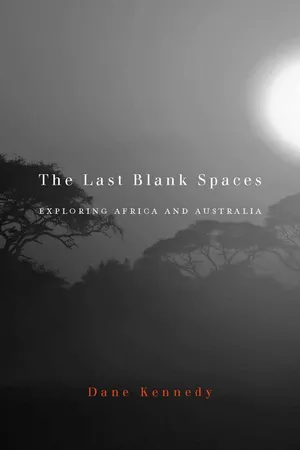
For a British Empire that stretched across much of the globe at the start of the nineteenth century, the interiors of Africa and Australia remained intriguing mysteries. The challenge of opening these continents to imperial influence fell to a proto-professional coterie of determined explorers. They sought knowledge, adventure, and fame, but often experienced confusion, fear, and failure. The Last Blank Spaces follows the arc of these explorations, from idea to practice, from intention to outcome, from myth to reality.
Those who conducted the hundreds of expeditions that probed Africa and Australia in the nineteenth century adopted a mode of scientific investigation that had been developed by previous generations of seaborne explorers. They likened the two continents to oceans, empty spaces that could be made truly knowable only by mapping, measuring, observing, and preserving. They found, however, that their survival and success depended less on this system of universal knowledge than it did on the local knowledge possessed by native peoples.
While explorers sought to advance the interests of Britain and its emigrant communities, Dane Kennedy discovers a more complex outcome: expeditions that failed ignominiously, explorers whose loyalties proved ambivalent or divided, and, above all, local states and peoples who diverted expeditions to serve their own purposes. The collisions, and occasional convergences, between British and indigenous values, interests, and modes of knowing the world are brought to the fore in this fresh and engaging study.
- English
- ePUB (mobile friendly)
- Available on iOS & Android
eBook - ePub
About this book
Information
Publisher
Harvard University PressYear
2013Print ISBN
9780674503861
9780674048478
eBook ISBN
9780674075016
CHAPTER 1
Continents
He had bought a large map representing the sea,
Without the least vestige of land:
And the crew were much pleased when they found it to be
A map they could all understand.
“What’s the good of Mercator’s North Poles and Equators,
Tropics, Zones, and Meridian Lines?”
So the Bellman would cry: and the crew would reply
“They are merely conventional signs!
“Other maps are such shapes, with their islands and capes!
But we’ve got our brave Captain to thank:
(So the crew would protest) “that he’s bought us the best—
A perfect and absolute blank!”
—Lewis Carroll, “The Hunting of the Snark” (1874)
EXPLORATION IS A knowledge-producing enterprise. It can be undertaken for a range of reasons—to seek resources, to conquer territory, to promote trade, to convert heathens, to gain fame, and much more. There are, of course, plenty of other ways of achieving those objectives. What distinguishes exploration has less to do with its purposes than with its premises and practices, which derive from how it construes and acquires knowledge. For the Western societies that have given the main impetus to modern exploration, it has been understood since at least the eighteenth century to be an enterprise that seeks knowledge of other places and peoples in terms that can be broadly characterized as scientific in meaning and method.
This book is about how British explorers produced knowledge about Africa and Australia, and about how that knowledge was made problematic by the conditions of its production. Its point of departure is the proposition that explorers’ efforts rested on the founding premise that the two continents were the conceptual equivalents of oceans, vast and empty spaces that could become truly knowable only through the application of scientific methods that seaborne explorers had pioneered. Over the course of the nineteenth century, hundreds of explorers who entered the interior of Africa and Australia emulated this approach by keeping journals and other written records of their observations and experiences; by using precision instruments to map their geographical locations and measure meteorological conditions; and by collecting and preserving large quantities of botanical, geological, and other specimens and artifacts. Local knowledge had little if any recognized place in this evidentiary system. Yet it proved essential to explorers’ abilities to overcome the challenges they faced in the field. Where they went and how they got there was often predicated on what they learned from guides, go-betweens, and other indigenous peoples. So too was their access to food, water, shelter, and other necessities. Above all, their passage through unfamiliar societies and polities was made less fraught and less subject to failure as a result of the information and assistance they received from indigenous agents. This irreconcilable tension between exploration as experience and exploration as epistemology is the central theme of the book.
The focal point of this tension was the explorer and the expedition he commanded. The explorer was in certain respects a creation of the early nineteenth century. This was when the word “explorer” first came into general use in the English language, a linguistic innovation that reflected the way the explorer was coming to be seen as different from other kinds of travelers. The difference derived from the specialized skills the explorer was required to possess and put into practice during his journey. These skills ranged from charting an accurate route to recognizing a rare plant to acquiring an understanding of indigenous peoples’ institutions, customs, and beliefs. The explorer shouldered heavy obligations, but he also acquired heightened status. He came to be seen as a protoprofessional whose duties were carried out in the service of science, society, and the state. The organizational framework for his errand in the wilderness was the expedition, another key term in the construction of exploration as a specialized enterprise. Every expedition was unique, but all of them shared certain characteristics: they were supported by institutional sponsors, such as governmental agencies and learned societies; they were supplied with instructions that outlined their operations and objectives; and they were structured with clear lines of command and defined duties. The Royal Geographical Society even prepared a kind of template for organizing expeditions and establishing their purposes, a document that went through multiple editions.1
While British explorers ventured to virtually every corner of the globe in the nineteenth century, they devoted more prolonged attention to Africa and Australia than to any other large landmass. The systematic exploration of these two continents occurred in the same time frame, beginning in both cases near the start of the nineteenth century and concluding toward its end. Africa and Australia were seen to harbor some of the greatest geographical mysteries on earth, and many of the century’s most famous explorers made their reputations by seeking answers to those mysteries. They provide what should be tempting targets for comparison. Yet Africa and Australia have rarely been placed in a comparative context.2 While the entirety of Australia and large portions of Africa had been incorporated within Britain’s imperial world system by the end of the nineteenth century, their patterns of incorporation seemed to accentuate rather than minimize the differences between them. The Australian colonies absorbed large numbers of British immigrants and adopted British institutions, while few of the African possessions claimed by Britain at century’s end followed a similar trajectory. The main exception was the Cape Colony, which shared some intriguing similarities with the Australian colonies, reinforced by the fact that Cape Town served as the key refreshment station for travelers in transit between Britain and Australia. Otherwise, the two continents entered the twentieth century on very different terms, with consequences that endure to the present day.
These differences are reflected in the contrasting ways social scientists and other scholars have sought to make sense of Africa and Australia. Australia is commonly seen as an antipodal outpost of the “global North,” a “neo-Europe” or “white man’s country” that has replicated Europe, and more particularly Britain, in its political structures, economic policies, and demographic character. Africa occupies a very different conceptual space, standing as the poster child of the political instability and economic underdevelopment that characterizes the global South, much of it traceable to the region’s victimization by slavery, colonial conquest, and other forms of exploitation by imperial powers. The historical scholarship on Australia and Africa has helped to shape these separate analytical trajectories, which are evident in the very different sorts of questions and concerns that have informed their historiographies. Although one might expect historians of the British Empire to adopt a more integrative stance, they have been no less insistent on positing an analytical gulf between the two continents, classifying Australia as emblematic of white settler colonialism and Africa as the archetypal administrative colonial sphere.
The present study has been written in reaction against this long-standing view that little can be learned by comparing the African and Australian experiences. It seeks to show that important insights can be gained by viewing the exploration of these two continents within a shared frame. The first of these insights concerns the sociological, ideological, and institutional impetus of nineteenth-century exploration itself. The explorers themselves were motivated by a shared set of interests, which included professional advancement, public celebrity, and personal profit. The expeditions they led were informed in turn by a shared set of scientific protocols and practices. A similar array of institutional sponsors (government agencies, learned societies, etc.) drafted the expeditions’ instructions, oversaw their preparations, and evaluated their outcomes. In Africa, where the British presence was limited to the Cape and a few entrepôts along the West African coast for much of the century and where other European and non-European parties had competing interests in the interior, the British imperial state took a more active and direct role in exploration than it did in Australia, where the rapidly expanding presence of settlers and the early elimination of any serious geopolitical challenge from other powers permitted London to adopt a lower profile, subcontracting much of the work of exploration to local agents. In both continents, however, the century-long process of exploration was inextricably bound up with the broader imperial interests and ambitions of Britain.
While empire and its vast network of agents and affiliates gave a common purpose to African and Australian explorers’ contemporaneous efforts to penetrate the interiors of the two continents, it is equally important to stress that the quotidian conditions they confronted on the ground often complicated and even undermined that purpose. Too much of the literature on exploration is too quick to draw a causal connection between intentions and outcomes, presuming that empire’s promotion of exploration meant exploration’s advancement of empire. The triumphalist teleology that informs this view neglects the significance of events and experiences that cast a different light on efforts to investigate unfamiliar lands—the expeditions that failed ignominiously, the explorers whose loyalties proved ambivalent or divided, and, above all, the indigenous peoples and other non-Western parties who helped to shape exploration, often diverting it to their own purposes. Comparing the patterns of exploration in Africa and Australia provides a perspective that gives greater clarity to the distinctive influences that local forces—and local peoples in particular—exerted on their course and character. One of the book’s key comparative conclusions is that African explorers were far more reliant on indigenous populations than their Australian counterparts. A second conclusion, however, is that the explorers of both continents were often weak and vulnerable. Far from demonstrating the great power of the British Empire, explorers in fact discovered its limits and learned that their success and, indeed, their very survival often depended on their ability to obtain local assistance and acquire local knowledge. Four decades ago the African historian Robert Rotberg made the case that explorers can best be seen “as precursors but not progenitors of imperialism.”3 It is a distinction that deserves more attention than it has received.
The Last Blank Spaces, then, is as much about the limits of empire as it is about empire’s reach. It is about the need to distinguish between the ways exploration served an imperial society’s panoply of purposes—political, economic, ideological, and more—and the ways it did not. It is about the gulf that arose between what expeditions were meant to achieve and what they actually accomplished. It is about the tension between explorers’ public personas as agents of knowledge and power and their privately acknowledged confusion and vulnerability in the field. It is about the collision between British and indigenous values, interests, and ways of knowing the world, but it is also about their occasional convergences and signs of mutual appreciation. Above all, it is about the ways explorers’ efforts to advance the West’s universalist system of knowledge came face-to-face with their need to understand and accommodate local knowledges, which is to say it is about what the collision between epistemology and experience meant for exploration and for the societies it brought into contact with one another.
One of the great paradoxes of exploration as it came to be understood and practiced by the British and other Europeans from the late eighteenth century onward is that it was possible to explore and “discover” places that were already known—known not simply by the indigenous peoples of those places but also by Europeans themselves. Perhaps the most striking example of this paradox comes from Alexander von Humboldt’s immensely influential travels through Latin America from 1799 to 1804, which he detailed in his thirty-volume Voyage aux régions équinoxiales du Nouveau Continent. While his meticulously documented journey came to be recognized as a model of scientific exploration, it traversed territory that the Spanish had for the most part occupied and colonized for several centuries. Humboldt was emblematic of how it became possible in the nineteenth century to explore territory that was not truly terra incognita to the explorers or their sponsors. Their aim was to discover the known anew.
This paradox derives in large measure from the transfer of maritime notions of space and methods of navigation and measurement to expeditions carried out across land. The great eighteenth-century voyages of discovery conducted by Louis-Antoine de Bougainville of France, James Cook of Britain, Alessandro Malaspina of Spain, and others had brought unprecedented prestige and authority to naval explorers, establishing them as heroes of national greatness and scientific progress. Not only did they sail across distant and dangerous seas, but they used the most sophisticated technologies available at the time to calculate and track their routes, measure and record meteorological and other environmental conditions, and collect and preserve an array of natural specimens from seas and shorelines, all the while meticulously recording their impressions and experiences in logbooks and journals. So successful were these endeavors that much of the mystery surrounding the Pacific and other great bodies of water had been solved by the end of the century, or so many contemporaries concluded. No one was a more influential proponent of this view than Joseph Banks, the naturalist on Cook’s first voyage and subsequently Georgian Britain’s most prominent and farsighted proponent of scientific exploration. In 1788 he joined with some gentleman friends to found the Association for Promoting the Discovery of the Interior Parts of Africa, commonly known as the African Association. In its prospectus, they proclaimed that “nothing worthy of research by Sea, the Poles themselves excepted, remains to be examined; but by Land, the objects of discovery are still so vast, as to include at least a third of the habitable surface of the earth: for much of Asia, a still larger proportion of America, and almost the whole of Africa, are unvisited and unknown.”4
This claim was not strictly true. By the late eighteenth century, the British and other Europeans had gleaned a great deal of information about the interiors of Africa, Asia, and the Americas (though not Australia). For Banks and his colleagues, however, the problem was that this information came from sources whose veracity could not be vouched for—from native informants, from foreign travelers, from random traders, trappers, and military adventurers, even from classical authorities such as Herodotus and Ptolemy, whose accounts still informed geographical commentary about the interior of Africa. The ambition of men such as Banks was to apply to land exploration the modes of investigation and discovery that had been developed and refined by seaborne explorers, deriving from them the kinds of scientific knowledge that could be measured, mapped, quantified, classified, catalogued, and compared. Although Humboldt’s original ambition was to follow in the footsteps of his mentor Georg Forster by sailing on a British or French naval expedition as a naturalist, he became convinced that the new frontier for exploration lay “beyond the sterile coast” in remote mountains and forests. Whatever was already known about the interior of Latin America was from Humboldt’s perspective either scientifically unverified or irrelevant. “In the New World,” he explained, “man and his productions disappear, so to speak, in the midst of a wild and outsized nature.”5 Much the same set of assumptions shaped the contemporaneous expeditions of Mungo Park in Africa, Alexander Mackenzie in Canada, and Meriwether Lewis and William Clark in the Unit...
Table of contents
- Cover
- Half Title
- Title Page
- Copyright
- Dedication
- Contents
- List of Maps and Illustrations
- 1. Continents
- 2. Sciences
- 3. Professionals
- 4. Gateways
- 5. Logistics
- 6. Intermediaries
- 7. Encounters
- 8. Celebrities
- Epilogue
- Comparative Timeline of African and Australian Expeditions
- Notes
- Bibliography
- Acknowledgments
- Index
Trusted by 375,005 students
Access to over 1.5 million titles for a fair monthly price.
Study more efficiently using our study tools.
Frequently asked questions
Yes, you can cancel anytime from the Subscription tab in your account settings on the Perlego website. Your subscription will stay active until the end of your current billing period. Learn how to cancel your subscription
No, books cannot be downloaded as external files, such as PDFs, for use outside of Perlego. However, you can download books within the Perlego app for offline reading on mobile or tablet. Learn how to download books offline
Perlego offers two plans: Essential and Complete
- Essential is ideal for learners and professionals who enjoy exploring a wide range of subjects. Access the Essential Library with 800,000+ trusted titles and best-sellers across business, personal growth, and the humanities. Includes unlimited reading time and Standard Read Aloud voice.
- Complete: Perfect for advanced learners and researchers needing full, unrestricted access. Unlock 1.5M+ books across hundreds of subjects, including academic and specialized titles. The Complete Plan also includes advanced features like Premium Read Aloud and Research Assistant.
We are an online textbook subscription service, where you can get access to an entire online library for less than the price of a single book per month. With over 1.5 million books across 990+ topics, we’ve got you covered! Learn about our mission
Look out for the read-aloud symbol on your next book to see if you can listen to it. The read-aloud tool reads text aloud for you, highlighting the text as it is being read. You can pause it, speed it up and slow it down. Learn more about Read Aloud
Yes! You can use the Perlego app on both iOS and Android devices to read anytime, anywhere — even offline. Perfect for commutes or when you’re on the go.
Please note we cannot support devices running on iOS 13 and Android 7 or earlier. Learn more about using the app
Please note we cannot support devices running on iOS 13 and Android 7 or earlier. Learn more about using the app
Yes, you can access The Last Blank Spaces by Dane Kennedy in PDF and/or ePUB format, as well as other popular books in History & African History. We have over 1.5 million books available in our catalogue for you to explore.