As humans evolved, we developed technologies to modify our environment, yet these innovations are increasingly affecting our behavior, biology, and society. Now we must figure out how to function in the world we've created.
Over thousands of years, humans have invented ingenious ways to gain mastery over our environment. The ability to communicate, accumulate knowledge collectively, and build on previous innovations has enabled us to change nature. Innovation has allowed us to thrive.
The trouble with innovation is that we can seldom go back and undo it. We invent, embrace, and exploit new technologies to modify our environment. Then we modify those technologies to cope with the resulting impacts. Gluckman and Hanson explore what happens when we innovate in a way that leads nature to bite back. To provide nourishment for a growing population, humans developed methods to process and preserve food; but easy access to these energy-dense foods results in obesity. To protect ourselves from dangerous pathogens we embraced cleanliness and invented antibiotics, which has led to rising rates of autoimmune diseases and antibiotic-resistant bacteria. More recently, our growing dependence on the internet and social media has been linked to mental health concerns and declining social cohesion. And we are only at the beginning of the digital transformation that will influence every part of our existence. Our ingenuity has not only changed our world—it has changed us.
Focusing on immediate benefits, we rarely pause to consider the longer-term costs of innovation. Yet we are now starting to see how our choices affect the way our brains develop and our bodies function. The implications are profound. Ingenious opens our eyes to the dangers we face and offers solutions we cannot ignore.
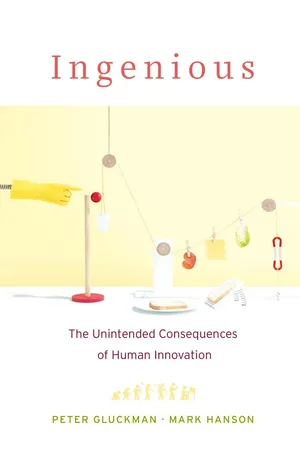
- 318 pages
- English
- ePUB (mobile friendly)
- Available on iOS & Android
eBook - ePub
About this book
Information
1 THE OUTBACK
IT WAS MIDDAY, the sun almost directly overhead. The car’s thermometer registered the outside temperature as 34°C, only a small fraction lower than human blood temperature. There was no real shade. Thankfully, we had air-conditioning inside the car and an electric fridge in the back. We also had an awning attached to the side of the car and when we stopped, we pulled it out and sat under it, relieved to be taking a break from the bumpy drive in Australia’s Northern Territory.
The landscape was remarkably uniform, somewhat dull. Occasionally we saw a group of wallabies loping along, or an eagle drop off from a bare branch and flap languidly away. Bushes were spaced evenly as far as we could see in every direction. They looked as if they were planted by an obsessed gardener trying to create an orderly display in an uninhabited rugged landscape. But the bushes themselves divided up the land. Each drew just enough moisture from the soil to survive in the dry season. Only when older bushes perished, or were stripped of their leaves, was there room for younger ones to thrive. Competition was fierce, even between members of the same species, in this place where resources were limited.
The bushes were not the only well-ordered features of the landscape. In every direction we could see termite mounds, substantial structures up to three meters high, made of compacted red earth glued together with the saliva of millions of insects. Like the bushes, the mounds are equally spaced, as if the colonies of termites negotiated territories. But they have another feature, unique to the mounds in this part of Australia. Whereas termite mounds in more temperate parts of the continent, and in Africa and South America, are roughly conical in shape, here they have two flat sides, rather like huge sand castles that have been pressed between the hands of a gigantic child.1 Even more extraordinary is that the massive, almost two-dimensional mud castles are all oriented in the same way, mile after mile through the Australian outback.
Astonishingly, the mounds are accurately oriented north-to-south. It would be possible to navigate through the country just by following the direction indicated by the termite mounds, something that must have given some comfort to early explorers of the region. Every fifty yards or so across this landscape stands a direction marker, pointing north to the mouth of the Adelaide River and the Timor Sea. It’s no wonder they are known as magnetic termite mounds.
We only needed to spend a few days here to learn important lessons about survival—for example, how the temperature varies over the day. At that time of year, the cloudless sky means that the temperature during the night drops dramatically. After a night shivering in our sleeping bags, we were glad to see the sun rising over the horizon and to stand in its warming rays while making breakfast. By mid-morning, temperatures rose and we shed our sweaters and jackets. As the sun sank back down in the late afternoon, we began to feel the chill and layered our clothing back on again.
Compass Mounds
How do other animals cope with these extremes in temperature without the ability to change clothing? One answer lies in the termite mounds. How is their construction determined, given that termites don’t have compasses? The changing shadows cast by the mounds over the course of the day offer the answer. One flat side of each mound faces east, which maximizes the warming effect of the rising sun. At noon, when (in the Southern Hemisphere) the sun beats down from the north, its heating effect on the interior of the mound is minimized by the narrow northerly edge the mound presents to the sun. Then, in the evening, the rate of cooling inside the mound is minimized by the sun warming the flat west face of the structure. The mounds, that is, are constructed to minimize variation in temperature.
It’s easy to imagine how, over many generations, the continually replicating colonies of termites achieved by trial and error a structure that keeps temperature variations inside to a minimum. Too much east–west construction, and the interior gets too hot in the middle of the day; not enough north–south extension of the flat sides, and it takes too long to warm up in the morning and cools down too quickly in the evening. In one still-growing mound—many of these mounds are hundreds of years old—a little excessive earth added in the east–west direction can be detected. The termites countered it with a little more extension in the north–south direction. Optimal conditions for the termite society within are maintained by orienting the mound north–south.
The termites have constructed a niche that allows them to flourish in their environment. The mounds’ interiors have a complex architecture of chambers and passages that accommodate as many as several million inhabitants per mound. Each mound’s intricate society has a queen, workers, and soldiers. Some termites leave the mound to forage for grass and other dry vegetation, which they bring back to be kept in special storage cells. This will be an essential food supply when the plain floods, as is common in the wet season between November and April. Safe in their castle above the water level, the termites can survive until the plain dries out again. Some termites never leave the mound and have adaptations for this life inside. Their skins and external skeletons are thinner—so thin, in fact, that they are almost transparent. Hidden from predators inside the mound, they do not need camouflage to resemble the grassland.
Over thousands of generations, the termites’ bodies and behavior evolved, shaped by the force that Charles Darwin termed natural selection. The behaviors that led to construction of the best mounds favored the survival and reproduction of certain termites. Each new generation of termites may have had to learn some behaviors, but they could not have invented the entire strategy anew. If we were to transport a colony of ants from a European garden to this part of the Northern Territory, the European ants would not survive, not having evolved any mound-building behavior. They would be too hot in the day and too cold at night. In the survival game, they would rapidly lose when faced with this change in environment. The concept of natural selection led Darwin to his idea of the evolution of species. But it took a voyage to the other side of the world to help him formulate it.
The Doctor’s Son and His Pigeons
As a child, Charles Darwin was fascinated by nature. It was not obvious how this would lead to a career, so he was encouraged to enroll in medical school in Edinburgh and follow in his physician father’s footsteps. He soon abandoned the course, much to his father’s displeasure, but while in Edinburgh he became deeply engaged with the scientific culture of the day. He was especially influenced by Robert Grant, an early transmutationist and a disciple of Lamarck and his study of small marine organisms.2 Another career option, in line with Victorian ideas about acceptable lines of work for young men from respectable families, was to study theology. Supposedly engaged in this in Cambridge, Darwin instead spent his time collecting beetles and studying natural history with some of the scientific luminaries of the time. From the Reverend John Stevens Henslow he learned botany, and from the Reverend Adam Sedgwick, geology. He became fascinated by the work of Charles Lyell, who had revolutionized geological theory with his claim that many geological features are the results of gradual forces rather than catastrophic events.3
Darwin was also inspired by the writings of the explorer and scientist Alexander von Humboldt, who had traveled widely in South America and made highly original observations about the interactions among plants, animals, and their environments.4 Darwin decided that he should undertake such an expedition himself. With Henslow and other friends, he planned to sail to the Canary Islands, where he was certain he would find the diversity of nature he longed to study. Unfortunately, Henslow withdrew from the plan and, in any case, it was not easy for Darwin to find either the ship or the financial resources needed to undertake the expedition. He was in despair. Then, in late August 1831, he heard from Henslow of a captain who needed a companion to sail with him on a long global expedition: Robert FitzRoy of HMS Beagle.5 It took some convincing for Darwin’s father to fund this venture, but perhaps he had already resigned himself to the idea that his son would not become a country parson any more than he would be a doctor. The Beagle embarked just after Christmas 1831 on a five-year expedition, and soon Darwin was no longer just a gentleman-companion but on his way to becoming the most distinguished naturalist and biologist of his time.
Darwin began that voyage believing in the natural theology—the concept that every feature of the world is a manifestation of God’s direct handiwork—that was central to his theological studies in Cambridge.6 Over time that belief was replaced by new ideas based on his geological, geographical, and biological observations. A cautious scientist, he was aware of the revolutionary implications of his ideas and recorded them in his notes, only gradually sharing them with friends.7 It was not until twenty years later that he actually published his ideas, spurred by correspondence from the collector-naturalist Alfred Russel Wallace, about whom we will say more in Chapter 2 and who was about to publish his own parallel recognition of the mechanisms by which species form.8 In 1859, Darwin’s “one long argument,” as he put it—On the Origin of Species by Means of Natural Selection—appeared in print. It set off considerable controversy and debate, which have never completely gone away. There has been debate, as well, over the relative contributions of Darwin and Wallace to the fundamental concept. Wallace himself, however, gave precedence to Darwin by recognizing that his ideas had been developing over a much longer period.9
Darwin realized that variations in features of individuals within a species endow some of them with advantages over others in terms of their ability to survive and reproduce under prevailing environmental conditions. Even if the environment is constant, not every member of a species is perfectly adapted to it. Degrees of adaptation, and thus individuals’ chances of reproductive success, vary. To the extent that an advantageous variation is heritable, this variant is more likely to be present in the next generation. Darwin termed this natural selection, recognizing the parallel with the conscious or artificial selection that farmers and breeders use as they choose animals or plants whose characteristics they want to see in subsequent generations. Darwin was fascinated by variation, and as he was working through his great idea, he spent much time with pigeon fanciers and livestock breeders.10 At one stage he had sixteen different breeds of fancy pigeons at Down House, his home in Kent. The naturally occurring variation in any feature or trait within a species or a breed was fundamental to Darwin’s concept of evolution.
Returning now to the Australian termites, we can consider how their present-day characteristics evolved. Unlike the interventions of Darwin’s breeders, these processes were gradual and played out under natural conditions, so that the characteristics—the so-called phenotypes—of the insects shifted gradually. Successive generations were made up of more favorable variants than the previous ones, until an adaptive match between the termites and their environment was achieved and an equilibrium established—as long as the environment did not change again. There may have been some dramatic events in terms of climate or sudden changes in predator numbers along the way to accelerate the shift in the termite phenotypes; if so selection pressures would have been greater under such circumstances. We can also imagine a gradual migration of the insects, some better adapted to new territories than others, causing particular species of termites to end up in different places. But evolution is never finished. For every species, there continues to be a dynamic interaction between the range of its anatomical and physiological characteristics and its environment, which is also never totally stable. For the termite, constructing the mound, its niche, to minimize the potentially threatening aspects of environmental variations has been a critical adaptive strategy.
Today we think of the three tenets of Darwin’s theory of evolution—phenotypic variation, natural selection, and organic (or, in modern terms, genetic) inheritance—as so fundamental to life and so uncontroversial that it seems hardly worth noting them. Yet we have to remember that the emphasis placed on these components, and even their necessary inclusion in his theory, was questioned from the very outset. Darwin does not once use the word evolution in The Origin of Species, referring only to new species’ ability to evolve from the complexities of nature.11 He uses the verb form as he ponders a tangled bank of vegetation on the last, and uncharacteristically poetic, page of the book.12
Darwin himself had no modern understanding of inheritance; the concept of the gene was yet to emerge, and it would be another hundred years before the structure of DNA was discovered, opening up the true study of genetic inheritance. Furthermore, Darwin was open to the ideas of earlier generations of transmutationists, including his grandfather Erasmus Darwin.13 He particularly respected Lamarck, who had argued that environmental influences in one generation could lead to acquired characteristics being inherited by the next.14
In Austria in 1859, the year when the first edition of The Origin of Species was published, the monk Gregor Mendel was cross-breeding variants of peas and formulating the principles by which certain characteristics are passed from one generation to the next. Mendel’s work was published in an obscure journal, however, and was yet to be discovered by other evolutionists and the broader scientific community. It was only when it started to receive recognition early in the twentieth century that its significance was recognized and the science of genetics was born.15
We now know that the basic unit of biological inheritance is the gene, which is a segment of DNA. Humans have about 22,000 genes spread over 46 chromosomes in 22 pairs of chromosomes (we have two copies of each) plus our two sex chromosomes (two copies of the X chromosome in females and one X and one Y chromosome in males). Other apes, including the gorilla, have 48 chromosomes; at some stage in our evolution from a common ancestor with the other apes, two chromosomes fused into one.1...
Table of contents
- Cover
- Title Page
- Copyright
- Contents
- Introduction
- 1. The Outback
- 2. Survival
- 3. Inheritance
- 4. Culture
- 5. Settlements
- 6. Cities
- 7. Online
- 8. Cost
- 9. Future
- Notes
- Acknowledgments
- Index
Trusted by 375,005 students
Access to over 1.5 million titles for a fair monthly price.
Study more efficiently using our study tools.
Frequently asked questions
Yes, you can cancel anytime from the Subscription tab in your account settings on the Perlego website. Your subscription will stay active until the end of your current billing period. Learn how to cancel your subscription
No, books cannot be downloaded as external files, such as PDFs, for use outside of Perlego. However, you can download books within the Perlego app for offline reading on mobile or tablet. Learn how to download books offline
Perlego offers two plans: Essential and Complete
- Essential is ideal for learners and professionals who enjoy exploring a wide range of subjects. Access the Essential Library with 800,000+ trusted titles and best-sellers across business, personal growth, and the humanities. Includes unlimited reading time and Standard Read Aloud voice.
- Complete: Perfect for advanced learners and researchers needing full, unrestricted access. Unlock 1.5M+ books across hundreds of subjects, including academic and specialized titles. The Complete Plan also includes advanced features like Premium Read Aloud and Research Assistant.
We are an online textbook subscription service, where you can get access to an entire online library for less than the price of a single book per month. With over 1.5 million books across 990+ topics, we’ve got you covered! Learn about our mission
Look out for the read-aloud symbol on your next book to see if you can listen to it. The read-aloud tool reads text aloud for you, highlighting the text as it is being read. You can pause it, speed it up and slow it down. Learn more about Read Aloud
Yes! You can use the Perlego app on both iOS and Android devices to read anytime, anywhere — even offline. Perfect for commutes or when you’re on the go.
Please note we cannot support devices running on iOS 13 and Android 7 or earlier. Learn more about using the app
Please note we cannot support devices running on iOS 13 and Android 7 or earlier. Learn more about using the app
Yes, you can access Ingenious by Peter Gluckman,Mark Hanson in PDF and/or ePUB format, as well as other popular books in Biological Sciences & Biology. We have over 1.5 million books available in our catalogue for you to explore.