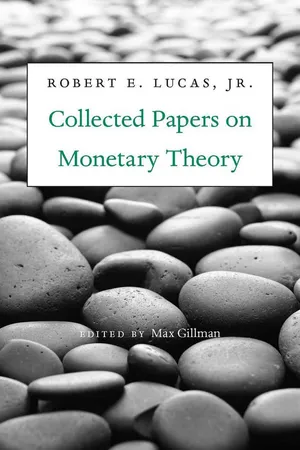
Robert Lucas is one of the outstanding monetary theorists of the past hundred years. Along with Knut Wicksell, Irving Fisher, John Maynard Keynes, James Tobin, and Milton Friedman (his teacher), Lucas revolutionized our understanding of how money interacts with the real economy of production, consumption, and exchange.
Lucas's contributions are both methodological and substantive. Methodologically, he developed dynamic, stochastic, general equilibrium models to analyze economic decision-makers operating through time in a complex, probabilistic environment. Substantively, he incorporated the quantity theory of money into these models and derived its implications for money growth, inflation, and interest rates in the long run. He also showed the different effects of anticipated and unanticipated changes in the stock of money on economic fluctuations, and helped to demonstrate that there was not a long-run trade-off between unemployment and inflation (the Phillips curve) that policy-makers could exploit.
The twenty-one papers collected in this volume fall primarily into three categories: core monetary theory and public finance, asset pricing, and the real effects of monetary instability. Published between 1972 and 2007, they will inspire students and researchers who want to study the work of a master of economic modeling and to advance economics as a pure and applied science.
eBook - ePub
Collected Papers on Monetary Theory
- 538 pages
- English
- ePUB (mobile friendly)
- Available on iOS & Android
eBook - ePub
Collected Papers on Monetary Theory
About this book
Information
1
Expectations and the Neutrality of Money
1. Introduction*
This paper provides a simple example of an economy in which equilibrium prices and quantities exhibit what may be the central feature of the modern business cycle: a systematic relation between the rate of change in nominal prices and the level of real output. The relationship, essentially a variant of the well-known Phillips curve, is derived within a framework from which all forms of “money illusion” are rigorously excluded: all prices are market clearing, all agents behave optimally in light of their objectives and expectations, and expectations are formed optimally (in a sense to be made precise below).
Exchange in the economy studied takes place in two physically separated markets. The allocation of traders across markets in each period is in part stochastic, introducing fluctuations in relative prices between the two markets. A second source of disturbance arises from stochastic changes in the quantity of money, which in itself introduces fluctuations in the nominal price level (the average rate of exchange between money and goods). Information on the current state of these real and monetary disturbances is transmitted to agents only through prices in the market where each agent happens to be. In the particular framework presented below, prices convey this information only imperfectly, forcing agents to hedge on whether a particular price movement results from a relative demand shift or a nominal (monetary) one. This hedging behavior results in a nonneutrality of money, or broadly speaking a Phillips curve, similar in nature to that which we observe in reality. At the same time, classical results on the long-run neutrality of money, or independence of real and nominal magnitudes, continue to hold.
These features of aggregate economic behavior, derived below within a particular, abstract framework, bear more than a surface resemblance to many of the characteristics attributed to the U.S. economy by Friedman [3 and elsewhere]. This paper provides an explicitly elaborated example, to my knowledge the first, of an economy in which some of these propositions can be formulated rigorously and shown to be valid.
A second, in many respects closer, forerunner of the approach taken here is provided by Phelps. Phelps [8] foresees a new inflation and employment theory in which Phillips curves are obtained within a framework which is neoclassical except for “the removal of the postulate that all transactions are made under complete information.” This is precisely what is attempted here.
The substantive results developed below are based on a concept of equilibrium which is, I believe, new (although closely related to the principles underlying dynamic programming) and which may be of independent interest. In this paper, equilibrium prices and quantities will be characterized mathematically as functions defined on the space of possible states of the economy, which are in turn characterized as finite dimensional vectors. This characterization permits a treatment of the relation of information to expectations which is in some ways much more satisfactory than is possible with conventional adaptive expectations hypotheses.
The physical structure of the model economy to be studied is set out in the following section. Section 3 deals with preference and demand functions; and in section 4, an exact definition of equilibrium is provided and motivated. The characteristics of this equilibrium are obtained in section 5, with certain existence and uniqueness arguments deferred to the appendix. The paper concludes with the discussion of some of the implications of the theory, in sections 6, 7, and 8.
2. The Structure of the Economy
In order to exhibit the phenomena described in the introduction, we shall utilize an abstract model economy, due in many of its essentials to Samuelson [10].1 Each period, N identical individuals are born, each of whom lives for two periods (the current one and the next). In each period, then, there is a constan...
Table of contents
- Cover
- Title Page
- Copyright
- Contents
- Preface
- Introduction
- 1. Expectations and the Neutrality of Money
- 2. Asset Prices in an Exchange Economy
- 3. Equilibrium in a Pure Currency Economy
- 4. Two Illustrations of the Quantity Theory of Money
- 5. Discussion of Stanley Fischer, “Towards an Understanding of the Costs of Inflation: II”
- 6. Interest Rates and Currency Prices in a Two-Country World
- 7. Optimal Fiscal and Monetary Policy in an Economy without Capital (with Nancy L. Stokey)
- 8. Money in a Theory of Finance
- 9. Principles of Fiscal and Monetary Policy
- 10. Money and Interest in a Cash-in-Advance Economy (with Nancy L. Stokey)
- 11. Money Demand in the United States: A Quantitative Review
- 12. The Effects of Monetary Shocks When Prices Are Set in Advance
- 13. Liquidity and Interest Rates
- 14. Supply-Side Economics: An Analytical Review
- 15. Review of Milton Friedman and Anna J. Schwartz, A Monetary History of the United States, 1867–1960
- 16. Nobel Lecture: Monetary Neutrality
- 17. Inflation and Welfare
- 18. Interest Rates and Inflation (with Fernando Alvarez and Warren Weber)
- 19. Macroeconomic Priorities
- 20. Menu Costs and Phillips Curves (with Mikhail Golosov)
- 21. Occasional Pieces
- Index
Trusted by 375,005 students
Access to over 1.5 million titles for a fair monthly price.
Study more efficiently using our study tools.
Frequently asked questions
Yes, you can cancel anytime from the Subscription tab in your account settings on the Perlego website. Your subscription will stay active until the end of your current billing period. Learn how to cancel your subscription
No, books cannot be downloaded as external files, such as PDFs, for use outside of Perlego. However, you can download books within the Perlego app for offline reading on mobile or tablet. Learn how to download books offline
Perlego offers two plans: Essential and Complete
- Essential is ideal for learners and professionals who enjoy exploring a wide range of subjects. Access the Essential Library with 800,000+ trusted titles and best-sellers across business, personal growth, and the humanities. Includes unlimited reading time and Standard Read Aloud voice.
- Complete: Perfect for advanced learners and researchers needing full, unrestricted access. Unlock 1.5M+ books across hundreds of subjects, including academic and specialized titles. The Complete Plan also includes advanced features like Premium Read Aloud and Research Assistant.
We are an online textbook subscription service, where you can get access to an entire online library for less than the price of a single book per month. With over 1.5 million books across 990+ topics, we’ve got you covered! Learn about our mission
Look out for the read-aloud symbol on your next book to see if you can listen to it. The read-aloud tool reads text aloud for you, highlighting the text as it is being read. You can pause it, speed it up and slow it down. Learn more about Read Aloud
Yes! You can use the Perlego app on both iOS and Android devices to read anytime, anywhere — even offline. Perfect for commutes or when you’re on the go.
Please note we cannot support devices running on iOS 13 and Android 7 or earlier. Learn more about using the app
Please note we cannot support devices running on iOS 13 and Android 7 or earlier. Learn more about using the app
Yes, you can access Collected Papers on Monetary Theory by Robert E. Lucas Jr.,Max Gillman,Robert E. Lucas, Jr.,Robert E Lucas, Max Gillman in PDF and/or ePUB format, as well as other popular books in Economics & Economic Theory. We have over 1.5 million books available in our catalogue for you to explore.