As Protestantism expanded across the Atlantic world in the seventeenth and eighteenth centuries, most evangelists were not white Anglo-Americans, as scholars have long assumed, but members of the same groups that missionaries were trying to convert. Native Apostles offers one of the most significant untold stories in the history of early modern religious encounters, marshalling wide-ranging research to shed light on the crucial role of Native Americans, Africans, and black slaves in Protestant missionary work. The result is a pioneering view of religion's spread through the colonial world.
From New England to the Caribbean, the Carolinas to Africa, Iroquoia to India, Protestant missions relied on long-forgotten native evangelists, who often outnumbered their white counterparts. Their ability to tap into existing networks of kinship and translate between white missionaries and potential converts made them invaluable assets and potent middlemen. Though often poor and ostracized by both whites and their own people, these diverse evangelists worked to redefine Christianity and address the challenges of slavery, dispossession, and European settlement. Far from being advocates for empire, their position as cultural intermediaries gave native apostles unique opportunities to challenge colonialism, situate indigenous peoples within a longer history of Christian brotherhood, and harness scripture to secure a place for themselves and their followers.
Native Apostles shows that John Eliot, Eleazar Wheelock, and other well-known Anglo-American missionaries must now share the historical stage with the black and Indian evangelists named Hiacoomes, Good Peter, Philip Quaque, John Quamine, and many more.
eBook - ePub
Native Apostles
Black and Indian Missionaries in the British Atlantic World
- 326 pages
- English
- ePUB (mobile friendly)
- Available on iOS & Android
eBook - ePub
About this book
Information
CHAPTER ONE
Apostles to the Indians
The sermons delivered to a small Massachusetts congregation in November of 1658 were part of a longer period of fasting and prayer that was organized “because of the great raine, and great floods, and unseasonable weather, whereby the Lord spoileth our labours.”1 Ruined crops, cattle on the brink of death, and rampant disease had ravaged the community. These were dark times. God clearly seemed furious with the congregation, and the first sermons of the morning made it all too evident that they had to repent for the sins which brought this terrible fate upon them. One preacher, described elsewhere as “bashful,” appeared none too bashful when he chastised the praying community for their lackluster piety.2 He drew from the twenty-second chapter of the Book of Genesis to explain how Noah, like his own congregation, had to make sacrifices to God in order to be preserved. The comparison with Noah made sense, for the torrential downpours they experienced that autumn drew obvious parallels to the flood that Noah survived. This preacher exclaimed, “God has chastised us of late, as if he would utterly Drown us; and he has Drowned and Spoiled and Ruin’d a great deal of our hay, and threatens, to kill our Cattel. ’Tis for this that we Fast and Pray this Day.” “We must by repentance purge our selves,” he continued, “and cleanse our hearts from all sin.” If they were sufficiently penitent, the preacher claimed, God would “with-hold the Rain, and Bless us with such Fruitful Seasons as we are desiring of him.” The message of repentance during a time of trial was a classic Puritan jeremiad: repent for your sins lest your soul (and your society) descend into an infinite pit of hellfire.3
In spite of the similarities with typical Puritan sermons, these were not “typical” Puritans. Instead, the audience was a group of Massachuset Indians. Most importantly, their preachers were also Indians. That Nishokon, the “bashful” Indian evangelist who implored his audience to repent for their sins, chose the story of Noah is no coincidence. Although the parallel with the torrential downpours was obvious, Nishokon may have had another agenda in mind. In fact, his sermon can be read against the many debates and tensions inherent in the effort to bring the Christian gospel to Native Americans. Nishokon preached from Noah’s story because he was situating Native American trials and experiences into a larger, sacred history of Christianity. The Old Testament claims that, after the famous flood, Noah’s three sons populated the earth. Japhet went to Europe, Shem to Asia, and Ham (the one who failed to cover up his father’s nakedness in a tent) went to Africa. Nishokon thus established a connection between Old Testament history and Native American Christianity by employing a biblical story that offered no place for Native Americans in the sacred geography of the world.4
Nishokon’s sermon was an attempt to use Christianity as a rhetorical device through which the Indian preacher could establish his congregation as legitimate heirs to Christ’s salvation. By analogizing Indian trials with those of Noah, he carved out a space for indigenous Christians within a larger community of believers. Yet, the sermon was more than a text, for its deliverance could be identified as an act of sacred performance. The very act of having an Indian preach the gospel meant that Nishokon, like other native preachers, became an active participant in the process of reinventing and translating the meaning of the gospel message. In placing Indians within a sacred genealogy that connected them not only to Christ but also to the ancient patriarchs of the Old Testament, Nishokon assured his listeners that Native Americans did have a place, and a central one, in the history and future of Western Christianity.5
Explorers, philosophers, and missionaries all wondered how Indians came to inhabit the Americas, and many searched for biblical evidence of their origination. The result of these searches, more often than not, was the assertion that “these are the children of Shem as we of Japhet . . . yea it seemeth to me probably that these people are Hebrews, of Eber, whose sonnes the Scripture sends farthest East . . . certainly this country was peopled Eastward from the place of the Arks Resting.”6 Several commentators wrote extensive tracts, including the cleverly titled Jews in America, to contend that Native Americans were one of the lost tribes of Israel.7 If this was true, of course, the significance for Indian and English preachers could not be overstated. Missionaries believed that the rediscovery and conversion of the Jews would lead to the eventual conversion of the entire world, bringing forth the final days of judgment and revealing the truths of God’s glory to all humankind. The stakes were high. Protestant ministers believed that the creation of American missions would be a seminal moment in the sacred history of Christianity, rivaling that of Christianity’s rapid expansion in the first century. Native preachers would be as central to the expansion of Christianity in the early modern Atlantic as they were when the first apostles set out from Jerusalem. And yet, in spite of their centrality to the aspirations of ministers and the daily practice of native Christian communities, indigenous evangelists have remained overlooked in seventeenth century Puritan New England. Indeed, if we understand missions less as sites of western imperial oppression and more as a middle ground, a physically and metaphorically contested space where indigenous peoples and colonists had to negotiate with one another instead of destroying each other, then the role of native preachers to these missions becomes all the more vital.8 John Eliot, the celebrated Puritan who helped pioneer these missions, has been dubbed the “apostle to the Indians.” What we have forgotten, however, is that he was not alone.
The first English effort to employ indigenous missionaries in the Anglo-American colonies was in tidewater Virginia, not Puritan Massachusetts. The first charter of Virginia in 1606 claimed that one of the colonists’ motivations was to spread Christianity “to such People, as yet live in Darkness and miserable Ignorance of the true Knowledge and Worship of God.”9 In fact, one of Pocahontas’s kin was a Powhatan Indian named Nanamack, who was sent to England purportedly for missionary training. He lived there for a year or two but died prematurely, before he could even be baptized and sent back to his people as a missionary. Since the English had little success bringing Indians across the Atlantic to an English college, they decided to build an English college for them in Virginia instead. This was precisely Sir Thomas Dale’s plan for a settlement at Henrico, only a few miles upriver from Jamestown. By the 1610s Dale was trying to establish the settlement as a protection against foreign invasion and a springboard for cultural diplomacy with Native Americans. He dreamed that the more scholarly of the Indian students would transform into “fitt Instruments to assist afterwards in the more generall Conversion of the Heathen people.”10 Dale’s ambitious plan had major flaws. Although he intended to pay ministers forty pounds a year—plus room and board—he had trouble securing them. Colonists who were recruited early to settle there were irate at the lack of urgency in constructing the settlement, as Indians shot at unsuspecting settlers from behind the forest’s trees. No indigenous peoples seemed willing to part with their children and place them in Dale’s English school. Thus, he had neither teachers nor students, so it was no surprise that, by 1622, the college had yet to be built. In that year a violent uprising against the Virginia settlers, orchestrated by a new Indian leader named Opechanganough, effectively destroyed Dale’s utopian scheme just as swiftly as Indians and English destroyed one another on Virginia’s riverbanks.
The missions established by Puritan evangelists in New England in later years would be more successful, and have a more enduring legacy, than their Virginia counterparts. With the volume of biblical texts he translated into indigenous languages as well as his creation of an ambitious network of Indian praying towns, John Eliot was certainly a key figure, but there were a handful of other English missionaries operating in early New England, including Richard Bourne, Thomas Mayhew, and John Cotton, Jr. There were also Indian preachers. In fact, the Indian evangelists outnumbered the English ones. From about 1640 to 1700, New England held twenty-four ordained Indian ministers and many more native teachers, deacons, and informal missionaries. By the time of the American Revolution, over 130 indigenous preachers had worked as evangelists to other Native Americans in the American colonies. As important as he was, Eliot was just one actor in a long drama of Christian missionary activity among New England Indians.11
New England Puritans expressed a complex range of impressions about Indian religion. Many agreed with the convention that the region’s indigenous peoples were, as Cotton Mather put it, “infinitely barbarous.”12 Indians were often characterized as “Forlorn and wretched heathen,” and “wild creatures, multitudes of them being under the power of Satan, and going up and downe with the chains of darkness rattling at their Heels.”13 However, for all of their rhetoric about the barbarity of Indians, Puritan ministers from John Eliot to Jonathan Edwards still believed that Indians were ultimately redeemable. Although there were major religious differences between Indian and Puritan spiritualities—the Calvinist emphasis on original sin and literacy were novelties to New England Indians—there were some general similarities. Both Puritans and indigenous New Englanders believed that God (or multiple forces) and Satan (or an evil counterforce) were active in peoples’ everyday lives. Daniel Gookin remarked in 1674 that indigenous religion was akin to that of the primitive Christian churches. Native Americans had some nascent ideas of God and Satan. “Generally they acknowledge one great supreme doer of good,” Gookin explained, “and him they call Woonand, or Maunitt: another that is the great doer of evil or mischief; and him they call Maupand, which is the devil; and him they dread and fear, more than they love and honour the former.”14 Unlike Gookin, John Eliot painted Indian religion as nonexistent, as a tabula rasa that Puritan theology would inscribe with its own meaning. He claimed that New England Indians had no religious principles at all, thus they “most readily yield to any direction from the Lord, so that there will be no such opposition against the rising Kingdome of Jesus Christ among them.”15 Nevertheless, Eliot, Gookin, and other Puritan ministers agreed that Indians were savage but salvageable, riddled with barbarity but ultimately redeemable.
Indian redemption was allegedly one of the driving forces behind Puritan colonization in the first place. The first charter of Massachusetts, drafted in 1629, contended that one of the primary motives of colonization was that Puritans “maie wynn and incite the Natives of Country, to the Knowledg and Obedience of the onlie true God and Savior of Mankinde, and the Christian Fayth.” This, it proclaimed, was “our Royall Intencon” and “the principall Ende of this Plantacion.” The Massachusetts Bay Colony’s official seal even had a Massachuset Indian at its centerpiece, invoking the 16th chapter from the Acts of the Apostles and imploring English Christians to “Come Over and Help Us.”16
By the 1640s, however, little had been done in the way of missionary activity, a point that Thomas Lechford noted in his notorious tract, Plain Dealing. Lechford assaulted Puritan leaders for not going out and preaching in Indian country, exclaiming, “They have nothing to excuse themselves in this point of not labouring with the Indians to instruct them, but their want of a staple trade, and other business taking them up.”17 Lechford’s criticisms highlighted English laxity in preaching to the natives and criticized colonists for being concerned only with the commercial, rather than spiritual, gains that the English might make in Indian country. But, while English settlers spent the first decades of their colony ignoring Christian evangelization, some Indians were already participating in it. In fact, the first Christian missionary to Indians in Massachusetts was not John Eliot, but rather a Massachusett native who traveled to a minister’s house in Salem, heard stories from the Bible, and then “went out amongst the Indians, and called upon them to put away all their wives save one, because it was a sinne.”18 Indian evangelists began the work of Christian evangelization while Puritan ministers dragged their feet.
Even John Eliot, the most famous apostle to the Indians, did not express interest in missionary activity until the 1640s, and he had been in Massachusetts since 1631. Exactly why he took up the call to preach to Indians is still heavily debated, but we do know that he began learning indigenous languages in 1643, most likely from an Indian who was taken captive during the Pequot War, a violent conflict that pitted English and Narragansett Indians against Pequot Indians living in coastal Connecticut. Eliot felt that by 1646 he knew enough Massachuset to try to convert some Indians, so he organized a series of camp meetings in the fall and early winter of that year. They took place in the hut of an Indian named Waban, a man who previously held no office or position of honor in indigenous society. English missionaries often tried to cultivate an indigenous spiritual leadership among existing native political leaders to graft a new, Christian hierarchy onto what they perceived as an already well-established indigenous one. When they failed to do so, they simply worked with whoever was willing to work with them, as was the case with Waban. The meetings that Waban and Eliot established were informal gatherings, but Eliot used them as opportunities to ask Indians questions concerning religion, deliver a series of lectures (one of the main themes was the scattering of peoples after Noah’s flood), and even draw support for a praying town in Noonatomen, near present day Watertown. Waban was installed as a kind of Justice of the Peace there.19 This new settlement was not just an experiment in “civilizing” Indians, but also a base for future evangelical work among them. Waban began using his newfound spiritual authority to set out on his own and preach among Indians near Concord, Merrimack, and other destinations north and west of Boston. His most important accomplishment, according to English officials, was to encourage others to take up the mantle of spreading the gospel. One Puritan divine even recalled that Waban produced a veritable cadre of skillful indigenous evangelists, as there were “now many others whom he first breathed encouragement into that do farre exceed him in the light and life of the things of God.” As Waban and other native preachers began the work of evangelizing other Indians, Puritan commentators began to boast of the progress of Christian evangelism in their own “city upon a hill”, a model for the rest of the world to follow. Thomas Shepard, the popular Puritan divine and Eliot’s personal friend, even proclaimed that the early evangelical triumphs of Eliot and Waban should “move bowels, and awaken English hearts to be thankfull.”20
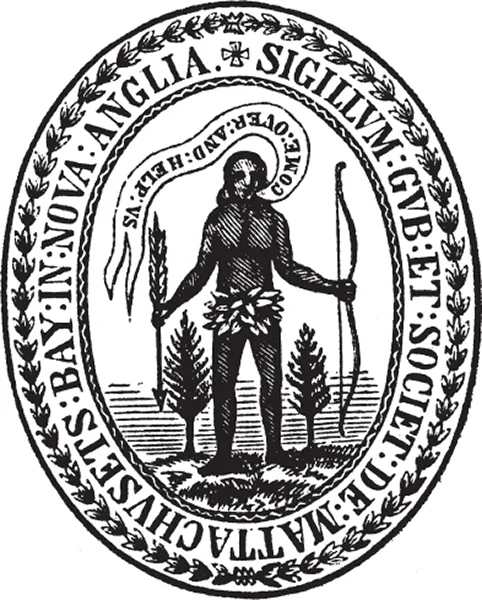
Seal of the Massachusetts Bay Colony. (Image courtesy of the Secretary of the Commonwealth of Massachusetts.)
The centerpiece of the Puritans’ evangelical plan was the praying town. Praying towns were similar to the famous reducciones of the Spanish and Portuguese empires, though they were much smaller and did not initially involve forced migration. In these towns Indians were supposed to build English style homes, cut their hair European-style, practice monogamous marriage, establish permanent farms, and generally subscribe to English ideas of civilization and Puritan ideas of religion. They were also to follow a series of behavioral codes that included avoiding alcohol, shunning local shamans, and refusing to “lie with a beast” upon penalty of death.21 And yet, a remarkable degree of autonomy was characteristic of many growing Christian Indian communities. Although Eliot was the central figure in their creation, the offices of church leadership were almost always filled with Native Americans, and usually along familial lines. The ascension ...
Table of contents
- Cover
- Title Page
- Copyright
- Dedication
- Contents
- List of Illustrations
- Introduction
- 1. Apostles to the Indians
- 2. The Expansion of the Indigenous Missionary Enterprise
- 3. Slave Preachers and Indian Separatism
- 4. A Black among Blacks
- 5. Native Evangelists in the Iroquoian Borderlands
- 6. Afro-Christian Evangelism and Indian Missions
- Conclusion
- Appendix: Table of Native Missionaries
- Notes
- Note on Sources
- Acknowledgments
- Index
Trusted by 375,005 students
Access to over 1.5 million titles for a fair monthly price.
Study more efficiently using our study tools.
Frequently asked questions
Yes, you can cancel anytime from the Subscription tab in your account settings on the Perlego website. Your subscription will stay active until the end of your current billing period. Learn how to cancel your subscription
No, books cannot be downloaded as external files, such as PDFs, for use outside of Perlego. However, you can download books within the Perlego app for offline reading on mobile or tablet. Learn how to download books offline
Perlego offers two plans: Essential and Complete
- Essential is ideal for learners and professionals who enjoy exploring a wide range of subjects. Access the Essential Library with 800,000+ trusted titles and best-sellers across business, personal growth, and the humanities. Includes unlimited reading time and Standard Read Aloud voice.
- Complete: Perfect for advanced learners and researchers needing full, unrestricted access. Unlock 1.5M+ books across hundreds of subjects, including academic and specialized titles. The Complete Plan also includes advanced features like Premium Read Aloud and Research Assistant.
We are an online textbook subscription service, where you can get access to an entire online library for less than the price of a single book per month. With over 1.5 million books across 990+ topics, we’ve got you covered! Learn about our mission
Look out for the read-aloud symbol on your next book to see if you can listen to it. The read-aloud tool reads text aloud for you, highlighting the text as it is being read. You can pause it, speed it up and slow it down. Learn more about Read Aloud
Yes! You can use the Perlego app on both iOS and Android devices to read anytime, anywhere — even offline. Perfect for commutes or when you’re on the go.
Please note we cannot support devices running on iOS 13 and Android 7 or earlier. Learn more about using the app
Please note we cannot support devices running on iOS 13 and Android 7 or earlier. Learn more about using the app
Yes, you can access Native Apostles by Edward E. Andrews in PDF and/or ePUB format, as well as other popular books in History & Early American History. We have over 1.5 million books available in our catalogue for you to explore.