Saving the Neighborhood tells the charged, still controversial story of the rise and fall of racially restrictive covenants in America, and offers rare insight into the ways legal and social norms reinforce one another, acting with pernicious efficacy to codify and perpetuate intolerance.
The early 1900s saw an unprecedented migration of African Americans leaving the rural South in search of better work and equal citizenship. In reaction, many white communities instituted property agreements—covenants—designed to limit ownership and residency according to race. Restrictive covenants quickly became a powerful legal guarantor of segregation, their authority facing serious challenge only in 1948, when the Supreme Court declared them legally unenforceable in Shelley v. Kraemer. Although the ruling was a shock to courts that had upheld covenants for decades, it failed to end their influence. In this incisive study, Richard Brooks and Carol Rose unpack why.
At root, covenants were social signals. Their greatest use lay in reassuring the white residents that they shared the same goal, while sending a warning to would-be minority entrants: keep out. The authors uncover how loosely knit urban and suburban communities, fearing ethnic mixing or even "tipping," were fair game to a new class of entrepreneurs who catered to their fears while exacerbating the message encoded in covenants: that black residents threatened white property values. Legal racial covenants expressed and bestowed an aura of legitimacy upon the wish of many white neighborhoods to exclude minorities. Sadly for American race relations, their legacy still lingers.
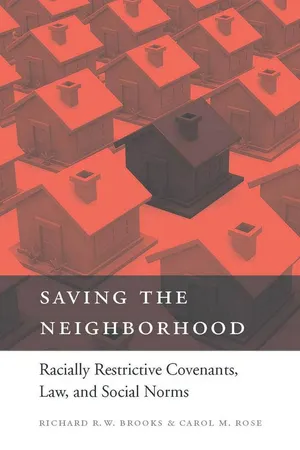
eBook - ePub
Saving the Neighborhood
Racially Restrictive Covenants, Law, and Social Norms
- 294 pages
- English
- ePUB (mobile friendly)
- Available on iOS & Android
eBook - ePub
Saving the Neighborhood
Racially Restrictive Covenants, Law, and Social Norms
About this book
Information
1
Introduction
Recalling Racialized Property
In the summer of 1986, an embarrassing fact came to light about conservative jurist William Rehnquist, then an associate justice on the U.S. Supreme Court. Rehnquist had been nominated by President Ronald Reagan to become chief justice of the Court, and during his confirmation hearings before the Senate Judiciary Committee, a routine background check unearthed a decades-old deed restriction on the Vermont summer house that Rehnquist had purchased in 1974. The restriction purported to exclude anyone of the “Hebrew race.”
Another embarrassing deed restriction came to light as well, this one dating back to 1929, on a house that Rehnquist had purchased in Phoenix in 1961 and sold a few years later. The racial covenant on that house would have barred sale or rental by “any person not of the White or Caucasian race,” a code phrase often used for African Americans and sometimes Asians. When Rehnquist’s opponents hinted that these transactions showed the justice’s insensitivity to racial issues, his conservative defenders dug up the information that Democratic Senator Joseph Biden (then a member of the Senate Judiciary Committee and later vice president in the Obama administration) as well as deceased President John F. Kennedy had also owned or lived in residences with racially restrictive covenants.1
Rehnquist himself claimed that he had not known about these old restrictions or had forgotten about them, and he promised to take steps to get rid of the restriction on his Vermont house, which he still owned. He observed, though, that covenants of this sort could not be enforced and were thus, in his words, “meaningless.”2
Rehnquist was right that these covenants no longer had any legal effect, and he was probably right that he had not thought much about them even if he knew of them when he bought the properties. By the 1980s, covenants of this sort seemed to most people to be at most a dimly recalled remnant of past prejudices. In Vermont, one of Rehnquist’s Jewish neighbors was startled to find out about the antisemitic restriction, and wondered whether there was a similar restriction on her own property. But Rehnquist’s experience suggested that the restrictions were not entirely meaningless. Though lacking any legal effect, old restrictions in the records had a feeble but persistent life of their own. They could still convey information and create inferences about owners and neighborhoods, however anachronistic those inferences might become at a later time. Political opponents could still use those inferences to demand an explanation—as they were to do at Rehnquist’s confirmation, and as they were to do again over a decade later. In January 1999, on the occasion when Chief Justice Rehnquist was sworn in to preside at the impeachment trial of President Bill Clinton, New York Times columnist Bob Herbert reminded his readers that Rehnquist had purchased the two properties, racial restrictions and all.3 But then, of course, so had many other prominent figures of all political stripes.
What are these racially restrictive covenants? Why have they continued to float up from time to time as singularly unpleasant ghosts of the past, especially now that no one seems to take them very seriously anymore? The short answer is that racially restrictive covenants were once a standard part of real estate transactions in the United States, and American recording practices make them quite difficult to eradicate, whether they are legal or not. The longer answer is the subject of this book, which will use the legal history of racially restrictive covenants—particularly as applied to African Americans, where persistent litigation has created a rich legal source—to explore the ways that racially restrictive covenants expressed social norms, and the ways that those social norms have related to legal norms, together facilitating patterns of residential racial segregation that long outlived these once technically legal devices.4
As a matter of legal history, racial covenants had a distinct arc. Developers of high-end urban residential areas began to use them regularly in the early years of the twentieth century. In the new urban subdivisions, racial covenants were only one part in the packages of deed restrictions that developers deployed to control such matters as construction styles and land uses. But in those early days, courts in the United States understood traditional property law to be quite chary of any private arrangements that purported to control land uses over long periods of time—and that chariness included racial covenants. Nevertheless, by the 1920s, the courts began to relax their earlier strictures about all kinds of residential restrictions, including the racial ones. Thereafter racially restrictive covenants spread through both newer subdivisions and older urban neighborhoods. Constitutional law seemed to offer no limitations, since real estate covenants were thought to be merely private arrangements, and hence not subject to the constitutional limitations on discrimination by governmental bodies.
This pattern of acceptance received an abrupt shock in 1948, when the U.S. Supreme Court decided the landmark case, Shelley v. Kraemer,5 ruling that any court that enforced racial covenants violated the equal protection clause of the Fourteenth Amendment to the U.S. Constitution. Surprisingly, racial covenants of one sort and another continued to be written into title documents, until they were finally flatly outlawed by the Fair Housing Act of 1968. Even after that act, however, old racial covenants were still in the record books, and they appeared in title searches and deeds copied from earlier documents, as in Justice Rehnquist’s case, however much they might be ignored by all concerned.
The historical arc of racially restrictive covenants—judicial suspicion, followed by relaxation, followed by the Shelley case and the denial of legal enforcement, followed by continuing but unenforceable covenants, followed by illegality, and followed finally by general but not complete indifference—suggests a unique topic for investigating the relationship between social norms and law. With that topic in mind, let us briefly reconsider this historical arc in the context of racial covenants that aimed to exclude African Americans.
Throughout the first half of the twentieth century and beyond, many white persons in urban areas in the United States preferred to avoid living near African Americans (with the telling exception of servants), and they preferred that their neighbors not sell or rent to African Americans either. This very strong set of preferences created both an internal and an external issue about the implicit rules that would govern their behavior. Internally, the white neighbors needed to control one another’s sales and rentals. Externally, they needed to stave off entry by unwanted minorities.
White neighbors could and did use what we euphemistically call “informal” methods to exclude racial minorities, including anything from polite warnings through threats to physical violence. Indeed, the most cohesive working class white neighborhoods were less likely to use formal racial covenants at all to enforce segregation; in many instances, informal enforcement was more than sufficient. But not every white neighborhood was so willing to rely exclusively on threats and violence. In a sense, racial covenants were a formal legal substitute for the more vigorous and potentially vicious informal means used by more closely knit social groups. Like real estate covenants of all kinds, racial covenants were supposed to “run with the land,” binding future owners as well as the original signatories; thus they were intended to have staying power for a neighborhood and to repel entry by unwanted new residents. We will argue that in addition, one of the chief functions of racial covenants was to provide a kind of formal normative node around which more loosely knit communities could organize their resistance to entry by other racial groups.
As we shall see in later chapters, covenants were only one of several legal devices that might have assisted the white neighbors in their resistance to minority encroachment. But for various reasons, the alternative legal devices all fell away by about 1920. What was left as a formal, legal route to enforce residential segregation was the use of racially restrictive covenants. These flourished in new subdivisions and urban neighborhoods in the next few decades, powerfully encouraged by real estate professionals, banking institutions, and an array of other institutions, including perhaps most importantly the New Deal’s Federal Housing Administration.
But uneasiness about racial restrictions also grew in this period. The pressure came from four major sources. Foremost was the sheer expansion of minority populations in American cities during and after the First World War, and especially during the Second World War, when overcrowding and ghettoization became increasingly alarming. Second, a larger public opinion grew wary of racial restrictions in light of the Nazi and fascist actions in Europe, again especially during and after the Second World War, in which many minority citizens fought, and some died, in service to the United States. Third was the postwar emergence of the Cold War, during which the legal segregation of residential neighborhoods became a profound embarrassment for American foreign policy. Finally, and fanning the discontent produced by all the other factors, was a steady drumbeat of anticovenant litigation spearheaded by the National Association for the Advancement of Colored People (NAACP).
When Shelley was decided in 1948, the NAACP and others had high hopes that the denial of racial covenants’ legal enforceability would usher in an era of residential integration. This did not occur. Instead, white flight became the new vehicle of segregation. What is more surprising, the Shelley case did not even put an end to the now-unenforceable racial covenants. The Federal Housing Administration, which since its inception had favored racial restrictions in home loans, insured homes in newly covenanted subdivisions for over a year after Shelley. Real estate professionals continued for a time to write racial covenants into new deeds, and they continued to refer to racial covenants when selling older covenanted properties.
Why did so little change with respect to covenants? One obvious reason is that white social norms against integration continued. White homeowners had long feared that their properties would lose market value if minorities moved into the neighborhood, and they continued to believe this—and to act on their belief—after the Shelley case. Given that set of beliefs, real estate professionals continued to reason that total real estate values would be higher if neighborhoods were segregated racially.
Some developers included racial covenants at least for a few years after Shelley because they thought that Shelley was so much of an out-lier that the case soon would be overturned or sharply limited, and they might as well have racial covenants in place. Still other developers continued to write and copy racial restrictions, not because these restrictions were legally enforceable—and by 1953 a second covenant case in the Supreme Court made it clear that they would not be—but because covenants sent a signal to buyers about the racial preference of their neighbors.
This communicative function of racial covenants will be of special interest in this book. The fact that racial covenants continued to be written after Shelley suggests that even before that case, a major function of racial covenants was to allow white neighbors to identify themselves as allies in a preference for segregation and an intention to maintain it, and to signal the same to outsiders. Actual legal enforceability had never mattered as much as civil rights advocates thought. And hence Shelley’s denial of legal enforceability did not matter so much either. The case certainly weakened the larger imprimatur on covenants, but it left intact covenants’ ability to create among all the relevant parties a common knowledge of the local racial attitudes. Even though the courts would not recognize racial covenants after 1948, these documents could still bolster neighborhoods’ sense of the rightness of whiteness, and they could send a message to would-be interlopers. Congress implicitly recognized the power of signals when it outlawed overt information about residential segregation—implicitly including information about covenants—in the Fair Housing Act of 1968.
THE CAST OF CHARACTERS
With that overall story in mind, let us identify some of the features that will be of most interest in this book.
Property claims. The tale of racially restrictive covenants is profoundly a story about property. One way in which property permeates this story is the ever-present mantra of property values. Probably the most consistent reason that people give for wishing to exclude unwanted outsiders is that the outsiders will exert downward pressure on the value of the insiders’ homes. As other authors have pointed out, this position is akin to the NIMBY syndrome—the “Not in My Back Yard” attitude that creates pressure to place unwanted land uses somewhere else. Moreover, by referring to property values, individuals can mask their own prejudices: “it’s not me, it’s the market.” On the other hand, their market assessment, sadly enough, has been correct often enough to mean that a concern for property values is not simply a makeweight but rather a powerful motivator, particularly in the case of the many persons for whom the home is the chief asset.6
Property permeates the restrictive covenant story in another and less obvious way as well. Property’s most fundamental characteristic has often been said to be the right to exclude, a right that serves as a platform for an owner’s use, investment, and trade. Through covenants, along with other signals of segregation, white neighbors attempted to establish a form of collective ownership, asserting that they informally “owned” the neighborhood as a whole, to the exclusion of nonwhite persons. Insiders were expected to understand and do their parts in maintaining this group property, but outsiders were supposed to get the message too. In the 1920s, ’30s, and ’40s, racially restrictive covenants were the one legally acceptable means to enforce this scheme of inside-group property. Racial covenants had the advantages that go with formality—written documentation, public recording, legal jargon—all of which would be effective in cajoling the insiders, but just as important, in warning off the outsiders who might be thinking of moving to the neighborhood.
Property law. Legal status gives property claims an especially long reach, both in space and in time. Through legal record systems, owners can effectively tell the world at large of their claims, and they can make their wishes effective on others far into the future—much further, for example, than contracts, which generally only affect the parties immediately involved in any given agreement and are largely unknown to the rest of the world.
Racially restrictive covenants enjoyed the reach and staying power that formal property law provides. But their formal legal status also meant that they were subject to the limits and logic of formal property law. In several ways, those limits and logic should have been distinctly unfriendly to racial restrictions. For example, group property has not fared well in traditional American property law, among other reasons because of the burdens that group property imposes on individual owners and the impediments it causes to new owners and uses. There are exceptions in traditional property law, and a considerable part of the brief legal history of racial covenants revolved around the question of whether those covenants could form a legal exception or not.7
But in addition, formal property law is generally hostile to constraints on who can own and use property, as opposed to the uses that owners or occupants can make. Constraints on land uses can solve problems of spillovers from individual property use, or what economists call externalities (e.g., loud noise or noxious fumes)—activities that affect other people without taking them into account. It smacks of rank prejudice, however, to block certain kinds of persons from owning or renting, for no reason other than their personal characteristics. This issue should have been particularly prominent to jurists in the early twentieth century, when many people continued to believe that property ownership would be the vehicle by which former slaves and their descendants would improve their status and become full participants in the larger community.
It is something of a puzzle, then, why courts were willing to allow racial residential restrictions through the property device of covenants running with the land. Although the opportunity was largely bypassed in the first few decades of the twentieth century, formal property law’s policing capacity might have been deployed with considerably more bite to curb some of the most egregiously discriminatory forms of residential segregation, especially through covenants. Some scholars and judges seemed to be growing aware of this curbing potential by the 1940s, and we suspect that even if Shelley had not been decided on constitutional grounds, courts increasingly would have used traditional property law principles to invalidate racial covenants. The larger point is that formal legal status entailed higher-level limitations on property claims, and thus legality carried risks as well as advantages for white neighbors.
Neighborhoods. As mentioned above, tightly cohesive, less well-to-do neighborhoods often did without racial covenants. These neighborhoods operated through their own norms of exclusion, and they did their own enforcing. The same was true of all-white smaller communities that dotted the countryside, the so-called sundown towns where no black person was supposed to allow the sun to set upon him or her.8 Racial covenants, on the...
Table of contents
- Cover
- Title Page
- Copyright
- Dedication
- Contents
- 1. Introduction: Recalling Racialized Property
- 2. Before Covenants
- 3. The Big Guns Silenced: How Racial Covenants Overcame Major Objections from Constitutional Law, Property Law, and Corporations Law
- 4. Pushing Down the Ghosts: Covenant Development and Unseen Legal Influences
- 5. The Calculus of Covenants
- 6. The Emergence of the Norm Breakers
- 7. The Great Dilemma for Legal Norms: Shelley and State Action
- 8. After Shelley: Reactions, Evasions, Substitutions
- 9. Changing Games in the Twilight of Covenants: Signals, Tipping Points, and Quotas
- 10. Conclusion: Covenants’ Legacy
- Notes
- Acknowledgments
- Index
Trusted by 375,005 students
Access to over 1.5 million titles for a fair monthly price.
Study more efficiently using our study tools.
Frequently asked questions
Yes, you can cancel anytime from the Subscription tab in your account settings on the Perlego website. Your subscription will stay active until the end of your current billing period. Learn how to cancel your subscription
No, books cannot be downloaded as external files, such as PDFs, for use outside of Perlego. However, you can download books within the Perlego app for offline reading on mobile or tablet. Learn how to download books offline
Perlego offers two plans: Essential and Complete
- Essential is ideal for learners and professionals who enjoy exploring a wide range of subjects. Access the Essential Library with 800,000+ trusted titles and best-sellers across business, personal growth, and the humanities. Includes unlimited reading time and Standard Read Aloud voice.
- Complete: Perfect for advanced learners and researchers needing full, unrestricted access. Unlock 1.5M+ books across hundreds of subjects, including academic and specialized titles. The Complete Plan also includes advanced features like Premium Read Aloud and Research Assistant.
We are an online textbook subscription service, where you can get access to an entire online library for less than the price of a single book per month. With over 1.5 million books across 990+ topics, we’ve got you covered! Learn about our mission
Look out for the read-aloud symbol on your next book to see if you can listen to it. The read-aloud tool reads text aloud for you, highlighting the text as it is being read. You can pause it, speed it up and slow it down. Learn more about Read Aloud
Yes! You can use the Perlego app on both iOS and Android devices to read anytime, anywhere — even offline. Perfect for commutes or when you’re on the go.
Please note we cannot support devices running on iOS 13 and Android 7 or earlier. Learn more about using the app
Please note we cannot support devices running on iOS 13 and Android 7 or earlier. Learn more about using the app
Yes, you can access Saving the Neighborhood by Richard R. W. Brooks,Carol M. Rose in PDF and/or ePUB format, as well as other popular books in Law & North American History. We have over 1.5 million books available in our catalogue for you to explore.