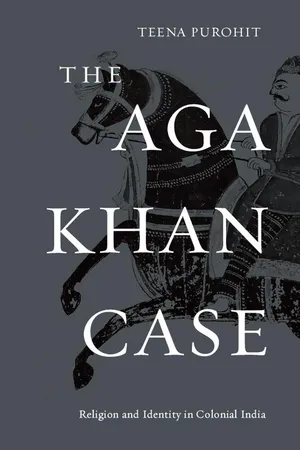
An overwhelmingly Arab-centric perspective dominates the West's understanding of Islam and leads to a view of this religion as exclusively Middle Eastern and monolithic. Teena Purohit presses for a reorientation that would conceptualize Islam instead as a heterogeneous religion that has found a variety of expressions in local contexts throughout history. The story she tells of an Ismaili community in colonial India illustrates how much more complex Muslim identity is, and always has been, than the media would have us believe.
The Aga Khan Case focuses on a nineteenth-century court case in Bombay that influenced how religious identity was defined in India and subsequently the British Empire. The case arose when a group of Indians known as the Khojas refused to pay tithes to the Aga Khan, a Persian nobleman and hereditary spiritual leader of the Ismailis. The Khojas abided by both Hindu and Muslim customs and did not identify with a single religion prior to the court's ruling in 1866, when the judge declared them to be converts to Ismaili Islam beholden to the Aga Khan.
In her analysis of the ginans, the religious texts of the Khojas that formed the basis of the judge's decision, Purohit reveals that the religious practices they describe are not derivations of a Middle Eastern Islam but manifestations of a local vernacular one. Purohit suggests that only when we understand Islam as inseparable from the specific cultural milieus in which it flourishes do we fully grasp the meaning of this global religion.
- 183 pages
- English
- ePUB (mobile friendly)
- Available on iOS & Android
eBook - ePub
About this book
Information
Table of contents
- Cover
- Title Page
- Copyright
- Dedication
- Contents
- Acknowledgments
- Note on Transliteration
- Introduction
- 1. Prehistories of the Isma‘ili Sect in Nineteenth-Century Bombay
- 2. Sectarian Showdown in the Aga Khan Case of 1866
- 3. Reading Satpanth against the Judicial Archive
- 4. Comparative Formations of the Hindu Swami Narayan “Sect”
- 5. Sect and Secularism in the Early Nationalist Period
- Conclusion
- Notes
- Index
Trusted by 375,005 students
Access to over 1.5 million titles for a fair monthly price.
Study more efficiently using our study tools.
Frequently asked questions
Yes, you can cancel anytime from the Subscription tab in your account settings on the Perlego website. Your subscription will stay active until the end of your current billing period. Learn how to cancel your subscription
No, books cannot be downloaded as external files, such as PDFs, for use outside of Perlego. However, you can download books within the Perlego app for offline reading on mobile or tablet. Learn how to download books offline
Perlego offers two plans: Essential and Complete
- Essential is ideal for learners and professionals who enjoy exploring a wide range of subjects. Access the Essential Library with 800,000+ trusted titles and best-sellers across business, personal growth, and the humanities. Includes unlimited reading time and Standard Read Aloud voice.
- Complete: Perfect for advanced learners and researchers needing full, unrestricted access. Unlock 1.5M+ books across hundreds of subjects, including academic and specialized titles. The Complete Plan also includes advanced features like Premium Read Aloud and Research Assistant.
We are an online textbook subscription service, where you can get access to an entire online library for less than the price of a single book per month. With over 1.5 million books across 990+ topics, we’ve got you covered! Learn about our mission
Look out for the read-aloud symbol on your next book to see if you can listen to it. The read-aloud tool reads text aloud for you, highlighting the text as it is being read. You can pause it, speed it up and slow it down. Learn more about Read Aloud
Yes! You can use the Perlego app on both iOS and Android devices to read anytime, anywhere — even offline. Perfect for commutes or when you’re on the go.
Please note we cannot support devices running on iOS 13 and Android 7 or earlier. Learn more about using the app
Please note we cannot support devices running on iOS 13 and Android 7 or earlier. Learn more about using the app
Yes, you can access The Aga Khan Case by Teena Purohit in PDF and/or ePUB format, as well as other popular books in History & 19th Century History. We have over 1.5 million books available in our catalogue for you to explore.