"This book is nothing less than the definitive study of a text long considered central to understanding the Renaissance and its place in Western culture."
—James Hankins, Harvard University
Pico della Mirandola died in 1494 at the age of thirty-one. During his brief and extraordinary life, he invented Christian Kabbalah in a book that was banned by the Catholic Church after he offered to debate his ideas on religion and philosophy with anyone who challenged him. Today he is best known for a short speech, the Oration on the Dignity of Man, written in 1486 but never delivered. Sometimes called a "Manifesto of the Renaissance," this text has been regarded as the foundation of humanism and a triumph of secular rationality over medieval mysticism.
Brian Copenhaver upends our understanding of Pico's masterwork by re-examining this key document of modernity. An eminent historian of philosophy, Copenhaver shows that the Oration is not about human dignity. In fact, Pico never wrote an Oration on the Dignity of Man and never heard of that title. Instead he promoted ascetic mysticism, insisting that Christians need help from Jews to find the path to heaven—a journey whose final stages are magic and Kabbalah. Through a rigorous philological reading of this much-studied text, Copenhaver transforms the history of the idea of dignity and reveals how Pico came to be misunderstood over the course of five centuries. Magic and the Dignity of Man is a seismic shift in the study of one of the most remarkable thinkers of the Renaissance.
eBook - ePub
Magic and the Dignity of Man
Pico della Mirandola and His Oration in Modern Memory
- English
- ePUB (mobile friendly)
- Available on iOS & Android
eBook - ePub
Magic and the Dignity of Man
Pico della Mirandola and His Oration in Modern Memory
About this book
Information
Topic
PhilosophySubtopic
European Renaissance HistoryPART ONE
DIGNITY
1
Vile Bodies and Naked Dignity
Our Lord Jesus Christ … shall chaunge our vile body, that it may be lyke to his glorious body.
—The Book of Common Prayer
1. The Honored Dead
Was Giovanni Pico a Phoenix? People have often said so. At any single moment, in all the world, there can have been just one bird so rare, an exotic wonder destined for a kind of immortality. After each unique Phoenix destroys itself in sweet-smelling fire, having lived for five centuries, another rises from the ashes. Angelo Ambrogini of Montepulciano, the erudite poet better known as Poliziano, was another unusual talent. Birds were on his mind when he told Lorenzo de’ Medici his nickname for their mutual friend, Giovanni Pico: “not ‘woodpecker’ (picus) but rather ‘Phoenix,’ the one now nesting in your Laurel Tree. So much do I expect of him, Lauro, that I would actually dare sing, keeping in tune with Propertius, ‘move over, you writers from Rome, move over, Greeks!’ ”1
Many tellings of the Phoenix legend were known when Poliziano wrote these lines of praise in 1489, and Pico was still three years short of thirty. Exactly what the older genius saw in this prodigious up-and-comer is hard to say. The expectations were great, plainly, and the flattery stuck. Almost five centuries later, in 1948, when the University of Chicago Press published Pico’s Oration in English, the speech was printed in Phoenix Books Number 1, the first release—still selling after seventy years—of a new series. Demand eventually called for a paperback edition that introduced the Oration to many, many readers: tens of thousands, at least. This Phoenix is still making a bid for immortality.2
Thanks to Poliziano, Anglophone students of the Renaissance have called Pico a Phoenix—but not a woodpecker. An Italian woodpecker is a picchio, however, and a picus in Latin: hence Poliziano’s discriminating ornithology. As the leading classicist of his day, he knew the ancient texts where a picus had nested. Closer to our time, about a century ago, when philology and anthropology were still partners, experts on the Bible and Greco-Roman mythology were still chasing woodpeckers through old books. They noticed this entry in a medieval dictionary from Byzantium: “Pêkos—also Zeus—died after passing the rule of the West on to Hermes, his own son. He lived 120 years, and as he was dying, he ordered his body to be buried on the island of Crete, where this is inscribed: here Pêkos, who is also Zeus, lies dead. Many have mentioned this tomb in their own writings.”
The learned birdwatchers recognized the ancient Greek woodpecker as just that—a dru-kolaptês, an oak-pecker—or sometimes an oak-looker, dru-ops, or sometimes a pelekas, a woodworker. But the Pêkos in the inscription, Πῆκος ὁ καὶ Ζεύς, reminded them of picus, the Latin ‘woodpecker,’ which is close to pica or ‘magpie.’ Painted (pictus) a glossy black and white, magpies are seen all over Europe, long-tailed and clever; their chatter is distinctive too. The coat of the green woodpecker (Picus viridis) is not so striking, however, and its beak is too soft for loud pecking. Drycopus martius, the black woodpecker, is larger, with wings than can span 32 inches. Named for Mars and crowned in red, this big bird has a beak hard enough to dig deep into trees: hammering away to find food, the black woodpecker makes its own local thunder.
Scholars who wondered why Pêkos was said to be Zeus heard an echo of this name in picus: like the sky-god, the woodpecker made noises up in the air, and sometimes the rain came down. Like other birds, woodpeckers were watched by diviners. Since everyone talked about the weather, why not keep an eye on the birds and listen to them—especially the thunderbirds?3
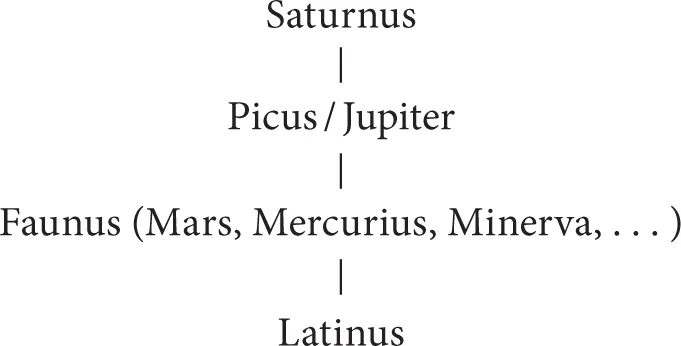
Every classicist, if not every schoolchild, knew that Aeneas rescued his family gods from Troy’s ruins and carried them to Latium in Italy, where King Latinus ruled the Latins who spoke the language of Vergil’s epic. Latinus was the son of Faunus, whose father was Picus; and his father was Saturn—Kronos in Greek, the father of Zeus or Jupiter. Picus and Jupiter shared a parent and belonged to the same generation of gods—before Mars, Mercury, Minerva, and other Olympians—so maybe the inscription from Crete (where the infant Zeus was nursed) was right: maybe Picus was also Jupiter. He was at least as old as the primeval Italus, who gave Italy its name, and he was a horse tamer, armed with a staff and shield. But Circe’s wand and drugs were stronger: her witchy magic changed the love-struck Picus into a woodpecker.4
Ovid, in his epic of shape-shifting, expanded Vergil’s story, adding bucolic and erotic decor. He also inserted a character, the songstress Canens, to fill out the drama: only she, of all the dryads and naiads in Latium, managed to enchant Picus, who could love no other. He spurned even Circe’s dreadful charms until he
saw feathers on his body and could not standwatching himself, right there in the woods of Latium,suddenly changing, unheard of, into a bird,driving his tough beak into wild oaks.
Ovid added another detail that was sure to attract the birdwatchers: that the ancients had a statue of Picus “wearing a woodpecker on top.” Asking “why he wore a bird and why a shrine should be dedicated to him,” the poet also supplied answers.5
Ovid spelled these reasons out again in another long poem, the Festivals, about Rome’s religion and calendar. The king who first taught the City to worship was Numa. Needing Jupiter to rain blessings from the sky, but fearing the god’s stormy anger, the original Romans learned from Numa how to draw a thunderbolt down with ritual or how to avert its blast. A pair of woodland gods, Faunus and Picus, taught these rites to Numa under compulsion and deception, after the king got them drunk. Faunus had a goat’s horns and feet. What did Picus—his companion—look like? Maybe he was the red-and-black woodpecker (picus) sent by Mars to preside at Rome’s founding and feed the newborn Romulus and Remus. If Picus was resplendent at the City’s creation, surely he deserved his statue and shrine.6
Picus was a glorious name wherever people learned the language of Latium. And a picus was no ordinary bird—as Poliziano realized when he gave Giovanni Pico his extraordinary totem: an absolutely singular Phoenix outdid many woodpeckers, however, no matter how loud and colorful. But Poliziano knew someone else from the same family—Giovanni’s nephew, Gianfrancesco, who wrote the first biography of his uncle and made a show of ignoring “ancestral deeds and pedigree.” What pedigree? A line that started with Picus?
No: when Gianfrancesco produced his Life of Giovanni Pico, his Christian piety was narrow and puritanical, not in keeping with Poliziano’s expansive erudition. Something he said about his uncle was truer of himself: that he liked no “Attic evenings,” no “storybook saturnalia,” meaning recherché notes and queries compiled by long-gone heathens—“anything easy and relaxing,” wrote one bookish pagan, “aimless and in no special order.” When Gianfrancesco skipped his uncle’s genealogy, he feared such amusements as traps of Satan. The stories of the Pico family that he mentioned and then bypassed, however, were neither pagan nor as old as Pêkos and Zeus. They went back a long way, just the same, to the founding of Christendom and the “Emperor Constantine through a great-grandson, Picus, from whom the whole family took its storied name.”7
Unlike Gianfrancesco Pico, Ingramo Bratti treasured the legends of chivalry. He was a cleric who gave legal advice to the Pio family of Carpi, close cousins of the Picos: the Pio castle was just fifteen miles from Mirandola. Late in the fourteenth century, Bratti memorialized both clans in an Italian chronicle—based on a Latin source, he claimed—“in praise of Manfredo’s heirs, especially the Pio family and the Picos of Mirandola, as well as other nobles.” He started the story in 320 CE with Constantine the Great, the first Christian emperor, who had three sons. The youngest was Costanzo, and Italy was his prize when Constantine divided his empire.
Costanzo’s daughter was Euride, though astonishing feats of motherhood would earn her another name—Miranda. And Costanzo’s dearest friend was his chamberlain, Manfredo, who betrayed their friendship by running off with Euride and ignoring her father’s wishes. Carrying her jewels, the pair fled to Italy and got there before Costanzo, ending up in a “wooded valley near Modena and Reggio.” Then Manfredo went adventuring and left Euride behind, disguised as a peasant and attended by kindly shepherds in their newfound valley. There, as she and Manfredo acquired more lands, triplets arrived—all boys: Pico, Pio, and Papazono. Years passed and seven other children followed: Pandello, Manfredo, Pedocha, Infante, Siculo, Costanza, and Euride—ten births in all, two girls and eight boys.8
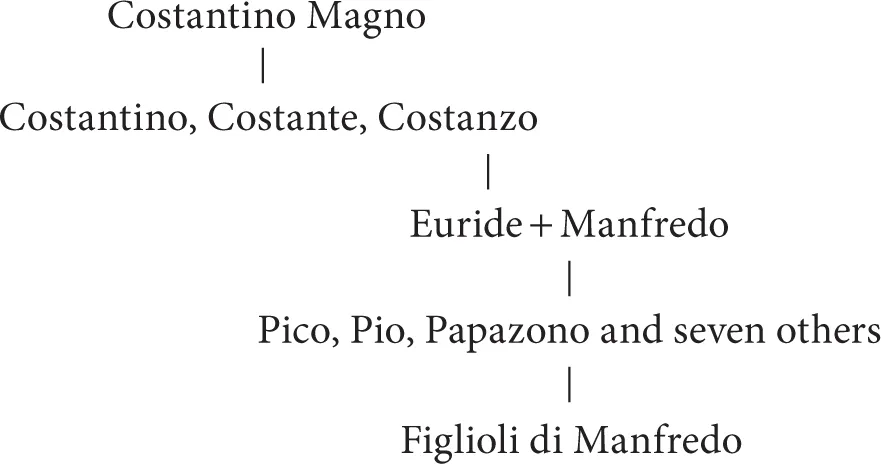
Meanwhile, Costanzo reached Italy and besieged Aquileia, a naval base at the top of the Adriatic. When the emperor’s army failed to take the city, Manfredo brought reinforcements and saved the day. The grateful Costanzo forgave his old friend’s offenses, knighted him, gave him lands, and bestowed a coat of arms. In memory of his bravery at Aquileia, Manfredo’s shield was to display a “black eagle (aquila) on a bright green field.” Costanzo also permitted Manfredo to build castles and towers between the Po and the Secchia, a tributary flowing northeast from the Apennines into the great river. Today the smaller stream runs through the Commune of Concordia, northwest of Mirandola—names then unknown to the shepherds in Euride’s valley.9
Delighted by Manfredo’s courage, Costanzo was also amazed by his daughter’s ten children—so many born to a mother so young. The emperor therefore decreed that “Euride would be called Miranda, from whom Mirandola got its name”—an origin story with imperial authentication. Then, while his friend returned to Aquileia, Manfredo marched b...
Table of contents
- Cover
- Title Page
- Copyright
- Dedication
- Epigraph
- Contents
- List of Figures
- Acknowledgments
- Introduction
- Part One: Dignity
- Part Two: Stories about Pico
- Part Three: Pico’s Oration
- Conclusion: Real Picos and Why They Matter
- Appendix A: Pico’s Oration
- Appendix B: Contents of Pico’s 900 Conclusions
- Appendix C: Selections from Pico’s 900 Conclusions
- Appendix D: Glossary
- Abbreviations
- Notes
- Bibliography
- Illustration Credits
- Index
Trusted by 375,005 students
Access to over 1.5 million titles for a fair monthly price.
Study more efficiently using our study tools.
Frequently asked questions
Yes, you can cancel anytime from the Subscription tab in your account settings on the Perlego website. Your subscription will stay active until the end of your current billing period. Learn how to cancel your subscription
No, books cannot be downloaded as external files, such as PDFs, for use outside of Perlego. However, you can download books within the Perlego app for offline reading on mobile or tablet. Learn how to download books offline
Perlego offers two plans: Essential and Complete
- Essential is ideal for learners and professionals who enjoy exploring a wide range of subjects. Access the Essential Library with 800,000+ trusted titles and best-sellers across business, personal growth, and the humanities. Includes unlimited reading time and Standard Read Aloud voice.
- Complete: Perfect for advanced learners and researchers needing full, unrestricted access. Unlock 1.5M+ books across hundreds of subjects, including academic and specialized titles. The Complete Plan also includes advanced features like Premium Read Aloud and Research Assistant.
We are an online textbook subscription service, where you can get access to an entire online library for less than the price of a single book per month. With over 1.5 million books across 990+ topics, we’ve got you covered! Learn about our mission
Look out for the read-aloud symbol on your next book to see if you can listen to it. The read-aloud tool reads text aloud for you, highlighting the text as it is being read. You can pause it, speed it up and slow it down. Learn more about Read Aloud
Yes! You can use the Perlego app on both iOS and Android devices to read anytime, anywhere — even offline. Perfect for commutes or when you’re on the go.
Please note we cannot support devices running on iOS 13 and Android 7 or earlier. Learn more about using the app
Please note we cannot support devices running on iOS 13 and Android 7 or earlier. Learn more about using the app
Yes, you can access Magic and the Dignity of Man by Brian P. Copenhaver in PDF and/or ePUB format, as well as other popular books in Philosophy & European Renaissance History. We have over 1.5 million books available in our catalogue for you to explore.