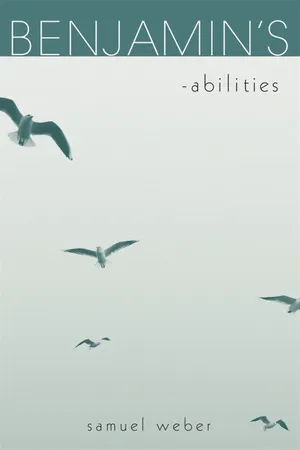
"There is no world of thought that is not a world of language," Walter Benjamin remarked, "and one only sees in the world what is preconditioned by language." In this book, Samuel Weber, a leading theorist on literature and media, reveals a new and productive aspect of Benjamin's thought by focusing on a little-discussed stylistic trait in his formulation of concepts.
Weber's focus is the critical suffix "-ability" that Benjamin so tellingly deploys in his work. The "-ability" (-barkeit, in German) of concepts and literary forms traverses the whole of Benjamin's oeuvre, from "impartibility" and "criticizability" through the well-known formulations of "citability," "translatability," and, most famously, the "reproducibility" of "The Work of Art in the Age of Its Technological Reproducibility." Nouns formed with this suffix, Weber points out, refer to a possibility or potentiality, to a capacity rather than an existing reality. This insight allows for a consistent and enlightening reading of Benjamin's writings.
Weber first situates Benjamin's engagement with the "-ability" of various concepts in the context of his entire corpus and in relation to the philosophical tradition, from Kant to Derrida. Subsequent chapters deepen the implications of the use of this suffix in a wide variety of contexts, including Benjamin's Trauerspiel book, his relation to Carl Schmitt, and a reading of Wagner's Ring. The result is an illuminating perspective on Benjamin's thought by way of his language—and one of the most penetrating and comprehensive accounts of Benjamin's work ever written.
- 374 pages
- English
- PDF
- Available on iOS & Android
eBook - PDF
Benjamin's -abilities
About this book
Information
Publisher
Harvard University PressYear
2010Print ISBN
9780674046061
9780674028371
eBook ISBN
9780674033955
Topic
PhilosophySubtopic
European Literary CriticismTable of contents
- Contents
- List of Abbreviations
- I Benjamin’s -abilities
- II Legibilities
- Appendix.Walter Benjamin’s “Seagulls”: A Translation
- Notes
- Acknowledgments
- Index
Trusted by 375,005 students
Access to over 1.5 million titles for a fair monthly price.
Study more efficiently using our study tools.
Frequently asked questions
Yes, you can cancel anytime from the Subscription tab in your account settings on the Perlego website. Your subscription will stay active until the end of your current billing period. Learn how to cancel your subscription
No, books cannot be downloaded as external files, such as PDFs, for use outside of Perlego. However, you can download books within the Perlego app for offline reading on mobile or tablet. Learn how to download books offline
Perlego offers two plans: Essential and Complete
- Essential is ideal for learners and professionals who enjoy exploring a wide range of subjects. Access the Essential Library with 800,000+ trusted titles and best-sellers across business, personal growth, and the humanities. Includes unlimited reading time and Standard Read Aloud voice.
- Complete: Perfect for advanced learners and researchers needing full, unrestricted access. Unlock 1.5M+ books across hundreds of subjects, including academic and specialized titles. The Complete Plan also includes advanced features like Premium Read Aloud and Research Assistant.
We are an online textbook subscription service, where you can get access to an entire online library for less than the price of a single book per month. With over 1.5 million books across 990+ topics, we’ve got you covered! Learn about our mission
Look out for the read-aloud symbol on your next book to see if you can listen to it. The read-aloud tool reads text aloud for you, highlighting the text as it is being read. You can pause it, speed it up and slow it down. Learn more about Read Aloud
Yes! You can use the Perlego app on both iOS and Android devices to read anytime, anywhere — even offline. Perfect for commutes or when you’re on the go.
Please note we cannot support devices running on iOS 13 and Android 7 or earlier. Learn more about using the app
Please note we cannot support devices running on iOS 13 and Android 7 or earlier. Learn more about using the app
Yes, you can access Benjamin's -abilities by Samuel Weber,Walter Benjamin in PDF and/or ePUB format, as well as other popular books in Philosophy & European Literary Criticism. We have over 1.5 million books available in our catalogue for you to explore.