In 1996, America abolished its long-standing welfare system in favor of a new and largely untried public assistance program. Welfare as we knew it arose in turn from a previous generation's rejection of an even earlier system of aid. That generation introduced welfare in order to eliminate orphanages.
This book examines the connection between the decline of the orphanage and the rise of welfare. Matthew Crenson argues that the prehistory of the welfare system was played out not on the stage of national politics or class conflict but in the micropolitics of institutional management. New arrangements for child welfare policy emerged gradually as superintendents, visiting agents, and charity officials responded to the difficulties that they encountered in running orphanages or creating systems that served as alternatives to institutional care.
Crenson also follows the decades-long debate about the relative merits of family care or institutional care for dependent children. Leaving poor children at home with their mothers emerged as the most generally acceptable alternative to the orphanage, along with an ambitious new conception of social reform. Instead of sheltering vulnerable children in institutions designed to transform them into virtuous citizens, the reformers of the Progressive era tried to integrate poor children into the larger society, while protecting them from its perils.
eBook - PDF
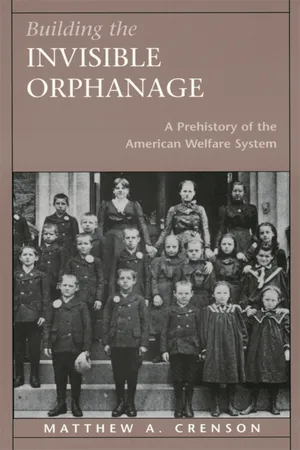
Building the Invisible Orphanage
A Prehistory of the American Welfare System
- 399 pages
- English
- PDF
- Available on iOS & Android
eBook - PDF
Building the Invisible Orphanage
A Prehistory of the American Welfare System
About this book
Information
Publisher
Harvard University PressYear
2009Print ISBN
9780674005549
9780674465916
eBook ISBN
9780674029996
Table of contents
- Contents
- Acknowledgments
- Introduction
- 1 The Decline of the Orphanage and the Invention of Welfare
- 2 The Institutional Inclination
- 3 Two Dimensions of Institutional Change
- 4 Institutional Self-Doubt and Internal Reform
- 5 From Orphanage to Home
- 6 The Orphanage Reaches Outward
- 7 “The Unwalled Institution of the State”
- 8 The Perils of Placing Out
- 9 “The Experiment of Having No Home”
- 10 Mobilizing for Mothers’ Pensions
- 11 Religious Wars
- Conclusion: An End to the Orphanage
- Notes
- Index
Trusted by 375,005 students
Access to over 1.5 million titles for a fair monthly price.
Study more efficiently using our study tools.
Frequently asked questions
Yes, you can cancel anytime from the Subscription tab in your account settings on the Perlego website. Your subscription will stay active until the end of your current billing period. Learn how to cancel your subscription
No, books cannot be downloaded as external files, such as PDFs, for use outside of Perlego. However, you can download books within the Perlego app for offline reading on mobile or tablet. Learn how to download books offline
Perlego offers two plans: Essential and Complete
- Essential is ideal for learners and professionals who enjoy exploring a wide range of subjects. Access the Essential Library with 800,000+ trusted titles and best-sellers across business, personal growth, and the humanities. Includes unlimited reading time and Standard Read Aloud voice.
- Complete: Perfect for advanced learners and researchers needing full, unrestricted access. Unlock 1.5M+ books across hundreds of subjects, including academic and specialized titles. The Complete Plan also includes advanced features like Premium Read Aloud and Research Assistant.
We are an online textbook subscription service, where you can get access to an entire online library for less than the price of a single book per month. With over 1.5 million books across 990+ topics, we’ve got you covered! Learn about our mission
Look out for the read-aloud symbol on your next book to see if you can listen to it. The read-aloud tool reads text aloud for you, highlighting the text as it is being read. You can pause it, speed it up and slow it down. Learn more about Read Aloud
Yes! You can use the Perlego app on both iOS and Android devices to read anytime, anywhere — even offline. Perfect for commutes or when you’re on the go.
Please note we cannot support devices running on iOS 13 and Android 7 or earlier. Learn more about using the app
Please note we cannot support devices running on iOS 13 and Android 7 or earlier. Learn more about using the app
Yes, you can access Building the Invisible Orphanage by Matthew A. Crenson,Matthew A. CRENSON in PDF and/or ePUB format, as well as other popular books in History & Social History. We have over 1.5 million books available in our catalogue for you to explore.