- English
- ePUB (mobile friendly)
- Available on iOS & Android
eBook - ePub
About this book
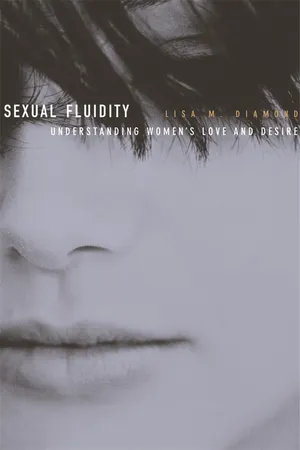
Is love "blind" when it comes to gender? For women, it just might be. This unsettling and original book offers a radical new understanding of the context-dependent nature of female sexuality. Lisa M. Diamond argues that for some women, love and desire are not rigidly heterosexual or homosexual but fluid, changing as women move through the stages of life, various social groups, and, most important, different love relationships.This perspective clashes with traditional views of sexual orientation as a stable and fixed trait. But that view is based on research conducted almost entirely on men. Diamond is the first to study a large group of women over time. She has tracked one hundred women for more than ten years as they have emerged from adolescence into adulthood. She summarizes their experiences and reviews research ranging from the psychology of love to the biology of sex differences. Sexual Fluidity offers moving first-person accounts of women falling in and out of love with men or women at different times in their lives. For some, gender becomes irrelevant: "I fall in love with the person, not the gender," say some respondents.Sexual Fluidity offers a new understanding of women's sexuality—and of the central importance of love.
Trusted by 375,005 students
Access to over 1.5 million titles for a fair monthly price.
Study more efficiently using our study tools.
Information
Publisher
Harvard University PressYear
2012Print ISBN
9780674032262
9780674026247
eBook ISBN
9780674072039
CHAPTER 1
Will the Real Lesbians Please Stand Up?
In 1997, the actress Anne Heche began a widely publicized romantic relationship with the openly lesbian comedian Ellen DeGeneres after having had no prior same-sex attractions or relationships. The relationship with DeGeneres ended after two years, and Heche went on to marry a man. The actress Cynthia Nixon of the HBO series Sex and the City developed a serious relationship with a woman in 2004 after ending a fifteen-year relationship with a man. Julie Cypher left a heterosexual marriage for the musician Melissa Etheridge in 1988. After twelve years together, the pair separated and Cypher—like Heche—has returned to heterosexual relationships. In other cases, longtime lesbians have unexpectedly initiated relationships with men, sometimes after decades of exclusively same-sex ties (examples include the feminist folk singer Holly Near, the activist and writer Jan Clausen, and Deborah Sundahl, a founding editor of the lesbian magazine On Our Backs). What’s going on? Are these women confused? Were they just going through a phase before, or are they in one now?
Consider, too, the growing number of popular terms that have been coined to describe women with changing patterns of same-sex and other-sex behavior, such as “heteroflexibility,” “has-bian,” and “LUG—lesbian until graduation.”1 This new lexicon has been matched by increasing media depictions of women who pursue sexual contact that runs counter to their avowed sexual orientation, ranging from the much-ballyhooed kiss between Madonna and Britney Spears at the MTV Video Music Awards to films such as Kissing Jessica Stein and Chasing Amy, which depicts a lesbian becoming involved with a man, contrary to the more widespread depictions of heterosexual women becoming involved in same-sex relationships.
The reason such cases are so perplexing is that they flatly contradict prevailing assumptions about sexual orientation. These assumptions hold that an individual’s sexual predisposition for the same sex or the other sex is an early-developing and stable trait that has a consistent effect on that person’s attractions, fantasies, and romantic feelings over the lifespan. What few people realize, however, is that these assumptions are based primarily on men’s experiences because most research on sexual orientation has been conducted on men.2 Although this model of sexual orientation describes men fairly accurately, it does not always apply so well to women.
Historically, women who deviated from this model by reporting shifts in their sexuality over time—heterosexual women falling in love with female friends, lesbian women periodically dating men—were presumed few in number and exceptional in nature. In other words, they were just inconvenient noise cluttering up the real data on sexual orientation. Yet as research on female sexuality has increased over the years, these “exceptional” cases now appear to be more common than previously thought. In short, the current conventional wisdom about the nature and development of sexual orientation provides an incomplete picture of women’s experiences. Researchers now openly acknowledge that despite significant advances in the science of sexuality over the past twenty years, “female sexual orientation is, for the time being, poorly understood.”3
This situation is now changing. As scientists have begun investigating female and male sexual orientation as distinct phenomena instead of two sides of the same coin, consensus is gradually building on why women appear so different from men. Specifically, we have found that one of the fundamental, defining features of female sexual orientation is its fluidity. We are now on the brink of a revolutionary new understanding of female sexuality that has profound scientific and social implications.
A Brief History of Fluidity
Sexual fluidity, quite simply, means situation-dependent flexibility in women’s sexual responsiveness. This flexibility makes it possible for some women to experience desires for either men or women under certain circumstances, regardless of their overall sexual orientation. In other words, though women—like men—appear to be born with distinct sexual orientations, these orientations do not provide the last word on their sexual attractions and experiences. Instead, women of all orientations may experience variation in their erotic and affectional feelings as they encounter different situations, relationships, and life stages. This is why a woman like Anne Heche can suddenly find herself falling madly in love with Ellen DeGeneres after an exclusively heterosexual past, and why a longtime lesbian can experience her very first other-sex attractions in her late forties.
The notion of sexual fluidity is not a new one. Rather, evidence for this phenomenon has circulated in the scientific literature for decades, though it has tended to be “submerged in the data rather than explicitly theorized.”4 Some of the earliest discussions of flexible, changeable patterns of sexuality came from sex researchers who kept finding perplexing cases of same-sex sexuality “in some unexpected places and among some apparently heterosexual people.”5 For example, in 1977 the psychologists Erich Goode and Lynn Haber published a study analyzing “experimental” same-sex behavior pursued by college women who identified themselves as heterosexual.6 They concluded that though some of these women appeared to be headed toward lesbianism, others simply seemed to be adventurous and open-minded about their sexuality. Similarly, in the late 1970s the sociologists Philip Blumstein and Pepper Schwartz conducted a groundbreaking study of more than 150 men and women with bisexual patterns of sexual behavior. They found that though some of their respondents had experienced same-sex desires for many years, others appeared to have undergone major changes in their sexual attractions.7 They concluded that early childhood influences on sexuality (whatever they may be) were not immutable, and that most individuals were unaware of their own capacity for change in sexuality over time.
In interviews with fourteen nonheterosexual women, the psychologist Joan Sophie found that many of the women experienced unexpected transitions in their self-identification and sexual expression over time. Sophie concluded that conventional identity models, with their emphasis on fixed selves, needed to be revised to account for such changes.8 Fritz Klein, Barry Sepekoff, and Timothy Wolf eventually took up the call and developed a new approach to measuring sexual orientation (the Klein Sexual Orientation Grid, or KSOG), which for the first time considered the element of time.9 Individuals rated their current, past, and “ideal” patterns of attraction, behavior, and identity, making explicit the existence of prior and perhaps future change. However, this time-sensitive approach did not take hold, and researchers generally continued assessing only current attractions, identities, and behaviors.
Around the same time, other academic fields began giving greater consideration to sexual fluidity. In 1984 the anthropologist Gilbert Herdt published a now-famous account of ritualized homosexuality among adolescent boys in Melanesia.10 What was notable about this practice was its developmental specificity. Unmarried men pursued only same-sex encounters during their adolescent years out of a belief that this practice was necessary for them to reach full maturity as men. Once they were adults, same-sex activity ceased (with a few exceptions); they then married and pursued only other-sex activity. Herdt’s account of such an abrupt developmental transition from same-sex to other-sex sexuality showed that our Western notion of fixed sexual “orientations” was culturally specific. We might view homosexuality as an inborn predisposition, but other cultures expected and even arranged for drastic changes in same-sex and other-sex desires and practices over the life course.
The anthropologist Evelyn Blackwood made the same observation in her extensive review of female same-sex sexuality across non-Western cultures, underscoring the limitations of the Western notion of fixed sexual orientations. These perspectives were consistent with a broad class of social constructionist models of sexuality (discussed in more detail in the next chapter), which posited that sexual identities did not exist as fixed types but were created and given meaning through social interactions and cultural ideologies.11 Most of the scholars advocating this perspective were not specifically interested in sexual fluidity, but they highlighted the evidence for it in order to challenge conventional, biologically determinist views of sexuality.
The poet Adrienne Rich was one of the first people to discuss fluidity’s specific relevance to female sexuality, and she took one of the broadest and most explicitly political perspectives on the issue.12 Rich argued that women throughout history and across a variety of different cultures had always managed to form intimate, emotionally primary ties to other women, despite the persistent efforts of male-dominated societies to rigidly channel them into heterosexual reproduction. Rich argued that all intense bonds between women, even if they were not explicitly sexual, occupied a “lesbian continuum” that ranged from purely emotional relationships to sexual liaisons. This model suggested that regardless of whether a woman currently experienced clear-cut same-sex desires, she maintained a capacity for diverse forms of same-sex intimacy and eroticism.
In the 1980s, the empirical evidence for sexual fluidity and its disproportionate prevalence in women increased. For example, in their study of gay, lesbian, bisexual, and heterosexual people living in San Francisco in the 1980s, Martin Weinberg, Colin Williams, and Douglas Pryor found that many of their participants—but especially the women—recalled experiencing both minor and major changes over time in their sexual attractions. This finding led the researchers to conclude that “sexual preference is not always a fixed phenomenon.” Although gay, lesbian, and heterosexual people reported smaller and less frequent changes than did bisexuals, Weinberg and his colleagues attributed this difference to the anchoring effects of claiming a gay, lesbian, or heterosexual identity, since such identities have “definable boundaries that can restrict the ability or desire to explore change.”13 They came to the conclusion that some degree of fluidity was a general property of sexuality, a view that already had a steady group of adherents at that time, and which continues to be influential.14 Although Weinberg, Williams, and Pryor observed more sizable and frequent changes among their female respondents, they did not advance an explanation for this difference, except to speculate that it might have to do with the women’s involvement with lesbian and feminist groups, which often encouraged women to question their sexual identities.
The psychologist Carla Golden provided some of the most compelling discussions to date of diversity and variability in female sexuality in her interview study of heterosexual, bisexual, and lesbian women in their twenties, thirties, and forties.15 She specifically analyzed the contexts that elicited sexual transitions, for example, political organizations and women’s studies classes. Golden argued against the notion that such experiences simply prompted women to “discover” long-suppressed same-sex orientations. Rather, she argued that in some cases, same-sex sexuality “may have started as an idea but it did not remain purely in the cognitive realm.” In other words, women were capable of real change occurring in real time.16
As for the causes underlying such changes, the psychologists Celia Kitzinger and Sue Wilkinson emphasized sociocultural influences and opportunities. They interviewed women who undertook abrupt transitions from heterosexuality to lesbianism in mid- to late adulthood, and concluded that such women “are no more driven by biology or subconscious urges than they are when, for instance, they change jobs; such choices could be viewed as influenced by a mixture of personal reevaluation, practical necessity, political values, chance, and opportunity.”17 The sociologist Paula Rust also emphasized complex interactions between personal and cultural factors that led some women to adopt different sexual identities and different practices at different times of life, depending on their circumstances.18
The role of intimate emotional relationships as a catalyst for change in women’s sexuality was also gaining attention. The psychologist Rebecca Shuster, for example, noted that “often women fall in love with someone of an unexpected gender, and the power of that relationship pulls them to re-evaluate their identity.” She argued that such experiences “uncover a range of sexual and emotional attraction and closeness of infinite variety” and pose an inevitable challenge to the notion of fixed sexual identities.19 The psychologist Vivian Cass made similar observations, noting that same-sex emotional ties were particularly influential for women: “It is not uncommon to see a woman who in mid-life ‘falls in love’ with another woman for the first time in her life. This experience may not necessarily include sexual responses, although the quality of the emotional experience is similar to other love relationships she may have had with men. Where a sexual component does become present, this may occur after a period of time or after the emotional responses have been reciprocated.”20 Other researchers had begun to wrestle with these apparent gender differences. The sociologist Vera Whisman conducted a comparison of lesbians’ and gay men’s personal understandings of the causes of their same-sex sexuality. She found that men were significantly more likely to view their sexuality as fixed and innate, whereas women more often acknowledged a role for specific relationships, choice, change, and circumstance.21
Current Perspectives
The psychologist Roy Baumeister was the first researcher to synthesize these accumulating strands of evidence into a comprehensive argument for female sexual variability.22 Several years ago he published a review of the extensive psychological, historical, and sociological evidence suggesting that women’s sexuality is more “plastic” than men’s. His notion of “plasticity” includes not just same-sex and other-sex sexuality but also overall sex drive, desired partner characteristics, preferred sexual practices, and consistency between attitudes and behaviors. His work provides critical support for the notion of a robust gender difference in women’s capacity for sexual variability. Note that I use the term “sexual fluidity” to distinguish flexibility in same-sex and other-sex sexuality, which is the topic of this book, from the broader forms of variability in sexual attitudes and practices discussed by Baumeister.
New research has provided even more support for the notion of gender differences. One study (described in detail in Chapter 4) found that both lesbian and heterosexual women became physically aroused by visual images of both men and women. In contrast, men’s responses fell in line with their self-described sexual orientations.23 That said, genital responses should not be considered more accurate measures of desire than individuals’ own subjective experiences (in fact, interpretation of genital arousal in such studies has long been controversial). But such findings certainly dovetail with the extensive evidence suggesting a pervasive gender difference in erotic variability and flexibility.
Not all sex researchers agree with this view. Some have argued strongly against the notion of a gender difference in fluidity, maintaining that women’s apparently greater sexual variability might be due to socia...
Table of contents
- Cover
- Title Page
- Copyright
- Dedication
- Contents
- 1 Will the Real Lesbians Please Stand Up?
- 2 Gender Differences in Same-Sex Sexuality
- 3 Sexual Fluidity in Action
- 4 Nonexclusive Attractions and Behaviors
- 5 Change in Sexual Attractions
- 6 Attractions to “the Person, Not the Gender”
- 7 How Does Fluidity Work?
- 8 Implications of Female Sexual Fluidity
- References
- Notes
- Acknowledgments
- Index
Frequently asked questions
Yes, you can cancel anytime from the Subscription tab in your account settings on the Perlego website. Your subscription will stay active until the end of your current billing period. Learn how to cancel your subscription
No, books cannot be downloaded as external files, such as PDFs, for use outside of Perlego. However, you can download books within the Perlego app for offline reading on mobile or tablet. Learn how to download books offline
Perlego offers two plans: Essential and Complete
- Essential is ideal for learners and professionals who enjoy exploring a wide range of subjects. Access the Essential Library with 800,000+ trusted titles and best-sellers across business, personal growth, and the humanities. Includes unlimited reading time and Standard Read Aloud voice.
- Complete: Perfect for advanced learners and researchers needing full, unrestricted access. Unlock 1.5M+ books across hundreds of subjects, including academic and specialized titles. The Complete Plan also includes advanced features like Premium Read Aloud and Research Assistant.
We are an online textbook subscription service, where you can get access to an entire online library for less than the price of a single book per month. With over 1.5 million books across 990+ topics, we’ve got you covered! Learn about our mission
Look out for the read-aloud symbol on your next book to see if you can listen to it. The read-aloud tool reads text aloud for you, highlighting the text as it is being read. You can pause it, speed it up and slow it down. Learn more about Read Aloud
Yes! You can use the Perlego app on both iOS and Android devices to read anytime, anywhere — even offline. Perfect for commutes or when you’re on the go.
Please note we cannot support devices running on iOS 13 and Android 7 or earlier. Learn more about using the app
Please note we cannot support devices running on iOS 13 and Android 7 or earlier. Learn more about using the app
Yes, you can access Sexual Fluidity by Lisa M. Diamond,Lisa M Diamond in PDF and/or ePUB format, as well as other popular books in Psychology & Developmental Psychology. We have over 1.5 million books available in our catalogue for you to explore.